Table of Contents
If you’ve ever written an idea down and then stared at it for 10 minutes thinking, “Okay… but is this actually any good?” then you’ll get why I like tools like FlowKitten. Most of us don’t need more brainstorming—we need a quick gut-check and a few next steps. That’s exactly what FlowKitten positions itself to do: take your idea and turn it into fast, actionable feedback.
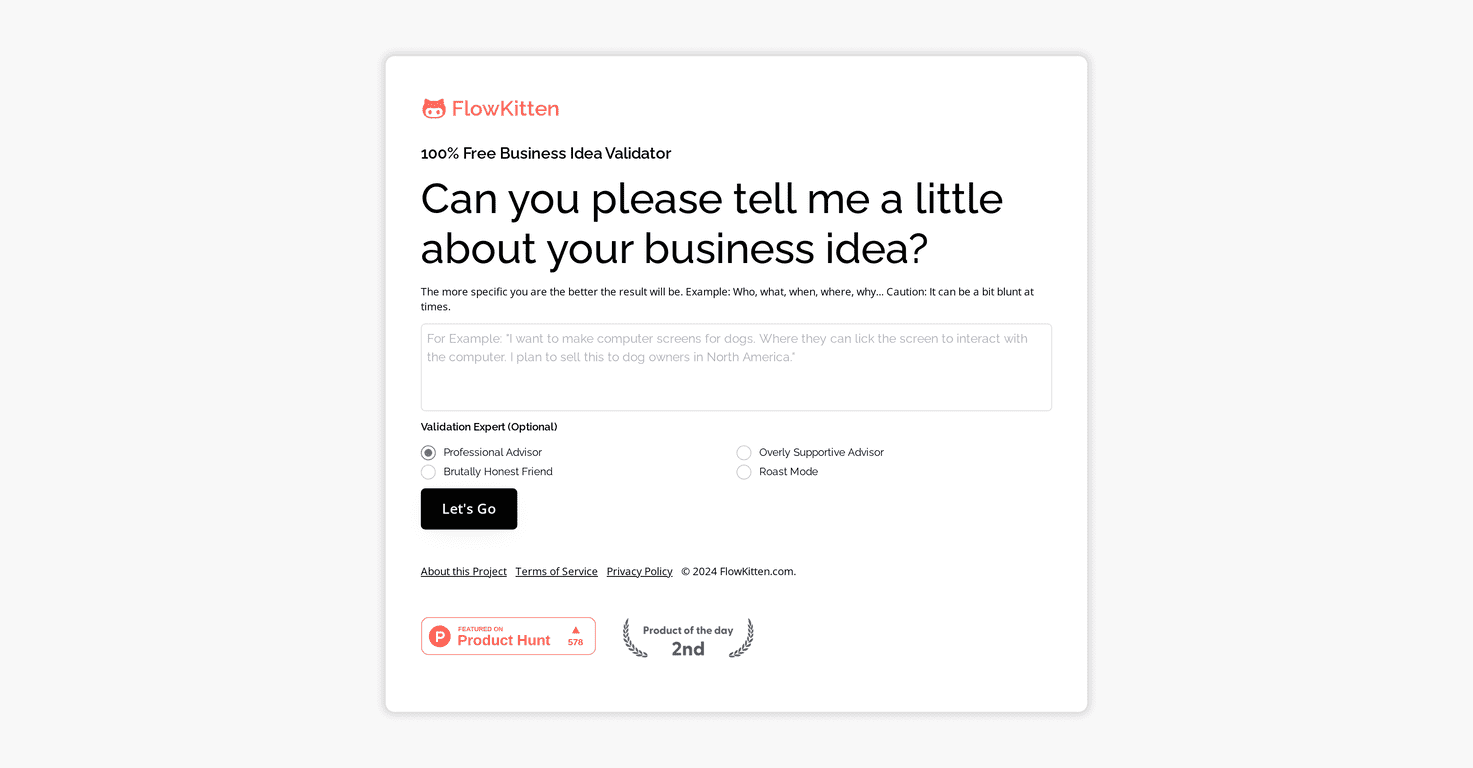
In my testing, the “20 seconds” claim is pretty believable. I typed in a short description (one paragraph, nothing fancy), hit submit, and got a response immediately. It wasn’t a full business plan or anything, but it did give me things to think about right away—like who the idea is really for, what might be missing, and where the biggest risks could be.
One thing I noticed: FlowKitten feels best for early-stage validation—when you’re still figuring out the basics and you don’t want to spend hours building assumptions. If you’re tossing ideas around, testing different angles, or trying to figure out what to research next, it’s genuinely useful.
That said, it’s not magic. You shouldn’t expect the same level of depth you’d get from paid strategy tools, consultants, or even a strong template + research workflow. The output quality depends a lot on how clearly you describe your idea. Give it a vague prompt, and you’ll get vague feedback. Give it a specific problem, audience, and goal, and it tends to be more helpful.
FlowKitten Review: Quick Idea Validation Without the Guesswork
FlowKitten is built for one main job: helping you validate business ideas fast. And honestly, that’s the hardest part for a lot of creators and first-time founders. You can have a “cool idea,” but until you pressure-test it, you don’t really know if anyone would care.
What I like about FlowKitten is the speed. You don’t need to set up a bunch of tools or go hunting for templates. You type your idea, and within about 20 seconds you get feedback you can actually react to. That’s huge when you’re doing multiple iterations in a single afternoon.
Here’s a simple example of how I’d use it: say you’re thinking about a niche productivity app. Instead of jumping straight into features, I’d run a version that clearly states:
- the problem (what’s annoying and for whom)
- the audience (job titles, industries, or specific pain points)
- the outcome (what “better” looks like)
Then I’d use the FlowKitten output to decide what to research next—like competitors, pricing expectations, or whether the value proposition is actually clear. It’s not replacing market research, but it helps you narrow the focus quickly.
Also, the feedback is best used as a brainstorming partner. Quick feedback is fantastic when you’re working through early objections—because you can adjust your pitch and rewrite your concept before you invest time building anything.
And yes, there’s a limitation: it won’t go as deep as paid tools that include more structured frameworks, datasets, or extended analysis. For me, it’s a “start smart” tool, not a “make decisions for you” tool.
Key Features I’d Actually Use
- Instant feedback on business ideas (so you can iterate while it’s still fresh)
- AI-powered analysis that helps surface gaps in your thinking
- Completely free to use (which matters when you’re testing ideas on a budget)
- Fast validation in around 20 seconds (great for rapid concept testing)
If you want better results, don’t just paste a headline. Add a sentence about the customer and the problem. Even 2–3 extra lines can make the output feel more grounded.
Pros and Cons (Straight From My Experience)
Pros
- No cost to use, so you can test multiple ideas without worrying about “burning” a subscription
- Quick turnaround for feedback, which makes it easier to iterate and refine your pitch fast
- AI-based insights that are generally easy to understand and act on right away
Cons
- It can feel less in-depth than paid tools—especially if you’re expecting detailed market sizing, pricing models, or heavy strategy work
- The usefulness can swing depending on how good your input is. Vague idea = vague feedback
One honest takeaway: if you’re already very experienced, you might find yourself doing extra follow-up work anyway (because you’ll want data). But if you’re early, it’s a solid shortcut.
Pricing Plans: Free, Period
FlowKitten is offered entirely free of charge. That’s a big deal for startups and aspiring entrepreneurs who want to validate ideas without immediately committing money. I especially like this if you’re in the “try and learn” phase—testing different niches, rewriting positioning, and figuring out what direction feels promising.
Wrap up
FlowKitten is a practical tool when you need fast idea validation and you don’t want to overcomplicate things. The speed (around 20 seconds), simple workflow, and free pricing make it easy to use regularly—like a daily “sanity check” for new concepts.
Just keep expectations realistic. It’s not going to replace deep research or a full business model. But it will help you spot obvious weaknesses early and point you toward what to improve next. If you’ve got an idea you’re not sure about yet, it’s worth trying—run a couple variations, compare the feedback, and see which direction starts to feel clearer.
Promote FlowKitten