Table of Contents
Mastering how to format dialogue is a crucial skill for any writer looking to breathe life into their characters and stories. It’s the difference between dialogue that flows naturally and speech that feels stilted or confusing.
When dialogue is formatted clearly, it not only enhances readability but also enriches the narrative, allowing characters’ personalities and relationships to shine through their words. Proper formatting helps readers easily follow conversations and understand who is speaking.
Whether you’re writing fiction, scripts, or creative non-fiction, understanding dialogue formatting is essential. It’s a foundational aspect of writing that can elevate your work from good to great, ensuring your readers stay immersed in the world you’ve created.
How to Format Dialogue
Here are some tips and tricks for formatting dialogue in your writing like a pro:
1. Use Quotation Marks Correctly
Using quotation marks correctly is fundamental in formatting dialogue, as they signal to the reader that characters are speaking. Here’s how to navigate the use of quotation marks for clear and effective dialogue:
Double Quotation Marks for Spoken Dialogue
In most cases, especially in American English, double quotation marks are used to enclose the exact words spoken by a character. For example:
- “I can’t believe you did that,” she said.
This tells the reader that the character directly uttered these words. Double quotation marks are the standard for dialogue in narrative writing, helping to differentiate spoken words from the rest of the text.
Single Quotation Marks for Quotes Within Dialogue
Single quotation marks are used for a quote within a quote, meaning if your character is speaking and refers to something someone else said, you enclose that statement in single quotation marks. For instance:
- “Did he really say ‘I’ll be back’ before leaving?” she asked.
This usage helps maintain clarity, showing the reader exactly what the character is quoting someone else as saying, without confusing it with the primary speaker’s words.
When to Use Each
The main difference lies in their application: double quotation marks are for direct dialogue, while single quotation marks are used for quotations within that dialogue. It’s essential to be consistent with these rules throughout your manuscript to avoid confusing your readers.
In British English, the convention can be the opposite, with single quotation marks used for dialogue and double for quotes within quotes.
However, regardless of which standard you follow, the key is consistency and clarity in signaling spoken words versus internal thoughts or narrative descriptions.
By adhering to these guidelines, writers can effectively use quotation marks to enhance their storytelling, making dialogues clearer and more engaging for the reader.
2. Include Dialogue Tags Wisely

Dialogue tags are phrases like “he said” or “she asked” that attribute spoken dialogue to a particular character. They serve as signposts, guiding readers through conversations by indicating who is speaking.
This is especially important if you plan on turning your book into audiobook. If you plan on doing so, it is very important that such seemingly small things are expressed clearly, as they will be much easier to understand in audio format.
While seemingly simple, the effective use of dialogue tags can significantly impact the flow and clarity of your narrative.
The Role of “Said” and “Asked”
“Said” and “asked” are the workhorses of dialogue tags. They’re unobtrusive, blending into the background so the reader’s focus remains on the dialogue itself. For example:
- “I don’t know,” he said.
- “Where are you going?” she asked.
These tags do their job without drawing attention away from the characters’ words.
Varying Dialogue Tags for Emotion and Clarity
To convey emotion or action, you might choose more descriptive tags. Examples include “whispered,” “shouted,” “murmured,” or “exclaimed.” Each offers a different nuance, adding depth to the dialogue:
- “Leave me alone,” she whispered.
- “That’s amazing!” he exclaimed.
However, use these varied tags sparingly. Overuse can distract the reader and weaken the dialogue’s impact.
Balancing Tags with Action
Sometimes, it’s more effective to use action beats instead of dialogue tags. Action beats are descriptions of what a character is doing as they speak, providing context and adding to the scene’s visual imagery. For example:
- “I’m not sure.” She looked away, unable to meet his gaze.
This technique can enhance the narrative, showing the reader how the character feels or what they’re doing without explicitly stating it.
Letting Dialogue Stand on Its Own
Well-crafted dialogue often doesn’t need a tag to clarify who’s speaking, especially in scenes with only two characters. Removing unnecessary tags can streamline the conversation and increase its pace:
- “Do you want to go?”
- “Not really.”
The Balance
The key to using dialogue tags effectively lies in balance. Rely on “said” and “asked” to keep the narrative flowing smoothly, but don’t be afraid to sprinkle in more expressive tags or action beats for emphasis and variety. Aim to use just enough tags to guide your readers without overshadowing the dialogue itself. Remember, the goal is to enhance your characters’ voices, not to interrupt them.
By wisely incorporating dialogue tags and action beats, writers can create vivid, engaging scenes that capture the essence of their characters and keep readers immersed in the story.
3. Punctuate Dialogue Properly
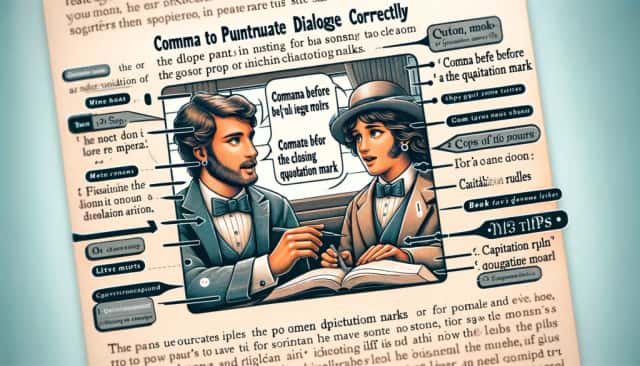
Proper punctuation is essential in dialogue to maintain clarity and readability. Understanding how to correctly use commas, periods, question marks, and exclamation points within quotation marks is crucial for writers. Here are some guidelines and common mistakes to avoid:
Commas with Dialogue Tags
When a dialogue tag follows a piece of dialogue, use a comma inside the closing quotation mark, and place the tag after the comma.
- Correct: “I’m coming,” she said.
- Common Mistake: “I’m coming.” She said.
If the dialogue tag comes before the dialogue, place the comma after the tag, before the opening quotation mark.
- Correct: She said, “I’m coming.”
Periods in Dialogue
Periods at the end of a sentence that’s part of the dialogue go inside the quotation marks. If a dialogue tag follows, start it with a lowercase letter (unless it’s a proper noun).
- Correct: “I’m coming.” She walked to the door.
- Common Mistake: “I’m coming”, She walked to the door.
Question Marks and Exclamation Points
Question marks and exclamation points follow the same general rules as periods, being placed inside the quotation marks. They do not change the capitalization of the following dialogue tag.
- Correct: “Are you coming?” he asked.
- Correct: “I’m coming!” she exclaimed.
- Common Mistake: “Are you coming”? he asked.
Punctuation with Action Beats
When an action beat is used, treat the action and dialogue as separate sentences. Use a period at the end of the action beat.
- Correct: “I’m coming.” She walked to the door.
- Common Mistake: “I’m coming,” she walked to the door.
Splitting Dialogue
When splitting a single piece of dialogue with a tag, use commas to pause without ending the sentence. The second part of the dialogue begins with a lowercase letter unless it starts a new sentence.
- Correct: “I’m coming,” she said, “but give me a minute.”
- Common Mistake: “I’m coming,” she said, “But give me a minute.”
Avoiding Common Mistakes
- Do not use a capital letter to start a dialogue tag following a question mark or exclamation point unless it’s a proper noun.
- Avoid placing punctuation marks outside the quotation marks unless they are part of the surrounding sentence.
- Be cautious of overusing exclamation points within dialogue; it can diminish their impact.
By following these punctuation rules, writers ensure that their dialogue is both professional and easy to follow.
Proper punctuation not only enhances readability but also helps express the intended tone and emotion of the dialogue, making the characters’ conversations more engaging and authentic.
4. Break Paragraphs for New Speakers
One of the fundamental rules in formatting dialogue is to start a new paragraph each time a new character speaks. This practice is crucial for several reasons, all of which contribute to the overall clarity and flow of your narrative, especially in dialogue-heavy sections.
Improving Clarity
Breaking paragraphs for new speakers helps readers easily distinguish between who is speaking at any given moment. When each character’s dialogue starts on a new line, it acts as a visual cue that the speaker has changed, reducing confusion and enhancing comprehension.
Without these breaks, dialogue can become a dense block of text, making it difficult for readers to follow the conversation.
Enhancing Flow
Paragraph breaks contribute to the natural rhythm of a conversation. In real-life dialogues, people typically pause when someone else begins speaking; starting a new paragraph for each speaker mimics this pause and creates a more realistic flow.
This technique allows the reader to “hear” the conversation in their mind, with the pacing and pauses they would expect in an actual dialogue.
Increasing Engagement
Dialogue that is easy to follow and feels natural is more engaging for readers. They are less likely to become lost or bored by the text and more likely to become immersed in the characters’ interactions.
Effective paragraph breaks keep the momentum going, encouraging readers to continue turning the page to find out what happens next in the conversation.
Example of Correct Usage
Incorrect: “Are you going to the party tonight?” John asked. Mary replied, “Yes, I’m looking forward to it. What about you?” “I might swing by after work,” he said.
Correct: “Are you going to the party tonight?” John asked. “Yes, I’m looking forward to it. What about you?” Mary replied. “I might swing by after work,” he said.
Common Mistakes to Avoid
- Avoid merging multiple speakers’ dialogues into a single paragraph. This practice can lead to confusion about who is speaking and diminish the impact of their words.
- Do not use excessive dialogue tags as a substitute for clear paragraph breaks. While tags are helpful, they cannot replace the visual clarity provided by a new paragraph.
By adhering to the rule of starting a new paragraph for each new speaker, writers can significantly improve the readability of their dialogue. This simple formatting technique makes conversations between characters easier to follow and more enjoyable to read, thus enhancing the overall quality of the narrative.
5. Use Action Beats for Natural Flow

Action beats are small actions or descriptions of what a character is doing either before, during, or after they speak. These beats can play a crucial role in dialogue, providing context, revealing character, and enhancing the natural flow of conversation without relying heavily on dialogue tags.
Adding Depth to Conversations
Incorporating action beats gives readers visual cues that add depth to the dialogue. For example, a character frowning or looking away while speaking can convey emotions such as doubt, sadness, or evasion more effectively than stating the emotion outright.
This method of “showing” rather than “telling” enriches the narrative and allows readers to engage more deeply with the characters and their interactions.
Example of Action Beats in Use
- Without Action Beat: “I don’t know,” she said.
- With Action Beat: She bit her lip. “I don’t know.”
The action beat here provides insight into the character’s hesitation or nervousness, adding a layer of emotional context to the dialogue.
Helping Avoid Overusing Dialogue Tags
While dialogue tags like “he said” or “she asked” are necessary, overusing them can disrupt the flow and simplicity of a conversation.
Action beats offer a dynamic alternative, allowing the dialogue to breathe and flow more naturally. By describing what a character is doing, you can indicate who is speaking without always having to use a tag.
Balancing Dialogue and Narrative
Action beats also serve to balance dialogue with narrative, grounding conversations in the scene. They remind readers of the setting and the physical presence of the characters, preventing dialogue from floating in a void.
This grounding can be particularly effective in long stretches of dialogue, where beats can break up the text and keep readers oriented in the story’s physical space.
Example of Balancing Dialogue with Action Beats
Incorrect (Overuse of Dialogue Tags): “I’m not sure,” he said. “Why not?” she asked. “It’s complicated,” he said.
Correct (Using Action Beats): “I’m not sure.” He looked away, unable to meet her eyes. “Why not?” She crossed her arms, waiting. He sighed. “It’s complicated.”
Encouraging Natural Flow
Using action beats can encourage a more natural flow of conversation, mirroring real-life interactions where people often express themselves through gestures and movements.
This technique can turn a simple exchange of words into a vivid scene that captures the complexity of human communication.
By skillfully integrating action beats into dialogue, writers can enhance the expressiveness and dynamism of their characters’ conversations.
This approach not only enriches the reader’s experience but also showcases the writer’s attention to detail and commitment to crafting immersive, believable narratives.
6. Formatting Internal Dialogue
Formatting internal dialogue involves distinguishing a character’s thoughts from spoken words, ensuring readers can easily differentiate between the two.
Proper formatting of internal dialogue enhances the narrative by providing insight into a character’s inner world without confusing it with external conversation.
Use of Italics
Italics are commonly used to denote internal dialogue or thoughts, setting them apart from the rest of the text. This visual cue immediately signals to the reader that the text is internal to the character, not spoken out loud. For example:
- Why did I say that? she wondered.
When using italics for thoughts, it’s essential to maintain consistency throughout your manuscript to avoid confusion.
Absence of Quotation Marks
Unlike spoken dialogue, internal dialogue is typically not enclosed in quotation marks. This distinction helps to keep the narrative clear:
- Incorrect: “I hope he doesn’t notice,” he thought.
- Correct: I hope he doesn’t notice, he thought.
Leaving out quotation marks for thoughts prevents them from being mistaken for spoken words, maintaining the flow and coherence of the narrative.
Integrating Internal Dialogue Naturally
While italics serve to differentiate thoughts, integrating internal dialogue naturally into the narrative is crucial. Thoughts should flow seamlessly from the narrative, reflecting the character’s personality and the context of the situation:
- As he walked away, Was that the right decision? The question lingered in his mind, heavy with doubt.
Balancing Internal Dialogue with External Action
To prevent overreliance on internal dialogue, balance it with external action and spoken dialogue. This balance keeps the narrative dynamic and prevents the story from becoming too introspective or stagnant:
- This is impossible, she thought, picking up the pace. “Can we try a different approach?” she asked.
Reflecting Character Voice
Ensure that the internal dialogue reflects the character’s unique voice and perspective, adding depth and authenticity to their portrayal.
The thoughts should be true to the character’s personality and situation, offering insights that spoken dialogue might not convey.
Use Sparingly for Impact
While internal dialogue can significantly enhance character development and plot progression, using it sparingly ensures it remains impactful.
Reserve it for moments of introspection, crucial decisions, or when revealing a character’s hidden fears and desires.
By adhering to these guidelines for formatting internal dialogue, writers can effectively reveal their characters’ innermost thoughts and motivations.
This not only deepens character development but also enriches the reader’s engagement with the narrative, making for a more immersive and compelling story.
Conclusion
Mastering how to format dialogue is essential for any writer aiming to bring their characters and stories to life with authenticity and clarity. Proper dialogue formatting not only enhances readability but also deeply enriches the narrative, allowing characters’ voices to resonate with readers.
Understanding how to format dialogue ensures that conversations flow naturally, emotions are conveyed effectively, and the reader remains fully immersed in the story. By following these guidelines, writers can avoid common pitfalls and elevate their storytelling, making their work stand out.
FAQ
How do you write a dialog correctly?
To write dialogue correctly, enclose the spoken words in quotation marks, start a new paragraph for each new speaker, use dialogue tags sparingly, and punctuate properly within and outside the quotation marks to indicate pauses, stops, and the flow of conversation.
What are the 5 rules of writing dialogue?
The five rules of writing dialogue include: 1) Use quotation marks to enclose spoken words. 2) Begin a new paragraph for each new speaker. 3) Use dialogue tags effectively to attribute speech. 4) Punctuate dialogue correctly to maintain clarity. 5) Integrate action beats to add depth and context to conversations.
What is the grammatically correct way to write dialogue?
The grammatically correct way to write dialogue involves using double quotation marks to enclose the spoken words, placing commas, periods, question marks, and exclamation points inside the quotation marks when they pertain to the dialogue, and starting a new paragraph each time a new character speaks.
Does dialogue need commas?
Yes, dialogue often needs commas, especially when followed by dialogue tags. Commas are placed inside the quotation marks before the closing quotation if a dialogue tag follows. If the tag precedes the dialogue, the comma comes after the tag and before the opening quotation mark.
Where do commas go in dialogue?
In dialogue, commas go inside the quotation marks if they are part of the spoken sentence. When a dialogue tag follows the dialogue, place a comma after the spoken sentence and before the closing quotation mark. If the dialogue tag comes before the dialogue, place the comma after the tag.
Can you write without dialogue?
Yes, it’s possible to write a story without dialogue, focusing instead on narrative description, internal monologue, and characters’ thoughts and actions. While challenging, this approach can explore themes and characters in depth, relying on the narrative voice to engage readers.
Is a script just dialogue?
No, a script is not just dialogue. While dialogue is a crucial component, scripts also include action descriptions, scene settings, character directions, and sometimes camera angles or editing notes. These elements work together to guide the production of the visual storytelling.
Does dialogue need its own paragraph?
Yes, dialogue needs its own paragraph every time a new character speaks. This formatting rule improves clarity, helps readers easily follow the conversation, and visually separates each character’s speech, enhancing the overall readability and flow of the narrative.