Table of Contents
Writing a fight scene can feel weirdly hard. Not because you can’t describe punches—but because you have to make the whole thing make sense while it’s happening, and still keep the reader emotionally invested. I’ve seen a ton of drafts where the action is technically “busy,” but the scene ends up confusing, repetitive, or oddly bloodless.
What I aim for (and what I’ll show you here) is a fight that’s clear in motion, brutal in cause-and-effect, and believable in timing. You’ll see how to pick a real goal, pace the beats, choose verbs that don’t sound like a thesaurus threw up, and then revise until the scene reads clean.
If you want the short version: you’re not writing “a fight.” You’re writing a sequence of decisions under pressure. And those decisions create rhythm, tension, and character.
Quick credibility note: I’m a fiction writer and editor. I’ve worked on narrative revisions where the biggest problem wasn’t the “violence”—it was clarity (who’s moving, why, what changes after each hit). I’ve also done a lot of martial-arts training over the years, and I’ll be honest about one thing I learned early: most people think speed is the main ingredient. It’s not. Distance is.
One more thing—this guide is for you if you write novels, short stories, scripts, or even game quests with combat scenes. If you’ve ever thought, “My fight reads like a checklist,” you’re in the right place.
Key Takeaways
Key Takeaways
- Start with intent: decide what the fight accomplishes in your story (plot, theme, relationship shift). If the goal is fuzzy, the action will be too.
- Pace it like reality: aim for 1–2 actions per sentence and keep most sentences under 15–18 words during the exchange.
- Use specific verbs: “lunged,” “jabbed,” “spun,” “staggered.” If you can’t picture it instantly, the reader can’t either.
- Show reactions: not just “he hit him,” but the breath, the flinch, the shake in the legs, the shock in the eyes.
- Consequences matter: bruising, fatigue, loss of balance, a sprained wrist—something should change after each meaningful beat.
- Let the environment fight back: obstacles, narrow space, slick floors, furniture placement—these create strategy and friction.
- Control rhythm with sentence variety: short punches for impact; longer lines for fear, thought, or recalculation.
- Balance body and mind: internal urgency (“don’t let them close the distance”) makes the violence feel personal.
- End with a real outcome: victory, retreat, betrayal, surprise. Then show the immediate aftermath so it doesn’t feel unfinished.
- Revise for clarity: read it aloud. If you stumble, the reader will too. Cut anything that doesn’t affect the next beat.
- Steal structure from real movement: watch drills and sparring—not to copy choreography, but to understand timing and distance.
- Practice intentionally: do distance drills, sketch beat maps, and analyze scenes beat-by-beat until your drafts improve.
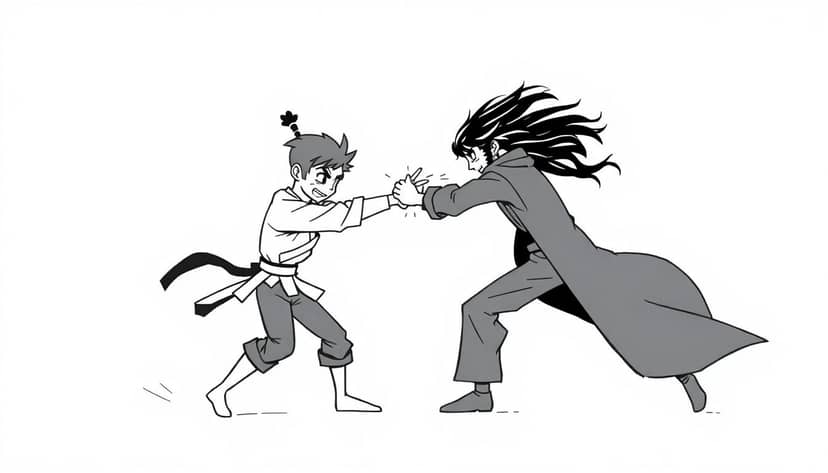
1. Clarify the Goal of Your Fight Scene
Before you write a single swing, decide what this fight is for. Not “because two characters are angry.” I mean the story job: does it reveal character, force a choice, expose a lie, or move the plot forward?
In my experience, the scenes that feel strongest have a clear goal stated in action. Survival has urgency. Revenge has obsession. Protecting someone has restraint—often the hardest kind to write, because your character can’t just go wild.
Mini example (before): “They fought in the alley. Punches flew. Someone got hurt.”
Mini example (after): “Mara needed one clean opening—just long enough to pull her brother behind the dumpster. If she got pinned, he’d be the one on the ground.” That’s a goal. Now every move has meaning.
What to cut: cut any sentence that doesn’t change the situation (who’s winning, who’s getting closer, what’s at stake right now).
Measurable target: write a one-liner for your scene goal and keep it visible while drafting. If you can’t summarize the fight in 10–15 words, you’re probably still guessing.
Common failure mode: the fight becomes a random montage because the author is “letting the characters fight” instead of making them solve a problem under pressure.
2. Keep Pacing Fast and Clear
Fight scenes should feel like the reader is breathing the same air as the characters. That means you need speed and clarity. Short sentences help, but they shouldn’t be robotic. The trick is to keep each beat readable.
I usually aim for this rhythm: setup (one sentence) → action (one sentence) → reaction (one sentence) → consequence (one sentence). Repeat until the moment shifts.
Mini example: “He feinted high. She bit. His shoulder crashed into her guard. Her breath punched out—then she stumbled back, heel catching on broken tile.”
What to cut: cut “camera-slow” descriptions like “the air seemed heavy” or “time slowed down” unless it’s directly tied to a character perception (and even then, use it sparingly).
Measurable target: during the exchange, try for 1–2 actions per sentence and keep most sentences under 18 words.
Common failure mode: stacking too many actions in one sentence (“He punched, then dodged, then kicked, then grabbed…”) so the reader loses track of who did what.
3. Use Strong and Specific Verbs
Vague verbs are the silent killers of fight scenes. “Moved,” “went,” “hit,” “struck”—sure, they’re not wrong. They’re just not vivid. A fight scene needs verbs that carry weight.
Instead of “he hit her,” try verbs that show intent and angle: “jabbed,” “slammed,” “clipped,” “hooked,” “parried,” “spun,” “staggered.”
Mini example: “The jab didn’t land clean—it clipped her cheek. But it bought him a half-second, and half-seconds decide fights.”
What to cut: cut adverbs that don’t add information (“quickly,” “suddenly,” “violently”). If it’s sudden, show what changed.
Measurable target: aim for at least one specific verb per sentence during the exchange.
Common failure mode: overusing the same verb (“dodged” every time). Mix it up: sometimes they slip, duck, weave, or turn their shoulder.
4. Show Actions and Reactions, Not Just Description
Here’s the thing: readers don’t connect to “what the fight looks like.” They connect to what it feels like. That’s action + reaction.
Action is what they do. Reaction is what it costs them. The flinch. The breath. The wobble. The moment their eyes widen because they misjudged distance.
Mini example (simple swap):
Before: “He was angry and punched.”
After: “His jaw tightened. He punched. His knuckles rang—then pain flashed up his wrist when she shifted at the last second.”
What to cut: cut “mood-only” lines that don’t tie to the body (“he felt fear” with no physical change).
Measurable target: for every major action, include a reaction beat. Think: action → immediate response within the next sentence.
Common failure mode: describing only the winner. Even if someone is dominating, the reader needs to see the other person’s adjustments.
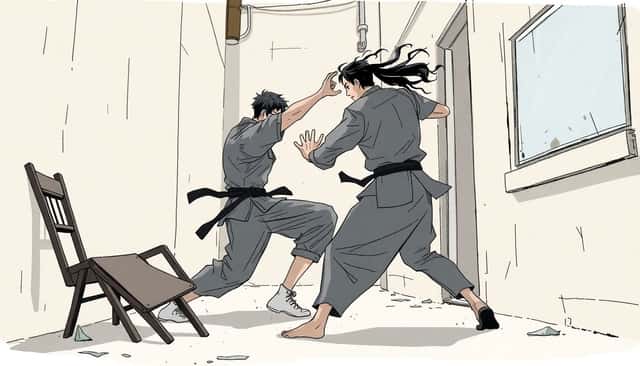
8. Incorporate Realistic Timing and Consequences
Real fights don’t unfold like a slow ballet. Most exchanges happen in seconds, and the body reacts fast—then you pay for it.
Don’t bog the scene down with slow, exaggerated movement. Instead, treat each beat like a domino:
- Someone throws → the other person changes position.
- Someone lands (or misses) → balance shifts.
- Someone gets hit → breathing changes.
- Breathing changes → speed and accuracy drop.
Mini example: “He punched. She parried. His next strike came half a beat late because his shoulder was still recovering. When she stepped in, he stumbled—winded, angry, and suddenly on the back foot.”
What to cut: cut “everything is fine” moments right after big impact. If you just got hit hard, your character should notice it immediately.
Measurable target: after each meaningful hit, include a consequence within 1–2 sentences (fatigue, bruise, loss of balance, adrenaline spike, or pain).
Common failure mode: injuries show up only at the end. Readers feel the disconnect. Pain doesn’t wait politely for the climax.
9. Use Layout and Environment to Enhance Action
Environment isn’t wallpaper. It’s a combatant. It changes footwork, angles, and options. A narrow hallway turns a “wide” fight into a close one. Loose gravel punishes forward pressure. A chair becomes leverage.
When I draft, I like to make a quick “map” in my head. Where are the choke points? What’s the escape route? What can break?
Mini example: “The alley forced them shoulder-to-shoulder. Every step mattered. When he backed up, his heel hit a slick patch near the drain, and her next strike landed because he couldn’t square his hips.”
What to cut: cut environment description that doesn’t affect movement. If the reader learns about a chandelier, it better matter—someone better use it, break it, or avoid it.
Measurable target: include at least one environmental interaction per 150–250 words in an action-heavy scene.
Common failure mode: the fight “ignores” the setting. Characters walk through obstacles like the world is made of fog.
10. Vary Your Sentence Structure for Impact
Sentence length is your steering wheel. Short lines create impact. Longer lines slow time just enough to show thought, fear, or calculation.
Try this pattern during peak intensity:
- Short: “He lunged. She ducked.”
- Short: “Pain flared.”
- Longer: “She realized too late that he’d baited her—because the next step was already gone.”
Mini example: “A punch. A stumble. Her breath caught. For a second she could hear her own heartbeat, loud as a drum, telling her she was losing time.”
What to cut: cut the same pacing everywhere. If every sentence is the same length, the scene feels flat even if the vocabulary is good.
Measurable target: aim for a mix where at least 30–40% of action sentences are short (5–10 words).
Common failure mode: only using short sentences. That can turn the fight into a staccato list instead of a living sequence.
11. Balance Action with Emotional and Internal Moments
Yes, fight scenes are physical. But if you never let the reader into the character’s head, the violence becomes generic.
Internal moments don’t have to be long. They just need to be specific. What are they afraid of? What are they trying to protect? What’s their plan—and is it working?
Mini example: “Not like this. Hold the line. Don’t let him close the distance.” Her feet adjusted without her thinking, because panic had already started to steal her timing.
What to cut: cut generic emotion (“he was scared”) unless it’s tied to an action choice (“he froze his stance” or “he backed away instead of moving in”).
Measurable target: include one internal thought or emotional reaction every 2–4 beats (not every sentence—unless you’re writing a very intense POV style).
Common failure mode: emotional monologues mid-swing. If the character has time to give a speech, they probably have time to rethink the fight.
12. Finish with a Clear Resolution and Aftermath
Don’t end a fight scene with “and then it stopped.” End it with an outcome that changes something.
Victory isn’t just “he won.” It’s what victory costs. Retreat isn’t just “she ran.” It’s what she chooses to save. Surprise outcomes are great too—just make sure the reader understands the logic of the twist.
Mini example: “He drove the final strike, but the impact knocked the knife loose from her hand. She didn’t fall—she smiled, because the real weapon was the alarm she’d triggered behind him.”
What to cut: cut lingering confusion. If the scene ends, the reader should know who is standing, who is hurt, and what changes next.
Measurable target: include at least 2 aftermath details (breath, injury, emotional shift, or a new threat/opportunity).
Common failure mode: resolving the fight but ignoring the body. People don’t bounce back instantly after a real hit sequence.
13. Revise for Authenticity and Clarity
Revision is where fight scenes stop being “cool ideas” and start being readable.
Here’s a method I actually use:
- Read it aloud (yes, out loud). If you trip over names, pronouns, or action order, the reader will too.
- Check continuity: who is moving? who is reacting? did the distance change?
- Remove clutter: delete any detail that doesn’t affect the next beat.
- Spot-check verbs: are they consistent and specific, or do you drift into “hit/moved”?
Mini before/after rewrite (realistic clarity upgrade):
Before (messy): “He swung and she dodged, then he punched again and she stepped back. They fought for a moment and it was chaotic. He kept attacking while she tried to defend. Blood was everywhere and she was scared.”
After (clear, consequence-driven): “He swung high. She dodged left—too far left. His next punch found the space his feint created, slamming into her guard. Her breath snapped out, and her feet skidded on grit as she tried to regain balance. She backed up, but the wall stopped her. ‘Don’t—’ she started, not to him, but to herself. The fear didn’t make her weaker. It made her late.”
What to cut: cut “general chaos” language. Replace it with specific cause-and-effect.
Measurable target: during revision, aim to reduce pronoun confusion by ensuring each paragraph clearly anchors to one POV character and one main opponent.
Common failure mode: polishing prose while leaving the underlying logic tangled. Style won’t fix a fight where the reader can’t track distance and intent.
14. Draw Inspiration from Real Fighting and Martial Arts
If you want fights to feel real, don’t just watch the “big moments.” Watch the boring stuff: footwork, resets, and the way fighters measure distance.
When you observe real training (or sparring clips), use a checklist:
- Distance: Who’s inside range? Who’s reaching?
- Timing: When do they commit—on the exhale, after a feint, during a step?
- Recovery: How do they reset after a missed strike?
- Body response: What happens to shoulders, breathing, and balance?
- Intent: Are they attacking, defending, or trying to create an opening?
Mini template (analyze any scene beat-by-beat):
- Intent: What does the attacker want?
- Distance: Close, mid, or long?
- Action: What exact move happens?
- Reaction: What does it cost the defender (breath, balance, pain)?
- Consequence: What changes next?
What to cut: cut the urge to copy choreography 1:1. Instead, copy the logic (how the opening appears and why it closes).
Measurable target: pick one clip and map 5 beats using the template above. You’ll start seeing patterns immediately.
Common failure mode: focusing only on flashy strikes and ignoring resets. Readers notice resets too—they just don’t know they’re noticing them.
15. Practice and Keep Studying
Practice beats talent. Every time. The good news? You don’t need to be in a gym to train your writing.
Here are drills I recommend:
- Distance drill (writing version): write the same fight three times: once at long range, once at mid, once at close. Notice how the options change.
- Footwork sketch: draw a stick-figure map on paper. Mark where each character is at the start of each beat.
- Beat compression: take a fight you wrote and cut it to 50–80 words without losing intent or consequence. Then expand again.
- Verb swap: highlight your verbs. Replace 30–50% with more specific actions. Read it back and see if the motion becomes clearer.
And if you want a practical workflow: use a beat sheet first, then draft. If you’re using an AI tool for outlining or drafting, try a prompt like: “Create a fight beat sheet with Intent, Distance, Action, Reaction, Consequence for 8 beats.” Then you write the prose yourself. You’ll get structure without letting the tool flatten your voice.
What to cut: cut “practice” that doesn’t produce a usable draft. Writing improves when you revise real pages, not when you only think about writing.
Measurable target: write one micro-fight every week (150–250 words). Keep it contained: one location, one goal, 6–8 beats.
Common failure mode: only practicing the parts you enjoy (the punching). Practice the boring parts too: resets, breathing, and decision-making.
FAQs
Define what the fight changes in your story. Is someone trying to escape, protect someone, prove a point, or force a confession? If you can’t summarize the scene goal in about 10–15 words, the action usually feels random.
Use short sentences and active verbs, but keep the logic clean: action → reaction → consequence. Aim for 1–2 actions per sentence and avoid stacking multiple moves in one line.
Specific verbs make the motion instantly understandable. “He hit” tells you almost nothing, while “he parried,” “he hooked,” or “he slammed” gives the reader timing, angle, and intent.
After each meaningful move, add a physical response: breath, balance, pain, surprise, or a sudden change in speed. If the character doesn’t react, it reads like the fight is happening to someone else.