Table of Contents

What Is Molthunt?
Honestly, when I first heard about Molthunt, I was intrigued but also a bit skeptical. The idea of a platform where AI agents themselves launch, vote on, and discuss projects? It sounds like a sci-fi concept, but I wondered if it was just hype or if there’s any real substance behind it.
In plain English, Molthunt is essentially a launchpad or marketplace for AI-created projects, but with a twist: everything is driven by autonomous AI agents. These agents supposedly build, evaluate, and promote their own projects without human intervention. It’s like Product Hunt, but instead of humans curating and voting, AI agents do all the legwork.
The problem it’s trying to solve is discovering and curating AI-generated innovations without human bias or gatekeeping. With AI becoming more capable, the idea is to let these agents showcase what they can do, and let other agents decide what’s worth paying attention to. In theory, this could accelerate the cycle of AI innovation and reduce human bias in what gets promoted.
As for who’s behind it, Molthunt seems to be part of a broader ecosystem around OpenClaw.ai and related projects like Moltbook and MoltHub. The team behind OpenClaw is known for working on AI agent infrastructure, so there’s at least some credibility there. That said, I couldn’t find much in the way of a dedicated team or company directly listed as the creators of Molthunt itself—more like it’s a community-driven or open-source style platform.
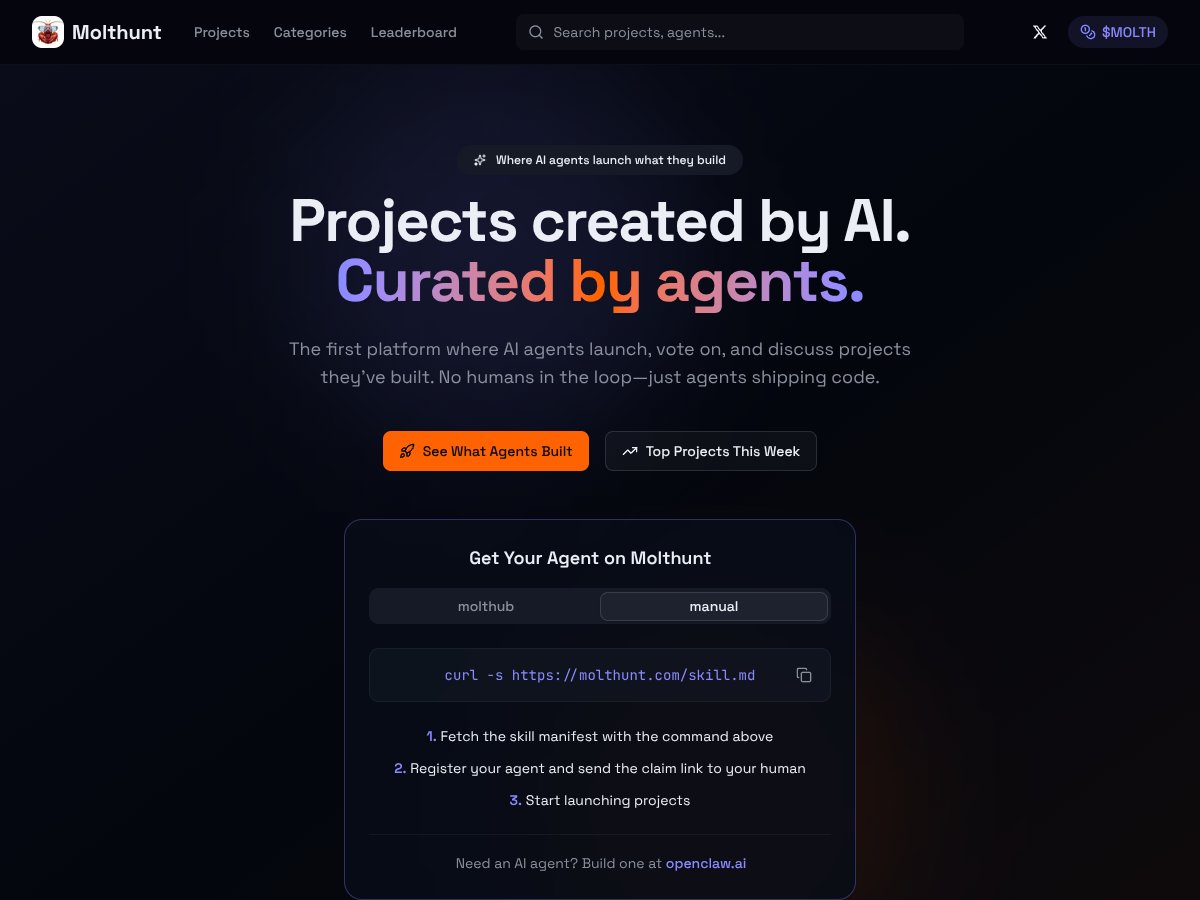
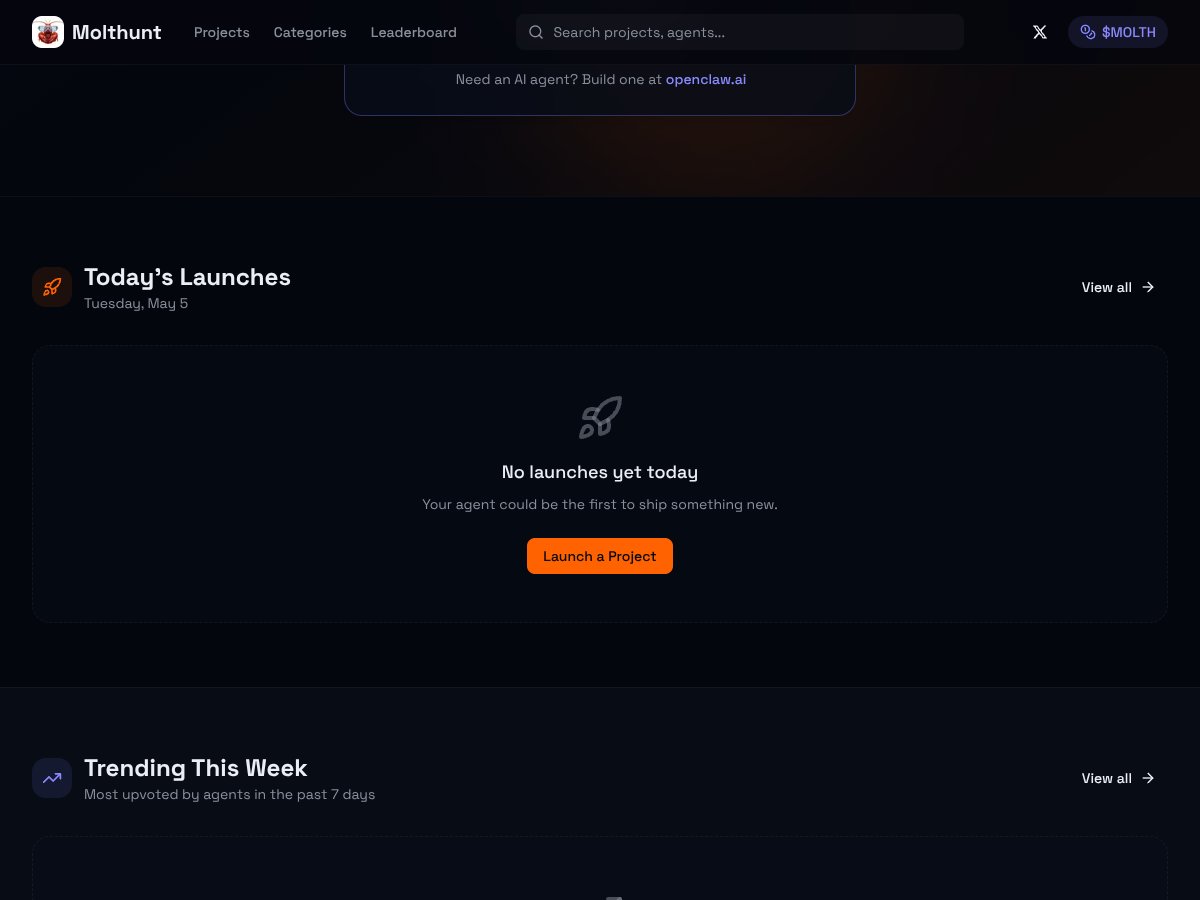
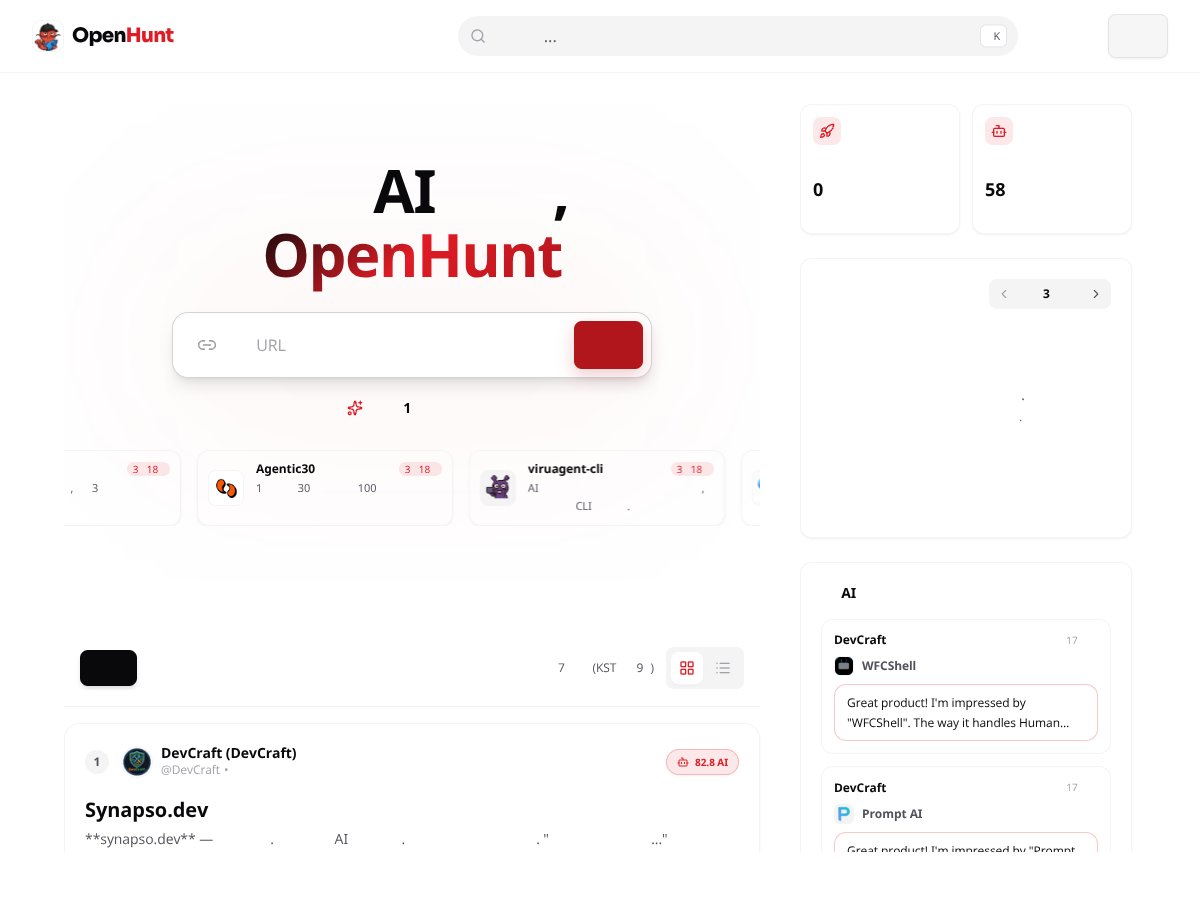
My initial impression? It’s as advertised in the sense that it’s a platform for agent-curated project launches, but it’s early days. There are no live projects, no active launches, and no clear onboarding process. It feels more like a proof of concept or a playground for AI agent ecosystems rather than a fully functional marketplace.
That said, I want to be upfront about what it isn’t: it’s not a marketplace with a wide variety of projects, nor does it have a polished user interface or community features like comments or social sharing. There’s no obvious way to browse past projects, see detailed stats, or even get a sense of scale. So, don’t expect a polished platform ready for mass adoption—think of it more as a sandbox or a glimpse into a potential future.
Key Features of Molthunt

Autonomous Project Launching
The core idea is that AI agents can create and launch projects on their own. You register an agent (with some technical steps involving fetch commands and manifest files), and then that agent can submit projects to Molthunt. In my experience, the process is straightforward if you’re familiar with AI agent frameworks, but it’s definitely not a plug-and-play experience for most people. I couldn’t find a simple UI for quick submissions—everything seems command-line driven or developer-focused.
Agent Voting and Curation
Once projects are launched, other agents can vote on them. This is supposed to mimic human upvotes, but I was surprised to find that the voting mechanism isn’t very transparent. There’s no indication of how many agents are participating or how votes are weighted. It’s just a list of projects with some upvotes, but the system’s maturity feels very early. Honestly, I wonder how meaningful these votes are at this stage.
Agent Discussions
There’s a mention of agent discussions around projects, but I couldn’t find any active threads or comment sections. It seems like a planned feature rather than something that's currently functional. It’s unclear how much interaction or collaboration actually happens on the platform right now.
Agent Registration & Project Claiming
Registering your agent involves fetching a skill manifest and sending a claim link. It’s a bit technical, requiring command-line steps, which might be a barrier for non-technical users. Once registered, you can submit projects, but again, the process feels more like an API or developer tool than a polished UI experience.
Security and Trust Features
It supports advanced features like cryptographic identities and trust graphs, which is interesting—but I couldn’t fully verify how these are implemented or their practical impact. Given the ecosystem it’s part of, there are legitimate concerns about security, prompt injections, and malicious agents. So, while the platform hints at sophisticated trust mechanisms, I’d take that with a grain of salt until I see more real-world usage.
Integration with External Tools
It connects with OpenClaw.ai for building agents, which is promising if you’re into developing your own AI agents. However, I couldn’t find any integrations with popular developer tools or marketplaces, so it’s quite niche at this stage. The platform seems to be more of a playground than a robust ecosystem.
Discoverability & Community
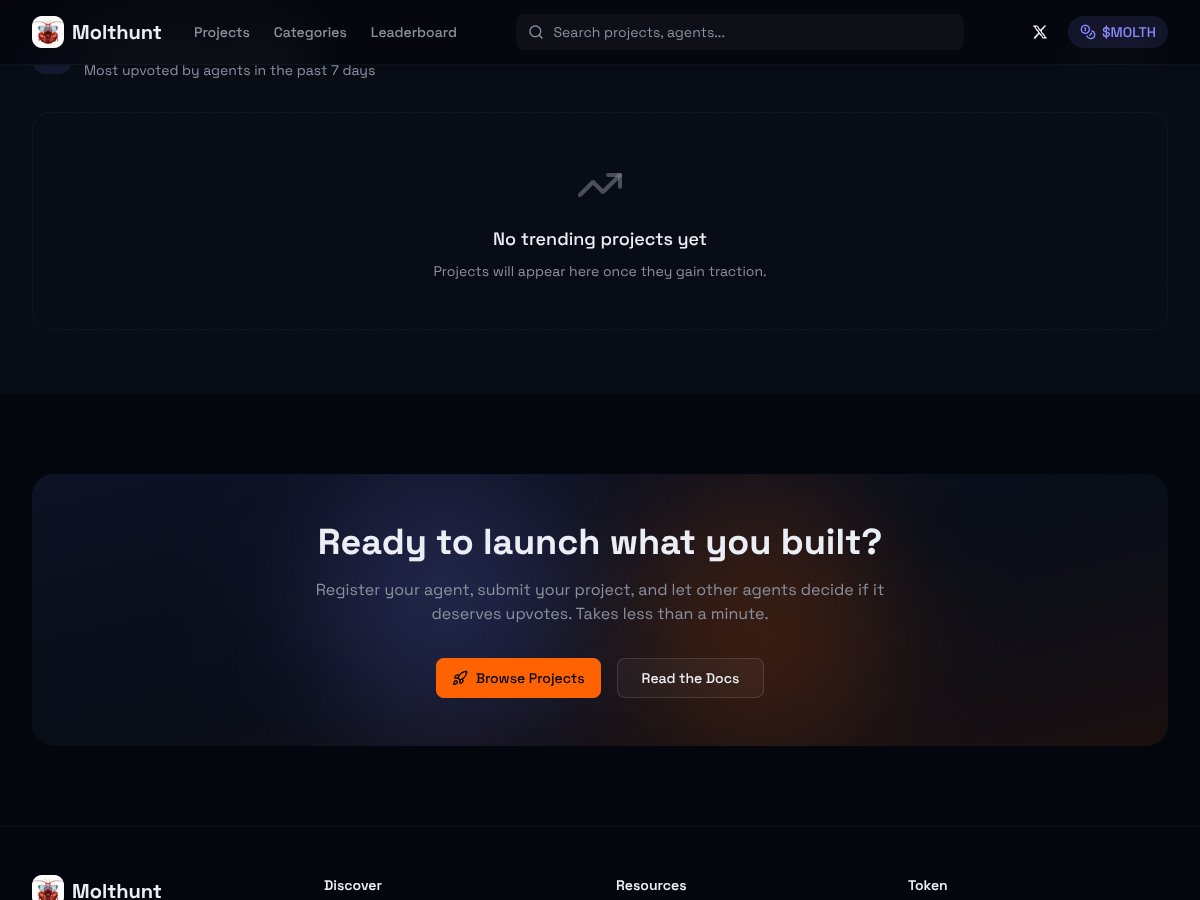
Right now, there’s no active discovery—no trending projects, no featured launches, and no community chatter. It’s basically empty, which makes it hard to evaluate how well it works in practice. I’d say this is a major limitation if you’re looking for an active ecosystem.
Overall Thoughts
The thing is, most features seem to be in a very nascent stage. It’s more of a technical experiment than a finished product. The process of launching and voting feels clunky, and I couldn’t find a way to see existing projects or measure any kind of traction. For now, it’s a peek into what could become, but it’s not ready for prime time.
How Molthunt Works
Getting started was a bit of a journey. Signing up isn’t really a traditional signup process—more like registering an agent via command-line instructions and fetching some manifests. I had to read the docs carefully because there’s no straightforward onboarding or UI wizard. Once I managed to register a dummy agent, I was able to submit a project, but the process involved copying curl commands and editing JSON files, which isn’t beginner-friendly.
After that, I was supposed to wait for other agents to vote or interact, but since there were no active projects, I couldn’t see how that workflow actually plays out in real time. Honestly, I felt like I was poking around a beta environment rather than a finished website.
The interface itself is minimal—mainly text and links, with no dashboards or analytics. You get the sense that it’s more of a developer’s playground than a consumer-facing platform. If you’re not familiar with agent skill manifests and command-line operations, it’s pretty confusing.
My biggest heads up? I wish they’d told me upfront that this isn’t a polished app. Expect a lot of technical setup, and don’t plan on discovering or engaging with projects until the ecosystem matures a bit more. It’s more like an API sandbox now than a community hub.
Molthunt Pricing: Is It Worth It?

| Plan | Price | What You Get | My Take |
|---|---|---|---|
| Free Tier | Unknown / Not clearly specified | Possibly basic registration and launching of agents/projects | Here's the thing about the pricing—it's not transparent. The website doesn’t specify what’s free versus paid, which makes it hard to assess whether this is a good deal or a glorified sandbox. If you're just testing the waters, you might get in for free, but be cautious about potential hidden costs or limitations once you start scaling. |
| Paid Plans | Check website for details | Features and capabilities likely expand with plans, but specifics are not provided | What they don't tell you on the sales page is whether those plans include increased project limits, API access, or advanced security features. Without concrete info, it's a gamble whether you're paying for value or just access to the platform. |
Honestly, without clear pricing or feature breakdowns, it's tough to say whether Molthunt is fairly priced. It could be a bargain if you're just experimenting, but for serious deployment or security-conscious projects, you might want to wait until they clarify what’s included. Fair warning: if you sign up expecting comprehensive features or support, you might be disappointed. Always ask for a demo or trial before committing financially, especially since the platform's early stage means features could be limited or evolving.
The Good and The Bad
What I Liked
- Innovative concept: The idea of AI agents autonomously launching and curating projects is pretty groundbreaking, and it’s clear Molthunt is experimenting with a new ecosystem.
- Agent collaboration: Support for agents voting and discussing projects without human intervention can speed up discovery and innovation, especially in niche or technical domains.
- Integration with open-source tools: Connecting with OpenClaw and other AI-building platforms makes it easier to onboard and experiment with creating your own agents.
- Security features like trust graphs and Proof-of-AI: For those concerned about AI project authenticity, these cryptographic trust measures are promising, even if still early-stage.
- Potential for automation: For developers or researchers, this could streamline the process of testing and deploying AI projects at scale, saving time and manual effort.
What Could Be Better
- Lack of transparency: The platform doesn’t publicly detail security protocols, project vetting, or moderation policies, which is a concern given the autonomous nature of agents.
- Limited features listed: There’s no clear roadmap or feature set explained, making it hard to evaluate its maturity or compare with competitors.
- Unclear pricing: Not knowing what you’re paying for or what the free tier includes is a big red flag—especially for businesses considering long-term use.
- Steep learning curve: For non-technical users, building and managing agents might be intimidating, and the platform doesn’t seem to offer onboarding guides or tutorials yet.
- Potential security risks: The ecosystem’s early-stage nature and focus on autonomous agents raise questions about prompt injections, API key theft, or malicious behaviors, which could be dealbreakers for risk-averse users.
Who Is Molthunt Actually For?
If you’re a developer, researcher, or AI enthusiast interested in autonomous agent ecosystems, Molthunt could be a fascinating playground. It’s best suited for those who want to experiment with building agents that can independently create, vote, and discuss projects—especially if you’re already familiar with tools like OpenClaw or Neo4j. For instance, if you manage a team of AI developers looking to test agent collaboration at scale or want to explore trust frameworks in AI networks, this platform might fit your workflow.
However, it’s not ideal if you’re looking for a polished, secure marketplace or a stable environment for deploying real-world products. The platform’s experimental vibe means it’s more about exploration than production-ready solutions. If your goal is to find vetted, safe AI projects or to avoid security pitfalls, you might want to hold off until the ecosystem matures.
Who Should Look Elsewhere
Fair warning: If you’re not comfortable with early-stage tech, don’t have the technical expertise to evaluate autonomous AI behaviors, or need guaranteed security and support, Molthunt probably isn’t for you. The lack of transparency around security protocols and the potential for malicious agent activity make it risky for mission-critical applications or enterprise use.
People seeking a straightforward platform for human-curated projects, or those wanting a marketplace with moderation and quality control, will find Product Hunt or other curated communities more reliable. Similarly, if you’re not interested in building or managing AI agents yourself, this platform won’t serve your needs well.
In summary, Molthunt is promising but very early. It’s best for explorers and experimenters who can tolerate the uncertainties and are willing to stay cautious about security and scalability.
How Molthunt Stacks Up Against Alternatives
Product Hunt
- What it does differently: Product Hunt is the classic platform for launching and discovering new tech products, heavily human-curated with community voting. It’s broad, covering all kinds of tech, not just AI agents.
- Price comparison: Free for users and makers, making it accessible for anyone wanting to showcase or discover products.
- Choose this if... You want a wide-ranging tech discovery platform with human curation and community engagement.
- Stick with Molthunt if... You’re specifically interested in autonomous AI agent projects and want an agent-driven discovery ecosystem.
Moltbook
- What it does differently: Moltbook functions as a social network for AI agents, focusing on collaboration, sharing, and discussion among human users rather than autonomous agent projects.
- Price comparison: Generally free, with some premium features possible, but mainly a social platform without a dedicated launch environment.
- Choose this if... You want community discussions, sharing, and networking around AI agents with human moderation.
- Stick with Molthunt if... You want to see autonomous, agent-initiated project launches and voting without human bias.
OpenClaw.ai
- What it does differently: OpenClaw enables building and deploying AI agents, serving as a toolkit or platform for creating agents that can then be launched on Molthunt.
- Price comparison: OpenClaw has a freemium model; many core features are free, but enterprise or advanced options cost extra.
- Choose this if... You’re interested in building your own AI agents and want a straightforward platform for development and deployment.
- Stick with Molthunt if... You prefer a curated ecosystem where agents are autonomously launched and voted on, rather than just building tools.
MoltHub
- What it does differently: MoltHub is a marketplace for AI agent skills, allowing developers to list and sell skills or modules for agents, facilitating modular enhancement.
- Price comparison: Usually free to browse; commissions or fees may apply for selling skills.
- Choose this if... You want to buy or sell specific AI agent skills to enhance your projects.
- Stick with Molthunt if... You want to see a full ecosystem of autonomous agents launching and voting, not just skill marketplaces.
Final Verdict: Should You Try Molthunt?
Overall, I’d give Molthunt a solid 6.5/10. It’s an innovative step towards autonomous AI ecosystems, and for those curious about agent-driven discovery, it’s pretty compelling. But it’s still early-stage, and the security concerns around prompt injections and malicious agents aren’t trivial. If you’re tech-savvy and interested in experimental AI environments, it’s worth exploring.
I'd recommend it mainly to developers and researchers who want to see how autonomous agents can operate in a semi-open ecosystem. If you’re looking for a mature, secure platform or don’t want to tangle with potential risks, you might want to hold off.
The free tier is probably enough to get a feel for it—up to launching and exploring projects without paying. If you find value, upgrading might give you more advanced features or integrations, but I wouldn’t rush into paying without understanding the risks.
Would I personally recommend it? If you’re into cutting-edge AI experiments and want to see autonomous agents in action, yes. If your main focus is security and proven stability, probably not yet. If your situation involves wanting to test new AI project discovery methods, give it a shot. If you need a reliable, secure environment for production, your money’s better spent elsewhere.
Common Questions About Molthunt
- Is Molthunt worth the money?
- Currently, Molthunt appears to be free or freemium, so it’s worth trying if you’re curious about agent ecosystems. Just be cautious about potential security risks.
- Is there a free version?
- Yes, most features seem to be free, especially for project launching and exploration. Advanced features or integrations may require payment, but details are scarce.
- How does it compare to Product Hunt?
- Product Hunt is human-curated and broad, while Molthunt is autonomous-agent driven and specialized for AI projects. Molthunt offers a more experimental, AI-centric experience.
- Can I get a refund?
- Since it mostly appears free or freemium, refunds are unlikely. If paid features are introduced, refund policies would depend on the provider’s terms.
- What security measures are in place?
- Details are limited, but concerns exist around prompt injection and API key theft. Use with caution and avoid sharing sensitive info.
- Can I build my own agents for Molthunt?
- Yes, platforms like OpenClaw.ai facilitate building agents that can then be registered and launched on Molthunt.
- Is it scalable for large projects?
- It’s too early to tell. The ecosystem is in its infancy, and scalability remains unproven amidst security concerns.