Table of Contents
What Is Platos | The runtime for Managed Agents?
Honestly, when I first heard about Platos, I was pretty skeptical. The whole idea of managing AI agents — deploying them, monitoring, orchestrating multi-agent workflows — sounds complicated enough. So I was curious: does this tool actually make life easier, or is it just another open-source project that promises too much?
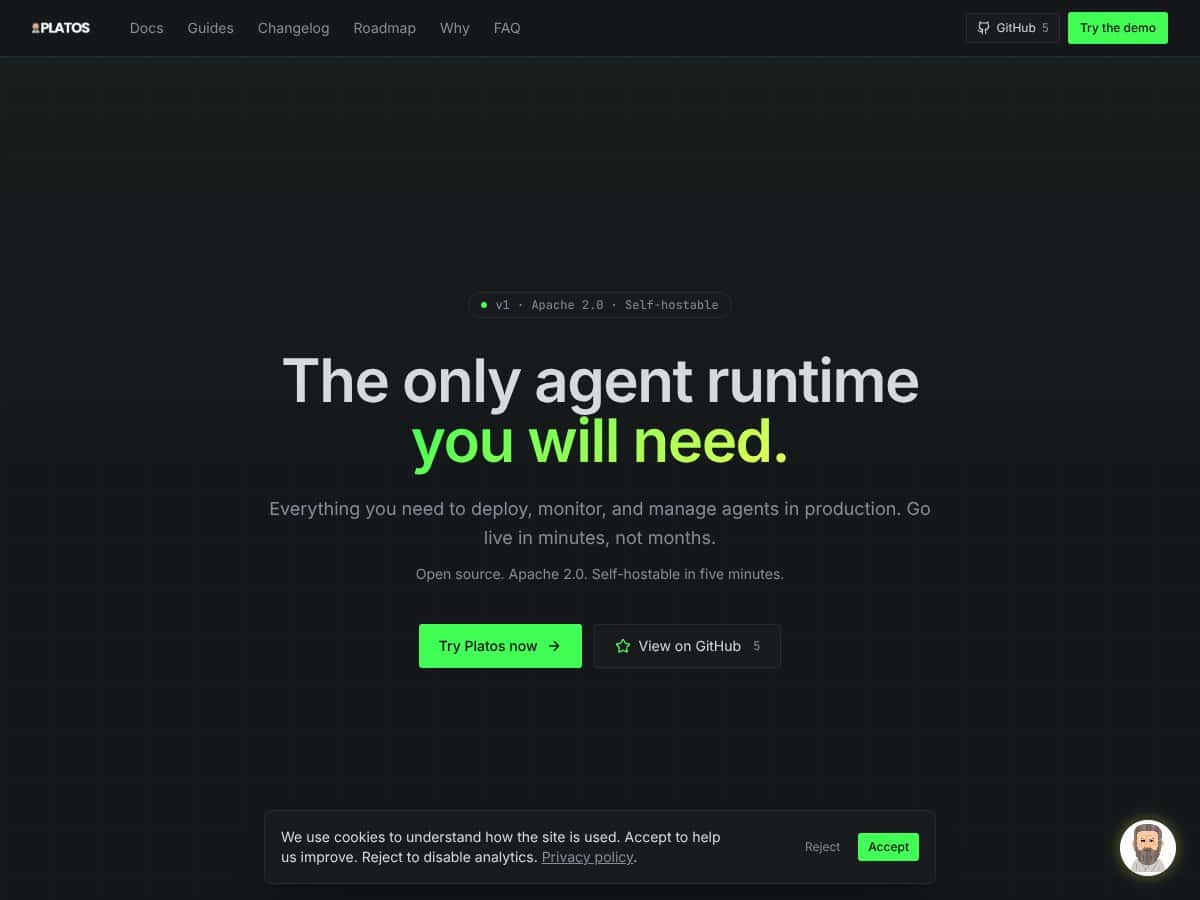
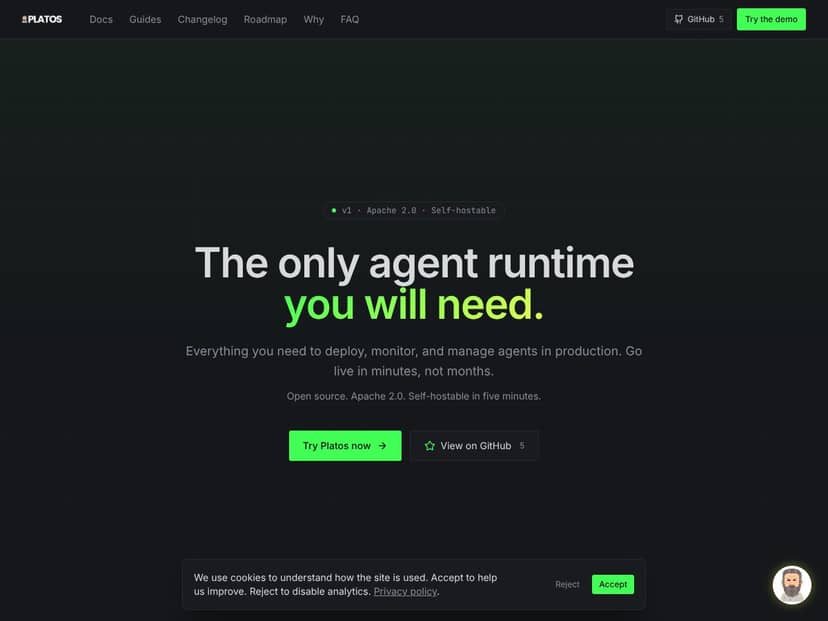
What I found is that Platos aims to be a kind of all-in-one runtime environment for AI agents. In plain English, it’s a framework you can self-host that lets you deploy, run, and coordinate AI-powered agents across different backends, like OpenAI, Anthropic, Google, and more. The goal here is to give developers a way to handle production-grade AI agents without relying entirely on managed services like Claude Managed Agents or LangChain’s cloud offerings.
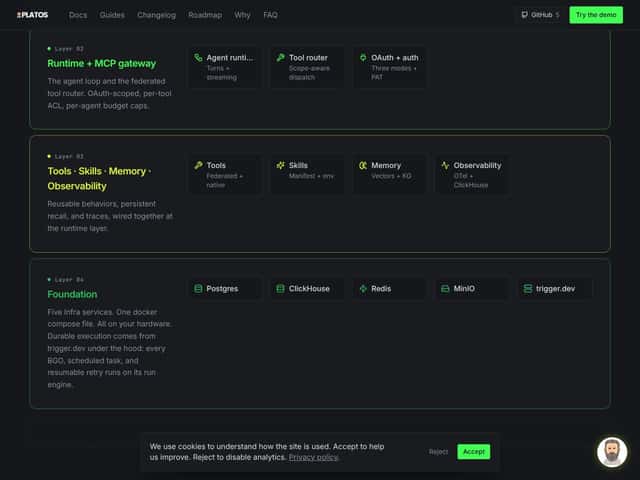
It’s built on trigger.dev, an open-source toolkit for event-driven workflows, and claims to be ready for production in just five minutes of setup. That’s a bold claim, but what it’s really doing is providing primitives to define agents, tools, memory, and orchestrations, then run them via REST, WebSocket, or its own MCP gateway.
As for who’s behind it, Platos is an open-source project with a GitHub repo under the Apache 2.0 license. I couldn’t find a dedicated team or company name attached, but it seems to have a small core community and recent updates, especially after their v2.0 release in March 2026. So I’d say it’s a community-driven project with some backing from the developers involved in trigger.dev and related open-source ecosystems.
My first impression? It’s as advertised — a flexible, low-level runtime that puts control in your hands. It’s not a plug-and-play SaaS with a slick dashboard (at least not yet), and I wouldn’t expect it to be. It’s more like a toolkit for developers who are comfortable with self-hosting, DevOps, and managing their own infrastructure.
Heads up, though: It’s not a full-blown agent management platform with a polished UI or enterprise governance features. If you’re looking for something simple to deploy with minimal fuss, this isn’t it. It’s more for folks who want to customize, integrate, and scale their own agent workflows — with all the complexity that entails.
In summary, Platos is an open-source, self-hostable runtime that offers a lot of power for managing AI agents across multiple providers. It’s not a turn-key product, but if you’re willing to roll up your sleeves, it could be a good fit for building scalable, multi-agent systems. Just don’t expect a friendly wizard guiding you through setup or a dashboard that makes everything obvious. It’s more like a toolbox than a finished product — and that’s both its strength and its limitation.
Platos | The runtime for Managed Agents Pricing: Is It Worth It?
| Plan | Price | What You Get | My Take |
|---|---|---|---|
| Free Tier | Unknown / Not publicly listed | Open-source software, community support, basic deployment options | Good for experimentation and small projects, but limited info makes it hard to gauge scalability or enterprise readiness. Likely sufficient for hobbyists or early-stage devs exploring agent management. |
| Paid Cloud Hosting | Starting at ~$0.02 per agent-hour; enterprise plans >$500/month | Managed hosting, enhanced support, SLAs, possibly additional features like priority updates or dedicated support | Fair pricing considering the self-hosted alternatives; for small-medium teams, this could be a cost-effective way to reduce DevOps overhead. |
Here's the thing about the pricing: since Platos is open-source, it doesn't come with a hefty subscription fee. Instead, your costs are tied to your hosting infrastructure and the LLM API usage. That means if you're running everything on your own servers or cloud provider, your only real expense is your infrastructure and API calls. The managed hosting option simplifies setup but adds a predictable monthly fee, starting at around twenty cents an hour per agent, which isn't bad for production workloads.
What they don't tell you on the sales page is how the actual costs can add up if you scale massively—say hundreds of agents running 24/7. Also, the pricing model is somewhat opaque for enterprise plans, so you'll need to reach out for a custom quote if you're a large organization. This might be a dealbreaker for some if you prefer clear, predictable SaaS billing.
Honestly, this pricing model makes sense for teams that want control and flexibility without vendor lock-in. Smaller teams or startups could start free, then scale into paid hosting as needed, avoiding lock-in with a vendor. Larger organizations should consider whether managing their own infrastructure or paying for managed hosting aligns better with their compliance and support needs.
The Good and The Bad
What I Liked
- Open-source foundation: Fully open-source under Apache 2.0, giving you full control and avoiding vendor lock-in.
- Flexible deployment options: Run locally, on Kubernetes, Docker, or cloud—great for hybrid setups or on-prem environments.
- Multi-model support: Supports Claude, OpenAI, and others seamlessly, which reduces provider dependency.
- Built-in MCP gateway: Simplifies federating tools and managing multi-provider setups—saving time and reducing complexity.
- Extensive observability: Every turn traced, cost attribution, and export capabilities—crucial for production monitoring and debugging.
- Versioned agents and long-running operations: Makes iteration and reliability easier, especially for complex workflows.
What Could Be Better
- Steep learning curve: The documentation and onboarding could be more beginner-friendly, especially for those unfamiliar with DevOps or container orchestration.
- Limited built-in integrations: No plug-and-play marketplace—adding new tools or models requires custom setup, which is less convenient than managed services.
- Pricing transparency: No clear info on free tier limits or enterprise plan costs, making budgeting tricky.
- Requires DevOps skills: To deploy and scale effectively, you’ll need some infrastructure expertise—this could be a barrier for smaller teams or non-technical users.
- Limited out-of-the-box features: No dedicated UI or no-code interface—more suited for developers comfortable with command line and scripting.
Who Is Platos | The runtime for Managed Agents Actually For?
If you're a developer, researcher, or enterprise team with a solid grasp of cloud deployment and API integrations, Platos is probably a great fit. It especially shines in scenarios where you need:
- Full control over agent orchestration, tooling, and data privacy
- A flexible, open-source runtime to build custom multi-agent workflows
- Hybrid or on-prem deployment options to meet strict compliance or latency requirements
- Long-running autonomous agents that need persistent memory and knowledge graphs
- Multi-provider support to avoid vendor lock-in and optimize costs
For example, if you're managing a team of AI agents that handle customer support, research automation, or complex data pipelines, and you want to tailor the runtime environment exactly to your needs, Platos provides the building blocks to do so.
However, if you're a non-technical user or want a plug-and-play managed SaaS with minimal setup, this might be overkill. It’s best suited for those who are comfortable with DevOps, want control over their environment, and are prepared to handle the initial setup and ongoing management.
Who Should Look Elsewhere
If your needs are simple—say, you want a quick, no-code way to deploy a basic chatbot or your team lacks technical expertise—Platos might be frustrating. The platform is powerful but expects a certain level of familiarity with cloud infrastructure, APIs, and agent orchestration.
Similarly, if you need enterprise-grade features like compliance certifications, dedicated support, or integrated governance tools out of the box, managed services like Claude Managed Agents or CrewAI could be more appropriate. These offer more polished interfaces and support structures, at the cost of higher vendor lock-in and potentially higher ongoing expenses.
Finally, if your primary goal is rapid prototyping or a low-cost sandbox environment without complex multi-agent workflows, simpler frameworks or hosted solutions may serve you better, as Platos’s learning curve could outweigh its benefits in those cases.
How Platos | The runtime for Managed Agents Stacks Up Against Alternatives
Claude Managed Agents
- What it does differently: Claude Managed Agents is a fully hosted, managed service that offers seamless integration with Anthropic's Claude models, with minimal setup required. It handles agent orchestration behind the scenes, providing enterprise-grade reliability and compliance features.
- Pricing: Starts around $0.05 per 1,000 tokens, with tiered plans that include support and SLAs. No need to manage infrastructure yourself, but costs can add up quickly with high usage.
- Choose this if... you want a turn-key, fully managed solution with enterprise support, and you're okay with vendor lock-in and higher ongoing costs.
- Stick with Platos | The runtime for Managed Agents if... you prefer open-source flexibility, want to avoid vendor lock-in, or need custom deployment options that Claude Managed Agents can't provide.
- What it does differently: These are open-source frameworks focused on building complex agent workflows with a lot of modularity. They provide libraries and runtime components but leave deployment and orchestration up to you.
- Pricing: Free, open-source. Costs depend on your infrastructure (cloud, local, etc.) and LLM API usage.
- Choose this if... you're comfortable with more hands-on development and want total control over your agent orchestration and infrastructure.
- Stick with Platos | The runtime for Managed Agents if... you prefer a ready-to-use runtime with built-in features and less setup hassle.
- What it does differently: Focused on multi-agent orchestration with a visual workflow builder and multi-agent coordination features. It's more of a platform designed for managing multiple agents working together.
- Pricing: Open-source, but some advanced features may require enterprise licensing or hosting costs.
- Choose this if... multi-agent workflow management with a visual interface is your priority.
- Stick with Platos | The runtime for Managed Agents if... you want a more flexible, code-centric approach over a visual platform.
- What it does differently: AutoGen is designed for building multi-agent systems with minimal code, focusing on automating conversations and task delegation across agents.
- Pricing: Part of Azure ecosystem, so costs depend on Azure usage, with a free tier for limited use.
- Choose this if... you want tight Azure integration and less manual setup for multi-agent workflows.
- Stick with Platos | The runtime for Managed Agents if... you need more control over deployment and agent orchestration, especially outside Azure.
- What it does differently: Focused on data-driven agents built on Llama models, with easy integration for document retrieval and knowledge bases.
- Pricing: Free and open-source, with costs coming from API usage and hosting infrastructure.
- Choose this if... your primary goal is data-centric agents that work with large document repositories.
- Stick with Platos | The runtime for Managed Agents if... you want a more comprehensive, multi-model, multi-tool setup with orchestration features.
- Is Platos | The runtime for Managed Agents worth the money? It’s free and open-source, so cost isn’t a concern. Its value lies in flexibility and control, which is worth it if you need customization.
- Is there a free version? Yes, it’s open-source and free to use. You’ll pay only for hosting infrastructure and API usage if applicable.
- How does it compare to Claude Managed Agents? Platos offers more customization and control at potentially lower costs, but requires more setup. Claude Managed Agents is easier but less flexible.
- Can I deploy Platos on my own server? Absolutely. It supports local, Docker, Kubernetes, and serverless deployments, giving you full control.
- Is there official support? No, it’s community-driven. You’ll rely on documentation and community forums for troubleshooting.
- How scalable is it? With proper DevOps skills, it can scale quite well, but it does require some expertise to manage production deployments.
- Does it support compliance or enterprise standards? Not officially; compliance depends on your hosting environment and configurations.
- Can I integrate it with other tools easily? Yes, it’s designed to be extensible with plugins and supports various deployment options.
LangChain / LangGraph
CrewAI
AutoGen (Microsoft)
LlamaIndex Agents
Bottom Line: Should You Try Platos | The runtime for Managed Agents?
Overall, I’d give Platos around a 7/10. It’s a solid choice if you’re comfortable with a bit of DevOps and want maximum control over your agent setup. The flexibility and open-source nature are definite pluses, especially if you want to avoid vendor lock-in and customize everything.
This tool is best for developers or teams who have some experience with deployment and orchestration, and who need a scalable, customizable runtime for production. The observability dashboards are a big win, making monitoring and iteration easier.
If you’re looking for a turn-key, no-fuss solution with enterprise SLAs, fully managed services like Claude Managed Agents might be better. But if you want to tinker, optimize costs, and host on your own terms, Platos is worth exploring.
Personally, I recommend trying the free tier first—it's open-source and straightforward to set up. If you find yourself hitting limitations or needing enterprise features, then consider upgrading or switching to a managed service.
If your project demands high customization, multi-agent orchestration, and open-source flexibility, give Platos a shot. If you prefer ease of use with less setup, look elsewhere.