Table of Contents
What Is Rosentic?
Honestly, when I first heard about Rosentic, I was intrigued but also skeptical. The idea of a tool that checks every pull request (PR) against all other open branches before merging sounds useful in theory, especially for teams juggling multiple agents or parallel development streams. But I wondered: does it actually work well in practice, or is it just another hype-driven add-on that promises the moon?
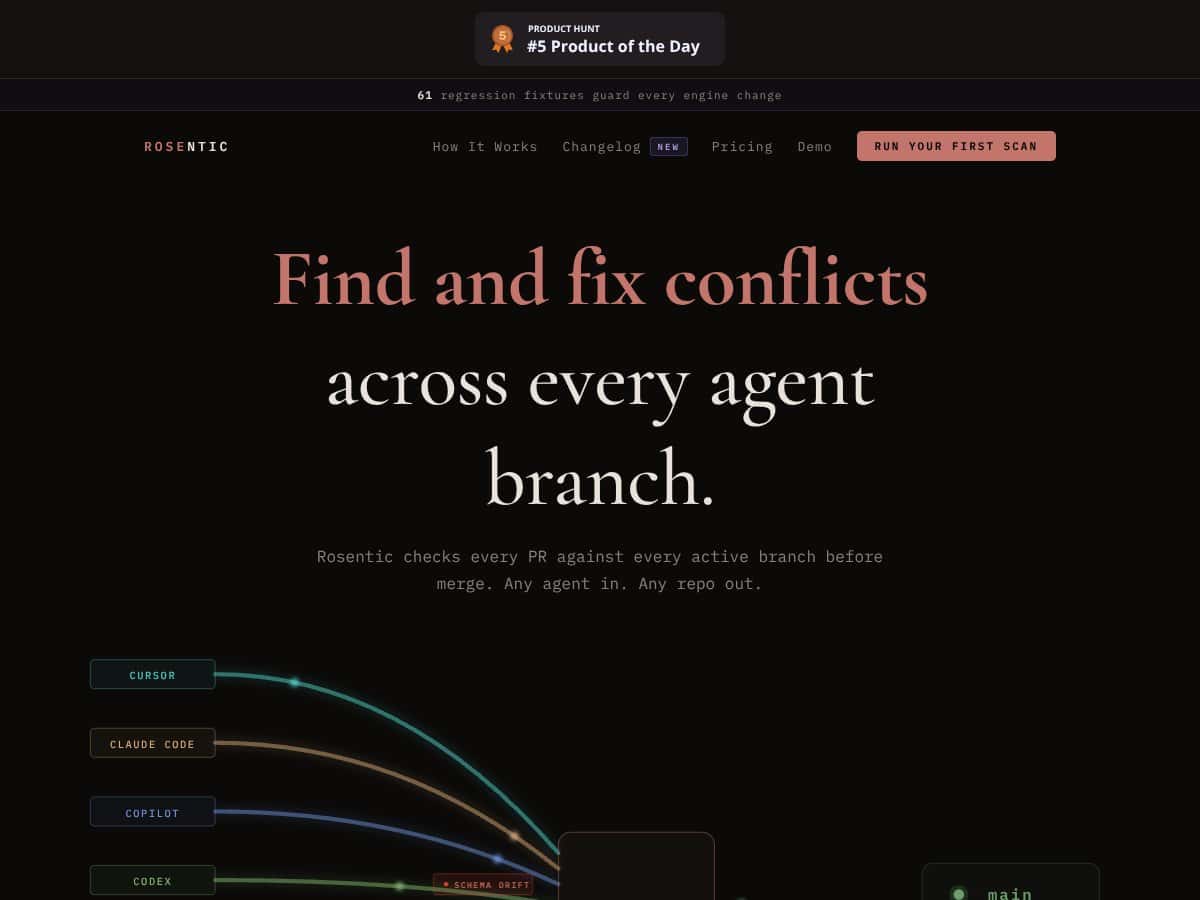
So, what exactly does Rosentic do? In plain terms, it scans your code repositories—specifically on GitHub—looking at every PR that's open and comparing it against every active branch. The goal is to catch conflicts or incompatibilities that might not surface until later, preventing those frustrating merge failures or broken code after you’ve already merged. It’s trying to be that extra safety net that ensures your code integrates smoothly, no matter how many branches or agents are working in parallel.
The problem it aims to solve is familiar to many dev teams: multiple developers or automated agents working simultaneously can step on each other's toes, leading to conflicts that are only discovered during or after merging. Traditional tools often only check conflicts within a single branch or PR, missing the bigger picture. Rosentic claims to do a deterministic, cross-branch verification that considers the entire active codebase, reducing surprises post-merge.
As for who’s behind it—officially, the website doesn’t go into much detail about the team or company. It seems to be a specialized project, probably developed by folks who understand the chaos of high-volume CI/CD pipelines, especially in AI or multi-agent environments. The website is pretty minimalist, and I couldn’t find much about their credentials or background, which makes me a bit cautious. It’s early-stage, in my experience, and not a fully fleshed-out enterprise solution.
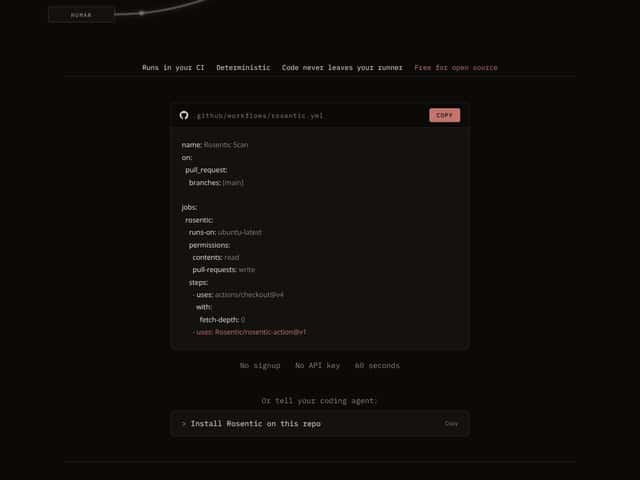
My initial impression? The tool is as advertised—at least on the surface. It promises quick setup, runs on your infrastructure, and checks all branches against each PR. The interface is clean, and their documentation is straightforward. That said, don’t expect a shiny dashboard or detailed analytics; it’s more like a silent partner that scans and reports. I was surprised to find how simple the setup was: just a YAML file and no sign-up or API keys needed. That’s refreshing, even if it leaves some questions about long-term support or updates.
One thing I want to be clear about—this isn’t a comprehensive code quality or testing tool. It doesn’t review code logic or style, and it doesn’t run tests. It’s purely about structural compatibility—checking whether changes will break other branches or PRs before you merge. So, if you’re expecting in-depth code review or AI-powered suggestions, you’ll be disappointed. It’s a niche tool that focuses narrowly on cross-branch conflicts, which is both its strength and limitation.
Rosentic Pricing: Is It Worth It?
| Plan | Price | What You Get | My Take |
|---|---|---|---|
| Free for open source | Free | Unlimited scans on open source repos, no signup, no API key, YAML setup | Solid for open source projects—no cost, easy to adopt, great for community-driven repos. But if you're working on private repos, you'll need to explore paid options or self-hosting costs. |
| Private repos | Not publicly specified | Likely self-hosted via GitHub Actions, potential infrastructure costs | Here's the thing about the pricing—since they don't list concrete prices for private repositories, you should be prepared for possible infrastructure expenses. This might be a dealbreaker for some teams with tight budgets or limited CI resources. |
What they don't tell you on the sales page is whether there's a cap on the number of scans per month or limits on repo size, so if you're planning to run this at scale, be sure to verify how it fits into your CI budget. I was honestly expecting a clearer tiered pricing model with explicit costs for private repos, but it seems to be a mostly self-hosted, usage-based approach.
This might be a dealbreaker for some—if you run a large private repo and need predictable billing, the lack of transparent pricing could be a concern. Fair warning: do your homework on infrastructure costs before integrating deeply.
How Rosentic Stacks Up Against Alternatives
Sweep AI
- What it does differently: Sweep AI offers AI-driven code review with a focus on agent conflict detection and automated suggestions, but it doesn’t perform cross-PR compatibility checks at the structural level like Rosentic. It’s more about high-level code review than deep multi-branch verification.
- Price comparison: Sweep AI is a paid service with tiers that vary based on usage; costs can add up quickly, especially for large teams or multiple repositories.
- Choose this if... you want AI-powered review combined with agent conflict detection, and are okay with a more general review process that isn't specifically tailored for cross-branch structural checks.
- Stick with Rosentic if... you primarily need deterministic, structural compatibility checks across multiple open PRs without extra AI noise. Open source projects benefit from Rosentic’s free tier and privacy focus.
CodeRabbit
- What it does differently: CodeRabbit focuses on AI-powered PR reviews with some awareness of multiple branches, but it doesn’t perform the thorough cross-PR, cross-branch verification that Rosentic does. It’s more about smart suggestions and general code quality.
- Price comparison: Paid plans with a free tier for small projects; pricing isn’t always transparent but generally more comprehensive than free tools.
- Choose this if... you want AI-driven insights and don’t mind less deterministic, structural analysis—especially if you’re looking for code quality tips alongside PR reviews.
- Stick with Rosentic if... your main concern is preventing merge conflicts caused by parallel PRs, especially in open source projects where privacy and deterministic results matter.
Qodo Merge
- What it does differently: Qodo Merge emphasizes cross-PR conflict detection with some focus on semantic issues, but it’s less about structural code analysis and more about ensuring merge safety across branches.
- Price comparison: Generally paid, with some free tier options; costs depend on repo size and usage, but it’s designed to be enterprise-friendly.
- Choose this if... you need robust merge conflict detection at a high level and are willing to trade off some structural insights for broader conflict coverage.
- Stick with Rosentic if... you’re an open source developer needing a free, privacy-focused, deterministic tool for structural cross-PR verification.
GitHub Copilot for Pull Requests
- What it does differently: Provides AI code review suggestions within GitHub’s interface, but lacks dedicated cross-PR or cross-branch structural analysis. It’s more about quick suggestions than deep conflict detection.
- Price comparison: Paid subscription, usually included in GitHub plans, but less specialized for conflict detection.
- Choose this if... you want quick AI suggestions integrated into your existing workflow without needing dedicated cross-PR checks.
- Stick with Rosentic if... you need thorough, deterministic cross-branch compatibility checks that GitHub Copilot isn’t designed for.
Bottom Line: Should You Try Rosentic?
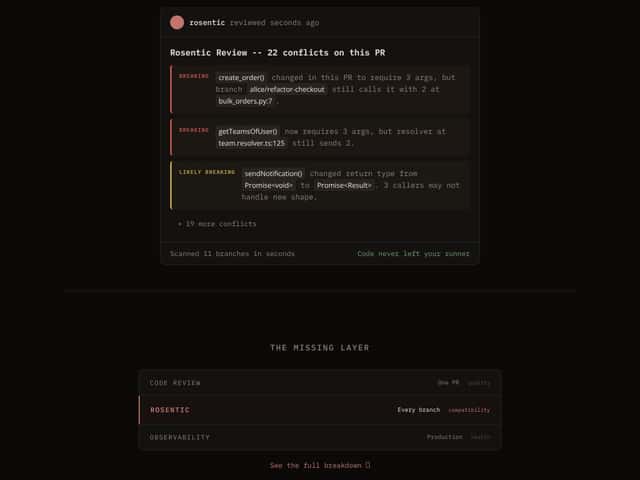
Overall, I’d give Rosentic a solid 7/10. It’s a niche tool that excels in preventing conflicts in high-PR-volume, open source workflows—especially if privacy and deterministic results matter. It’s not a full-blown testing or behavioral analysis engine, but if your main pain point is cross-branch compatibility and conflict prevention, it’s a real help.
If you’re managing multiple parallel PRs, especially with AI coding agents or complex codebases, you should definitely give it a shot. The setup is straightforward—just a YAML file, no accounts, no fuss—and the free tier for open source is a big plus. Paid plans for private repos aren’t clearly listed, but if you’re running on infrastructure, it could be cost-effective.
On the flip side, if you need deep runtime testing, behavioral validation, or extensive customization, Rosentic might fall short. Its closed-source engine means you can’t tweak the core logic, and it’s still early in its evolution with limited public reviews and enterprise features.
If your team’s primary challenge is avoiding merge conflicts caused by multiple parallel PRs, especially in open source projects, I’d recommend trying Rosentic first. If you need broader code review, AI suggestions, or integration with other tools, look into alternatives like CodeRabbit or Sweep AI.
Ultimately, it’s worth experimenting with the free tier to see if it catches issues you might otherwise miss. If your workflow involves lots of cross-branch merges and conflicts, giving Rosentic a try makes sense. Otherwise, investing in more general AI review tools might be better for your needs.
Common Questions About Rosentic
Is Rosentic worth the money?
For open source projects, yes—it's free and effective at catching cross-PR conflicts. For private repos, it might be worth it if you need deterministic, structural checks, but costs could add up depending on your infrastructure.
Is there a free version?
Yes, Rosentic is free for open source repositories. There’s no signup required, and setup is quick. For private repos, you’ll need to self-host, which is essentially free aside from your infrastructure costs.
How does it compare to Sweep AI?
Sweep AI offers AI-driven reviews with a focus on agent conflicts and code suggestions, but it doesn’t perform the detailed, deterministic cross-branch checks that Rosentic does. If structural verification is your priority, Rosentic wins.
Can it handle multiple languages?
Rosentic primarily works with GitHub repositories and supports common languages like JavaScript, Python, and others, but detailed language support info is limited. It’s designed for structural analysis rather than language-specific features.
Is it safe to run on my infrastructure?
Absolutely. Rosentic runs entirely on your infrastructure via GitHub Actions, keeping your code private and secure without external data sharing.
Can I get a refund?
Since Rosentic is free for open source and self-hosted for private repos, refunds aren’t typically applicable. Check with the maintainers if you’re paying for a hosted version or additional features.