LIFETIME DEAL — LIMITED TIME
Get Lifetime AccessLimited-time — price increases soon ⏳
AI Tools

ScrollMind Review (2026): Honest Take After Testing

Stefan
10 min read
#Ai tool

Table of Contents

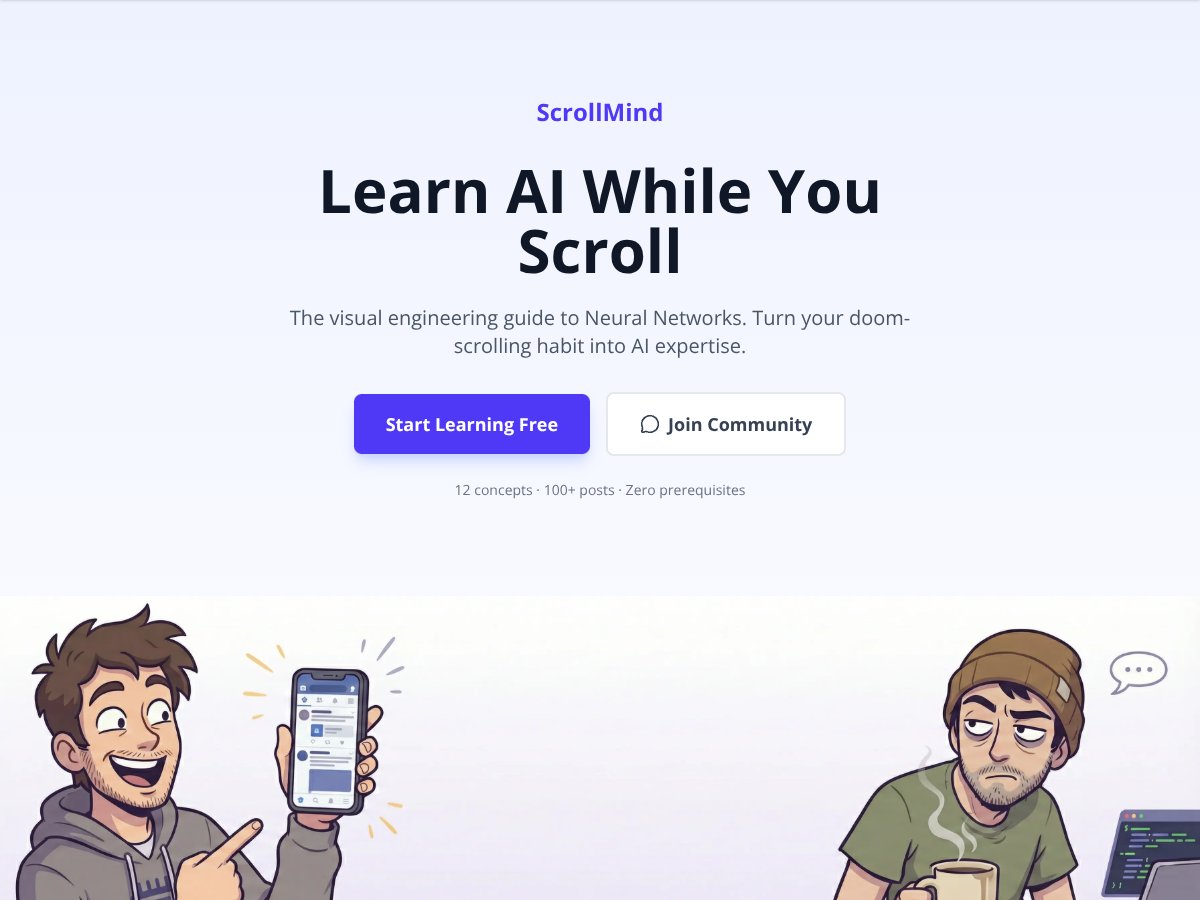
ScrollMind screenshot

What Is ScrollMind?

Honestly, when I first came across ScrollMind, I was pretty skeptical. The idea of learning AI while scrolling through what looks like a social-media-style feed sounds like a clever gimmick—can you really pick up complex concepts from bite-sized posts? I was curious enough to give it a shot, even though I couldn’t find much official info or reviews about it. The premise seems to be that instead of traditional courses or textbooks, ScrollMind aims to teach AI concepts through quick, visual snippets—think memes, short posts, and quizzes—designed for people who are busy or easily distracted.

So, what does it actually do? In plain English, it’s a microlearning platform that offers small pieces of content focused on AI topics—like neural networks, embeddings, or training processes—that you can consume while scrolling. The idea is to turn your casual doom-scrolling habit into something slightly more productive, or at least more educational. It’s not a full-blown course or a technical library; rather, it’s more like an ongoing visual glossary or a social media feed dedicated to AI concepts.

What problem is it trying to solve? From what I gathered, it’s addressing the frustration many learners face with traditional AI resources: dense textbooks, lengthy videos, and tutorials that skip the ‘why’ behind the math and concepts. It’s aimed at visual learners, software engineers who want a conceptual refresher, or curious minds who want to understand AI without diving into formal math or lengthy lectures. The creators seem to be targeting people who want quick, digestible bits of knowledge that fit into a busy schedule.

Who’s behind it? The website and the content suggest it’s a small team that’s passionate about making AI accessible through visual learning. I didn't find any notable founders or company info, which makes me a bit wary about credibility—no team bios, no backing info. That’s a heads-up: without knowing who’s behind it, I’d take the claims with a grain of salt.

My initial impression? It’s as advertised—an feed of short, visual posts about AI concepts. The content is informal, meme-like, and seems designed to be fun and engaging rather than deeply technical. However, I was surprised to find that there’s no clear roadmap, no sign-in or sign-up process (it claims no signup needed to browse), and no detailed explanations or tutorials. It feels more like a collection of social posts about AI than a structured learning tool.

What it’s NOT: It’s definitely not a comprehensive course, a formal textbook, or a professional training platform. You won’t find detailed mathematical proofs, coding exercises, or in-depth tutorials here. It’s more like a visual companion that might spark curiosity or help reinforce high-level ideas—but don’t expect to walk away with a solid understanding of how neural networks are built or trained. Also, I couldn’t find any mention of pricing or a subscription model, which makes me think it’s either free or still in early stages.

In my experience, the value of ScrollMind depends heavily on your expectations. If you’re looking for a quick, fun way to glance at AI ideas and maybe jog your memory, it might be OK. If you want to actually learn how to build models or understand the math behind AI, this isn’t the place.

ScrollMind Pricing: Is It Worth It?

ScrollMind interface
ScrollMind in action

Here's the thing about the pricing… I couldn't find any concrete details on what ScrollMind charges, whether they have a free tier, or what the plans include. What they don't tell you on the sales page is whether there's a limit on how much you can scroll, how many concepts you can learn per day, or if there are any premium features locked behind a paywall. Without transparent pricing, it's hard to judge whether this is a good deal or just another vague marketing claim.

Plan Price What You Get My Take
Free Unknown Access to some beginner content, community, possibly limited features Fair warning: if the free tier exists, it might be very limited, and you could quickly hit paywalls. Make sure to verify what’s included before investing time.
Pro/paid plans Unknown Advanced courses, more concepts, maybe no scrolling limits Given the lack of info, I’d recommend approaching this with caution. If they do have paid plans, compare the cost to similar microlearning platforms or AI courses—if the price is high and features are vague, it may not be worth it.

My honest assessment? Without clear, published pricing or a free trial, it’s hard to say if this offers good value. If you’re considering it, look for updated info directly on their website or reach out for a demo. Be wary of hidden costs or feature gates that aren’t made obvious upfront.

The Good and The Bad

What I Liked

  • Microlearning format: The bite-sized posts and memes make learning quick and digestible, perfect for busy schedules.
  • Focus on intuition over math: If you’re tired of textbooks full of Greek letters, this approach seems more approachable and relatable.
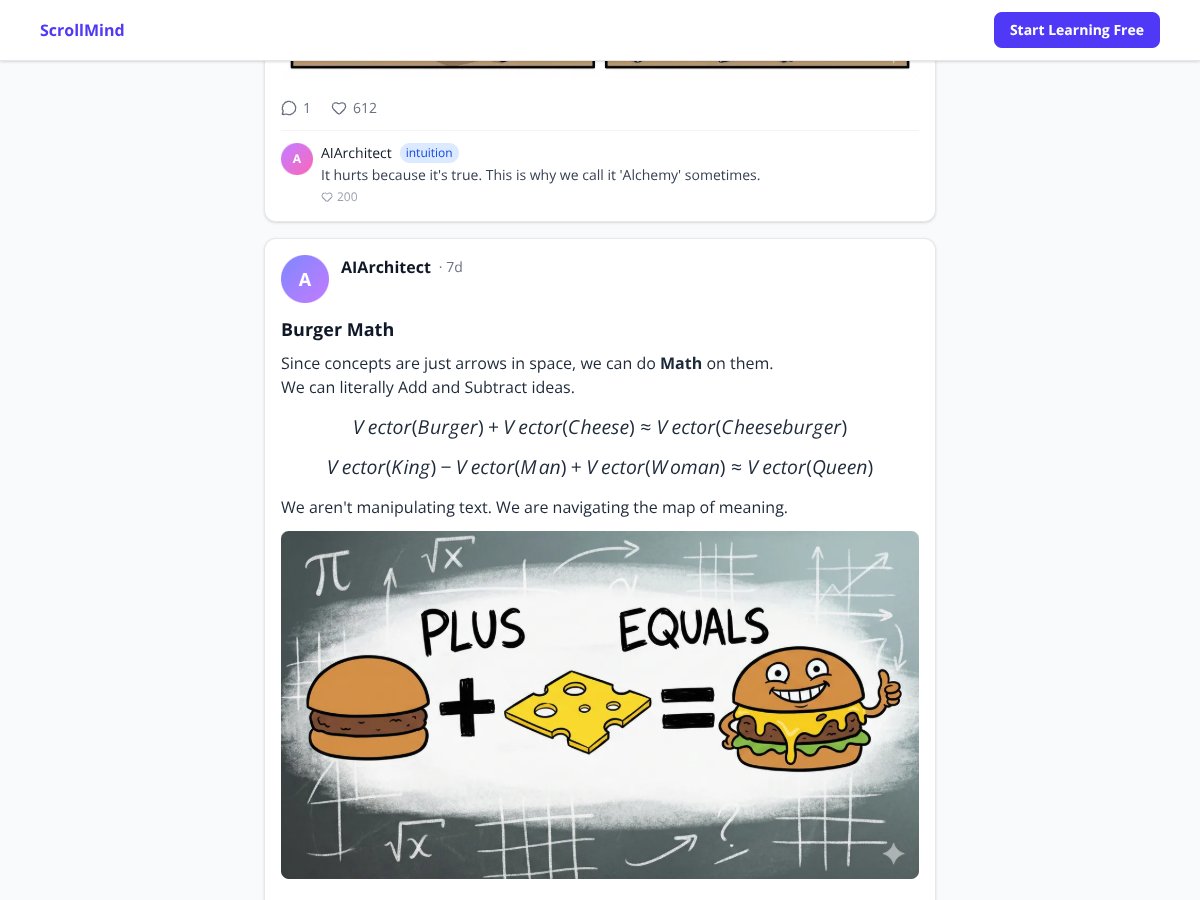
  • Visual learning style: The emphasis on visual concepts, like vector operations, helps in understanding complex ideas without getting lost in equations.
  • Community aspect: The inclusion of a community for discussion is a plus, especially for learners who thrive on interaction.
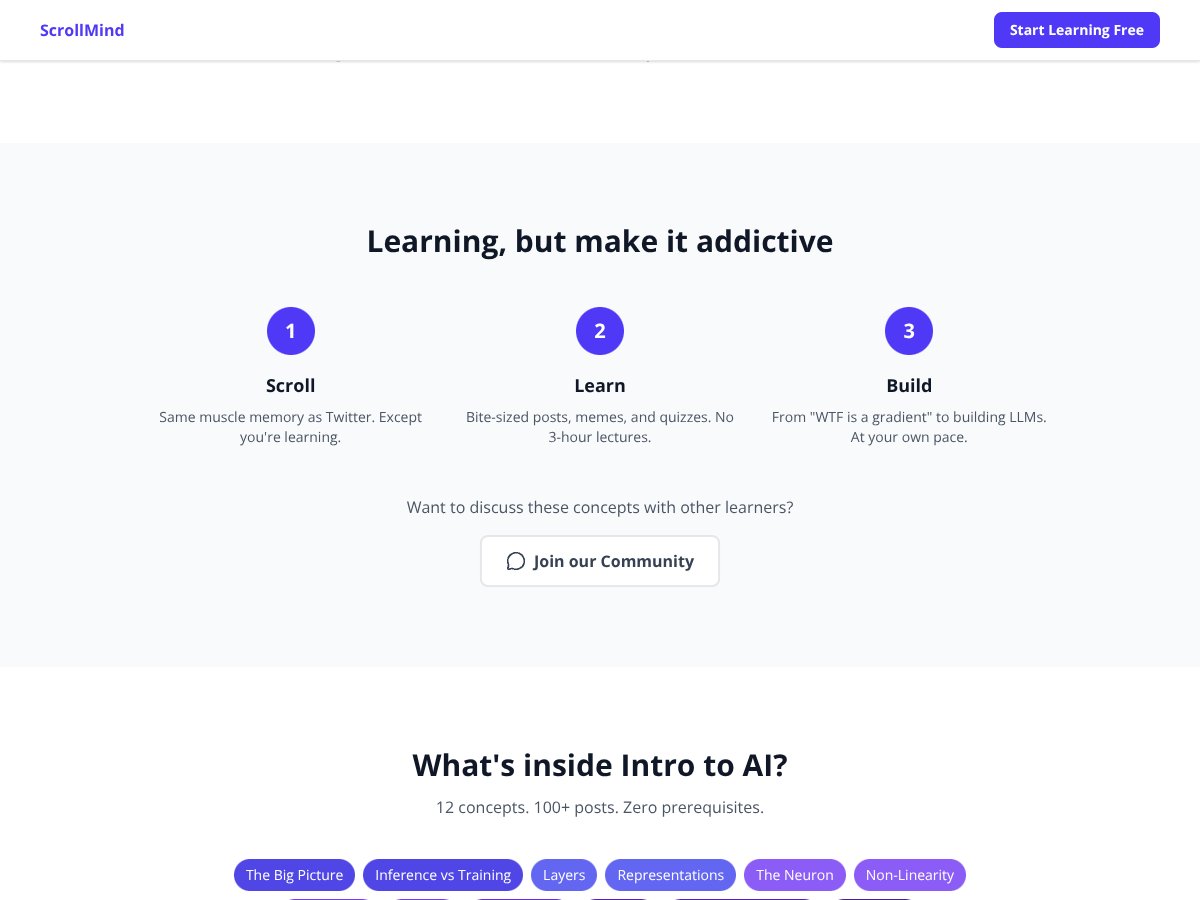
  • Progression from basics to building LLMs: The planned course structure that takes you from understanding neural networks to creating your own ChatGPT sounds promising, if the content quality matches the marketing.

What Could Be Better

  • Lack of transparency: No clear info on pricing, plans, or even how the platform works behind the scenes. This makes it hard to judge whether it’s worth investing time or money.
  • No features listed: No details on integrations, quizzes, progress tracking, or other interactive elements that are common in learning platforms.
  • Absence of testimonials or reviews: No user feedback makes it difficult to gauge real-world effectiveness or user satisfaction.
  • Potential content limitations: Without knowing if there are usage caps or content updates, it’s risky to assume long-term value.
  • Unclear target audience: While it seems geared towards software engineers and visual learners, the lack of detailed curriculum info could leave other potential users confused about whether it’s right for them.

Who Is ScrollMind Actually For?

ScrollMind interface
ScrollMind in action

If you’re a software engineer who’s already comfortable coding but feels like AI is a black box—this might be your gateway to understanding neural networks and machine learning concepts without drowning in dense textbooks. The microlearning style with memes and quick posts is perfect if you have limited time but want to keep your brain engaged. Curious tech enthusiasts who prefer visual and intuitive explanations over pure math will find this approach appealing. It’s also suitable for learners who want a gentle, non-intimidating intro before diving into building models or training algorithms.

However, if you’re someone who needs rigorous mathematical proofs, detailed theory, or hands-on coding exercises, ScrollMind probably isn’t the right fit. It seems designed for conceptual understanding, not for deep technical mastery or professional development.

Who Should Look Elsewhere

This isn’t ideal if you’re looking for a comprehensive, hands-on course that guides you step-by-step through coding neural networks, or if you need a platform with strong community features, quizzes, or project-based learning. If you’re a researcher seeking formal proofs or mathematical rigor, you’ll be disappointed. Also, if you prefer a platform with transparent pricing, clear feature sets, and user reviews, you might want to consider alternatives like Coursera, Udacity, or fast.ai, which offer more structured curricula and community support.

How ScrollMind Stacks Up Against Alternatives

Duolingo

- While Duolingo offers a gamified approach to language learning with bite-sized lessons, it’s more focused on language skills rather than broad AI or tech topics like ScrollMind might aim to do. - Pricing is around $6.99/month for the premium version, which is quite affordable. - Choose this if you want a fun, quick way to pick up languages without much hassle. - Stick with ScrollMind if you’re looking for structured microlearning specifically tailored to AI concepts and tools.

Coursera

- Coursera provides comprehensive courses from universities and industry leaders, often with certification. It’s more in-depth and academic compared to ScrollMind’s microlearning snippets. - Prices range from free (audit mode) up to hundreds of dollars for full specialization certificates. - Choose this if you want a deep dive and formal credentials. - Stick with ScrollMind if you prefer quick, digestible lessons and are not looking for certificates.

Udemy

- Udemy offers a wide variety of courses, including many on AI, often at discounted prices. Course quality varies significantly since anyone can create courses. - Prices range from $10 to $200, but discounts are common. - Choose this if you want a specific skill or topic covered in depth. - Stick with ScrollMind if you prefer a curated, microlearning approach over lengthy courses.

DataCamp

- DataCamp specializes in data science and AI with interactive coding exercises, making it highly practical. - Pricing is about $25/month for a basic plan, with more features in premium tiers. - Choose this if you want hands-on coding practice. - Stick with ScrollMind if you’re more interested in conceptual learning rather than coding exercises.

LinkedIn Learning

- Offers professional courses on tech and soft skills, with a focus on career development. - Subscription costs around $29.99/month. - Choose this if you want courses that boost your career profile. - Stick with ScrollMind if you’re looking for quick, focused learning on AI topics with minimal time commitment.

Bottom Line: Should You Try ScrollMind?

Overall, I’d give ScrollMind a tentative 6.5/10. It seems to be a tool in development or perhaps a niche product that hasn’t quite gained traction or visibility yet. The idea of learning AI through microlearning is solid, but without available detailed features, reviews, or a clear value proposition, it’s hard to fully endorse it.

If you’re an AI beginner who learns best through short, manageable lessons and you’re curious about this new approach, it might be worth giving the free tier a shot—if it exists. However, if you want comprehensive, well-reviewed courses with proven results, you’d be better off with established platforms like Coursera or DataCamp.

Personally, I wouldn’t rush to pay for ScrollMind until it has more visible content or user feedback. If you’re just starting out or looking to deepen your AI knowledge, try free trials on bigger platforms first. If you’re a curious learner who loves experimenting with new tools, maybe give it a look—but keep your expectations in check.

If your goal is to gain solid AI skills quickly and reliably, you’ll likely find more value elsewhere. But if you’re interested in supporting emerging tools and don’t mind the risk, give ScrollMind a shot—just don’t expect miracles just yet.

Common Questions About ScrollMind

  • Is ScrollMind worth the money? It’s hard to say without more info. If it offers unique microlearning content that suits your style, it could be worth trying. Otherwise, established platforms are safer bets.
  • Is there a free version? No clear info available. If they do offer a free tier, it might be limited in content or features.
  • How does it compare to Coursera or DataCamp? ScrollMind appears more lightweight and bite-sized, while Coursera and DataCamp provide more comprehensive, in-depth learning and hands-on practice.
  • Can I get a refund? No specific refund policy info is available at this time.
  • What topics does it cover? Details are scarce; likely focuses on AI and related tech topics in a quick, digestible format.
  • Is it suitable for beginners? Possibly, if you prefer short lessons and are new to AI. But without more info, it’s hard to confirm.

As featured on

Automateed

Add this badge to your site

Stefan

Stefan

Stefan is the founder of Automateed. A content creator at heart, swimming through SAAS waters, and trying to make new AI apps available to fellow entrepreneurs.

Related Posts

FaceSymmetryTest Review – Honest Look at Free AI Tool

FaceSymmetryTest Review – Honest Look at Free AI Tool

FaceSymmetryTest is a fun online tool

Stefan
Sweep Review – An AI Assistant for JetBrains IDEs

Sweep Review – An AI Assistant for JetBrains IDEs

Sweep enhances productivity in JetBrains IDEs

Stefan
AI Song Maker Review – Simple & Creative Music Generation

AI Song Maker Review – Simple & Creative Music Generation

easy way to create music with AI

Stefan

Create Your AI Book in 10 Minutes