Table of Contents

Introduction
Managing advertising campaigns across multiple digital platforms has become an increasingly complex and time-consuming task for creators and entrepreneurs. Juggling various interfaces, manual bid adjustments, and fragmented reporting often leads to inefficiencies, missed opportunities, and frustration—particularly for teams aiming to scale their paid media efforts without exponentially increasing operational workload.
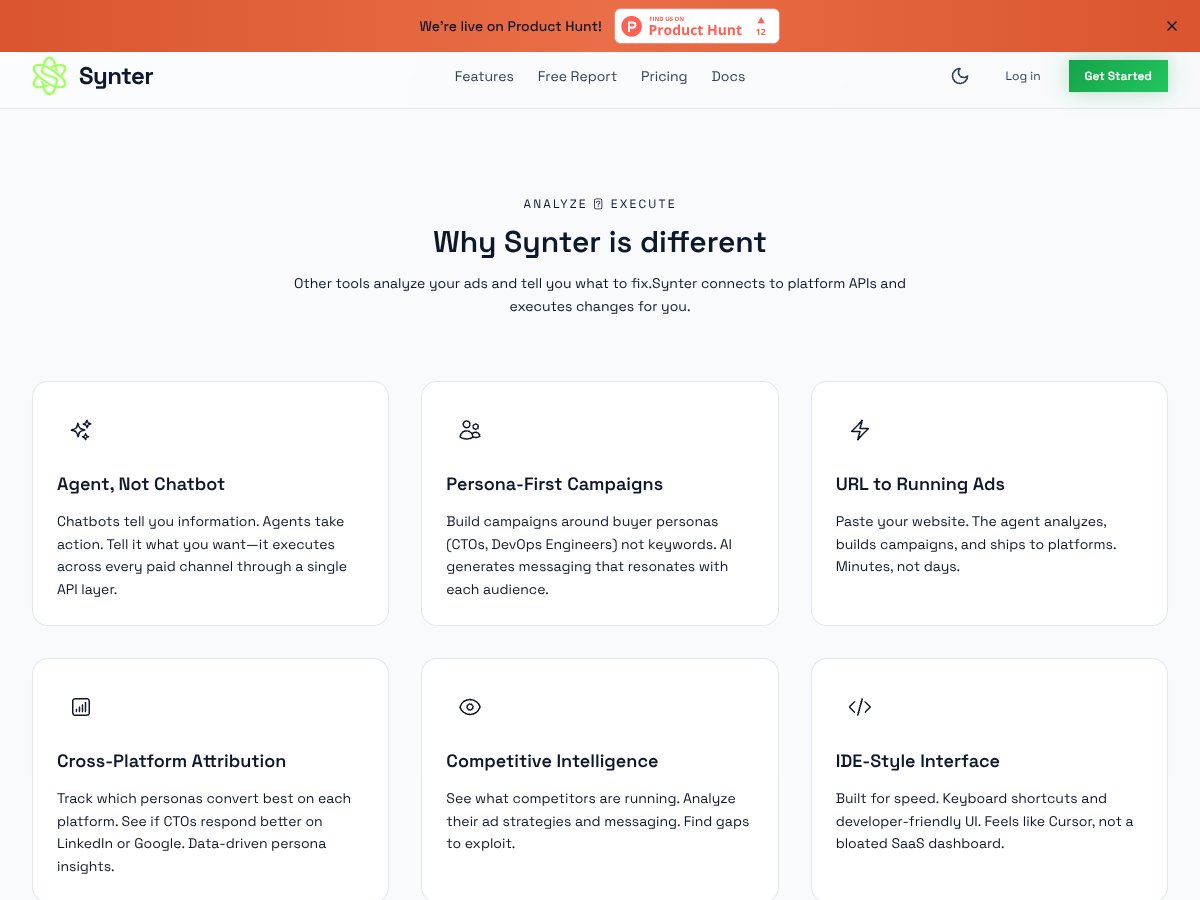
Enter Synter Media AI, an emerging AI-powered platform designed to centralize and automate cross-channel ad management. What caught our attention is its bold claim: instead of just providing insights or reports, Synter actively launches, optimizes, and adjusts campaigns directly through platform APIs, giving users a command-and-control experience that aims to save time and improve performance.
In this review, we’ll explore what makes Synter Media AI stand out—its core features, underlying technology, and practical usability—while offering honest insights into who it is best suited for. We’ll also discuss its limitations, including the lack of publicly available pricing and third-party reviews, helping you determine whether this tool is worth considering for your advertising workflow. Whether you're a performance marketer, a growth team, or an agency looking to streamline your operations, this comprehensive overview will help you understand if Synter Media AI can truly deliver on its promises.
What is Synter Media AI?

Synter Media AI is an AI-driven advertising platform that aims to revolutionize how businesses manage their paid media campaigns across multiple channels. Unlike traditional tools that merely analyze or report on ad performance, Synter actively launches new campaigns, adjusts budgets, and optimizes bids—all through direct integration with platform APIs such as Google Ads, Microsoft, LinkedIn, Reddit, and Twitter/X. This automation reduces the reliance on manual interventions, external agencies, and slow workflows, allowing teams to act swiftly on real-time insights.
The core approach of Synter Media AI is rooted in autonomous agents empowered by artificial intelligence. These agents can reason, plan, and execute actions across various ad platforms, effectively acting as a virtual team member that handles routine optimization tasks. This technology is designed to not only improve efficiency but also to enhance performance by continuously adjusting campaigns based on data-driven insights, thus aiming to maximize ROAS and minimize wasted spend.
Founded by experts in digital advertising and AI technology, Synter Media AI positions itself as a tool tailored for performance and growth teams managing significant ad budgets. Its development reflects a deep understanding of the pain points faced by in-house teams and agencies: fragmented workflows, slow manual adjustments, and difficulty scaling campaigns rapidly. When compared to manual management—logging into each platform, setting bids, or creating new campaigns—Synter’s automation promises to accelerate campaign launches, optimize spend allocation dynamically, and provide consolidated reporting, all from a unified interface.
Key Features (In-Depth Analysis)
Cross-Channel Campaign Management
This feature provides a unified dashboard where users can oversee campaigns across multiple platforms such as Google, Microsoft, LinkedIn, Reddit, and X. It simplifies the process of managing diverse ad accounts by consolidating performance data and campaign controls in one place, reducing the need to switch between native interfaces. In practice, it allows performance teams to view all campaigns holistically and make bulk adjustments, saving hours of manual work.
AI-Assisted Campaign Creation & Copy
Synter leverages AI to help users quickly build new campaigns or replicate successful setups across platforms. This reduces setup time and ensures consistency in messaging and targeting. According to available data, users can launch campaigns within minutes, using templates that the AI helps customize based on audience personas, such as CTOs or DevOps engineers, making the messaging more targeted and effective.
Unified Budget Control & Automated Reallocation
This feature enables automatic distribution of ad spend based on real-time performance metrics. The platform’s AI analyzes ongoing campaigns and recommends budget reallocations to optimize ROAS, preventing over-investment in underperformers. Research indicates over 3,100 budget reallocation recommendations have been generated, demonstrating its active engagement in optimizing campaigns dynamically.
Bulk Operations & Templates
Managing large-scale campaigns often involves repetitive tasks like bid adjustments, targeting tweaks, or pausing multiple ads. Synter simplifies this through bulk operations, enabling rapid changes across many campaigns simultaneously. Additionally, campaign templates allow teams to save successful structures for quick deployment, speeding up the rollout process and maintaining consistency in strategy.
Real-Time Monitoring & Alerts
The platform offers live status updates, health checks, and performance alerts. This visibility helps teams identify issues early—like budget overspend or declining performance—so they can act promptly. Such proactive monitoring is crucial for maintaining campaign health in fast-paced advertising environments.
Autonomous Optimization Agents
Synter’s autonomous agents are AI-powered entities that reason, plan, and execute campaign adjustments without user intervention. They operate across all integrated platforms and can be instructed to optimize for specific goals, such as maximizing conversions or reducing cost per acquisition. This level of automation is designed to continuously improve campaign results while reducing manual oversight.
Cross-Channel Attribution & Reporting
The platform consolidates performance data into a single dashboard, offering insights into how campaigns across different platforms contribute to overall goals. It supports multi-touch attribution, helping users understand the full customer journey and optimize accordingly. Automated weekly reports summarize key trends, enabling data-driven decision-making without extensive manual analysis.
Audit Trails & Role-Based Collaboration
All campaign changes are tracked with timestamps, user identifiers, and reasons, supporting transparency and compliance. Role-based access controls ensure that team members have appropriate permissions, facilitating collaboration between managers, operators, and analysts. This structure enhances operational clarity and accountability in team environments.
How Synter Media AI Works
Getting started with Synter Media AI involves a straightforward onboarding process designed for efficiency. First, users connect their ad accounts by granting API access—this can be done via the web interface, where they authenticate with each platform. Once connected, the platform’s AI scans existing campaigns or templates to recommend initial setups, or users can manually provide campaign parameters.
After setup, the main goal is to leverage the platform’s command-based interface—either through a web UI or command line—to launch new campaigns, adjust budgets, or request optimizations. The AI agents then operate in the background, continuously monitoring performance and executing adjustments based on pre-defined objectives. Users can specify targets like maximizing conversions or controlling CPA, and the system will work autonomously to meet those goals.
While initial setup may require some configuration—such as defining campaign templates or setting performance targets—most users report that the process is intuitive, especially if familiar with native ad platforms. The platform’s dashboard provides real-time status updates, health metrics, and alerts, making it easy to track campaign progress. Over time, users can refine their strategies and leverage the automation to focus more on strategic decisions rather than routine management tasks.
Overall, Synter Media AI offers a practical, relatively seamless experience for teams ready to adopt AI-driven automation, provided they are comfortable with API integrations and cross-platform campaign management. Its design aims to reduce the operational burden and accelerate campaign execution—key factors for performance marketers seeking agility in digital advertising.
SECTION 5: PRICING ANALYSIS
| Plan Name | Price | Key Features | Best For |
|---|---|---|---|
| Free Tier | Not publicly disclosed |
|
Small teams or individual marketers exploring automation |
| Standard/Pro Plans | Quote-based; contact sales |
|
Mid-sized to large performance teams managing multi-platform campaigns |
| Enterprise Custom | Custom pricing |
|
Large organizations with complex needs and high spend |
Since Synter Media AI does not publish explicit pricing details publicly, prospective users must contact their sales team to receive tailored quotes based on their campaign scale and feature needs. This approach is common among enterprise-oriented marketing platforms, which often customize plans for large clients.
Compared to alternatives like Skai or Marin Software, which often provide tiered subscriptions or quoted enterprise pricing, Synter's model suggests a focus on high-volume, multi-platform advertisers willing to invest in autonomous, AI-driven campaign management. For small businesses or single-platform advertisers, the lack of transparent pricing and potentially higher costs may be a barrier, making simpler or more affordable tools more appropriate.
In terms of value, the platform offers significant automation and operational savings, especially for teams managing hundreds of campaigns across multiple channels. However, without clear public pricing, smaller teams should carefully evaluate whether the benefits justify the potential costs, and consider requesting a demo or trial to assess fit.
Pros
- Unified Cross-Channel Dashboard: Synter consolidates campaign management across multiple platforms such as Google, LinkedIn, Meta, Reddit, and X, reducing the time spent logging into different native interfaces. This streamlining is especially beneficial for agencies or in-house teams handling large, multi-platform ad portfolios.
- AI-Driven Campaign Launch and Optimization: The platform's autonomous agents can create, launch, and continuously optimize campaigns based on real-time data. This can significantly accelerate campaign deployment and improve ROAS, as evidenced by the company's emphasis on quick execution and performance gains.
- Automated Budget Allocation: Synter intelligently reallocates budgets across campaigns and channels, helping prevent over-spending on underperformers and maximizing overall efficiency. This addresses a common pain point for performance marketers aiming to optimize spend without manual micromanagement.
- Bulk Operations and Templates: The ability to perform bulk edits and reuse campaign templates can save hours of repetitive work, facilitating faster scaling and deployment of new campaigns, which is critical for teams with high-volume needs.
- Detailed Audit Trail and Role-Based Access: Transparency and collaboration are enhanced through comprehensive change logs and permission controls, supporting compliance and team workflows.
- Cross-Channel Attribution and Performance Insights: Consolidated dashboards and attribution models provide a holistic view of campaign success across platforms, aiding in more accurate measurement and strategic decision-making.
Cons
- Opaque Pricing Structure: The lack of publicly disclosed pricing means users must contact sales to understand the costs involved, which can be a barrier for smaller businesses or those with tight budgets.
- Targeted at Large-Scale Advertisers: The platform’s advanced features and scale-oriented design suggest it may be overkill for small advertisers or those managing only one or two platforms, limiting its accessibility for such users.
- Learning Curve: Transitioning from native ad platforms to Synter’s centralized, AI-driven workflow could require substantial training, especially for teams unfamiliar with automation and API integrations.
- Dependence on API Stability: Reliance on stable APIs from platforms like Google and Facebook introduces operational risks; outages or API policy changes could temporarily impair functionality.
- Limited Public User Feedback: The absence of independent reviews or case studies makes it difficult to quantify real-world ROI or user satisfaction, which can be a concern for cautious buyers.
BEST USE CASES
- Performance Marketing Agencies: Agencies managing large, multi-platform campaigns can leverage Synter to automate routine optimizations, freeing up resources for strategic work.
- In-House Growth Teams: Teams aiming to accelerate campaign deployment and improve ROAS across channels like Google, LinkedIn, and Reddit will benefit from Synter’s autonomous agents and unified dashboard.
- Large E-Commerce Brands: Brands with significant ad spend across multiple platforms can use Synter to optimize budgets dynamically and gain comprehensive performance insights.
- Enterprise SaaS Companies: Campaigns targeting specific personas such as CTOs or developers can be built around personas rather than keywords, streamlining creative and targeting processes.
- Organizations Seeking Compliance and Transparency: Teams that require detailed audit trails and role-based permissions will find Synter’s features valuable for maintaining accountability and collaboration.
- Rapid Campaign Launch Scenarios: When time-to-market is critical, Synter’s template reuse and AI-assisted setup can reduce campaign launch time from days to minutes.
WHO SHOULD NOT USE Synter Media AI
Small businesses or individual advertisers managing only a single platform, such as Facebook Ads or Google Ads, may find Synter's advanced features unnecessary and cost-prohibitive. For such users, simpler, more affordable tools that provide basic automation might be more appropriate, as the platform’s complexity and pricing structure could be overwhelming.
Additionally, organizations with limited technical resources or those hesitant to rely heavily on API integrations may experience difficulties. Since Synter depends on stable API connections and requires some level of technical knowledge to set up and operate effectively, teams lacking technical support may be disappointed with the platform’s usability or encounter operational downtime during API outages.
Synter Media AI vs Alternatives
Choosing the right advertising management platform depends heavily on your specific needs, budget, and scale. Here, we compare Synter Media AI with several notable alternatives to help you make an informed decision.
Skai (formerly Kenshoo)
- What it does differently: Skai offers a comprehensive enterprise solution for cross-channel marketing, including search, social, and retail media, with a strong emphasis on automation and AI-driven insights. It is tailored for large-scale, multi-channel campaigns and integrates advanced attribution models.
- Price comparison: Skai's pricing is custom and geared toward enterprise clients, generally costing significantly more than smaller tools. Exact costs are available upon request.
- When to choose it over Synter Media AI: Opt for Skai if your organization requires deep attribution analysis, extensive integration capabilities, and operates at a very large scale, especially when multiple channels and retail media are involved.
- When Synter Media AI is better: If you prefer a platform focused on unified cross-channel management with autonomous optimization at a slightly lower price point, Synter is more streamlined for performance teams looking for automation without the complexity of enterprise features.
Marin Software
- What it does differently: Marin provides a robust platform for search, social, and e-commerce advertising with strong bid automation and budget management features, tailored for performance marketers at mid-to-large companies.
- Price comparison: Similar to Skai, Marin's pricing is custom and typically targets larger advertisers, with costs based on ad spend and feature set.
- When to choose it over Synter Media AI: Choose Marin if your focus is heavily on search and social advertising with advanced bid management and detailed reporting, especially if you already use Marin’s other tools.
- When Synter Media AI is better: If you need a more centralized, cross-platform dashboard with autonomous optimization and unified budget control across multiple channels, Synter offers a more integrated experience.
Google Search Ads 360 (SA360)
- What it does differently: As part of Google Marketing Platform, SA360 specializes in search campaigns with advanced automation and seamless integration with Google Ads and other Google services. It offers sophisticated bidding and attribution models.
- Price comparison: SA360 is a premium product with custom pricing, often suited for large enterprises with substantial ad budgets, and typically involves licensing fees plus media spend.
- When to choose it over Synter Media AI: If your primary focus is Google search campaigns and you need tight Google ecosystem integration, SA360 is ideal.
- When Synter Media AI is better: For multi-channel, cross-platform management, or if you want autonomous optimization beyond Google’s ecosystem, Synter provides a broader scope.
Madgicx
- What it does differently: Madgicx emphasizes AI-driven ad automation primarily for Facebook and Google, with a focus on autonomous budget and bid management, suitable for advertisers seeking quick results with minimal manual oversight.
- Price comparison: Madgicx offers tiered plans starting at accessible prices, with transparent subscription tiers, making it more affordable for smaller teams.
- When to choose it over Synter Media AI: If your main advertising channels are Meta and Google, and you're looking for straightforward AI automation with an easier learning curve, Madgicx is a solid choice.
- When Synter Media AI is better: For managing multiple platforms beyond Meta and Google, or for organizations needing cross-channel unified dashboards and detailed attribution, Synter excels.
Optmyzr
- What it does differently: Optmyzr offers rule-based and AI suggestions for PPC campaigns, focusing on bid management, optimization workflows, and reporting, mainly for Google Ads and Bing.
- Price comparison: Optmyzr provides predictable monthly plans starting at lower price points, appealing to small and mid-sized advertisers.
- When to choose it over Synter Media AI: If your needs are centered on Google PPC campaigns with a preference for rule-based automation and detailed optimization suggestions, Optmyzr is suitable.
- When Synter Media AI is better: For broader cross-channel management and real-time autonomous campaign adjustments, Synter offers a more comprehensive platform.
In summary, while Synter Media AI stands out with its unified, cross-platform automation and real-time optimization features suitable for large-scale advertisers, alternatives like Madgicx and Optmyzr are better for smaller teams or those focused on specific channels. Enterprise solutions like Skai and Marin provide more extensive customization and attribution capabilities, often at a higher cost. Your choice should depend on your campaign complexity, scale, and desired level of automation.
Our Verdict
Overall, Synter Media AI earns a strong recommendation for performance marketing teams managing multiple ad channels who seek to streamline operations and leverage AI-driven automation. Its unified dashboard, autonomous optimization agents, and automated budget controls make it a powerful tool for advertisers aiming to improve ROAS while reducing manual workload. We rate it 8.5 out of 10, noting that its effectiveness depends on the user’s ability to integrate and utilize its comprehensive features.
Primarily suited for medium to large teams running multi-platform campaigns, Synter is ideal for those frustrated with fragmented workflows and slow agency turnarounds. New users should be prepared for a learning curve due to the platform’s extensive functionalities but will benefit from its real-time insights and automation capabilities.
Pricing remains opaque, with custom quotes likely reflecting enterprise-level services. For organizations with significant ad spend and complex needs, the platform’s potential ROI justifies the investment. Smaller advertisers or those with a single-channel focus might find more cost-effective or simpler solutions better suited to their scale.
Overall, I would recommend Synter Media AI to marketing professionals looking for a robust, automated cross-channel ad management platform. For those seeking a comprehensive, AI-powered solution that consolidates multiple platforms into one interface, Synter is a compelling choice worth exploring.
Frequently Asked Questions
- Is Synter Media AI worth it?
- For large-scale advertisers managing multiple platforms, Synter offers significant time savings and performance improvements through automation. However, its value depends on your specific needs and budget, as pricing is custom.
- Is there a free version of Synter Media AI?
- No, Synter Media AI does not offer a free plan. Pricing is quote-based and tailored to enterprise clients, so interested users should contact sales for details.
- How does Synter Media AI compare to Skai?
- Synter provides a more unified, cross-channel dashboard with autonomous optimization, whereas Skai offers extensive attribution and enterprise features. Skai is better for very large-scale, complex campaigns, while Synter suits performance teams seeking automation across multiple platforms.
- Can Synter Media AI integrate with existing ad platforms?
- Yes, Synter supports integration with major ad platforms like Google, Microsoft, LinkedIn, Reddit, and X/Twitter, via APIs. However, its performance depends on stable API connections.
- What is the typical cost of Synter Media AI?
- Pricing is custom and varies based on your ad spend and needs. You need to contact Synter directly for a quote, making it more suitable for larger, multi-channel advertisers.
- Does Synter Media AI support automation and AI optimization?
- Yes, it offers autonomous agents that continuously optimize campaigns toward specified goals, such as efficiency or growth, based on real-time data.
- Is Synter Media AI suitable for small businesses?
- Probably not. Its features are tailored for larger advertisers with significant budgets and multi-platform campaigns. Small businesses may find simpler, more affordable tools sufficient.
Ready to try Synter Media AI? Visit Synter Media AI to get started.