Table of Contents
Quick heads-up: I’m keeping this week’s roundup focused on what’s actually happening right now—plus a couple AI tools I’d personally spend time with. If you’re into military tech or you just like seeing how fast AI is moving, you’re in the right place.
Here are the latest breaking news updates:
- U.S. Army
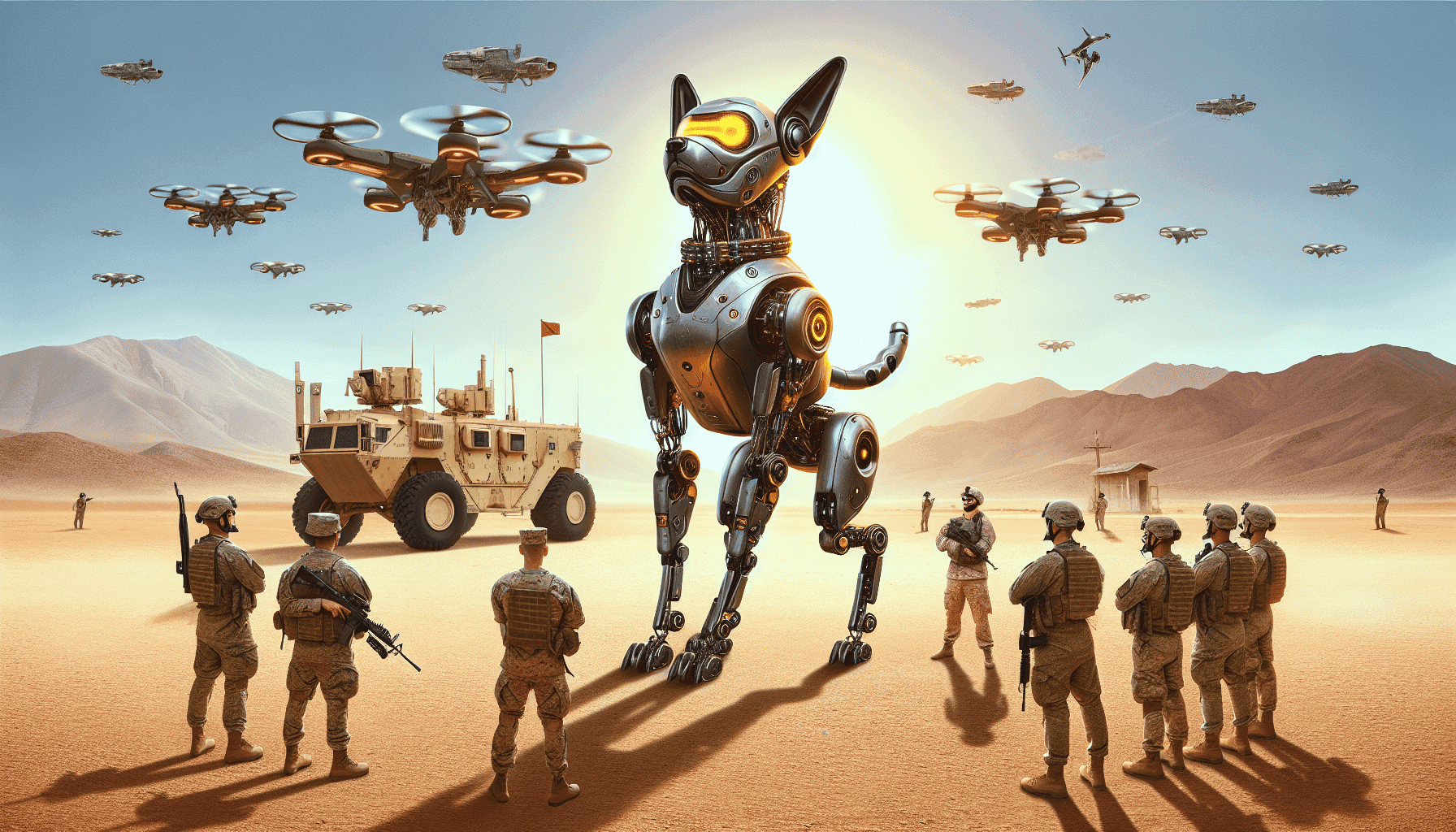
- I read this one twice, because “armed robot dog” is not exactly a phrase you see every day. According to the report, the U.S. Army has been testing a robot dog equipped with a weapon and smart tech as part of operations in the Middle East.
- What stood out to me wasn’t just the headline—it was the idea that these systems are being evaluated in real environments where terrain, dust, heat, and unpredictable movement matter. Robot platforms only look impressive in controlled demos. Put them into messy, real-world conditions and suddenly you find out what’s actually solid and what still needs work.
- If you’re wondering what the big implications are, here are a few practical ones people usually focus on:
- Mobility and reach: A legged platform can potentially get closer to areas that are hard for wheeled robots or vehicles.
- Decision support: “Smart technology” usually means sensing + navigation + some level of autonomy, which can reduce the burden on human operators.
- Operational testing: This kind of trial suggests the military isn’t treating robotics as a science project anymore—they’re evaluating performance under mission constraints.
- Now, to be fair, testing doesn’t automatically mean full deployment. Still, the direction is clear: robotic systems are moving from “interesting” to “serious.”
- Microsoft
- Microsoft is updating Copilot, and the changes sound like the kind you’ll actually feel day to day—especially if you use voice and vision features. The report highlights improvements in voice and vision capabilities plus a refreshed interface.
- In my experience, the “voice” part is where assistants either become genuinely useful or just annoy you. If the redesign improves accuracy and responsiveness, that’s a big deal. The “vision” piece matters too—being able to interpret what’s in front of you (screens, screenshots, documents) can cut down how often you have to explain everything from scratch.
- One question I keep asking with tools like this: will the interface make it easier to get the right result quickly, or will it add steps? A clean UI can save time. A cluttered one can do the opposite.
- Anthropic
- Durk Kingma (co-founder of OpenAI) joining Anthropic is one of those moves that signals where the talent and research focus may be heading next. If you follow AI closely, you know hiring can be as telling as product announcements.
- I’m not going to pretend this automatically changes what you can use tomorrow, but it usually correlates with deeper work behind the scenes—model research, alignment, and the engineering details that end up improving performance over time.
Check out these awesome new AI tools:
- SoBrief– You can understand 73,530 books in just 10 minutes by reading or hearing short summaries made by AI
- If you don’t have time to read full books (same), a summary tool like this can be a fast way to build context. Just don’t treat it like the real thing—use it to decide what’s worth your time.
- Nexus AI– A complete AI platform for creating content and designs offering tools for writing, programming, voice work, and additional features
- I like platforms that don’t force you to jump between five tabs. If Nexus AI really covers writing + programming + voice in one place, that’s the kind of “less friction” setup I look for.
- Pulse Hero– Collect reviews to lower customer loss for your SaaS, boosting happiness among all users
- For SaaS teams, customer feedback can be the difference between “churn” and “fixing the right thing.” Tools like this are most useful when they help you act on feedback quickly—not just collect it.
- Molmo AI– Discover advanced open-source AI that works with different types of data to help everyone be more productive
- Open-source can be a win if you care about flexibility. I always check whether the setup is painful or straightforward, because that’s usually where “cool in theory” dies.
- Ren AI v1.10– Receive AI-based personal help for challenging questions for each team member, accessible at any time
- Team help tools are great when they reduce repeated questions. If it can answer quickly and consistently, it can save real time—especially for onboarding or internal “how do we do X?” issues.
- X-Ray Contact– Keep your email organized by sorting messages wisely and focusing on important tasks first
- Email sorting is one of those things I’m picky about. If it mislabels stuff, you end up doing more work later. But when it gets it right, it’s a huge mental load reducer.
- ZapStart– Check startup ideas using AI to make the most of startup plans effectively
- For founders, idea validation is everything. I’d use something like this to stress-test assumptions early—then pair it with real customer conversations.
- AI Answer Pro– Get answers from AI for your digital marketing queries without needing to sign up or register
- Instant access tools can be surprisingly useful when you just need a quick steer. I’d still verify anything important—especially numbers or claims—but for brainstorming, it can be fast.
- Fable– Capture any web application keeping all the interactive features to make effective product demonstrations
- Demo tools matter more than people think. If Fable preserves interactivity, that’s the difference between a pretty video and something that actually shows the product working.
Today’s prompt to inspire your creativity:
"Act as a marketing expert specializing in [insert niche]. Provide a comprehensive strategy that includes the following elements: 1) Target audience identification and analysis, 2) Key messaging and value proposition, 3) Recommended social media platforms and content types (e.g., Instagram, TikTok, Facebook, YouTube) tailored to [insert niche], 4) SEO techniques relevant to [insert niche], 5) Suggested timelines and tactics for campaign execution, and 6) Metrics for measuring success. Ensure that each element is tailored to the unique characteristics and trends within [insert niche]."