Table of Contents
Start a war novel with a person who has something to lose and a decision they can’t put off. Choose the conflict and setting, work out what that person wants, then let the war make it harder to get. Battles matter when their outcome changes a life the reader already cares about.
You can tell that story through a soldier, a nurse, a family trying to leave home or a clerk deciding whether to change a name on a list. You can also invent the war for a fantasy or science-fiction novel. In either case, you need a believable chain of events and characters whose choices carry into the next chapter.
The examples below follow an invented town facing the loss of its rail connection. We’ll use it to build a plot, develop a civilian viewpoint and revise a short scene. If you adapt the example to a real conflict, replace the fictional procedures with details that fit that place and time.
Choose your conflict, viewpoint and central problem
“Europe during the Second World War” gives you a huge subject to research. “One apartment building during the week its rail connection closes” gives you people, a place and a deadline. Start at a scale you can bring to life. You can reveal the wider conflict through the pressures reaching that small part of it.
Write down who your main character is, what they want before the war intervenes, and what becomes impossible afterward. A caretaker may have promised to stay with a housebound neighbor while also promising to get his child away. Neither promise is trivial. The departure deadline forces him to face the fact that he may not be able to keep both.
Choose a viewpoint that puts the reader close to this problem. Who sees it developing? Who has enough power to act, but not enough to fix everything? A second viewpoint is worth adding when it brings a different choice or consequence. You don’t need a new narrator simply to explain what another army is doing.
Give the story a question, but don’t decide that one character will deliver the correct answer in every scene. What does loyalty mean when helping a relative puts a neighbor at risk? How long can someone claim neutrality while deciding who receives food? Let characters discover the limits of their beliefs through what they do.
If you’re inventing the war
Decide what each side wants, why negotiations have failed and what would count as an acceptable end. Different people on the same side can want different things: a ruler wants territory, a merchant wants a route reopened, and a conscript wants to go home. Those differences give you conflict within the conflict.
Make a simple timeline of the major changes, then place your character’s story alongside it. If magic or technology changes travel, communication or healing, decide what it costs and where it stops working. A powerful invention can solve one problem while leaving another intact. Don’t let a new ability appear only when the plot needs a rescue.
Research real experiences for insight into displacement, institutions and relationships, while keeping your invented history clear. You can learn from several periods without treating their customs as interchangeable. The fictional world should have its own consistent reasons for how people behave.
Research the details your scenes actually need
Start with a reliable history or chronology to get your bearings. Then research the questions raised by your opening chapters. What happened in this town? What were residents told? How could they travel, find food or contact relatives? You’ll write more convincing scenes when you understand these ordinary systems as well as the major battles.
Choose a few different kinds of sources. Five accounts repeating one official announcement won’t tell you how a household reacted to it. Use this table to decide what each source might help you find:
| Source type | Details to investigate | Questions before using it |
|---|---|---|
| Contemporary newspaper | Public announcements, prices, vocabulary, advertisements, and reported events | Who owned it? What audience did it address? What censorship or publication deadline needs investigation? |
| Diary or letter | Household routines, relationships, rumors, and uncertainty | Who was expected to read it? Was this an original entry, a revised text, or a translated edition? |
| Administrative record | Permits, employment, property, relief, detention, and movement | What decision did the form enable? Which people or experiences fall outside its categories? |
| Photograph or object | Clothing, tools, room layouts, signage, damage, and repair | What establishes its date and location? Does the caption belong to the original record? |
| Oral history | Remembered experience, personal interpretation, and leads for further investigation | When was the interview recorded? What did the interviewer ask? What other evidence can illuminate the account? |
The Library of Congress’s Chronicling America collection is a starting point for historic American newspapers. Articles, advertisements and notices can suggest questions about daily life. For events elsewhere, look for local records too; an American report about a foreign city isn’t the same as evidence from someone living there.
For Holocaust-related research, the United States Holocaust Memorial Museum collections include photographs, documents, films and oral histories. Follow the catalog information to the particular item you need. A museum’s name is a useful starting point, but your notes should tell you which record supports which detail.
Keep bringing the research back to a decision. If a nurse needs to move patients, find out who could arrange transport, what was available and where they could go. These answers can create obstacles and possibilities. Collecting the names of every vehicle used in the conflict won’t help much if none changes her choices.

Know what your sources can tell you
A diary, a government notice and a later interview describe events from different positions. Note who created each item, when and for whom. The Library of Congress’s primary-source guidance offers a useful approach to asking about context and comparing accounts.
In your research notes, keep three simple labels:
- Documented: an identified source directly supports this specific statement.
- Inferred: the evidence supports a plausible conclusion without establishing it directly.
- Invented: you created the detail for the story and checked it against the relevant fixed facts.
Add the page, catalog number or interview timestamp so you can return to it. Include the edition and translator when relevant. Keep the event date separate from the date the account was written: someone remembering an incident decades later may know its outcome, while your character living through it would not.
If two accounts disagree, look for a reason before choosing between them. The witnesses may have stood in different places, heard different rumors or described different hours of the same day. Sometimes you won’t resolve the disagreement. You can acknowledge that in your notes without forcing the evidence to support your favorite version.
Imagine researching an evacuation notice. A newspaper gives you its wording; a municipal record identifies affected addresses; a diary says when one family heard about it. Those details can work together, but they don’t establish what every household knew. Your fictional family’s conversation still comes from you.
Check a scanned newspaper page before relying on a crucial name or number. The Library of Congress explains that automated text recognition can misread historic print. An unsuccessful text search doesn’t necessarily mean the name is absent. Likewise, don’t transfer a witness’s distinctive words to an invented character as though you wrote them.
Show how the war changes ordinary life
Civilians don’t experience a conflict only through a sequence of battles. They still need water, food, work, shelter, medicine and news of people they love. Track the changes that affect your cast: a school closes, a route becomes unavailable, a landlord disappears, or a document suddenly becomes necessary.
Put these changes on a calendar beside the public events. Record when a rule is announced, when it takes effect and when each character hears about it. Then ask who can comply easily and who can’t. A family with money, transport and relatives elsewhere may have options their neighbor does not.
If legal rules matter to a historical scene, use sources appropriate to its date. The ICRC’s overview of civilian protection explains that the Fourth Geneva Convention was adopted in 1949 and the Additional Protocols in 1977. Don’t put later legal language into an earlier character’s mouth without a reason.
Keep the law, official orders and people’s actual experiences distinct in your research. A protection existing on paper doesn’t tell you what happened at one checkpoint. Find out what applied in the conflict you’re writing about, and what your particular character would know about it.
In our invented building, everyone hears that rail service ends on Friday. The teacher tries to contact parents, the shopkeeper worries about unsold stock, and the caretaker needs help moving a neighbor. Bring them together at a locked storage room: one wants packing materials, another claims the crates, and the third needs the room cleared for someone staying behind. Their argument gives the wider emergency a human shape.
Fit your characters into the history
For historical fiction, make two lists: what the record establishes and what you plan to invent. The first might contain a route closure, a public date or a known outcome. The second might contain your residents, their private conversations and their attempts to get somewhere before that closure.
Your protagonist doesn’t have to be secretly responsible for a famous event. A clerk can change whether one family reaches the station without masterminding an entire evacuation. Keep their influence believable for the position they hold. Small acts can matter enormously to the people affected.
Be careful when assigning unsupported actions to real people. A gap in a biography isn’t evidence of a hidden crime, romance or belief. If the plot needs a major invented action, consider giving it to a fictional character or explaining the deliberate departure from history.
The same care helps with composite characters. Note which experiences you combined and what you changed. Give the resulting person their own work, preferences, relationships and blind spots. One character shouldn’t have to represent every experience within a community, especially when those experiences differ sharply.
Build scenes around difficult choices
A theme such as “duty versus compassion” becomes interesting when someone must act on it. A nurse can keep a vehicle for tomorrow’s patients or use it now for her brother. Now you have a limited resource, competing needs and people who will live with her decision.
Before drafting a major scene, answer these six questions:
- Ordinary duty: What was the character supposed to accomplish?
- Historical pressure: What condition makes that duty difficult or dangerous?
- Competing claims: Who needs something incompatible from the character?
- Available knowledge: What can the character verify, and what remains uncertain?
- Choice and cost: What do they do, and who bears the loss or risk?
- Continuing consequence: What relationship, resource, or belief changes afterward?
Try to make more than one option understandable, without pretending every action is equally defensible. People can face real pressure and still be responsible for the harm they cause. Your scene becomes stronger when readers understand both the choice and who pays for it.
Carry the cost forward. A forged paper may help one person leave while putting its maker at risk. Giving away a room removes somewhere another family might have sheltered. An omitted name may matter years later. Add those consequences to the outline so the next chapter doesn’t reset everyone’s resources and relationships.
Write battle scenes from inside the moment
Before describing the action, decide what the viewpoint character is trying to do and what they can actually perceive. They may be carrying a message, searching for someone or trying to understand an order. A limited, immediate task is easier to follow than a paragraph explaining every movement across a battlefield.
Give readers enough geography to understand the choice, then keep returning to the character’s experience. If they can’t see around a building, don’t casually tell us what is happening there unless the narrative viewpoint allows it. Confusion can be part of the scene; unclear writing doesn’t have to be.
Vary the pace. A brief action can be followed by a pause in which the character realizes what has changed. Exhaustion, relief, shame, affection and unfinished practical tasks can all matter afterward. Research equipment and movement for the setting, but keep the scene’s attention on the people using them.
Example: a permit, a deadline and a favor
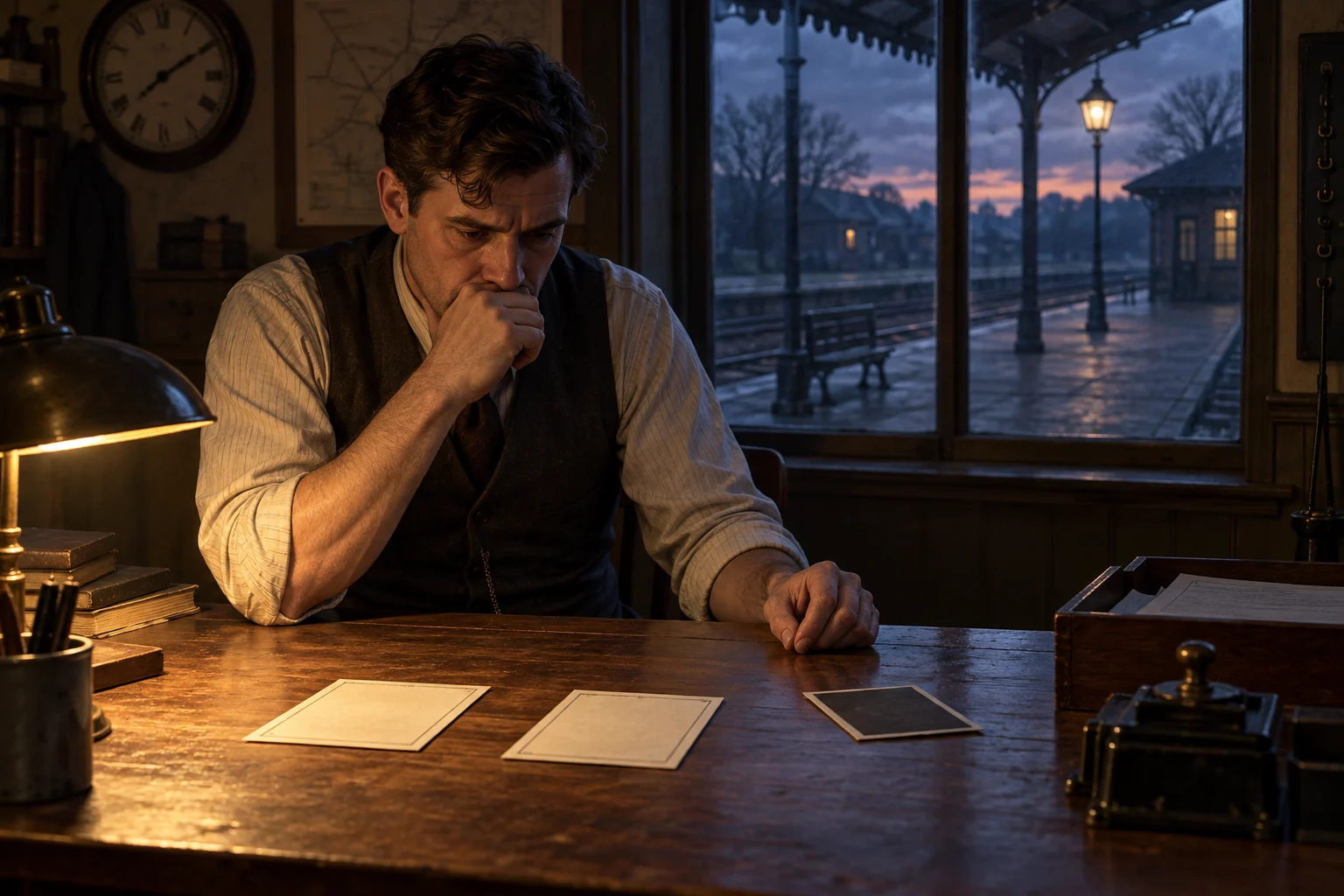
Tomas is closing a station desk when his former teacher asks him to correct a misspelled name on a travel permit. Usually he would check the register and amend the paper. Tonight, the final departure is approaching, his supervisor has taken the correction stamp, and the child with the teacher has a permit containing the same mistake.
This is an invented setting, so we can define the procedure for the exercise. Tomas can inspect the register and ask questions. He can’t guarantee the train will leave or promise that officials at the destination will accept a correction. His teacher’s trust makes him feel responsible without giving him more power.
“It is one letter,” she said.
Tomas looked at the child’s permit. The same letter. The same careful mistake.
“The stamp is upstairs.”
“Then go upstairs.”
He could still hear the supervisor’s shoes in the corridor, although the man had left an hour ago. Tomas folded his own coat over the register. “Tell me which name he answers to.”
The scene changes when Tomas asks which name the child answers to. He’s no longer treating the problem as an ordinary spelling error. The coat over the register gives him something to do while he hesitates. We can see an attempt at privacy or delay without being told exactly which emotion to assign to it.
Let the teacher respond as a person with choices of her own. She could answer, refuse, or decide that Tomas is asking something she can’t safely explain. The child might need the toilet, misunderstand the question or unexpectedly answer it. An ordinary response can complicate the moment without turning the child into a prop.
Choose an outcome that gives you somewhere to go next. Tomas might obtain a legitimate correction through a colleague and owe that person a favor. Or the teacher might abandon the journey because changing the name would reveal a different problem. A narrow success or an unresolved choice can carry more story than a guaranteed escape.
For a real historical setting, check the permit, the issuing office, the correction process and the travel rules. Keep the emotional problem if it works, but replace the stamp arrangement with a mechanism your research supports.
Write about suffering without reducing people to it
Read testimony as the account of a particular life. Look at its provenance, translation, catalog description and any conditions on reuse. Ask why you want a detail in your novel: does it help readers understand that person or situation, or are you collecting it mainly for shock?
The USHMM’s collection scope includes prewar communal life as well as persecution and murder. That wider attention matters in fiction too. Research people’s work, friendships, tastes and plans, including the parts of life that don’t lead neatly toward a scene of harm.
Give a victim or survivor relationships and unfinished intentions. If you write an atrocity scene, decide what the viewpoint character can see and what the detail tells us. The person should remain more than an image of injury after the scene ends.
Sometimes a missing place at a table or an unanswered search for a name carries the loss your scene needs. Sometimes explicit description is necessary. Choose the detail for the story and the person, rather than escalating it because the previous paragraph no longer feels shocking. Be clear about responsibility for what happened.
Keep separate testimonies separate in your notes. If you combine experiences or invent an encounter, explain major composites in an author’s note. Historical and cultural readers can help with questions outside your experience; ask them about specific passages and decisions rather than seeking a blanket endorsement.
Revise for accuracy, clarity and story
A scene can be historically possible and still feel lifeless. It can also be exciting only because someone knows something they couldn’t have known. Separate these problems when you revise:
- Historical pass: Verify dates, routes, institutions, notices, objects, legal terminology, real people, and quotations against specific records. Flag unresolved claims instead of allowing repeated drafts to make them seem established.
- Knowledge and causality pass: Trace how information reaches each character. Check travel time, access, authority, resources, and the sequence connecting one action to the next.
- Story pass: Ask what every research detail changes. Keep details that affect a decision, reveal a relationship, or clarify a cost. Shorten explanations that merely repeat context the reader already understands.
Read the dialogue on its own. Would these people really explain the permit system to each other, or would they argue over the missing signature in front of them? Let a refusal, correction or unanswered question reveal the rule when possible. Keep enough explanation for the reader to follow the stakes.
Use an author’s note for important departures from history, composite people or places, and compressed dates. Name a consequential change instead of saying vaguely that you took liberties. The note can explain your choices, but the novel should still make sense without the reader stopping to consult it.
Make the ending grow out of earlier choices
After the permit scene, Tomas might owe his colleague, hold a secret or discover that his teacher no longer trusts him completely. Pick a consequence and give it a concrete demand. It should change what someone asks for or what Tomas is willing to promise.
Perhaps the colleague requests a shift exchange on the day Tomas promised to accompany a relative. The request doesn’t have to be blackmail. A reasonable favor can expose the fact that Tomas keeps offering help he cannot always deliver. That makes the next problem part of the same story.
Apply this thinking after battles too. Who is missing? What equipment or transport is unavailable? Which relationship has changed? A civilian narrator may experience the fighting mainly through these consequences. For a story centered on service life, our military fiction guide goes further into roles, orders and logistics.
Plan the aftermath as carefully as the emergency. A war ending doesn’t automatically reunite a family, restore a home or settle an unpaid promise. Your final chapters can follow those unfinished problems without needing another spectacular event.
Return to the question that made you choose this character. If Tomas’s story asks what happens when helpfulness creates obligations he can’t honor, give him a final action that confronts that limit. You can resolve his central struggle even when the wider conflict remains complicated.