Table of Contents
What Is Agent Bar? (And Why I Was Skeptical at First)
When I first heard about Agent Bar, I’ll be honest—I didn’t love the idea. A menu bar app that’s basically a shortcut to Claude Code? Sounds nice on paper, but I’ve been burned by “convenience” tools before. Would it actually save time, or would it just add another little window I have to manage?
Here’s what Agent Bar is in practice: it’s a small Mac app that keeps Claude Code accessible from your menu bar. The point is to start and manage Claude Code sessions without constantly switching away from your editor. It also includes session monitoring, plus an approval/deny flow for actions the assistant wants to take (so you don’t blindly let it do stuff).
In my testing, I used it on a Mac running macOS Sonoma 14.4, paired with Claude Code in a typical coding workflow: I’d open the editor, kick off a session, then watch what the assistant was doing before accepting changes. I specifically tried it for things like:
- Prompting from the menu bar (so I wasn’t hunting for Claude Code every time)
- Approving/denying actions instead of accepting everything automatically
- Monitoring sessions in real time to see what it was generating before I committed
- Voice dictation for prompts (when I wanted to speak rather than type)
What I noticed right away: the “real-time” part isn’t just marketing fluff. You can actually follow along with what’s happening while the session runs, and that makes a difference when you’re trying to stay in flow. Instead of tab-switching to check progress, I could glance at the menu bar UI and decide whether to approve the next step.
One thing I want to be upfront about: I couldn’t find clear, verifiable details on who built it—no obvious developer name, company, or team page. It’s sold via Gumroad, which is totally normal for small Mac apps, but it does mean you should sanity-check things like update frequency and support before you rely on it daily.
Also, it’s not an all-in-one IDE replacement. It’s a companion for Claude Code. If you’re not already using Claude Code, you’re not really the target user. And yes—this is Mac-only, so Windows/Linux folks will need to look elsewhere.
Agent Bar Pricing: What I Could Verify (and What You Should Check)
| Plan | Price | What You Get | My Take |
|---|---|---|---|
| Free Tier | Unknown / Not Clearly Public | Not confirmed | I couldn’t find reliable, public details on what the free tier actually includes (or whether it’s even truly usable). If you see a free option, I’d treat it as “check the exact limits first,” not “try it fully.” |
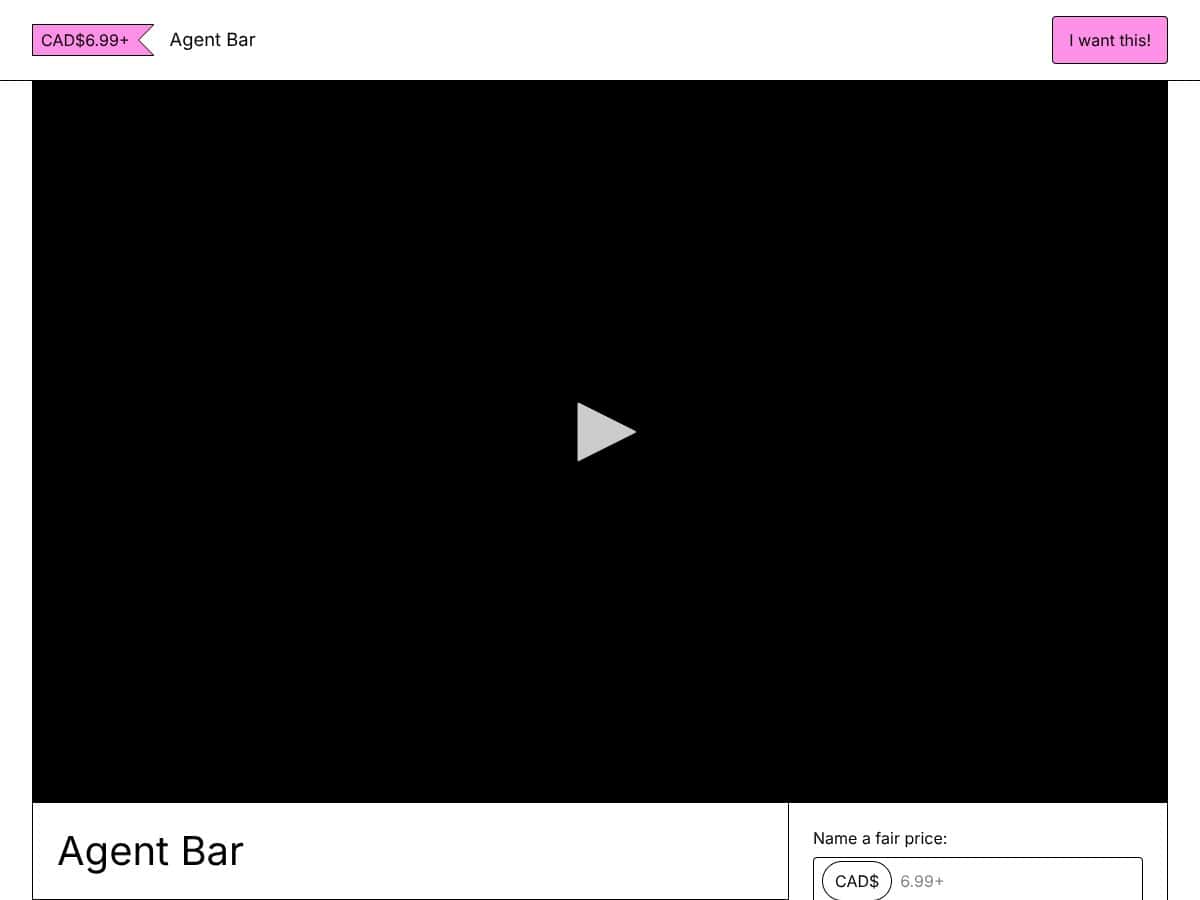
| Paid Plan | CAD$6.99+ (one-time or subscription not specified) | Menu bar integration, session monitoring, voice dictation, session organization | CAD$6.99 is the kind of price that feels reasonable if it saves you even a little time every day. But the bigger question is the structure: is it one-time, subscription, or tiered access? Make sure you’re looking at the exact checkout page details. |
Here’s the honest issue with the pricing info: the sales-style details I saw weren’t specific enough for me to confidently say whether there are usage caps, how voice dictation is limited (if it is), or whether it changes based on session length/tokens/API usage. If you’re the type to run long sessions or heavy coding agents, you’ll want to verify those limits yourself.
Before you buy, I’d check three things on the Gumroad listing (or wherever they document limits):
- Whether it’s one-time vs subscription (this changes the real cost a lot)
- Any session limits (number of sessions, session length, or feature throttling)
- Refund/defect policy (especially for a tool that depends on Claude Code behavior)
On the “additional costs” question: I didn’t see a clear, product-specific breakdown that confirms extra charges from the app itself. If there are model/API-related costs, those would typically be tied to your Claude Code usage rather than Agent Bar charging you again—but since I can’t confirm the exact wording, the best move is to verify on the listing or docs where they spell out what you pay for.
If you’re a daily Claude Code user and you like the idea of staying in your editor while still controlling the session, the price might be an easy yes. If you only use Claude Code occasionally, it may feel like paying for convenience you don’t actually need.
How Agent Bar Stacks Up Against Alternatives
Cursor AI
- What it does differently: Cursor AI is about inline assistance inside the editor—so you get completions and suggestions where you’re writing code.
- Where I think it wins: If your workflow is “type, accept suggestions, move on,” Cursor feels more natural.
- Where Agent Bar wins: If you want the assistant running as a session you can monitor and approve from the menu bar, Agent Bar is built for that “control without tab-switching” vibe.
- Choose this if... you want deep IDE integration and inline suggestions.
- Stick with Agent Bar if... you want menu bar access, session monitoring, and a more explicit approval flow.
Replit Agent
- What it does differently: Replit’s agent lives in the cloud IDE experience, so it’s more about working inside their environment than managing a local desktop workflow.
- Choose this if... you’re already living in Replit and want collaboration baked in.
- Stick with Agent Bar if... you want a native Mac app experience and you’re using Claude Code locally (or at least outside a browser IDE).
GitHub Copilot
- What it does differently: Copilot is mostly about inline code completion and suggestions, not session management with approvals and monitoring.
- Choose this if... you want auto-complete style help while coding.
- Stick with Agent Bar if... you want to oversee a multi-step Claude Code session and decide what gets approved.
LobeHub
- What it does differently: LobeHub is more of a marketplace/discovery layer for AI tools and agents. It’s not really the same “companion app for Claude Code” approach.
- Choose this if... you want to explore lots of different agents and tools.
- Stick with Agent Bar if... you want one focused tool that supports a Claude Code workflow from your menu bar.
Bottom Line: Should You Try Agent Bar?
After using Agent Bar in my Claude Code workflow, I’d rate it 7/10. The best part isn’t “AI magic.” It’s the practical stuff: menu bar access, session monitoring, and the ability to keep approvals in your control without constantly switching windows.
What I liked most:
- Fewer context switches: I didn’t have to jump to another window just to see what the assistant was doing.
- Monitoring that’s actually usable: it felt easier to decide “approve now” vs “wait” because I could track progress while staying in the editor.
- Voice dictation for prompts: it was genuinely helpful when I wanted to describe a change quickly without typing a full prompt.
What didn’t wow me:
- It won’t replace your editor. If you’re expecting an IDE-level experience, this isn’t that.
- It’s only worth it if you use Claude Code a lot. If you only run Claude occasionally, the learning curve and setup won’t feel “paying off.”
So yeah—this is a good fit if you’re a Mac user who’s already deep into Claude Code and you care about staying focused. It’s not a great fit if you’re on Windows, or if you want something more like a full IDE plugin that lives inside your code editor.
Quick checklist:
- Buy if: you use Claude Code daily, want menu bar access, and prefer explicit monitoring/approval.
- Skip if: you only use Claude Code occasionally, you need multi-model support, or you’re looking for an editor-native inline assistant.
Common Questions About Agent Bar
- Is Agent Bar worth the money? If you frequently use Claude Code and you like staying in your editor while controlling sessions, it’s worth considering. If you’re casual, it might feel unnecessary.
- Is there a free version? I couldn’t confirm clear public details on the free tier. If a free option exists, check the exact limits on the Gumroad page before assuming it’s fully functional.
- How does it compare to Cursor AI? Cursor AI is inline and editor-first. Agent Bar is desktop/menu-bar-first and focuses more on session monitoring and control.
- Can I use it with other AI models? From what I can tell, it’s designed specifically for Claude Code. If you want multi-model support, you’ll likely need a different tool.
- Does it support voice commands? Yes—optional voice dictation for prompts is part of the experience.
- Can I get a refund? Refund rules depend on Gumroad’s terms and the specific listing. For digital purchases, it’s often “non-refundable unless there’s a defect,” so check the exact policy on the page you’re buying from.
- Is it Mac-only? Yes, Agent Bar is currently Mac-only.