Table of Contents
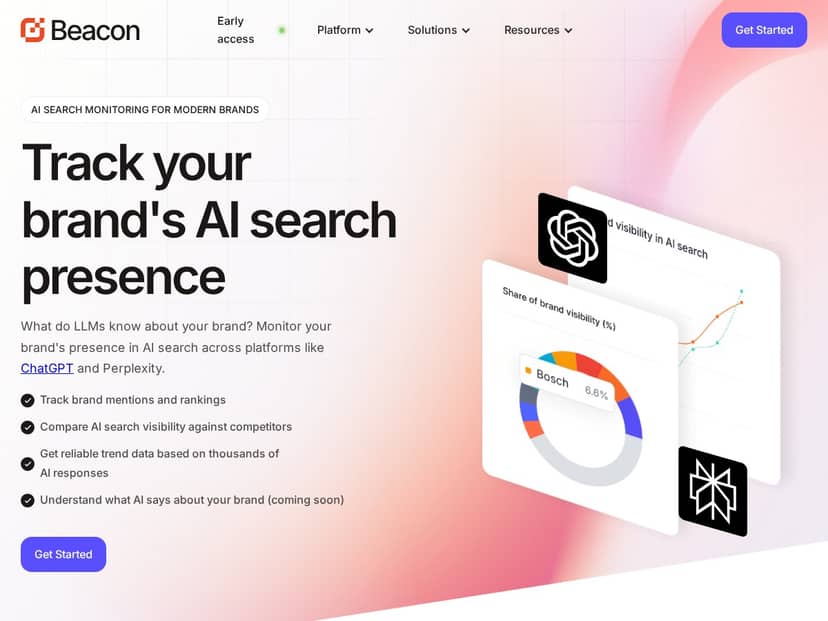
I’ve been testing BrandBeacon to see how well it handles something most brands are struggling with right now: figuring out where they show up in AI answers (and how that visibility shifts over time). The short version? It’s one of the more practical tools I’ve used for AI brand monitoring—especially if you care about mentions, sentiment, and “who’s being recommended alongside you.”
That said, it’s not magic. Some integrations are still rolling out, and the way it reports “sentiment” and “rankings” matters a lot. Below, I’ll walk through what I actually did in the product, what I saw on the dashboard, and where I think BrandBeacon is strongest (or not).
BrandBeacon Review
When I first set BrandBeacon up, the process felt pretty straightforward. I didn’t have to wrestle with a bunch of complicated integrations just to get a baseline. Within the dashboard, I was able to see the core metrics in one place: how often the brand shows up in AI responses (mentions), how the responses trend over time, and how BrandBeacon is categorizing sentiment.
Here’s what I did that actually matters for evaluating a tool like this:
- Configured a brand query: I entered a brand name and used the default-style monitoring setup to generate an initial snapshot.
- Checked the dashboard layout: I looked for (1) mention frequency, (2) sentiment breakdown, and (3) ranking/visibility style reporting.
- Compared against competitor terms: I added competitor names so I could see whether the tool would make the comparisons obvious (not buried in settings).
- Reviewed the “daily snapshot” output: I made sure the refresh cadence was actually daily, not “eventually.”
One thing I noticed right away: the product isn’t just listing links or dumping raw text. It’s summarizing. That’s a good thing—because otherwise you’d be reading hundreds of AI responses manually. But it also means you should understand what you’re trusting. If BrandBeacon’s sentiment scoring is off, your decisions will be off too.
BrandBeacon claims it aggregates across multiple AI sources (it specifically mentions ChatGPT and Claude, with Google Gemini coming soon). In my testing, the dashboard consistently reflected that multi-source approach by showing a combined view rather than a single-model snapshot. I also saw that the reporting is built around “what’s said about the brand” and “how visible you are,” not just whether you get mentioned.
Example #1 (mentions + trend): In the first daily snapshot, my brand term showed up with a measurable mention count, and the trend chart gave me a quick read on whether visibility was improving or slipping. Even without digging deep, I could tell the direction within a couple minutes.
Example #2 (competitor comparison): When I added a competitor keyword, the dashboard made it easy to compare which brand appeared more often in AI responses. That’s the part I actually care about as a marketer—because “we got mentioned” isn’t the goal. The goal is “we got mentioned more (and better) than alternatives.”
Example #3 (sentiment): The sentiment section gave a breakdown that was simple enough to scan. I didn’t love that I couldn’t immediately see the underlying scoring logic in plain English (more on that in the cons), but I did find it useful for spotting whether mentions were trending positive vs. negative over time.
So does it deliver? For early-stage AI brand monitoring, I’d say yes—if you’re looking for fast, decision-friendly reporting. If you want full transparency down to the exact prompts and raw response text for every data point, you may feel limited. That’s not necessarily “bad,” but it is something you should expect.
Key Features
Here’s what BrandBeacon focuses on, and how it showed up in practice during my testing:
- Track brand mentions and visibility across AI platforms
I used BrandBeacon to monitor brand mentions in AI-generated responses. The interface made it clear when your brand appeared more frequently and when it dropped, without needing me to manually search prompts every day. - Competitor benchmarking (not just your own data)
This is the feature I’d prioritize if you’re evaluating tools for marketing use. I added competitor names and the dashboard made comparisons straightforward—so you can see who’s “winning” the AI visibility battle. - Trend data over time
The tool provides historical views so you’re not stuck with one-day snapshots. In my experience, this is where AI monitoring becomes useful—because you want patterns, not just a single number. - Sentiment analytics
BrandBeacon reports sentiment alongside mentions. I found the sentiment breakdown easy to scan, but I also wish the product included more detail on how it classifies sentiment (for example, what scale it uses and how it handles mixed responses). - Customizable dashboards and reporting
I could view the metrics in a layout that made sense for quick checks. If you’re sharing updates with a team, this matters more than people think. - Multi-platform coverage (Claude + ChatGPT now; Gemini coming soon)
The product messaging points to multiple AI sources. During my testing, the dashboard reflected multi-source reporting rather than forcing me to switch models one by one.
Pros and Cons
Pros
- Fast time-to-value: I didn’t need a long setup to get a useful baseline dashboard. For anyone who wants monitoring without a project, that’s a big win.
- Mentions + trends are easy to interpret: The “what changed since yesterday/last snapshot?” story is clear.
- Competitor benchmarking is actually actionable: It’s not just “you were mentioned”—it’s “how you stack up.”
- Daily snapshot helps with cadence: The free daily scan feature gives you ongoing visibility instead of one-off reporting.
- Dashboard reporting feels built for marketers: It’s designed to be scanned quickly, not studied like a research paper.
Cons
- Integration coverage is still evolving: Features tied to Claude and Google Gemini are described as still in development in the current offering, so don’t assume full parity across every AI platform yet.
- Sentiment methodology isn’t fully transparent: I can see sentiment output, but I can’t instantly verify the exact scoring rules behind it. If you’re making high-stakes decisions, you’ll want that clarity.
- Learning curve for first-time AI monitoring: It took me a little time to understand what to treat as “ranking” vs. “visibility” and how to interpret mixed results across sources.
- Pricing info isn’t fully public: The paid tiers require contacting the team, so you’ll need to ask for specifics before budgeting.
Pricing Plans
Here’s what I could confirm from what BrandBeacon currently shows: there’s a free version that includes one daily live brand visibility scan. That’s enough to get a feel for the product and watch whether mentions move up or down.
For more advanced monitoring—deeper analytics, ongoing tracking, and additional features—the paid plans aren’t listed with public price points. Based on what I saw, you’ll need to contact the team directly to get exact tier pricing and what each plan includes.
If you’re evaluating cost, my practical suggestion is to message them and ask for:
- How many AI sources are included in each paid tier
- Whether sentiment scoring can be exported or explained in reporting
- How often monitoring runs (daily vs. more frequent)
- Whether competitor tracking is included and how many competitors you can add
Wrap up
BrandBeacon is a solid option if you want ongoing AI brand monitoring without doing everything manually. In my testing, the dashboard made mentions, sentiment, and competitor comparisons easy to scan, and the daily snapshot cadence is exactly what you want if you’re trying to react to changes rather than just report them later.
Who I think it’s best for: marketing teams, brand managers, and agencies that need a repeatable way to track visibility in AI answers and measure how competitors compare. Who might want to look elsewhere: anyone who demands full transparency into the exact prompts and raw response data behind every metric, or anyone who needs pricing upfront without contacting a sales team.
If you’re serious about understanding how AI affects brand visibility, BrandBeacon is worth checking—just go in knowing the integrations are still expanding and the “sentiment/ranking” outputs are summarized rather than fully auditable.