Table of Contents

What Is CabbageSEO?
When I first ran into CabbageSEO, I’ll be honest—I was skeptical. “AI visibility tracking” sounds like one of those buzz phrases that turns into another dashboard you barely use, right?
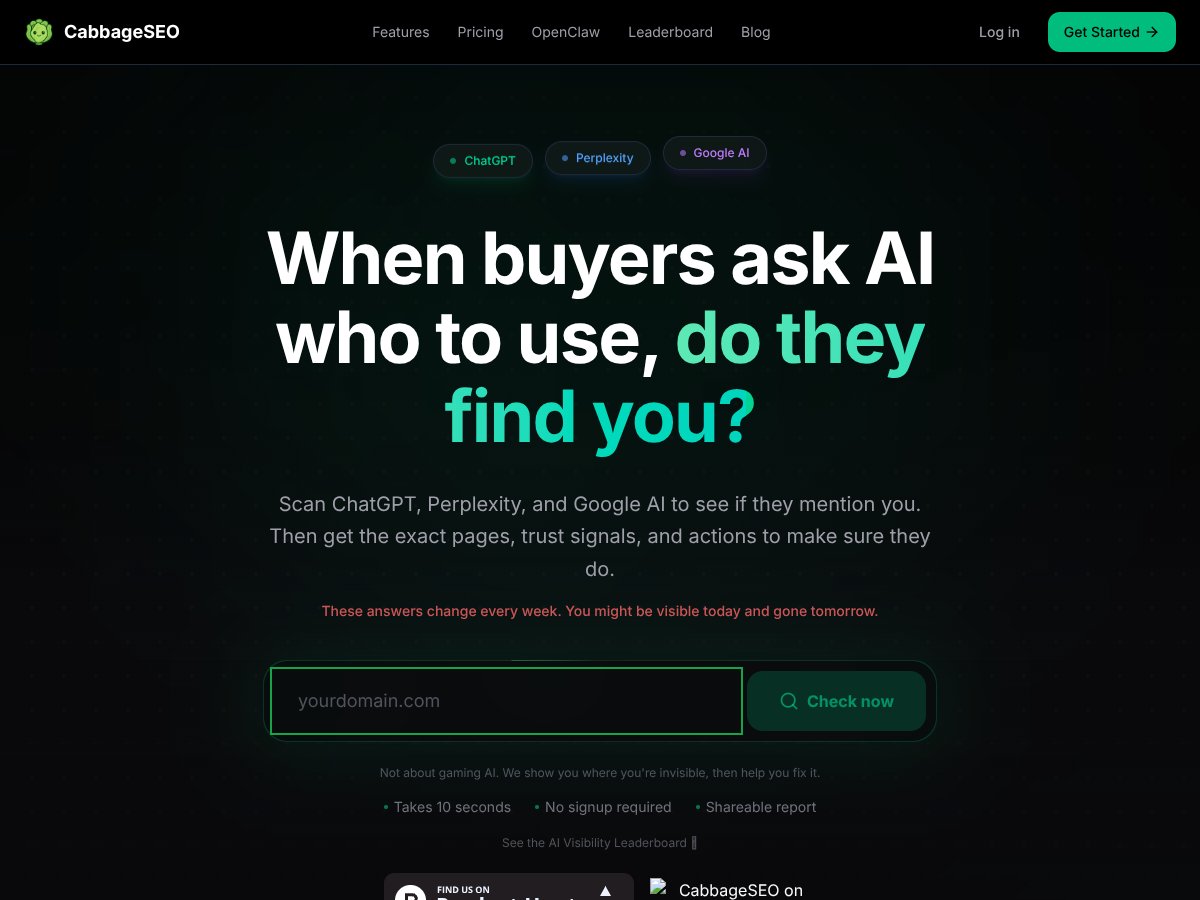
But the basic idea is pretty straightforward: CabbageSEO checks whether your website (or specific pages) show up in AI-driven answers and citations—especially across platforms people actually use like ChatGPT, Perplexity, and Google AI. If your site isn’t mentioned or cited, the tool flags the gaps and tries to point you toward fixes.
The core problem it’s aiming at is that most traditional SEO tools still focus on rankings in Google. That’s important, sure. Yet AI assistants don’t work like search engines. If you want an AI model to recommend your page, you need more than “good SEO.” You need signals that the model can reliably pull into its response.
One thing I noticed right away: the website doesn’t clearly name the team or founders. I couldn’t find a solid “about” page with verifiable details, and that makes me a little cautious. Not a deal-breaker, but it does matter if you’re planning to rely on it for ongoing work.
Also, expectations: this isn’t trying to be an all-in-one SEO suite. There’s no keyword research, no backlink explorer, no “here’s your traffic trend for the last 12 months” type of vibe. It’s laser-focused on AI citation / AI visibility. If that’s your priority, it can be useful. If you want a full SEO platform, you’ll feel boxed in.
CabbageSEO Pricing: Is It Worth It?

| Plan | Price | What You Get | My Take |
|---|---|---|---|
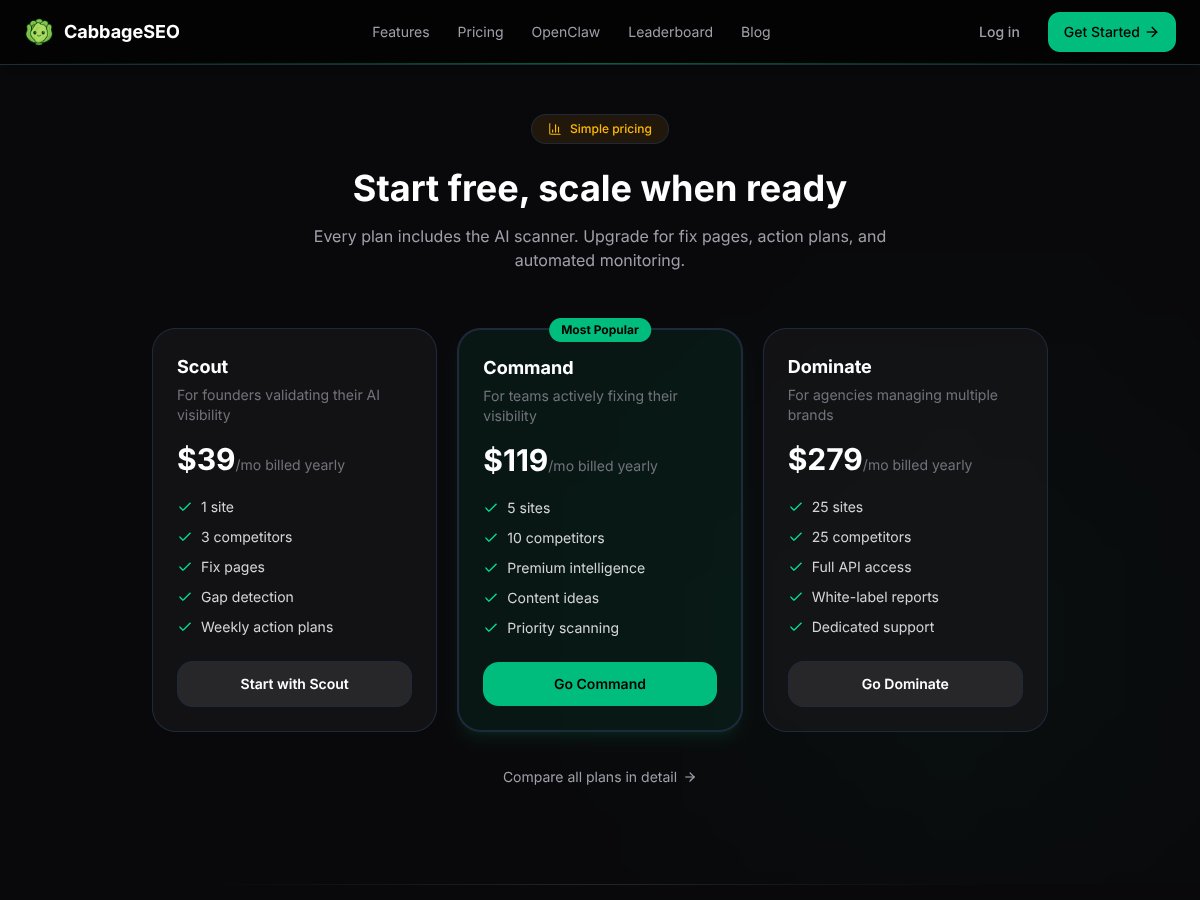
| Free Tier | Unknown / Not publicly listed | Limited scans, basic reports, no clear limits specified | They advertise a free tier, but the “how much is free” part isn’t spelled out clearly. In practice, that’s the first thing I’d want confirmed before I’d plan on it for regular use. |
| Paid Plans | Check website (pricing not publicly available) | Likely includes more scans, deeper reports, competitor comparisons, and advanced fixes | Since pricing isn’t transparent, you’ll probably need to request details. That’s not automatically bad—but it does make it harder to compare value against tools that list exact tiers. |
I’m going to say this plainly: without published numbers, it’s tough for me to confidently claim “this is a steal” or “this is overpriced.” I can only judge the product based on what it does and how clearly it explains usage limits.
What I couldn’t verify from the available info: whether there are scan caps, monthly limits, or feature gates (like advanced reporting or multi-engine checks) that only kick in on higher tiers. If you’re the type who likes to know costs upfront, that uncertainty is worth taking seriously.
My practical advice: if there’s a free tier, use it to test your exact workflow. Run a couple of scans for your key pages and check whether the results are detailed enough to act on. If you can’t get clear pricing and limits, ask before upgrading—seriously. A quick email asking “how many scans per month?” is usually faster than guessing.
My honest assessment? If you want ongoing AI citation monitoring, you’ll only know the value after you see the scan limits and report depth. If the free plan is truly usable for more than a one-off check, it’s easier to justify. If it’s basically a teaser, you might end up paying sooner than you expected.
The Good and The Bad
What I Liked
- AI-first focus (not a generic SEO dashboard): The tool is built around AI visibility/citation. That’s refreshing because most SEO tools still act like “visibility” only means Google rankings.
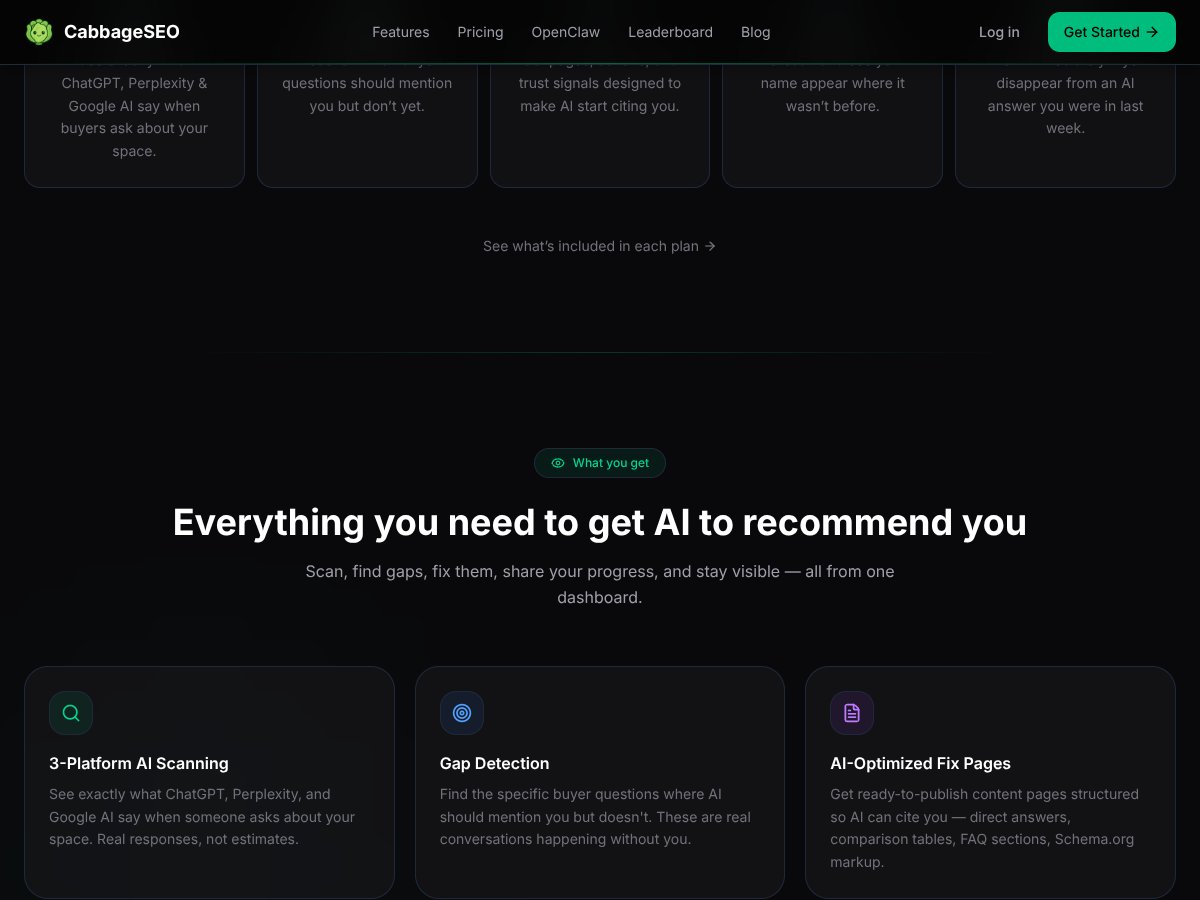
- Actionable recommendations (when they’re specific): What stood out to me is that the output isn’t just “you’re missing.” It often includes copy-paste style guidance—things like schema changes and on-page adjustments—so you can actually implement rather than just report.
- Shareable reporting: Even if you’re not doing client work, having a report you can show someone (team, stakeholder, or even “future you”) is genuinely helpful. It reduces the back-and-forth.
- Designed for quick checks: I don’t want to pretend I measured every runtime scenario, but the workflow feels built for “scan → review → act.” That’s usually what I want when I’m chasing AI citations.
- One place to look for AI mentions: Instead of manually prompting different platforms and hoping you get consistent results, CabbageSEO gives you a single place to see what’s happening.
What Could Be Better
- Pricing transparency is weak: The lack of clear plan pricing and usage limits makes budgeting harder than it should be.
- Not enough verifiable test details in the public info: If you’re trying to judge performance (scan speed, coverage, free tier limits), you’ll need to test yourself or wait for clearer documentation.
- Limited integrations / automation clarity: I couldn’t find solid, public documentation about API access or integrations with common tools (CMS, analytics, etc.). If automation matters to you, this is a question you should confirm before committing.
- UX and documentation feel minimal: If you’re not comfortable with SEO basics (especially schema), you might need to do extra research to implement the recommendations correctly.
- AI platforms can be inconsistent: Even with tools like this, AI answers vary based on the model, prompt style, and timing. So you should treat results as directional—not “forever guaranteed.”
Who Is CabbageSEO Actually For?

In my experience, CabbageSEO makes the most sense for teams and creators who care about being referenced by AI—not just showing up in Google.
For example, if you run a small SaaS and you want your product pages to be mentioned when people ask questions in ChatGPT or Perplexity, this tool can help you identify obvious “we’re not getting picked up” issues. Same idea for niche content sites where being cited matters more than ranking for a generic keyword.
Here’s the more specific version of “who it’s for.” It’s best when:
- You’re already publishing consistently and want a fast feedback loop on whether AI is picking up your pages
- You care about AI citation visibility across multiple engines (not just one platform)
- You want implementation guidance (schema and on-page tweaks) rather than a pile of vague metrics
- You prefer simple, shareable outputs for internal reviews or client updates
And honestly? If you’re the kind of person who enjoys testing and iterating, this kind of tool will probably feel less annoying than traditional SEO platforms.
Who Should Look Elsewhere
If your goal is classic SEO—ranking for keywords, increasing organic traffic, tracking backlinks, running technical audits—CabbageSEO isn’t built for that. It’s specifically about AI citation/visibility, so it won’t replace tools like SEMrush, Ahrefs, or Moz.
Also, if you need heavy automation (API access, deep CMS integrations, syncing results into analytics dashboards), you’ll want to look elsewhere unless CabbageSEO clearly documents those capabilities. As of my review, I couldn’t find reliable public documentation for API/integration workflows, which is a problem if you’re trying to build a scalable process.
Fair warning: if you’re expecting a full “SEO operating system,” you’ll probably feel like you’re missing half the features you want. It’s a niche tool. That can be a strength—or it can be frustrating, depending on what you’re trying to do.
| Feature check | CabbageSEO | What to verify before paying |
|---|---|---|
| AI citation coverage | Focused on AI platforms (ChatGPT, Perplexity, Google AI mentioned) | Which engines are actually included in your plan, and whether coverage changes by tier |
| Schema output | Recommendations for schema markup are part of the workflow | Whether it provides exact JSON-LD snippets you can paste (and for which schema types) |
| Exports | Not clearly documented in the provided info | Whether you can export reports (CSV/PDF) and how |
| API / integrations | Not clearly documented publicly | Whether there’s API access, webhooks, or CMS integrations |
| Pricing transparency | Free tier exists, but pricing/limits aren’t clearly listed | Scan caps, monthly limits, and what’s locked behind higher tiers |
| One-click publishing | Claimed as “one-click publishing” (details not confirmed here) | Which platforms it supports, what “one-click” actually does, and whether it requires credentials |
How CabbageSEO Stacks Up Against Alternatives
Search Atlas
- What it does differently: Search Atlas leans heavily into traditional SEO work—rank tracking, keyword research, competitor insights. It may touch AI visibility, but it’s not primarily built around AI citations.
- Pricing: Commonly starts around $99/month for broader plans (you’ll still want to check current tiers). CabbageSEO’s free scans (if usable for more than a one-off) can be a lower-friction way to test.
- Choose this if... You need a full SEO workflow for Google rankings and content performance.
- Prefer CabbageSEO if... Your main objective is “are we being cited by AI?” and you want targeted fixes.
Clearscope
- What it does differently: Clearscope is strong for content optimization aimed at Google—keyword-driven briefs, grading, and topical guidance. It’s not an AI citation tool.
- Pricing: Often around $170/month depending on plan. If you only care about AI citations, you might not want to pay for a tool that’s optimizing for a different outcome.
- Choose this if... You’re primarily trying to improve Google search performance.
- Prefer CabbageSEO if... You’re chasing AI mentions and need implementation help tied to that niche.
SurferSEO
- What it does differently: SurferSEO focuses on content structure and SERP-driven recommendations for Google. It may use AI in various ways, but it’s not centered on AI citations.
- Pricing: Often in the $59–$99/month range for basic plans (varies with tier). CabbageSEO’s barrier to entry depends on how meaningful the free tier is.
- Choose this if... You want detailed on-page guidance for ranking.
- Prefer CabbageSEO if... You want faster “are we cited?” checks with schema/on-page suggestions.
Copy.ai
- What it does differently: Copy.ai is mainly about generating content. It’s not a visibility/citation tracker.
- Pricing: Often starts around $35/month with trials available (depending on current offers). If you already have content and you’re stuck at “AI isn’t citing us,” Copy.ai won’t solve that directly.
- Choose this if... You need help writing or scaling content production.
- Prefer CabbageSEO if... You need to diagnose why AI isn’t referencing your pages and what to change.
Bottom Line: Should You Try CabbageSEO?
I’ll give CabbageSEO a 7/10 based on what it’s trying to do: it’s focused, niche, and built around AI citation visibility instead of generic SEO metrics. If you’re actively trying to get cited by AI assistants, that focus is a real advantage.
But here’s the catch: without clear pricing and usage limits, you’ll want to test the free tier and see whether the reports are detailed enough for your implementation workflow. If the free tier is limited to a couple of scans and you need ongoing monitoring, budgeting could get annoying fast.
Who should definitely try it? Content teams, niche marketers, and small businesses that publish regularly and want a fast way to check whether their pages are being mentioned/cited by AI platforms like ChatGPT and Perplexity.
Who should skip it? People who need traditional SEO tooling—keyword research, backlink analysis, technical audits, and deep Google performance tracking.
Is the free tier worth trying? In my view, yes—if it gives you enough scans to validate the output quality. If you can run a few checks across your key pages and the recommendations are specific, it’s a good way to decide whether the paid plans are worth it.
Would I recommend it personally? If your priority is AI citation and you like getting quick, implementation-oriented suggestions, then yes. If your priority is broader SEO strategy and reporting, you’ll likely get more value from established SEO platforms.