Table of Contents

What Is Chirpz Agent?
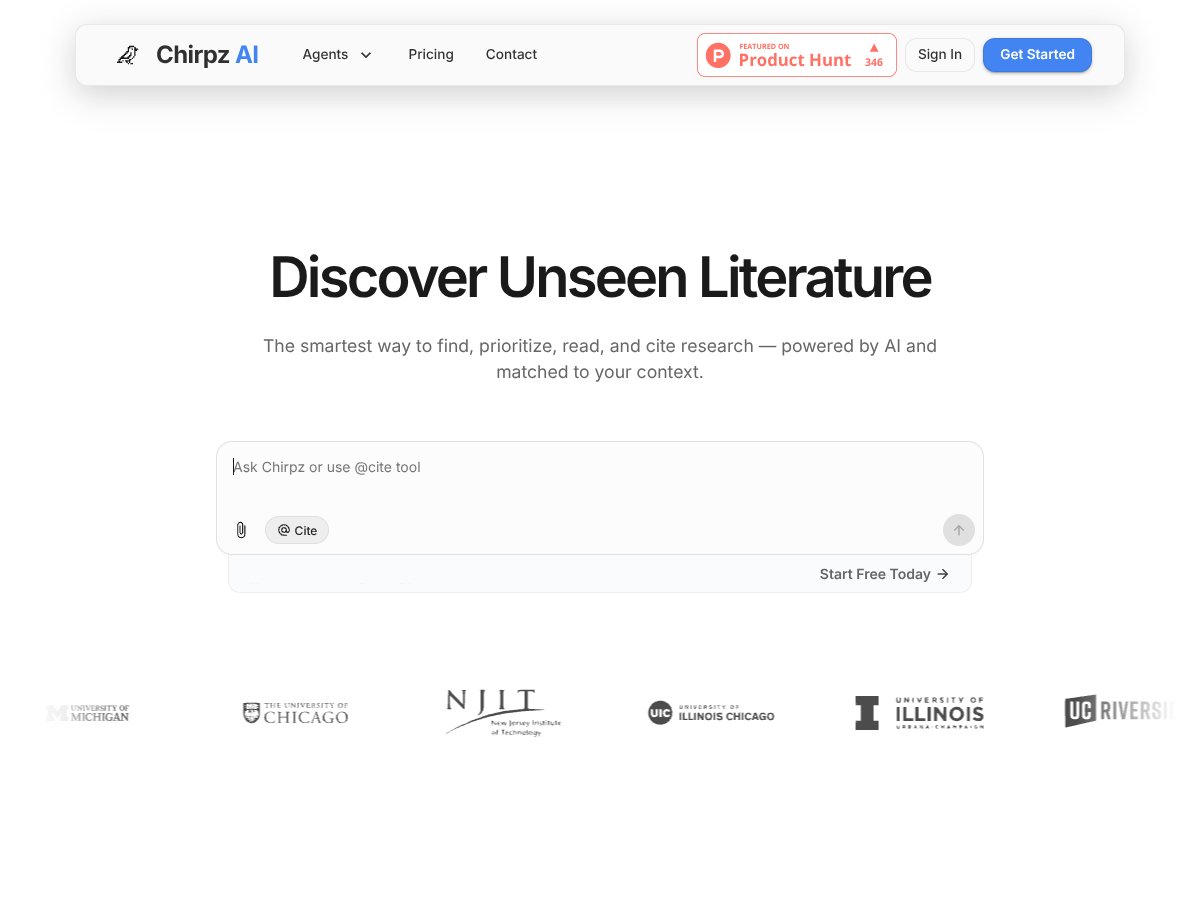
Honestly, I was pretty skeptical when I first heard about Chirpz Agent. Research tools that promise to sift through hundreds of millions of papers and surface exactly what you need tend to sound too good to be true. So I decided to put it through its paces, curious whether it could actually cut down the noise and help with real literature discovery.
What Chirpz Agent claims to do is quite straightforward in theory: it’s an AI-powered platform that helps researchers find relevant research papers and citations faster. Instead of relying on traditional keyword searches that drown you in irrelevant results, Chirpz tries to understand your research question or draft and then surfaces papers that are truly pertinent. It also claims to identify gaps in your drafts, suggest citations, and even summarize papers—basically trying to be a comprehensive research assistant in one package.
As for who’s behind it, the website doesn’t give much detail about the team or company. That’s always a bit of a red flag, honestly—no transparency about developers or backing. Still, the platform seems to pull data from reputable sources like PubMed, arXiv, and various journals, which adds some credibility.
My initial impression? It mostly does what it advertises, at least on paper. The interface is clean enough, and the core features seem functional. But I was surprised to find that there are no detailed tutorials or onboarding guides—just a quick demo and a prompt to start exploring. So, there’s a bit of a learning curve if you want to get the most out of it.
What I want to clarify upfront is what Chirpz isn’t: it’s not a fully automated research assistant that writes your papers or replaces in-depth review. It’s a discovery tool, and a pretty good one, but not a magic bullet. Also, there’s no mention of a free trial or pricing transparency beyond “start free”—so I can’t say how accessible it is for casual users or small teams.
Key Features of Chirpz Agent

Conversational Literature Discovery
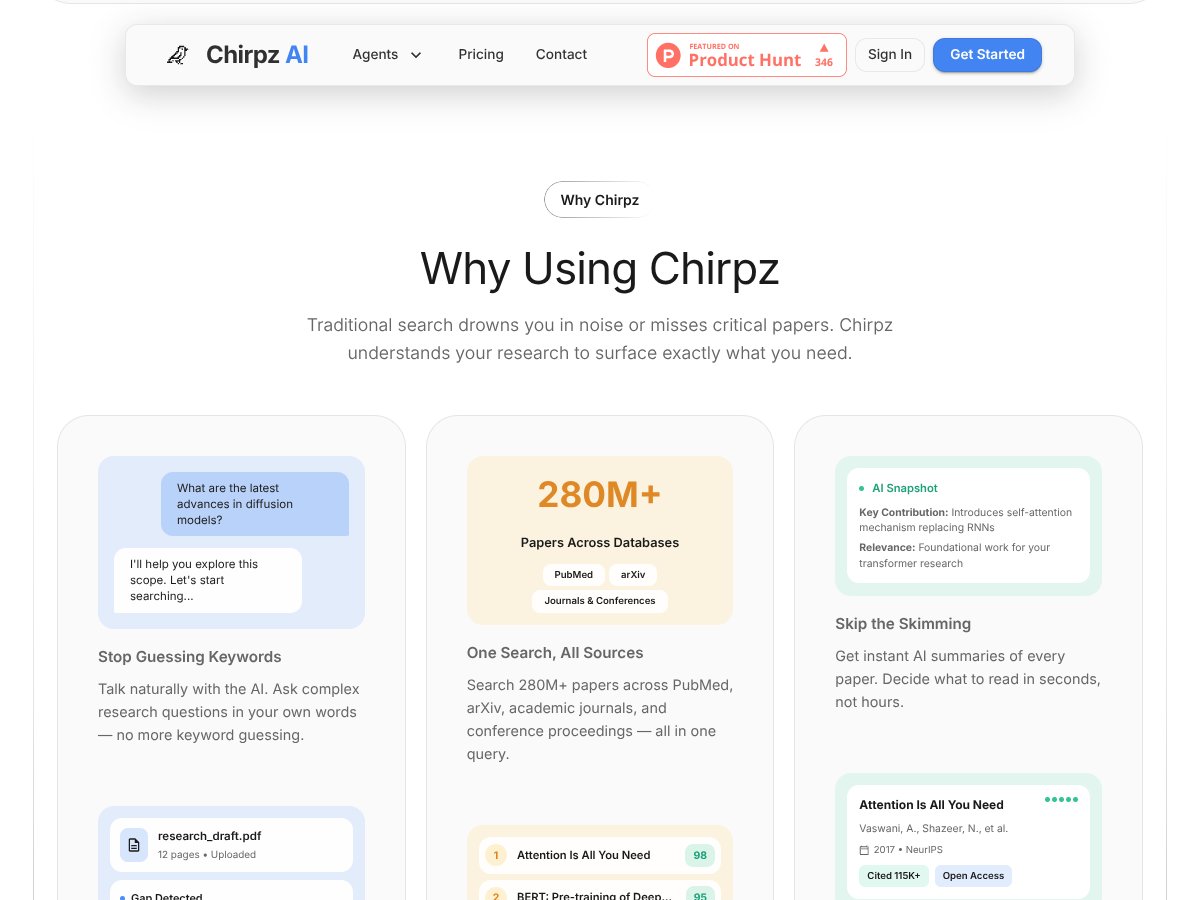
This feature allows you to ask natural language questions or upload a draft to find relevant papers. In my experience, it works reasonably well for straightforward queries like “What are the latest advances in diffusion models?”—the AI pulls up papers that seem on point. But I noticed that for more niche or complex questions, it sometimes missed key papers or returned results that were tangential. It’s definitely better than keyword searches, but not perfect.
Search across 280 Million+ Papers
It claims to scan a massive database including PubMed, arXiv, journals, and conferences all in one go. I tested a few broad topics, and the results were quite comprehensive. However, I did find that some newer papers or less common publications didn’t always show up, which makes me wonder about the freshness of the index or potential gaps. Still, the breadth is impressive for an all-in-one tool.
AI Relevance Ranking
The platform reads the papers and ranks them based on relevance to your research context. What I noticed was that it prioritizes papers that match the scope of my query, rather than just those with matching keywords. It’s a subtle but useful difference. That said, sometimes the top-ranked papers still felt a bit off, especially for interdisciplinary topics. It’s not perfect, but definitely helpful compared to manual filtering.
AI Summaries of Papers
One feature I liked was the instant summaries for each paper. You upload or select a paper, and the AI generates a brief overview. This saved me a lot of time, especially when skimming through dozens of papers. The summaries were decent but sometimes missed key nuances—so I wouldn’t rely on them entirely, just as a quick filter.
Gap Detection & Citation Suggestions
Upload your draft, and Chirpz scans it for missing citations or unsupported claims. I tested this with a sample draft, and it flagged some areas lacking references. It then suggested relevant papers to fill those gaps. Honestly, I was surprised to find it picked up some papers I’d overlooked. However, I wish it provided more detailed rationales for its suggestions; sometimes it felt like a shot in the dark.
Export & Citation Management
The tool offers metadata export, BibTeX, and citation management features, which seemed straightforward. But I couldn’t find advanced citation styles or integration with popular reference managers like Zotero or EndNote. So, if you’re expecting a full citation workflow, it’s somewhat limited.
Deep Research Agent & Draft Analysis
This chat interface allows for more in-depth searches and draft building. I tried asking it to outline a research plan, and it generated a decent structure. Still, the quality varied depending on how specific I was. It’s a nice addition but not a substitute for thorough manual work.
Summaries & Citation Verification
The instant summaries are useful, but I’d be cautious—AI can sometimes oversimplify or miss critical points. The verification feature, claiming zero hallucinations, is promising but I couldn’t test it extensively. So, take that claim with a grain of salt.
How Chirpz Agent Works
Getting started was relatively smooth—sign-up was straightforward, and I was able to log in in a minute. The interface is clean, with a main dashboard that offers options like asking questions, uploading drafts, or starting a new search. There’s no onboarding tutorial, which could be a hiccup for first-time users, but the layout is intuitive enough to explore.
To do anything useful, I’d say you need to spend about 5-10 minutes familiarizing yourself with the dashboard. The first few searches or uploads felt a bit trial-and-error, especially figuring out how to phrase questions for the best results. The AI’s understanding of context was decent but not flawless; sometimes it interpreted queries too broadly or narrowly.
One heads-up: I couldn’t find detailed instructions on how the scoring or ranking works, and the results sometimes felt inconsistent. So, I’d recommend double-checking key papers rather than relying solely on the AI’s suggestions.
Overall, it’s a platform that’s easy enough to start using quickly, but to get high-quality results, some trial, error, and critical evaluation are needed. I wish they’d upfront clarify the limitations and how often their database updates, but that info isn’t readily available.
In summary, Chirpz Agent is promising as a research assistant, but it’s not a magic bullet. It’s useful for narrowing down large pools of papers and highlighting relevant literature, but you’ll still need to do the hard manual review. Keep your expectations realistic, and you’ll find it a handy addition to your toolkit.
The Good and The Bad
What I Liked
- Context-Aware Relevance: Unlike traditional keyword searches, Chirpz AI understands your research context and prioritizes papers accordingly. This means I spent less time sifting through irrelevant results and more time on meaningful literature.
- Comprehensive Database Coverage: Access to over 280 million papers across multiple databases like PubMed, arXiv, and conference proceedings is impressive. It consolidates so much scholarly content into one search, saving me from juggling multiple platforms.
- Integrated Workflow: The platform combines discovery, citation management, drafting, and exporting in one workspace. I especially appreciated how seamlessly I could upload a draft and get citation suggestions without switching tools.
- AI Summaries and Gap Detection: The instant summaries helped me decide quickly whether a paper was worth reading, and the gap analysis highlighted missing citations in my drafts, which was a huge time-saver.
- Zero Hallucination and Metadata Completeness: The citations provided are verified and include complete metadata like BibTeX export, which is critical for accuracy in scholarly work. I trust the results more because of that transparency.
- User-Friendly Interface: Asking research questions in natural language felt intuitive, and the AI understood complex queries without me needing to craft precise keywords. It made literature discovery feel more conversational than transactional.
What Could Be Better
- Pricing Transparency: The lack of detailed paid plan information is frustrating. Without knowing the costs upfront, I hesitate to recommend it for long-term use, especially for budget-conscious researchers.
- Limited User Feedback: I couldn't find many reviews or ratings from actual users, making it hard to gauge real-world satisfaction or reliability over time.
- Niche or Emerging Fields: Since the AI relies on existing literature, it might struggle with very new or niche topics where papers are sparse or not well-indexed.
- Field-Specific Support: There’s no mention of support for non-English papers or specialized fields like engineering or social sciences, which could limit usability for certain researchers.
- Dependency on AI Accuracy: While the zero hallucination claim is reassuring, AI relevance ranking might still miss subtle nuances in highly specialized topics, leading to overlooked critical papers.
Who Is Chirpz Agent Actually For?
If you're a researcher or graduate student working on a literature review in a well-established field like machine learning, biomedical sciences, or physics, Chirpz Agent can significantly streamline your workflow. It’s ideal if you often need to find relevant papers quickly, especially when your research questions are complex and context-dependent. For example, if you're exploring the latest advances in diffusion models or trying to fill citation gaps in your draft, this tool helps you narrow down the most pertinent literature without hours of manual searching.
It’s especially useful for those who manage large amounts of literature, need to generate citations efficiently, or want to ensure they aren’t missing key references in their drafts. The integrated citation suggestions and gap analysis make it a good fit for systematic reviews, thesis writing, or any project where thoroughness and accuracy are critical.
Who Should Look Elsewhere
If you're primarily interested in casual research or exploring topics without a specific focus, Chirpz might be overkill. Its advanced features are best suited for intensive academic work. Researchers in highly niche or emerging fields where literature is sparse could find the AI less helpful, especially if they need very recent or non-English papers.
Additionally, if you’re budget-sensitive or require transparent pricing upfront, the current lack of clear plan details could be a dealbreaker. Those who prefer a straightforward keyword search or are comfortable with traditional platforms like Google Scholar or PubMed might prefer sticking with familiar tools.
Finally, if your work involves fields outside of mainstream academia—like industry-specific research, non-English literature, or highly specialized technical domains—Chirpz might not provide the depth or language support you need. In such cases, more specialized or field-specific databases and tools could serve you better.
How Chirpz Agent Stacks Up Against Alternatives
Google Scholar
- Google Scholar is a free, straightforward search engine that indexes a wide array of academic papers across disciplines. It relies on keywords and citation counts but lacks advanced relevance filtering and context-aware discovery that Chirpz offers.
- Price: Completely free.
- Choose this if... you need quick access to a broad, free search without specific filtering or AI-driven relevance ranking.
- Stick with Chirpz Agent if... you want more precise, context-aware search results and citation management, especially for complex research topics.
Elicit
- Elicit is another AI-powered research assistant focusing on literature discovery and summarization. It helps generate structured insights and can handle complex queries but isn't as deeply integrated with citation management or extensive databases as Chirpz.
- Price: Free tier available; paid plans are not publicly detailed but may require subscription for full features.
- Choose this if... you primarily need AI-generated summaries and structured research outlines rather than detailed citation analysis.
- Stick with Chirpz Agent if... you want comprehensive literature searches across major databases, detailed citation suggestions, and integrated drafting tools.
Scite.ai
- Scite.ai specializes in citation context analysis, helping researchers understand how papers are cited and the nature of those citations. It's excellent for verifying claims but doesn't focus as much on broad literature discovery.
- Price: Offers free basic access, with additional features in paid plans (pricing varies).
- Choose this if... your main goal is citation verification and understanding citation sentiment rather than discovering new papers.
- Stick with Chirpz Agent if... you need a one-stop solution for discovery, citation management, and drafting rather than specialized citation analysis.
PubMed & Embase
- PubMed is a free biomedical database, and Embase offers more advanced indexing for drug and disease research. They provide highly specialized search capabilities but are more manual and less AI-driven.
- Price: PubMed is free; Embase is subscription-based, often expensive.
- Choose this if... you need niche, specialized biomedical or pharmaceutical research and are comfortable with manual searches.
- Stick with Chirpz Agent if... you prefer a more automated, AI-enhanced discovery process that spans multiple disciplines and databases.
Final Advice
If you're a researcher overwhelmed by the sheer volume of papers and need a smarter way to find relevant literature, Chirpz Agent offers a solid balance of AI-driven relevance and workflow integration. It's especially useful for those conducting comprehensive reviews or needing precise citations quickly.
However, if you're in a very niche biomedical field and only need the basics, PubMed or Embase might serve you better, albeit with more manual effort. For citation verification and understanding citation contexts deeply, Scite.ai is a better fit.
Bottom Line: Should You Try Chirpz Agent?
Overall, I’d rate Chirpz Agent a 7/10. It’s a handy tool that saves time and streamlines research workflows, but it’s not perfect—especially if you’re looking for niche-specific insights or are on a tight budget. It’s best suited for graduate students, early-career researchers, or anyone juggling multiple papers and needing a centralized platform for discovery and citation management.
If you’re just starting out or want an all-in-one tool that simplifies your literature review process, give the free tier a shot. The paid plans could be worth it if you find yourself regularly doing complex searches or drafting papers. But if your research is very specialized or you prefer manual control, you might want to stick with traditional databases or other AI tools.
Personally, I’d recommend it for anyone who values efficiency and a conversational AI interface—just keep expectations realistic, and don’t rely solely on AI for niche topics.
If you’re handling broad, interdisciplinary research or need a modern, integrated workflow, give Chirpz Agent a try. If your focus is on very specific biomedical research or citation analysis, explore other specialized tools instead.
Common Questions About Chirpz Agent
Is Chirpz Agent worth the money?
It depends. The free tier is a good starting point to test its features, but the paid plans could be worthwhile if you need deeper AI assistance and faster discovery for large projects.
Is there a free version?
Yes, Chirpz offers a free tier with limited features. It’s a good way to get a feel for the platform before considering a paid upgrade.
How does it compare to Google Scholar?
Google Scholar is free and broad but lacks AI relevance ranking and advanced filtering. Chirpz provides smarter, context-aware searches but at a cost.
Can I upload my drafts for citation suggestions?
Yes, Chirpz has an integrated editor that analyzes your drafts and suggests supporting citations with metadata, streamlining your writing process.
Does it support non-English papers?
While it searches across major databases like PubMed and arXiv, the platform’s focus is primarily on English-language research. Support for other languages may be limited.
Can I get a refund if I’m not satisfied?
Refund policies depend on the platform’s terms, so check their website or contact support if you’re considering an upgrade. Usually, trial periods or cancellations are straightforward.