Table of Contents
What Is Citable (and What I Actually Found After Testing It)?
I’ll be honest—I didn’t go into Citable expecting it to be anything more than another “AI analytics” dashboard. The pitch about AI visibility and citations sounded a little hand-wavy at first. So I did what I always do with tools like this: I poked around, ran a few brand checks, and tried to see whether the output was useful enough to change decisions.
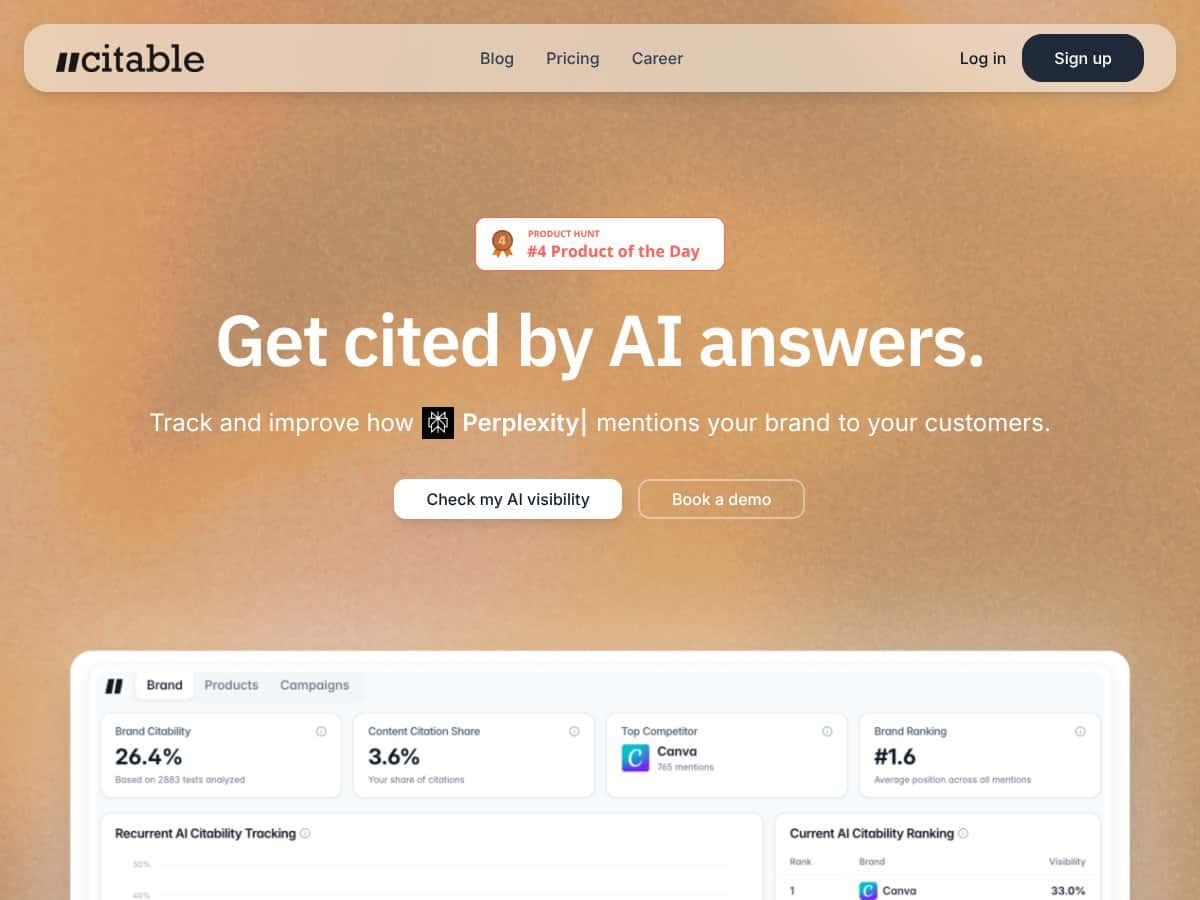
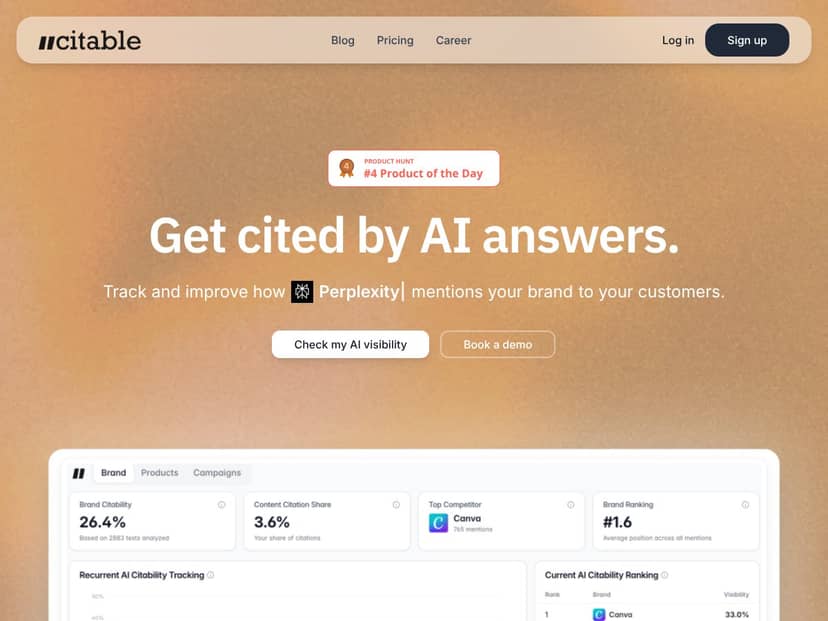
Here’s the simplest way I’d describe it: Citable is an AI-powered platform that focuses on where your brand shows up in AI-generated answers—and then tries to explain how you can improve that visibility. That includes models like ChatGPT, Perplexity, Claude, and similar AI answer systems.
The core promise is twofold:
- AI citation tracking: Citable checks whether your brand is mentioned and in what context (not just “traffic,” but actual answer-level references).
- Actionable improvement ideas: it doesn’t stop at “you’re missing.” It tries to recommend next steps based on the gaps it finds.
Traditional SEO is still important, but AI answers don’t work the same way as classic rankings. If your brand isn’t being referenced (or isn’t showing up in the sources AI systems rely on), you can do everything “right” for SEO and still get ignored in AI responses. That’s the gap Citable is trying to bridge.
Now, about the company itself: I couldn’t find much in terms of named founders, a detailed “about” page, or a clear timeline of product updates. What I could infer from the messaging is that it’s aimed at marketing teams and brand owners who care about AI-driven discovery (and not just content performance in the traditional sense).
One more thing: Citable doesn’t feel like a full SEO suite. When I looked for the usual stuff—keyword research, backlink explorers, content scoring—it wasn’t that kind of platform. It’s narrower. It’s built around AI citations and visibility, and that specialization is either a strength or a weakness depending on what you need.
Limitations I noticed: I couldn’t find a level of methodological detail that I’d expect from a research-heavy product. For example, it’s not obvious (from the public-facing material) how often the checks run, what exact query templates are used, or how the “accuracy” of citations is evaluated. That doesn’t automatically mean it’s wrong—but it does mean you should treat results as directional until you’ve validated them against your own expectations.
Also, I couldn’t locate a fully transparent pricing page with full plan breakdowns. That matters, because if you’re trying to decide whether it’s worth it, you shouldn’t have to guess what’s included.
So overall? Citable looks legitimate as a niche tool for AI citation visibility. Just don’t expect it to replace your SEO platform. It’s more like a “did we get mentioned in AI answers?” layer on top of everything else.
Citable Pricing: What You Pay (and What I’d Watch Before Upgrading)
| Plan | Price | What You Get | My Take |
|---|---|---|---|
| Starting Plan | $99/month | Basic AI visibility audits, persona-based insights, competitor gap analysis, initial action plan, 7-day free trial | If you want to test whether Citable’s output matches reality, $99/month is a reasonable entry point. The bigger issue is that the public info doesn’t clearly spell out usage caps (reports, checks, exports), so you’ll want to confirm that once you’re in the product. |
| Higher Tiers | Unknown (website suggests custom enterprise options) | Likely includes more extensive audits, ongoing tracking, team collaboration, and deeper analytics | If you’re an agency or managing multiple brands, you’ll probably need to ask for details. I’m not a fan of “custom” pricing when you can’t compare features side-by-side. |
In my experience, $99/month is “mid-range” for a specialized tool like this. The question isn’t just whether it’s expensive. It’s whether it earns its keep by turning AI citation insights into content decisions you can measure.
Here’s what I’d specifically look for before paying:
- Usage limits: Are you limited by number of audits, number of prompts/queries, or number of reports?
- Export options: Can you export results for stakeholders (PDF/CSV)? If you can’t, it’s harder to justify internally.
- Model coverage: Does it actually track the models you care about most (ChatGPT, Claude, Perplexity, etc.)?
- Update frequency: How often are results refreshed? Weekly vs. monthly changes how “actionable” the data is.
My take: if you’re a small to mid-size team exploring AI visibility for the first time, the 7-day free trial is the smartest way to judge value. If the insights are clear and the recommended actions are easy to execute, paying $99/month might make sense. If the outputs are vague or feel too high-level, you’ll notice quickly.
The Good and the Bad (Based on What the Product Actually Does)
What I Liked
- Persona Simulation: The persona feature is one of the most interesting parts. Instead of only asking “does Citable find my brand mentions?”, it tries to show how different audiences might encounter your brand in AI answers. In practice, that’s helpful because two people can ask the “same” question with totally different intent.
- Competitor Gap Analysis: Seeing where competitors get cited (and you don’t) is genuinely useful. It gives you a starting point for content and positioning rather than forcing you to guess.
- Action Plans (not just reports): What I appreciated is that it pushes toward next steps—like what kinds of pages or sources might help, and what to focus on first. It’s not perfect, but it’s better than tools that only diagnose.
- Prompt Monitoring Concept: The idea of running multiple checks across AI models is important. If you only test one query once, you’ll get noisy results. Citable’s approach is meant to reduce that “one-off answer” problem.
- Free Trial: Being able to test the core workflow before committing is a big deal for niche tools. You don’t want to pay and then realize you needed exports, integrations, or deeper reporting.
- GEO Focus: I like that it’s explicitly thinking about Generative Engine Optimization (GEO). Whether you love the term or not, the point is real: AI answers need a different kind of visibility strategy than classic SEO.
What Could Be Better
- Methodology transparency: The biggest gap for me is that the “how” isn’t fully explained publicly. I want clearer detail on things like query sets, update cadence, and what counts as a citation.
- Limited “marketing stack” features: This isn’t an outreach tool, content planner, or CMS integration platform. If you want one dashboard for everything, you’ll still need other tools.
- Pricing clarity: Beyond the $99/month starting plan, the details get fuzzy. For a tool like this, you need to know what scales and what doesn’t.
- Usability details aren’t obvious: The product might be easy once you’re logged in, but the public info doesn’t show the workflow clearly. If you’re not technical, you’ll want to test it hands-on in the trial.
- Fit depends on your goals: If your main KPI is Google rankings or organic traffic, Citable may feel like a side quest. It’s focused on AI answers and citations.
How Citable’s Persona Simulation Works (What It’s Trying to Model)
One reason persona simulation stands out is that it’s not just “run the same query.” It’s trying to reflect the fact that AI answers change based on who you are and what you’re trying to do.
In my view, the feature is essentially doing this:
- Define persona context: each persona represents an audience with a specific role and intent (for example: a buyer comparing vendors vs. a technical user researching implementation details).
- Run citation checks per persona: instead of only measuring brand mentions in one generic prompt, it tests how your brand appears under different audience assumptions.
- Highlight differences: you should see differences in whether your brand is mentioned, how it’s described, and whether it shows up in the “best fit” style answers.
What I’d suggest you do in the trial: pick one high-intent question your customers ask and run it as two different personas. For example, if you’re a B2B SaaS company:
- Persona A: “Operations manager looking for a tool to reduce workflow bottlenecks.”
- Persona B: “Security lead evaluating compliance and risk.”
If Citable is working the way it claims, you should see citation differences—not just the presence/absence of your brand, but the context (what your brand is associated with in the answer). That’s the practical value: it helps you tailor messaging to the way different people actually search and decide.
Who Is Citable Actually For?
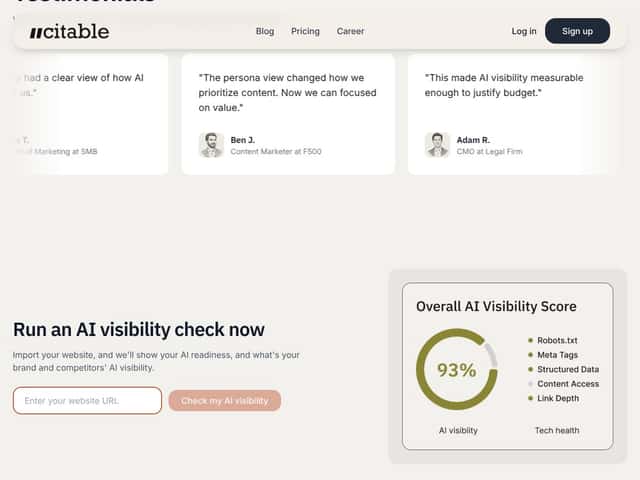
If you’re a B2B or SaaS brand where being referenced in AI answers matters—especially in competitive categories—Citable can be a solid fit. It’s most useful when you already know AI visibility is part of your discovery funnel and you want data to guide what to fix.
In particular, I think it’s a good match if:
- you publish content but aren’t sure which pieces are actually getting cited in AI answers
- your sales team relies on “trust signals” and you want to strengthen how your brand is described
- you’re comparing yourself to competitors and want a clearer picture of citation gaps
Agencies may also like it, especially if they can run audits across multiple clients and turn results into recommendations. Persona modeling is a nice differentiator for client work because it gives you a story you can present: “Here’s how different buyers see you in AI answers, and here’s what to change.”
That said, it’s not for everyone. If your priorities are purely Google SEO rankings, or you don’t have a plan for turning insights into content/source updates, the tool may feel expensive. And if you’re a solo marketer without a real AI visibility strategy, you might not get enough value from a niche product.
Who Should Look Elsewhere
If your main goal is classic SEO—rankings, backlinks, traffic forecasting—then Citable probably won’t scratch that itch. It’s built around AI citations and visibility, not keyword research and link building.
Also, if you’re a small team with limited budget and you don’t have someone who can translate “AI citation gaps” into concrete content changes, you might be better off investing in foundational SEO tools or general marketing analytics first.
One more practical point: I didn’t see strong public signals about deep integrations with other marketing stacks or content systems. If your workflow depends on pulling data into dashboards or pushing tasks into project tools, you’ll want to confirm what’s possible during the trial.
Finally, if you need performance analytics like conversion tracking, channel attribution, or detailed website analytics, you’ll still need something else. Citable is focused on citations, not full-funnel measurement.
How Citable Stacks Up Against Alternatives
Perplexity
- Perplexity is more about producing AI answers and experience inside its ecosystem, with analytics that can overlap with visibility goals.
- It’s often easier if you’re already living inside Perplexity day-to-day.
- Choose Perplexity if you want a more “assistant-first” approach and lighter visibility analytics.
- Choose Citable if you want a dedicated focus on brand citation audits and GEO-style recommendations.
Ahrefs
- Ahrefs is mainly an SEO platform: backlinks, keywords, content analysis.
- It can include AI-related insights, but it’s not specialized in AI citation tracking.
- Choose Ahrefs if you need a full SEO toolkit across traditional search.
- Choose Citable if your priority is “are we mentioned in AI answers?” and what to do about it.
SEMrush
- SEMrush is a broad SEO/content suite with some AI features, but it’s not built specifically for AI citations.
- Plans tend to run higher because you’re paying for a bigger suite.
- Choose SEMrush if you want an all-in-one marketing platform.
- Choose Citable if you want specialized AI visibility and citation-focused insights.
BrightEdge
- BrightEdge is more enterprise-oriented and positioned around AI search optimization at scale.
- Pricing is typically custom and usually outside the “small team trial” budget.
- Choose BrightEdge if you’re an enterprise and need a large-scale platform.
- Choose Citable if you want targeted AI citation insights without enterprise-level overhead.
Final Verdict: Should You Try Citable?
My overall rating after looking closely is 7/10. It’s a smart, niche tool for brands that care about AI citations and GEO-style visibility. The persona angle and competitor gap framing are the parts that feel most directly useful.
Where I’m cautious is transparency and depth. If you need a lot of “why” behind the numbers, or if you expect a full analytics suite with exports and integrations, you may find the experience too lightweight.
Who should try it? If you’re serious about improving how your brand shows up in AI answers—and you’re ready to act on insights—start with the 7-day free trial. That trial is where you’ll learn the truth fast: do the citations match what you see when you search, and do the recommendations translate into content/source updates you can actually ship?
If your focus is broader SEO performance or you don’t have a plan for execution, you might get more value from tools like Ahrefs or SEMrush first.
Common Questions About Citable
- Is Citable worth the money? It can be, if you’re specifically trying to improve AI citation visibility and you’ll use the insights to make changes. If you only care about traditional SEO metrics, it may feel like overkill.
- Is there a free version? There’s a 7-day free trial. I didn’t see a long-term free plan beyond that.
- How does it compare to Perplexity? Citable is more focused on brand citation auditing across AI models. Perplexity is more of an assistant ecosystem with analytics that may overlap, depending on how you use it.
- Can I track citations across multiple platforms? Yes, the positioning is that it checks across major AI answer systems (including ChatGPT, Claude, Perplexity, and others).
- Is the methodology transparent? Public details appear limited. If you’re the type who needs full clarity on data sources, query sets, and scoring logic, you’ll want to verify what’s available inside the product during your trial.
- Can I get a refund if I’m not satisfied? Refunds are typically handled case-by-case based on their policy. Check their terms before subscribing.
If you’re going to test Citable, don’t just glance at the first report and call it a day. Run a couple of your real-world queries, compare what you see to the outputs, and decide whether the recommendations are specific enough to justify the subscription.