Table of Contents
When I first looked into making an audiobook, I honestly expected the price to be way simpler. You write the book, you hire a narrator, you’re done… right? But the more I dug in, the more I realized audiobook cost is basically a stack of small decisions—how long it is, who narrates it, how many revisions you want, and whether you’re recording in a real studio or at home.
So if you’re trying to figure out the cost to produce an audiobook in 2026, here’s what I’d focus on: the typical budget ranges, what drives them up or down, and a practical way to estimate your own project without guessing.
Key Takeaways
- A professional 10–12 hour audiobook in 2026 commonly lands around $2,000–$5,000, with many vendors pricing around $250–$500 per finished hour (PFH).
- Length isn’t just “more hours.” It usually means more narration time, more editing time, and more mastering time—so the budget grows fast after ~12 hours.
- Narration is usually the biggest line item. Typical professional narration rates often land in the $90–$200+ per finished hour range (varies by talent, usage rights, and revision expectations).
- Studio time (or home recording) matters. Studio rental can run $50–$200+/hour, but home recording shifts that money into equipment, room treatment, and extra prep.
- When you request quotes, don’t just ask for a price—ask what’s included (editing style, number of revision rounds, file formats, delivery timeline, and whether you’re paying for pickups).
- Word count → finished hours is the math you’ll use everywhere. A finished hour typically corresponds to roughly 9,000–9,400 words (and it’s the basis for PFH estimates).
- Budgeting smart means planning a “real” buffer for pickups, retakes, and timeline changes—not just hoping everything goes smoothly.
Alright—here’s the real-world baseline. For a professional, polished audiobook in 2026, you’re usually looking at $2,000–$5,000 for a 10–12 hour finished product. That range typically assumes you’re paying for narration, editing/proofing, and mastering.
If you want a quick rule of thumb, many production companies price using per finished hour (PFH). In practice, a PFH quote often lands around $250–$500. So if your project is ~10 finished hours, the math looks like:
10 PFH × $250–$500 PFH = $2,500–$5,000
To sanity-check your broader publishing budget, you can also refer to this typical budget for writing/publishing planning.
1. What Is the Typical Cost to Produce an Audiobook?
Average production costs (and what they usually include)
In my experience, most professionally produced audiobooks in the mainstream market land around $2,000–$5,000 for a 10–12 hour book. That’s the “everything” range you’re probably imagining: narration, editing/proofing, and mastering.
Pricing is often expressed as per finished hour (PFH). Many vendors quote $250–$500 PFH for a standard, single-voice audiobook with one narrator and a reasonable revision process.
For shorter projects, the total can drop. A ~5 hour audiobook might be closer to $1,000–$3,000, especially if you’re self-recording or working with a smaller studio workflow.
2. What Factors Affect the Cost of Producing an Audiobook?
1) Length of the audiobook (the PFH math)
Length drives everything. Here’s the part that trips people up: you don’t pay for “your manuscript word count.” You pay for finished hours, which is how the final narration time lands after performance and pacing.
A commonly used estimate is that a finished hour contains about 9,000–9,400 words. So if you have, say, 100,000 words, you’re looking at roughly:
100,000 ÷ 9,000 to 9,400 = ~10.6 to 11.1 finished hours
That’s why costs can spike as you move past 12 hours. More hours means more narration sessions, more edits, and more mastering time.
To make it concrete: a 6-hour audiobook might land around $1,200–$3,000, while a 15-hour book can easily push beyond $3,750 (and higher once you add extra revisions, pickups, or multiple narrators).
2) Narrator fees (and revision expectations)
Narrator talent is usually the biggest line item. Typical professional narration rates are often in the $90–$200+ per hour range (sometimes quoted differently depending on vendor and usage rights).
What I noticed when comparing quotes: two narrators can have similar hourly rates, but the total budget still differs because of how many revisions you get and how pickups are handled.
If you’re paying for a well-known voice or union talent, narration can jump—sometimes substantially. If you’re using AI narration or amateur voice-over, you can cut costs, but you’ll want to think hard about the quality bar you’re aiming for and how it will be received.
3) Studio and equipment costs (DIY vs. pro recording)
When you record in a professional studio, studio time often runs around $50–$200+ per hour depending on the market and the setup. If you DIY, you’re trading studio rental for equipment and room treatment.
That’s not automatically cheaper. A cheap mic in a noisy room can create editing headaches that cost you later. But if you invest in a decent microphone, monitor headphones, and basic sound treatment, DIY can reduce overall costs on smaller budgets.
If you want a starting point, check out DIY recording setups and planning tips.
4) Editing, proofreading, and mastering (where “cheap” can get expensive)
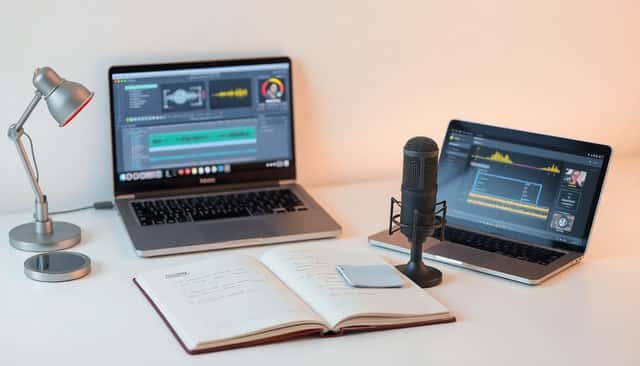
After narration, you still have to clean it up. Editing can include removing mouth clicks, correcting pacing, handling misreads, and tightening consistency. Proofing is the pass where mistakes get caught. Mastering is what makes the final audio sound “finished” across platforms.
Some vendors bundle this into PFH. Others separate it—or they include only light editing unless you pay for heavier cleanup. If you’ve ever listened to a low-quality audiobook, you know exactly why this matters: it’s fatiguing.
5) Rights, royalties, and special requirements
This is where budgets can surprise people. If you’re producing for commercial distribution, you may need to consider usage rights (and sometimes royalty structures, depending on your narrator contract and platform agreements).
Also: sound effects, multiple character voices, dialect coaching, and “urgent turnaround” can add real cost. Those are not always included in a baseline PFH quote.
4. A Sample Budget for a 10-Hour Book
Worked example: 10-hour fiction audiobook (single narrator, one revision round)
Let’s say you have a fiction manuscript that estimates to 10 finished hours. You’re hiring a professional narrator and a production team that includes editing and mastering.
Assumptions I’m using:
- PFH rate: $300–$450 (mid-range pro production)
- Finished hours: 10
- Revisions: 1 round included
- No sound effects, single narrator
- Budget buffer: ~10% for pickups/changes
Estimated cost:
- Narration + production (PFH): 10 × $300–$450 = $3,000–$4,500
- Buffer for pickups/extra edits: ~10% = $300–$450
- Optional add-ons: cover art, rush delivery, or extra proofing (not included here)
Likely total: $3,300–$4,950
Worked example: 10-hour nonfiction audiobook (more proofing + tighter accuracy)
Nonfiction can take longer in editing and proofing because you’re dealing with facts, names, and terminology. Let’s keep the same 10 finished hours but assume you’ll request a bit more careful cleanup.
Assumptions I’m using:
- PFH rate: $350–$500
- Finished hours: 10
- Revisions: 1 round included, but you’ll likely request pickups for misreads of names/terms
- Extra proofing: baked into the higher PFH
- Buffer: ~15% (because nonfiction tends to have more “check this” moments)
Estimated cost:
- Narration + production (PFH): 10 × $350–$500 = $3,500–$5,000
- Buffer for pickups/extra corrections: ~15% = $525–$750
Likely total: $4,025–$5,750
5. What Should You Keep in Mind When Budgeting for an Audiobook?
- Ask what “PFH” actually includes. Some quotes bundle editing and mastering. Others include narration only, then tack on post-production separately.
- Clarify revision rounds and pickups. If your quote includes “1 revision round,” does that mean one full edit pass, or only minor fixes? Also ask how pickups are billed if the narrator needs to rerecord a chunk.
- Get delivery timelines in writing. “Two weeks” can mean different things. I always ask: when does recording start, when do you get the first auditions/reads, and when is final delivery due?
- Don’t forget cover art (if you need it). If you’re distributing on major audiobook platforms, you’ll likely need compliant cover artwork. That’s another cost category people forget.
- Budget for the “human” part. Even well-run productions need small course corrections—pronunciation tweaks, character name consistency, or fixing a few chapters after feedback.
- Be honest about your quality goals. If you want “listener-ready” professional sound, cutting corners on editing/mastering usually shows up fast.
6. How to Plan Your Budget for an Audiobook
Here’s the budgeting workflow I recommend (and the one I use when I’m comparing quotes):
- Step 1: Estimate finished hours. Take your word count and divide by 9,000–9,400 words per finished hour. Write down a low and high estimate.
- Step 2: Pick your PFH target. If you’re aiming for a standard pro production, start with $250–$500 PFH as your baseline. If you’re doing nonfiction, multiple narrators, or heavier proofing, plan closer to the upper end.
- Step 3: Request a line-item quote (not a single number). When you ask for pricing, include these deliverables:
- Narration length and rate basis (PFH vs. per hour)
- Editing/proofing scope (light vs. full cleanup)
- Mastering included? (and any loudness/format requirements)
- Number of revision rounds
- Pickup/re-record policy and how it’s charged
- File formats delivered (WAV/MP3, chaptering, sample rate/bit depth)
- Estimated timeline from script delivery to final masters
- Step 4: Add a buffer. I generally plan 10–15% extra for pickups and last-minute changes. If you’re doing nonfiction with lots of names/terms, lean toward 15%.
- Step 5: Decide on DIY only where it makes sense. DIY recording can save money if you have a quiet space and decent gear. If not, you might end up paying more in editing time.
If you’re considering automation or AI narration to reduce cost, treat it like a trade-off: it can lower your upfront spend, but you’ll still need editing, QC, and a quality check so the final audio doesn’t feel “off.”
FAQs
For a standard, professionally produced audiobook, you’ll usually see totals around $2,000–$5,000 for about 10–12 finished hours. Many vendors price using per finished hour (PFH), often around $250–$500 PFH, depending on narration talent, editing scope, and revisions.
The biggest drivers are finished length (PFH math), narrator rates, and editing/proofing/mastering scope. Add-ons like sound effects, multiple narrators, extra revision rounds, and rush timelines can push the budget higher quickly.
Yes—two common approaches are (1) recording yourself and paying for only the parts you can’t DIY well (editing/mastering), and (2) using AI narration to reduce upfront narration costs. Just be careful: you’ll still need quality control, and you may spend more on editing if the raw audio isn’t clean.