Table of Contents
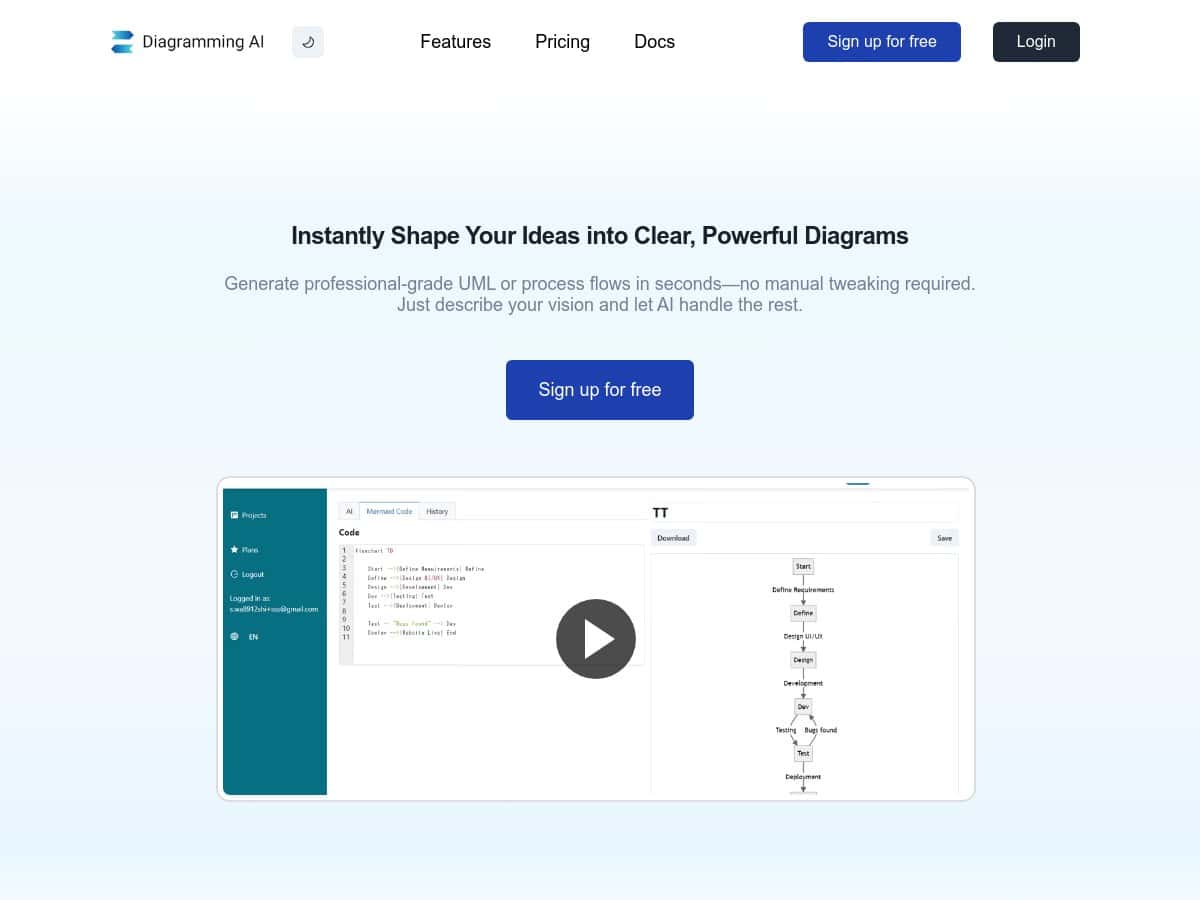
If you’ve ever tried to turn a messy idea into a clean flowchart (and then got stuck tweaking boxes for an hour), you’ll know the pain. Diagramming AI is built for exactly that moment: paste some text, get a diagram, and then refine it without needing to be a diagram wizard.
After testing it, what stood out to me wasn’t just the “AI makes diagrams” part—it was how quickly I could go from rough notes to something I’d actually share. The editor feels straightforward, the AI chat is genuinely useful, and it supports a bunch of diagram types without forcing you into one workflow.
Diagramming AI Review
Here’s the short version: Diagramming AI is one of the faster “text to diagram” tools I’ve used, and it’s not just speed—it’s the way it handles iteration. I can generate something decent, ask for changes, and usually get a cleaner result without starting over from scratch.
That said, it’s not magic. If your prompt is vague, the diagram will be vague too. And if you want pixel-perfect layouts, you’ll still need to do some manual tweaking in the editor.
What I liked most: it feels friendly for beginners but still useful if you’re comfortable with things like Mermaid or UML. In other words, it doesn’t lock you into a single format, which matters if you’re working with different teams.
How it works (what I actually did)
My workflow was pretty simple:
- Create a project (so diagrams don’t get lost).
- Pick a diagram style/format (flowchart, UML, etc.).
- Paste notes as plain text.
- Generate the diagram, then use the AI chat to fix what looks off.
- Export (PNG/SVG) or grab a shareable URL.
Timing-wise, here’s what I observed in my testing:
- From paste to first diagram: about 15–20 seconds for Mermaid-style outputs.
- For UML-ish diagrams: closer to 25–35 seconds, especially when the text had multiple entities/relationships.
- For revisions: usually 10–25 seconds per iteration when I asked targeted questions (like “make the transitions explicit” or “add missing class relationships”).
Now for the part you actually care about: examples.
Example 1: Flowchart from messy process notes
Text I pasted (prompt):
“I want a flowchart for how a user logs in. Steps: user opens app → enters email/password → system checks credentials → if correct, create session and redirect to dashboard → if wrong, show error and allow retry → after 3 failed attempts, lock account for 15 minutes.”
What I noticed in the output: the tool turned my steps into a clean left-to-right flow with decision points. One thing I had to adjust: it initially bundled “session creation” too vaguely. I asked the AI chat to be more explicit.
AI chat follow-up I used:
“Make the ‘correct’ branch say: validate credentials → create session token → redirect to dashboard. Also label the retry path and include the ‘lock for 15 minutes’ after 3 attempts.”
Result: the revised diagram separated the validation and session steps, and the “3 failed attempts” rule became a distinct decision/transition. That’s the kind of iteration I’d normally do manually.
Example 2: UML-style class relationships
Text I pasted (prompt):
“Create a UML diagram for an e-commerce system. Classes: User, Order, OrderItem, Product. User places Orders. Order has many OrderItems. OrderItem references a Product. Include multiplicities: a User can have many Orders; an Order has 1..* OrderItems; each OrderItem contains exactly 1 Product; a Product can appear in many OrderItems.”
What happened first: it generated a UML diagram with the right class names, but the multiplicities weren’t fully consistent (some links were missing the “many” side).
AI chat follow-up I used:
“Re-check multiplicities on every relationship. Make sure: User 1..* Orders, Order 1..* OrderItems, OrderItem 1 Product, Product 0..* OrderItems. Show them on the associations.”
Result: the second version matched the multiplicities I specified. I didn’t have to redraw the relationships from scratch—huge time saver.
Quick tip from my testing: when you want correct relationships, include the wording “show multiplicities” or “label the cardinalities.” Otherwise, the AI tends to be a bit too interpretive.
Key Features
- AI-powered diagram creation from plain text
- In my experience, it works best when you write in steps or bullet-like sentences (even if you paste it as one paragraph). If you dump a story with no structure, the diagram gets messy fast.
- Interactive AI chat for ongoing help
- This is where it felt most “real” to me. Instead of just regenerating everything, I could ask for specific fixes—like adding a missing decision branch or clarifying a relationship. That reduced the number of full re-rolls I had to do.
- Automatic error detection and AI-assisted fixes
- I saw this when the first output had obvious gaps (missing labels, inconsistent cardinalities, or a connection that didn’t reflect my text). The AI chat helped correct those without me hunting through the diagram manually.
- Visual editor with project/diagram management
- The editor is clean enough that I didn’t feel lost. I could move elements and make tweaks without constantly fighting the interface. If you’re new, you’ll probably still do a bit of cleanup—but it won’t feel like punishment.
- Export and sharing options
- I tested exports for PNG and SVG. SVG was especially handy when I wanted crisp lines for documentation. Shareable URLs were useful for quick reviews with teammates.
- Templates and color themes
- Templates help when you don’t want to start from scratch. I didn’t obsess over themes, but I did notice it’s easier to make diagrams look consistent across multiple diagrams in the same project.
- Multiple formats (Mermaid, PlantUML, Graphviz, Excalidraw)
- Having multiple formats is a big deal. I used Mermaid for process flow, UML for system structure, and Excalidraw when I wanted something more “sketchy” for ideation. You’re not forced into one output style.
- Diagram variety: flowcharts, UML, ER diagrams, mind maps, infographics
- It can handle different diagram styles, but the quality depends on how structured your input is. For ER diagrams, I got the best results when I spelled out entities + relationships explicitly.
Pros and Cons
Pros
- Fast first drafts — I typically saw a usable diagram in under ~20 seconds for flow-style prompts.
- AI chat is actually practical — targeted fixes (missing labels/multiplicities) beat regenerating from scratch.
- Supports multiple formats — Mermaid/UML/Graphviz/Excalidraw gave me flexibility depending on the use case.
- Editor feels approachable — I could refine layouts without needing specialized training.
- Export options are useful — PNG/SVG and shareable links made it easy to use in docs and reviews.
Cons
- Prompt clarity matters — vague text leads to vague diagrams. I consistently got better results when I used step-by-step phrasing or listed entities/relationships.
- Some diagrams need manual cleanup — even after AI fixes, I sometimes had to adjust spacing/labels in the editor.
- Advanced outputs can be a little overwhelming — if you’re brand new, the number of formats and settings can feel like too much at first.
Pricing Plans
Pricing is pretty straightforward, and I like that there’s a free option to test the workflow.
- Free: 2 projects, 3 diagrams each. Good for trying the tool and doing a couple experiments.
- Lite — $3/month: unlimited projects/diagrams, plus URL/image-to-diagram features.
- Starter — $6/month: higher credits and improved AI models (useful if you’re generating more complex diagrams).
- Pro — $14/month: best AI capabilities, unlimited projects, and maximum credits.
What I’d watch for: the plans mainly differ in credits/limits and the “strength” of the AI models. So if you’re going to iterate a lot (like fixing multiplicities, adding missing branches, or refining ER relationships), it’s worth paying attention to credits so you don’t hit a wall mid-project.
My take after testing
If you want fast diagram drafts and you’re willing to refine with AI chat, Diagramming AI is a solid choice—especially for flowcharts, UML-style diagrams, and structured system diagrams. It struggles a bit when your input is unstructured, and you’ll still do some cleanup in the editor for polished results.
Best use case: turning rough notes into shareable diagrams quickly. Struggles with: vague prompts where the tool has to guess too much.