🌸 SPRING SALE — Fresh Start, Fresh Savings
Spring Into SavingsSpring Pricing 🌼
AI Tools

Duster - Build better products Review (2026): Honest Take After Testing

Stefan
8 min read
#Ai tool

Table of Contents

Duster - Build better products screenshot

What Is Duster - Build better products?

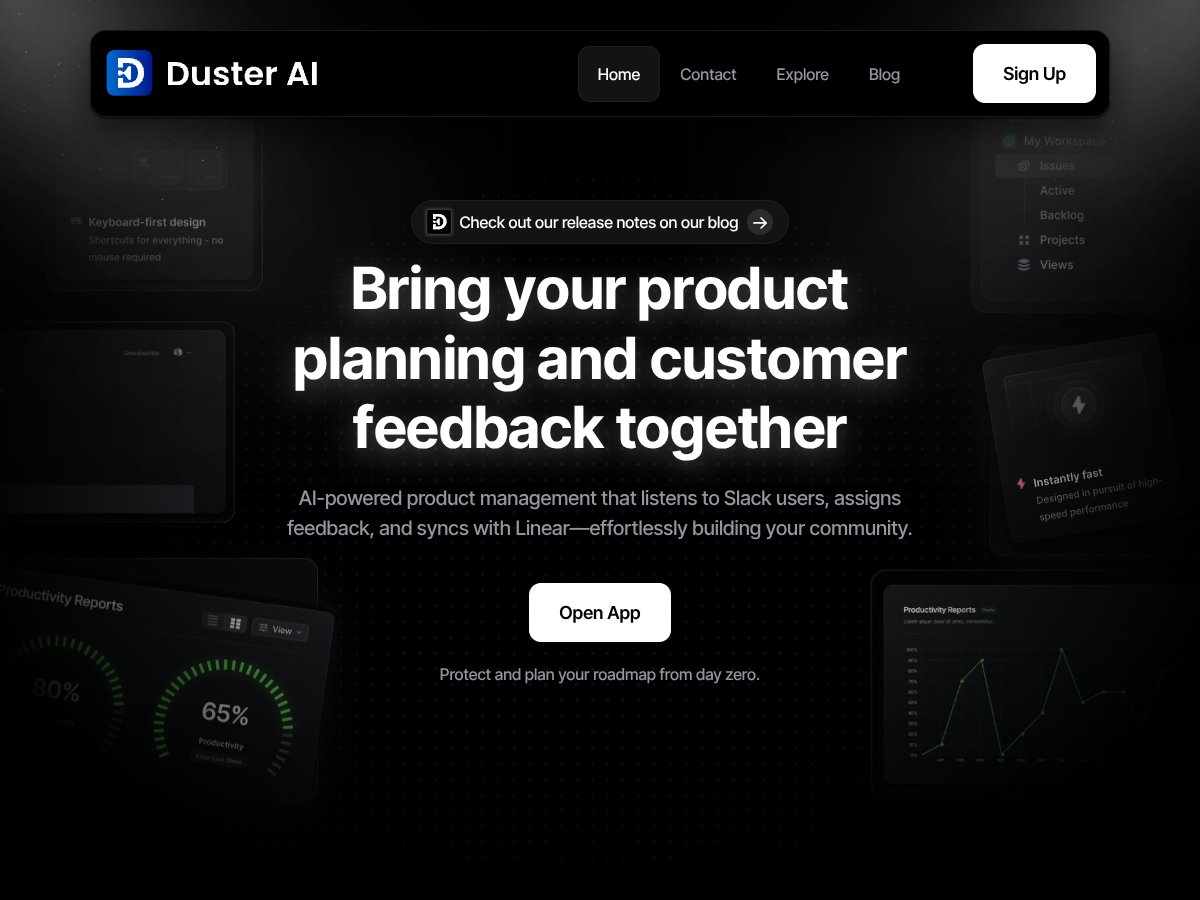
Honestly, I was pretty curious about Duster after hearing it’s supposed to help product teams stay aligned and build better products by using AI-driven tools. In practice, what I found was a platform that aims to streamline collaboration, task management, and project insight — all with some AI magic sprinkled in. The thing is, it promises to help teams move from just answering tickets and managing chaos to actually having a clear roadmap and better focus.

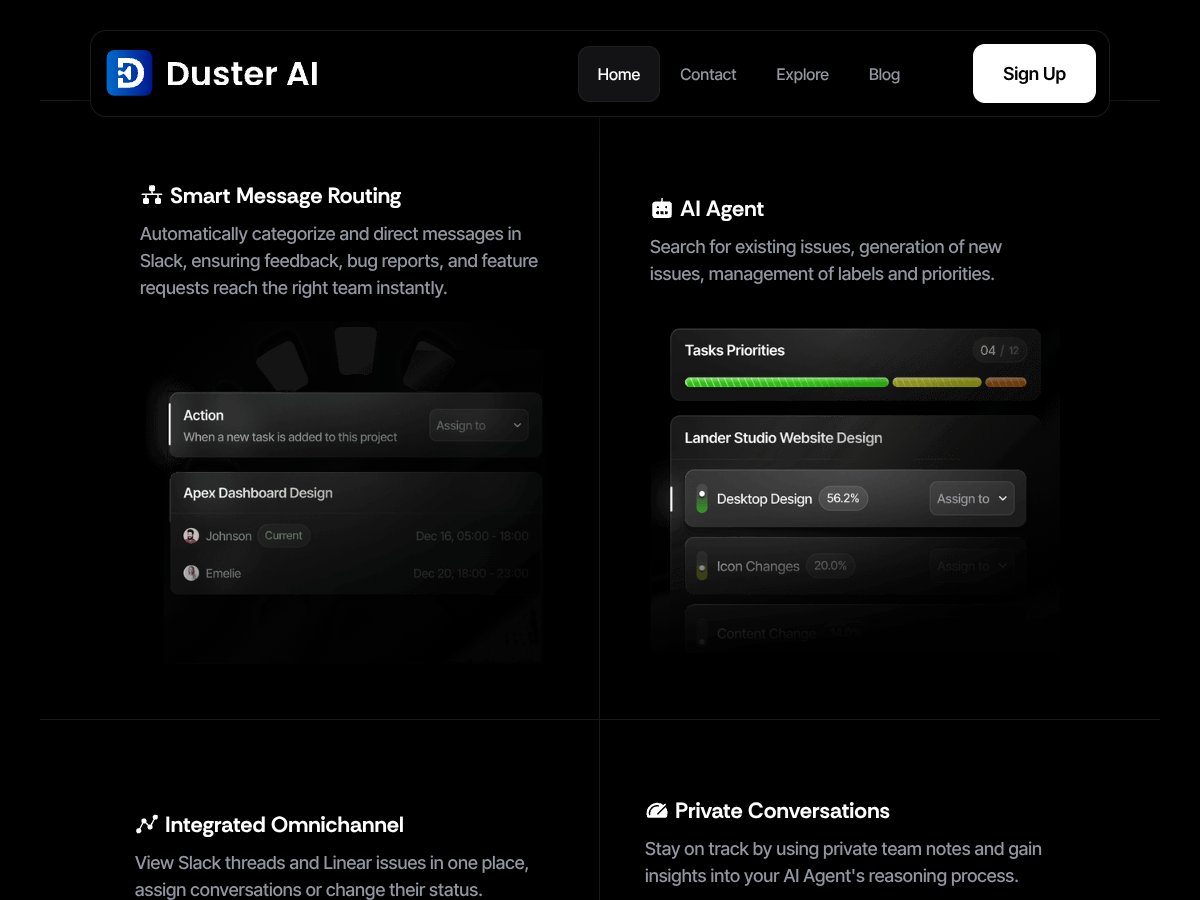
What it’s trying to solve is the common mess in product development: too many tools, scattered communication, unclear priorities, and a lot of wasted time. Duster claims to bring everything together — Slack, Linear, Discord, and OpenAI — so teams can work more efficiently without jumping between apps. It’s pitched as a way to reduce the noise and keep everyone on the same page, with AI helping to surface insights and automate routine tasks.

As for the behind-the-scenes, Duster is developed by Automateed.com, which is not a household name but seems to focus on AI-powered productivity tools. My initial impression was that it’s a fairly straightforward idea — a kind of command central for product teams — but I was skeptical about how well it actually pulls off this integration and whether it’s more than just a fancy wrapper around existing tools.

To be upfront, Duster isn’t a full-fledged project management suite like Jira or Notion. It doesn’t seem to have a deep feature set for detailed planning or documentation. Instead, it’s more about creating a smooth workflow and giving teams some AI-powered guidance. It’s not a replacement for your project management tool, but rather a supplement — if it works as advertised.

One heads up: The platform’s features, as described, seem promising but somewhat vague. I didn’t find detailed documentation or a clear demo beforehand, so I had to dive in to see what’s really there. Also, there’s no info on how well it scales or how it handles complex workflows. So, manage expectations — it might be useful for small to medium teams, but larger enterprises could find it limited.

Duster - Build better products Pricing: Is It Worth It?

Duster - Build better products interface
Duster - Build better products in action
Plan Price What You Get My Take
Free Tier Free Basic access, limited AI credits, core collaboration tools, integrations with Slack and Linear, private notes, basic workflows Great to test drive, ideal for small teams or individual users curious about AI-assisted product management. However, the free tier likely limits AI credits and advanced features, so it may not support heavy workflows.
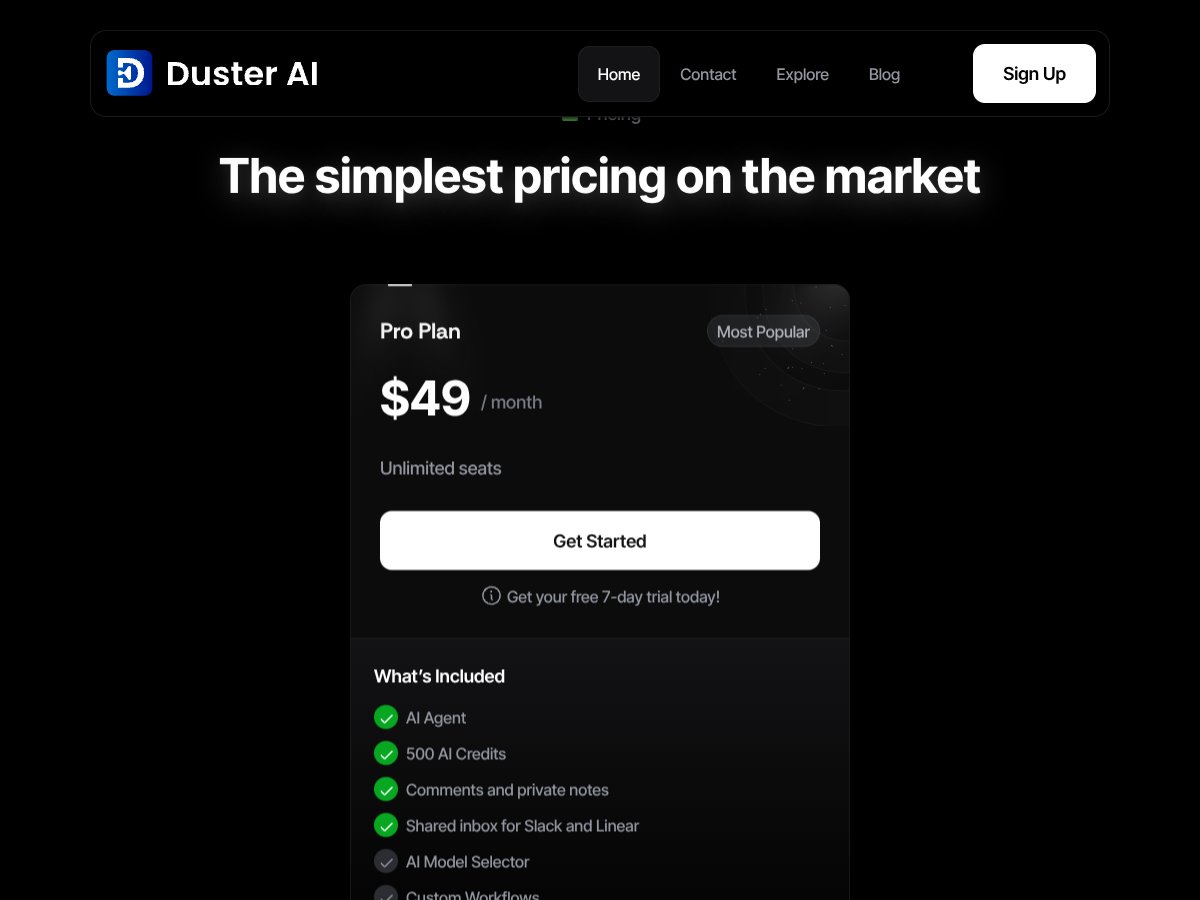
Pro Plan $49/month Unlimited seats, 500 AI credits, AI agent, comments/private notes, shared inbox, AI model selector, custom workflows, multimodal support, live onboarding, organization management, free integrations, unlimited storage, pay-as-you-go credits This plan seems targeted at growing teams needing full collaboration with AI assistance. $49/month isn’t cheap, but considering unlimited seats and advanced features, it could be fair—if you’re getting real value from the AI and integrations.

Honest assessment: Here's the thing about the pricing—

While the Pro plan's $49/month price point isn’t the lowest on the market, it’s relatively competitive given the scope—unlimited seats, AI credits, and integrations. Compared to alternatives like Productboard or Aha!, which can run into hundreds per month for similar team sizes, Duster’s pricing might be attractive for startups or small teams that want AI-powered workflows without breaking the bank.

What they don't tell you on the sales page is whether the 500 AI credits are enough for your use case—some teams might burn through that quickly if they rely heavily on AI for issue generation or insights. And, as always, watch out for potential feature gates or usage caps that could limit the value—details are a little fuzzy here, so be prepared to ask questions during onboarding.

Fair warning: If your team is very large or needs extensive integrations and customizations, the free integrations and storage might not cut it long-term. Also, if you’re expecting transparent, detailed pricing with no hidden costs, this might be less clear until you explore the plan in more detail on their site.

Overall, for teams wanting AI-driven product management tools at a reasonable price, the Pro plan could be a solid choice. But if you’re a solo founder or a small team just experimenting, the free tier might suffice—just be aware of its limitations.

How Duster - Build better products Stacks Up Against Alternatives

Productboard

  • Productboard is a mature, feature-rich product management tool that offers in-depth roadmapping, customer feedback collection, and prioritization. It’s more comprehensive for teams needing detailed customer insights and stakeholder management.
  • Pricing is generally higher, starting around $20/user/month, and can go up depending on the plan and add-ons. It’s not cheap but packed with advanced features.
  • Choose this if you need extensive customer feedback integration, detailed roadmaps, and stakeholder collaboration in one platform.
  • Stick with Duster if you want a more streamlined, purpose-driven workflow focused on team alignment and AI-powered insights without the bloat of extra features.

Aha!

  • Aha! is a powerful roadmapping tool that emphasizes strategic planning and goal-setting. It’s ideal for product teams that need to align their roadmaps with broader business objectives.
  • Pricing starts around $59/month for small teams, which is quite steep, especially for startups or small businesses.
  • Choose Aha! if your focus is on high-level strategic planning and linking product ideas to company goals.
  • Stick with Duster if you prefer a more tactical, day-to-day product management tool with AI support rather than heavy strategic features.

Roadmunk

  • Roadmunk offers simple, visual roadmapping with drag-and-drop interfaces and collaboration options. It’s great for teams needing clear visual plans and easy sharing.
  • Pricing starts at about $19/user/month, making it accessible for smaller teams.
  • Choose this if you want straightforward visual roadmaps and minimal fuss in planning.
  • Stick with Duster if you need more integrated AI-driven suggestions and a focus on team alignment rather than just visuals.

ProdPad

  • ProdPad combines product backlog management with roadmapping and customer feedback. It’s useful for teams wanting to connect backlog prioritization with strategic planning.
  • Pricing is around $20/user/month, with tiers offering more features.
  • Choose ProdPad if backlog and customer feedback management are your priorities.
  • Stick with Duster if your main goal is to streamline team collaboration and goal alignment with AI insights, rather than backlog management.

Craft.io

  • Craft.io offers a flexible product management platform with backlog, roadmaps, and collaboration tools. It’s geared towards teams that want an all-in-one solution.
  • Pricing is similar, around $15-$25/user/month, depending on features.
  • Choose Craft.io if you need a comprehensive product management suite with robust planning tools.
  • Stick with Duster if you prefer a lighter, AI-powered, purpose-driven approach over a full suite of product management features.

Bottom Line: Should You Try Duster - Build better products?

Duster - Build better products interface
Duster - Build better products in action

Overall, I’d rate Duster a solid 7/10. It’s a fresh, purpose-driven tool that’s great if your team values alignment, focus, and AI insights. It’s not perfect — the interface can feel a bit early-stage, and some integrations are still limited. But if you’re looking to cut through the noise and build better products with a clear roadmap, it’s worth a shot.

If your team is small, hungry to stay aligned without drowning in features, give Duster a try — especially the free tier to see how it fits your workflow. For larger organizations needing extensive integrations and detailed planning, you might find more mature tools like Productboard or Aha! better suited. I’d personally recommend it if you’re starting a new product or want to test a more purposeful, AI-powered approach.

In short, if your main pain is team misalignment or scattered priorities, give Duster a shot. If your needs are more strategic or customer feedback-heavy, look at alternatives first.

Common Questions About Duster - Build better products

  • Is Duster - Build better products worth the money? - It’s a promising tool for teams focused on alignment and purpose. It’s still early-stage, so it might lack some advanced integrations, but if those are not critical, it’s worth trying.
  • Is there a free version? - Yes, Duster offers a free tier, which is great for testing basic features. Paid plans add more integrations and advanced AI insights.
  • How does it compare to Productboard? - Duster is more streamlined and AI-focused, while Productboard offers more comprehensive customer feedback and stakeholder management. If you want simplicity and purpose, Duster wins; for detailed customer insights, Productboard might be better.
  • Can I get a refund? - Refund policies depend on the plan and the vendor’s terms, so check their website or contact support for specifics.
  • Does it integrate with Slack or other tools? - Yes, Duster supports Slack, Linear, Discord, and OpenAI, making collaboration smoother for teams using those platforms.
  • Is it suitable for large teams? - It’s best for small to mid-sized teams. Larger organizations might need more robust solutions with extensive integrations and customization.

As featured on

Automateed

Add this badge to your site

Stefan

Stefan

Stefan is the founder of Automateed. A content creator at heart, swimming through SAAS waters, and trying to make new AI apps available to fellow entrepreneurs.

Related Posts

FaceSymmetryTest Review – Honest Look at Free AI Tool

FaceSymmetryTest Review – Honest Look at Free AI Tool

FaceSymmetryTest is a fun online tool

Stefan
Sweep Review – An AI Assistant for JetBrains IDEs

Sweep Review – An AI Assistant for JetBrains IDEs

Sweep enhances productivity in JetBrains IDEs

Stefan
AI Song Maker Review – Simple & Creative Music Generation

AI Song Maker Review – Simple & Creative Music Generation

easy way to create music with AI

Stefan

Create Your AI Book in 10 Minutes