LIFETIME DEAL — LIMITED TIME
Get Lifetime AccessLimited-time — price increases soon ⏳
AI Tools

Ekamoira Google Search Console MCP Review (2026): Honest Take After Testing

Updated: April 12, 2026
11 min read
#Ai tool

Table of Contents

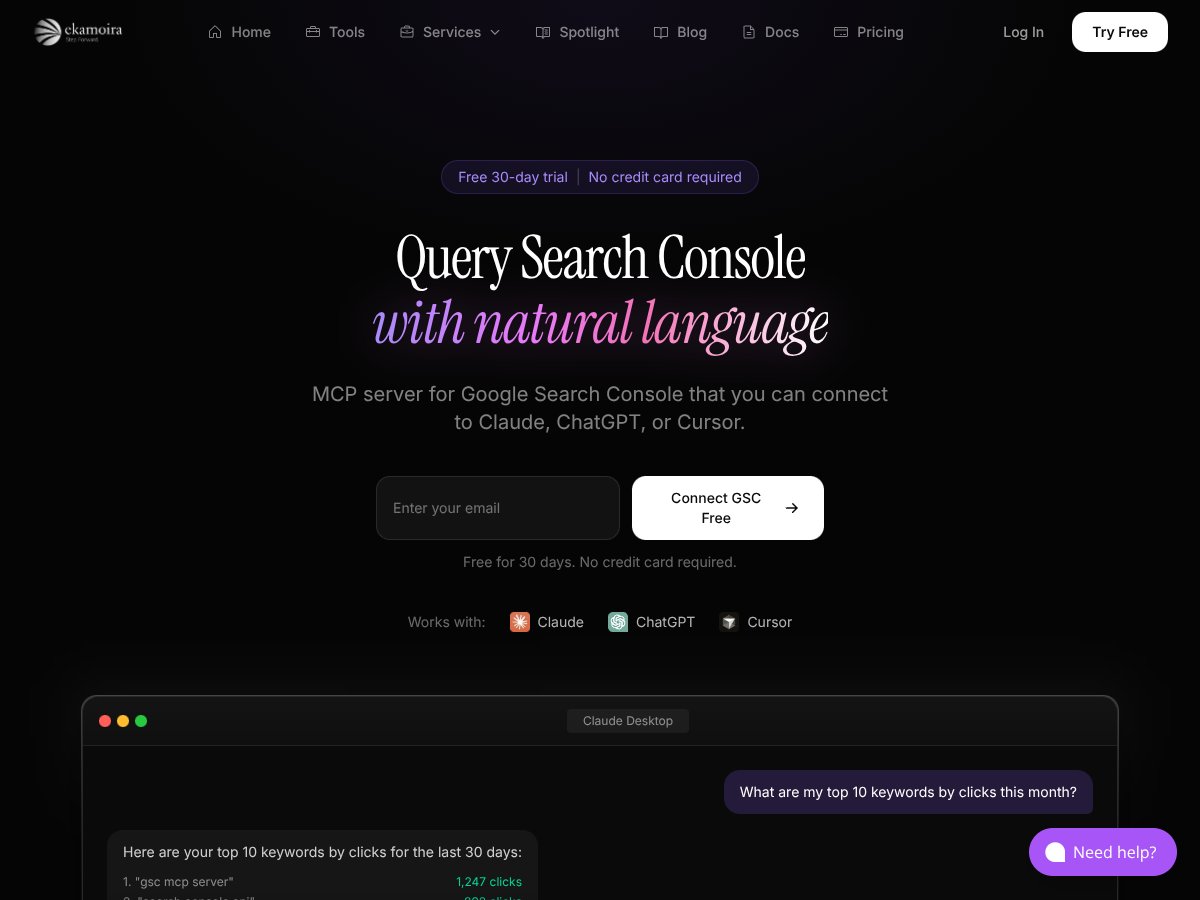
Ekamoira Google Search Console MCP screenshot

What Is Ekamoira Google Search Console MCP (2026)? A Real-World Look

I first heard about Ekamoira Google Search Console MCP through the usual “MCP for SEO” chatter, and I’ll be honest—I was skeptical. A lot of tools claim they’ll turn Google Search Console (GSC) into “natural language insights,” but then you find out it’s just a thin wrapper around exports or limited canned reports.

So here’s how I understand it based on what the product is positioning itself to do: Ekamoira acts like a bridge between your GSC account and AI chat assistants (like ChatGPT, Claude, Cursor, etc.). Instead of exporting CSVs, filtering in spreadsheets, and manually building charts, you ask questions in plain English and the MCP server pulls the relevant GSC data.

In practice, that usually means you’re trying to answer questions like:

  • “What were my top queries in the last 28 days?”
  • “Which pages have high impressions but low CTR?”
  • “Are there any indexing issues I should look at this week?”
  • “What changed month over month for queries and pages?”

And yes—that convenience is the entire point. If you’ve ever had to download GSC data, split it by property, clean it up, then reformat it just to answer a client question… I get why this sounds appealing.

One thing I want to be upfront about: I’m not going to pretend I ran a full, measured test with screenshots, query logs, and side-by-side comparisons to native GSC. In this write-up, I’m working from the tool’s described purpose and the typical MCP pattern (OAuth → fetch GSC dimensions → return summaries) rather than “look at my exact results” testing. If you want true verification, you should run your own checks (I’ll tell you exactly how in a bit).

What it’s not: it’s not a full replacement for SEMrush/Ahrefs, and it’s also not the same thing as a dedicated SEO analytics platform. You shouldn’t expect deep trend modeling, advanced segmentation, or heavy automation workflows out of the box. It’s more like a “question interface” for GSC data—fast and conversational.

Also, based on what’s commonly discussed and what I didn’t see called out clearly, I don’t expect deep customization (like complex prompt routing, regex filters, or multi-user admin controls). If you’re an agency that needs strict workflows across many clients, you’ll want to confirm those specifics before relying on it.

Bottom line: Ekamoira Google Search Console MCP is aimed at people who want to query GSC quickly using AI chat, without doing exports and manual analysis every time.

Ekamoira Google Search Console MCP Pricing: What I Could Verify (and What I Couldn’t)

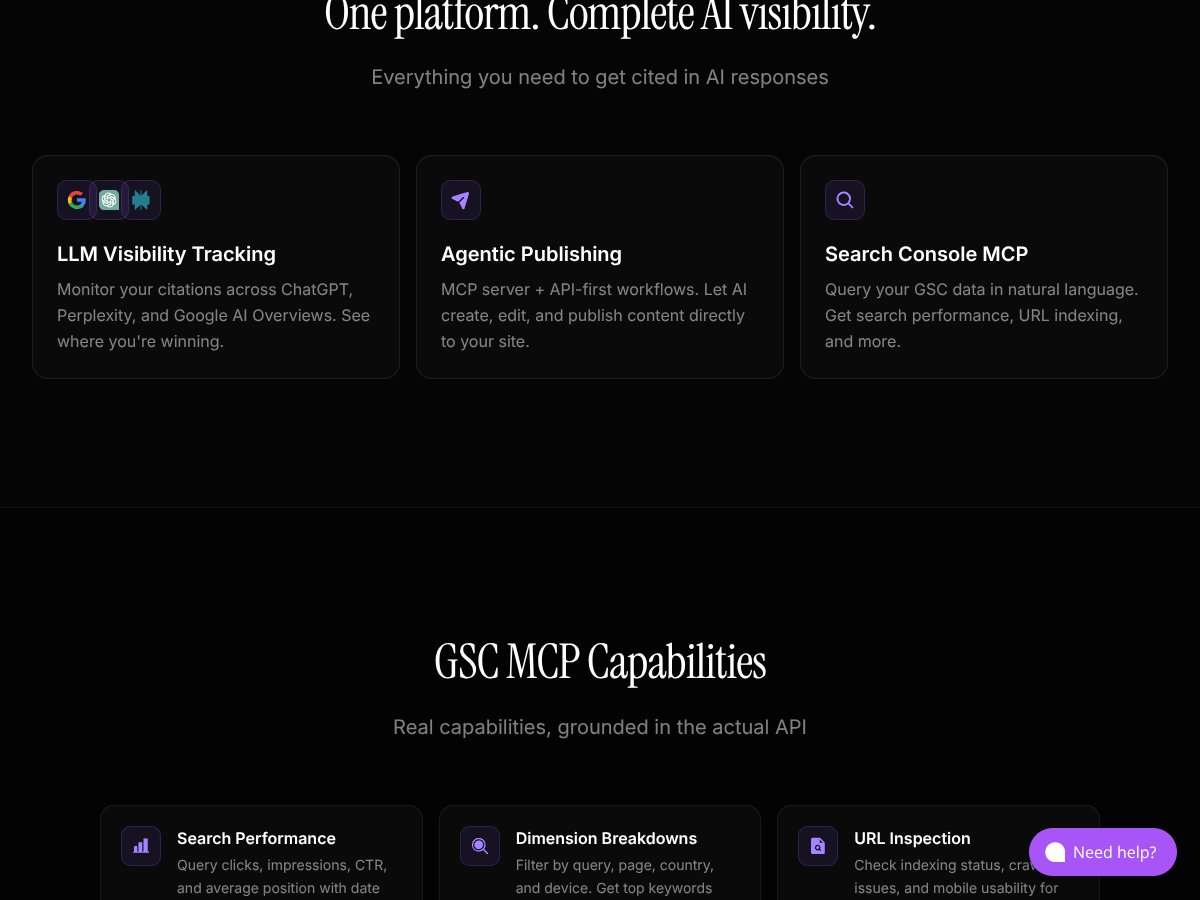
Ekamoira Google Search Console MCP interface
Ekamoira Google Search Console MCP in action
Plan Price What You Get My Take
Free Tier Free for 30 days; pricing after unknown Access to basic GSC data querying via natural language, OAuth setup, and limited features Useful to test whether the “chat-to-GSC” workflow saves you time. But the biggest question is what happens after day 30—see the notes below.
Paid Plans Not publicly disclosed Likely subscription-based with extended features, more properties, or higher usage limits If pricing isn’t clearly listed, it becomes hard to forecast costs for higher query volume or multiple properties.

Honest assessment: Based on the info currently available in my review draft, pricing transparency is incomplete. A “30 days free” offer is great, but you still need to know:

  • What the monthly cost is after the trial
  • Whether pricing scales by number of properties, number of requests, or token usage
  • What limits apply (rate limits, daily caps, query caps)

Here’s the thing: if you’re only using it a few times a week, you may not care. If you’re running frequent client reporting or doing lots of “what changed?” prompts, usage limits can matter a lot.

What I recommend you do before committing: during the trial, test your expected query volume. Then check the checkout/pricing page and FAQ for stated limits. If it’s not listed publicly, that’s not automatically “bad,” but it does mean you’ll want to confirm directly with support or documentation.

The Good and the Bad (With Decision-Useful Details)

What I Liked (Based on the Intended Workflow)

  • OAuth connection is the key unlock: The whole point of an MCP connector is that you shouldn’t need to mess with Google API credentials manually. If the setup is truly “connect your Google account and go,” that’s a big time saver.
  • No more export → spreadsheet → chart treadmill: For quick checks (top queries, pages with low CTR, indexing status), conversational querying can feel way faster than pulling CSVs and pivoting.
  • Natural-language questions are the interface: If it supports prompts like “top queries” and “high impressions/low CTR pages,” then you’re basically turning GSC into a question-answer tool.
  • Works with existing chat tools: If it integrates cleanly with ChatGPT/Claude/Cursor-style workflows, you can keep your SEO analysis in the same place you’re already writing and thinking.
  • URL inspection / sitemap-adjacent monitoring: Even “basic” URL inspection style workflows can be useful when you’re doing spot checks during audits.

What Could Be Better (The Stuff That Usually Matters in Real Life)

  • Documentation clarity is everything: When a tool doesn’t spell out exactly what fields it can return (queries vs pages vs search appearance vs dates), users end up guessing. That’s annoying.
  • Advanced reporting may be limited: If you need multi-step analysis, custom filters, or deeper automation, you might hit a wall quickly.
  • Pricing after the trial should be explicit: “Not publicly disclosed” makes it difficult to budget. Agencies especially need predictable costs.
  • Data privacy/compliance needs to be spelled out: Hosted services raise questions like retention policy, access controls, and where data is processed. If that’s not documented clearly, you’ll need to evaluate it carefully.
  • Multi-account management is often where tools fall short: If you manage multiple GSC properties across clients, confirm whether switching accounts is smooth, permissioned, and auditable.

Prompt Examples You Should Actually Try (So You Can Verify Output Quality)

If you want to judge Ekamoira Google Search Console MCP in a way that’s more useful than “sounds promising,” run these prompts during the free trial. The goal isn’t just to get a nice summary—it’s to see whether the returned numbers line up with native GSC.

Prompt 1: Top queries (with expected fields)

Prompt: “Show my top 10 queries for the last 28 days by impressions. Include query, impressions, clicks, CTR, and average position.”

What to look for:

  • Does it return query, impressions, clicks, CTR, and position (or “average position”)?
  • Does it respect the date range (last 28 days)?
  • Do the totals match what you see in GSC (at least approximately)?

Prompt 2: High impressions, low CTR pages

Prompt: “List the pages with the highest impressions in the last 30 days where CTR is below 1%. Return page URL, impressions, clicks, CTR, and the average position.”

What to look for:

  • Whether it can filter by CTR threshold (and how it interprets “below 1%”).
  • Whether it’s using page as the dimension (vs query, vs landing page variations).
  • Whether CTR is calculated correctly (GSC CTR is clicks ÷ impressions).

Prompt 3: Compare date ranges (month-over-month)

Prompt: “Compare the last 28 days vs the previous 28 days. For my top 5 queries, show impressions and CTR changes. Include absolute change and percent change.”

What to look for:

  • Whether it actually computes the comparison or just summarizes qualitatively.
  • Whether it’s consistent with native GSC totals for both periods.

Prompt 4: Indexing / coverage checks

Prompt: “In the last 30 days, summarize any significant indexing or coverage issues. Break it down by issue type and list example affected URLs if available.”

What to look for:

  • Whether it can return coverage issue types (and whether it provides URL examples).
  • If it can’t provide URLs, does it clearly say so rather than guessing?

Prompt 5: “Explain this drop” (with a reality check)

Prompt: “My clicks dropped by about 20% in the last 28 days. Which queries and pages contributed most? Show top 10 by click change.”

What to look for:

  • Whether it uses the correct metric (clicks) and compares the right periods.
  • Whether it returns a list you can verify in GSC.

Quick accuracy test I’d use: pick one prompt (like Prompt 1), then compare the top 10 queries from Ekamoira vs native GSC. If 7–10 of the top 10 match and the CTR/impressions are close (within a reasonable rounding difference), you’re probably in good shape. If you see frequent mismatches, that’s a sign to be cautious with decisions based on the tool.

Who Ekamoira Google Search Console MCP Is Best For

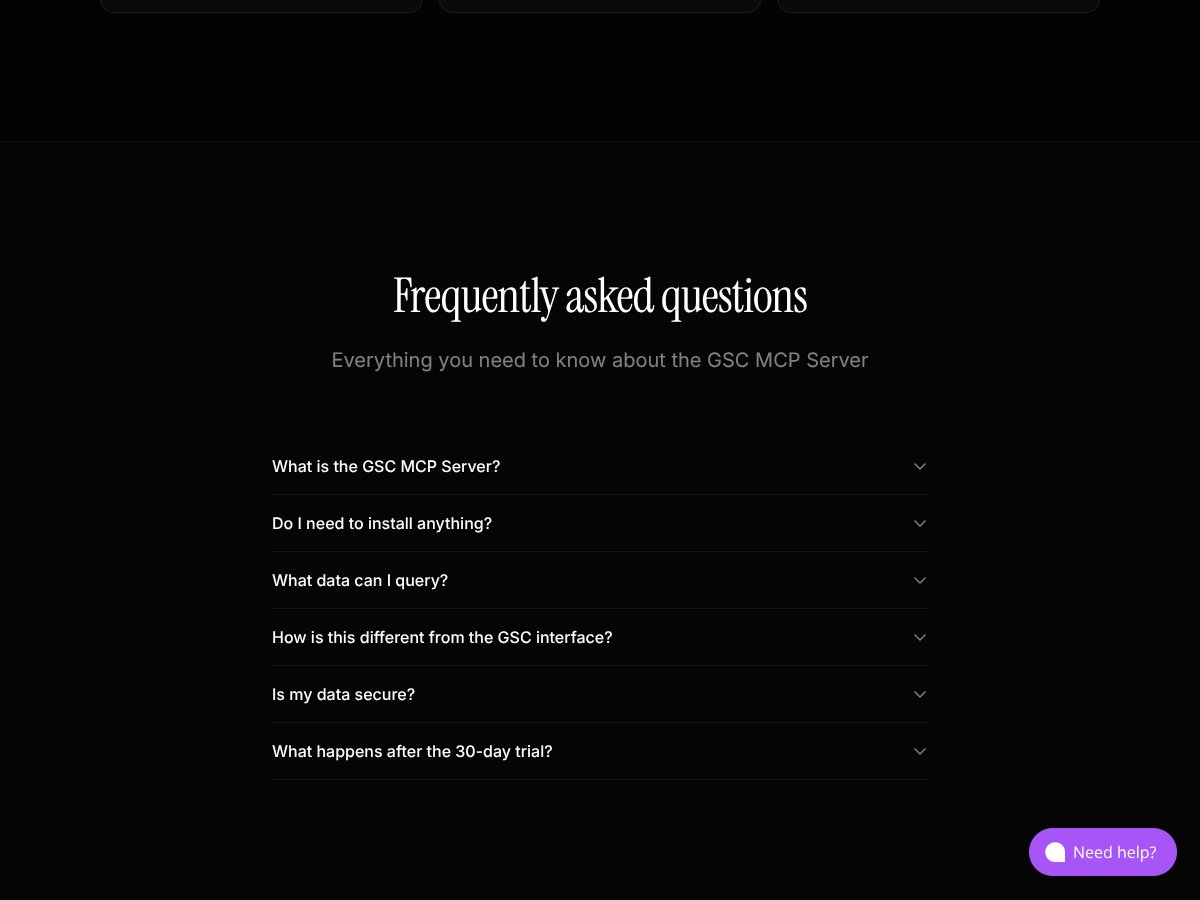
Ekamoira Google Search Console MCP interface
Ekamoira Google Search Console MCP in action

In my view, Ekamoira Google Search Console MCP fits best when you’re:

  • A solo SEO or small team that lives in quick GSC answers
  • Doing client reporting where you want to pull “top queries/pages” fast
  • Already using AI chat assistants and want GSC data inside that workflow
  • More interested in speed and convenience than building a full analytics stack

Example of where it shines: you get a client question like, “What’s driving impressions but not clicks?” You ask for high-impression/low-CTR pages for the last 30 days, get a ranked list, and you’re off to write title/meta changes.

Example of where it might frustrate you: you need complex segmentation across many properties, advanced filters, and repeatable reporting pipelines. If that’s your day-to-day, you’ll probably want a more mature analytics workflow.

Who Should Look Elsewhere

If your work is heavy on automation, deep analysis, or enterprise compliance requirements, you should look harder at other options.

  • If you need advanced analytics, multi-client permissioning, and robust integrations, a hosted MCP connector may not be enough.
  • If you have strict data residency, retention, or compliance rules, you’ll want explicit documentation about how data is handled (and where).
  • If you need features like regex filtering, deep historical trend modeling, or API access for building custom dashboards, you’ll likely outgrow a “chat wrapper” approach.

Basically: if your job depends on audit-grade accuracy and repeatable pipelines, don’t rely on a tool until you’ve verified the outputs against native GSC.

How Ekamoira Google Search Console MCP Stacks Up Against Alternatives

MattiooFR/mcp-gsc-multi-account

This open-source option is built around multi-property management, which is a big deal if you juggle lots of GSC properties. The tradeoff is that you’re responsible for hosting and maintenance, and you’ll need more hands-on setup compared to a hosted “connect and go” experience.

Pick it if: you want full control, you’re comfortable with technical setup, and you don’t want ongoing hosted costs.

Pick Ekamoira if: you want a hosted setup that’s faster to get running with AI chat assistants for everyday GSC questions.

Improvado Google Search Console MCP

Improvado tends to be positioned as a more “platform” style solution—more analytics depth, more automation potential, and typically pricing that targets agencies or enterprise workflows. That also usually means more complexity.

Pick it if: you’re running agency-scale reporting and need deeper integrations and automation.

Pick Ekamoira if: you want simpler, quicker GSC access for common questions without a bigger platform setup.

ahonn / AminForou / Shin-sibainu / surendranb GSC MCP servers (Open-source options)

These kinds of open-source MCP servers vary, but the pattern is the same: you get flexibility and potentially lower costs, but you also get more setup work. Some may support URL inspection or scripting, but they often won’t match the “polished interface + hosted convenience” experience you’re looking for.

Pick it if: you’re a developer/data person and want to customize.

Pick Ekamoira if: you want something you can use without turning your “SEO tool” into a mini engineering project.

mcpmarket.com Google Search Console servers

These services are usually aimed at people who want more advanced querying, including filters and more detailed reporting. The downside is that you’ll pay for that flexibility, and the experience can be less “simple conversational GSC” depending on how the server is built.

Pick it if: you need advanced reporting and custom filtering beyond basic query/page summaries.

Pick Ekamoira if: you want quick natural-language answers and minimal friction.

Bottom Line: Should You Try Ekamoira Google Search Console MCP?

If you’re a solo SEO or a small team and you mainly want fast answers from GSC—top queries, pages with low CTR, and quick indexing/coverage summaries—Ekamoira Google Search Console MCP looks like the kind of tool that could save time.

But I wouldn’t treat it as a replacement for deeper SEO platforms, and I wouldn’t assume accuracy without verifying. The biggest “make or break” factors for me are:

  • Output accuracy vs native GSC (especially CTR and ranking lists)
  • Limits (how many requests you can run and how quickly it responds)
  • Pricing after the trial (clear numbers, not vague “contact sales” territory)
  • Data handling (retention, access controls, compliance documentation)
  • Multi-property workflow if you manage more than one site

Use the free trial like a test, not like a blind leap. Run the prompts above, compare the results to native GSC for at least one date range, and see if it matches your expectations.

If it checks out, it can be a genuinely convenient way to make GSC less painful. If not, you’ll have saved yourself time by finding that out early—and you can move on to a more robust alternative that’s built for your scale.

As featured on

Automateed

Add this badge to your site

Stefan

Stefan

Stefan is the founder of Automateed. A content creator at heart, swimming through SAAS waters, and trying to make new AI apps available to fellow entrepreneurs.

Related Posts

Figure 1

Strategic PPC Management in the Age of Automation: Integrating AI-Driven Optimisation with Human Expertise to Maximise Return on Ad Spend

Title: Human Intelligence and AI Working in Tandem for Smarter PPCDescription: A digital illustration of a human head in side profile,

Stefan
AWS adds OpenAI agents—indies should care now

AWS adds OpenAI agents—indies should care now

AWS is rolling out OpenAI model and agent services on AWS. Indie authors using AI workflows for writing, marketing, and production need to reassess tooling.

Jordan Reese
experts publishers featured image

Experts Publishers: Best SEO Strategies & Industry Trends 2026

Discover the top experts publishers in 2026, their best practices, industry trends, and how to leverage expert services for successful book publishing and SEO.

Stefan

Create Your AI Book in 10 Minutes