LIFETIME DEAL — LIMITED TIME
Get Lifetime AccessLimited-time — price increases soon ⏳
AI Tools

Fineas.ai Review – Your Friendly Investment Chat Companion

Updated: April 20, 2026
7 min read
#Ai tool#Finance

Table of Contents

If you’re trying to learn investments without drowning in spreadsheets, Fineas.ai is the kind of tool that sounds like it could help. I tested it by using the chat and the analysis flow to ask a few “real life” questions—stuff I’d actually want answered when I’m scanning markets and trying to understand what a move might mean.

Quick note on my testing: I used it as a regular user (not as a developer), and I focused on what you can see and do in the UI: how the chat responds, what “analysis” produces, and whether there’s enough transparency to trust the output. I didn’t see any obvious, public-facing documentation that explains the data sources, model details, or performance metrics—so I’m calling that out where it matters.

Fineas.ai Review: What It’s Like to Use for Stock & Market Questions

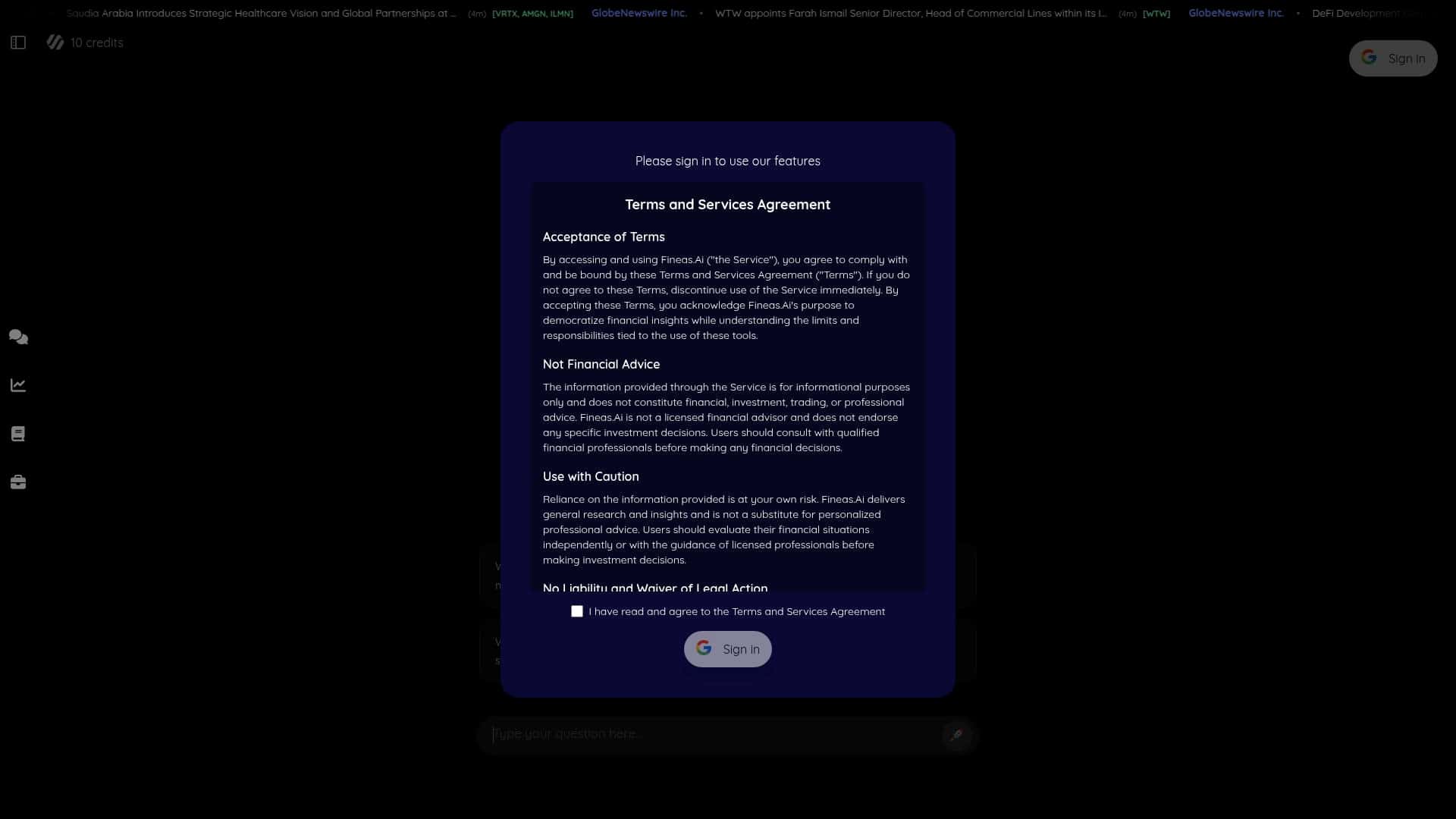
When I opened Fineas.ai, the first thing I noticed was how straightforward it feels. The layout is clean, and the navigation is simple enough that I didn’t feel like I had to “learn the app” before I could start asking questions. You’ve got the main sections up front, and I could jump between them without getting lost.

What I actually used most was the chat. The tone is friendly and educational, and it’s built for explaining concepts in plain English. That’s a big deal if you’re new, because nobody wants to read a 2,000-word primer every time they wonder what a term means.

Here are a few examples of the kinds of prompts I tried, and what stood out:

  • Example prompt #1: “Explain what a high P/E ratio usually means for a stock, and when it might not be a red flag.”
    In my experience, the response broke it down clearly—talking about growth expectations and comparing “expensive vs. justified” rather than just saying “high P/E = bad.” That’s helpful for learning.
    Limitation I noticed: I didn’t see a consistent, explicit source list (like links to filings/news) inside the response, so I couldn’t verify where each explanation came from.
  • Example prompt #2: “Give me a simple checklist to evaluate a company before buying.”
    The chat gave a structured checklist vibe—things like business model, competitive position, financial health, and risks. It felt like something you could use right away.
    Limitation I noticed: it didn’t turn into a “bring me the company’s latest numbers” workflow in a way that felt fully grounded in live, verifiable data. It read more like guidance than like a hard data report.
  • Example prompt #3: “How should I think about risk if I’m investing for 3–5 years?”
    This was one of the more practical answers. It framed risk in terms of time horizon and volatility, and it didn’t just throw jargon at me.
    Limitation I noticed: there’s no obvious place where it shows performance metrics, latency, or any transparency about how it decides what to emphasize for your horizon.

So yes—the chat is engaging, and it does a decent job of translating finance into something easier to digest. But it’s not the same thing as a professional research terminal. If you’re looking for hard numbers, citations, and audit-friendly reasoning, you may find yourself doing extra checking elsewhere.

Key Features: Chat, Analysis, Courses, and Portfolio (as I saw them)

  • Analysis section (what it seems to do): The app is set up to help you explore investment ideas through an analysis flow. In practice, I used it as a guided way to think through topics rather than expecting it to behave like a full valuation engine. The outputs felt like summaries and structured explanations more than deep model-driven reports.
  • Chat interface: This is the core. You ask a question, and it responds with explanations and next-step thinking. There are also suggested prompts, which I liked because they help you get started when you don’t know what to type.
  • Suggested question prompts: These are handy for “warm starting” your learning. Instead of staring at a blank box, you can pick a prompt and adapt it to your interests (stocks, markets, investing basics, etc.).
  • Courses: Fineas.ai also includes a learning layer. I didn’t spend hours inside each course module during my test, but the existence of courses matters because it signals the app isn’t only reactive chat—it’s also trying to teach.
  • Portfolio section: There’s a Portfolio area in the navigation. I’m mentioning it because it’s part of the “investor companion” concept. That said, I didn’t see enough public detail about how portfolio tracking works (what’s imported, what’s stored, and how often it refreshes data), so I can’t confidently say it’s fully robust yet.
  • Responsive design: The UI adapts well across devices. I tested it on different screen sizes, and it remained usable without feeling cramped or broken.

One thing I wish I had: clearer transparency. For example, I didn’t find a straightforward “how it works” section that explains whether it’s pulling from specific market data providers, whether it cites sources, or how it handles uncertainty. For investing content, that transparency isn’t “nice to have”—it’s essential.

Pros and Cons (based on what I experienced)

Pros

  • Clean, intuitive UI: The navigation makes it easy to switch between chat, analysis, courses, and portfolio without friction.
  • Friendly explanations: The chat feels designed to teach, not just answer. It’s easier to understand than a lot of “finance speak” content.
  • Suggested prompts help beginners: If you’re not sure what to ask, the app gives you a starting point.
  • Works across devices: I could use it comfortably on both smaller and larger screens.

Cons

  • Pricing/subscription clarity is lacking: I couldn’t find a clear pricing breakdown during my review, which makes it hard to judge value.
  • Limited transparency on data/security: I didn’t see clear information about backend technology, data handling, or security practices.
  • No obvious performance metrics: I didn’t see latency stats, model type/model version, or accuracy evaluation. For an AI assistant, those details matter if you care about reliability.
  • May feel basic for advanced users: If you want deep analytics (like factor models, detailed valuation frameworks, or citation-heavy research), you may end up wanting more.
  • Not always “verifiable research”: Explanations were helpful, but I didn’t consistently see citations or source links that would let me quickly verify claims.

Pricing Plans: What I Could (and Couldn’t) Confirm

Here’s the part I don’t love: Fineas.ai doesn’t clearly spell out pricing plans or subscription tiers in a way I could verify during this review. I can’t confidently tell you what’s free, what’s paid, or what premium users get—because the details weren’t clearly available.

Why this matters: with tools like this, pricing affects how you should evaluate it. If the “analysis” features are locked behind a paywall, that changes the whole value proposition. If chat is free but portfolio tracking isn’t, that’s also a big difference.

What you should do next: when you open Fineas.ai, check the in-app pricing page (or any “Billing/Plans” section in settings). If you don’t see it, that’s a red flag for transparency. At minimum, you want to confirm:

  • Is there a free tier?
  • What’s included in any paid plan?
  • Whether features like analysis depth, courses, or portfolio tools require a subscription
  • Any limits (message caps, access windows, or usage restrictions)

Wrap up

Fineas.ai is a solid option if you want a friendly investment chat companion that helps you learn and think through topics without feeling overwhelmed. I liked the clean interface, the suggested prompts, and how easily the chat explains concepts.

But if you’re the type of investor who needs verifiable sources, clear pricing, and transparency around data/security and performance metrics, you might feel held back. My recommendation is pretty simple: try the chat and see if the explanations match what you’d expect—then verify pricing and data transparency before you rely on it for decisions.

If Fineas.ai adds more backend insight (and makes pricing and sourcing clearer), it could become a lot more trustworthy. For now, it’s best viewed as an educational assistant—not a full research platform.

Stefan

Stefan

Stefan is the founder of Automateed. A content creator at heart, swimming through SAAS waters, and trying to make new AI apps available to fellow entrepreneurs.

Related Posts

Figure 1

Strategic PPC Management in the Age of Automation: Integrating AI-Driven Optimisation with Human Expertise to Maximise Return on Ad Spend

Title: Human Intelligence and AI Working in Tandem for Smarter PPCDescription: A digital illustration of a human head in side profile,

Stefan
AWS adds OpenAI agents—indies should care now

AWS adds OpenAI agents—indies should care now

AWS is rolling out OpenAI model and agent services on AWS. Indie authors using AI workflows for writing, marketing, and production need to reassess tooling.

Jordan Reese
experts publishers featured image

Experts Publishers: Best SEO Strategies & Industry Trends 2026

Discover the top experts publishers in 2026, their best practices, industry trends, and how to leverage expert services for successful book publishing and SEO.

Stefan

Create Your AI Book in 10 Minutes