Table of Contents
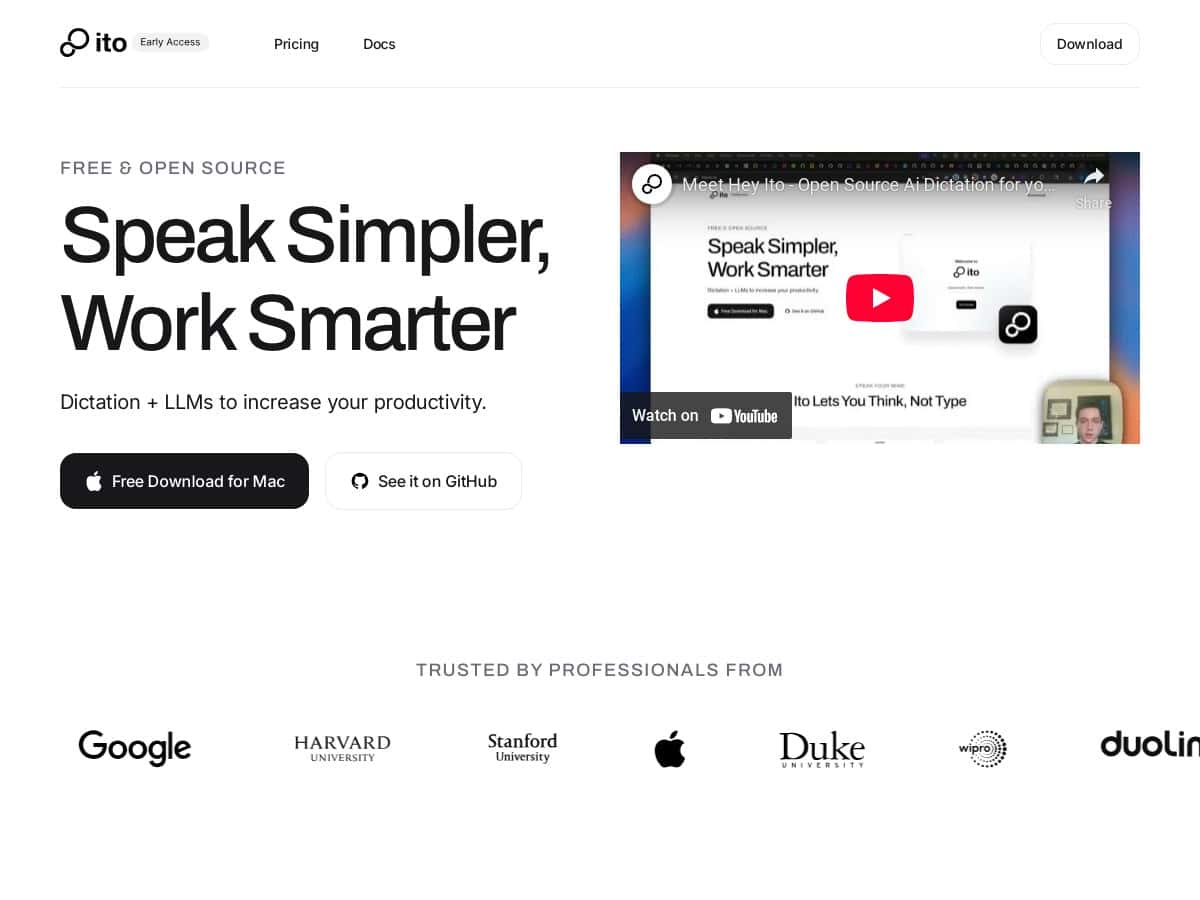
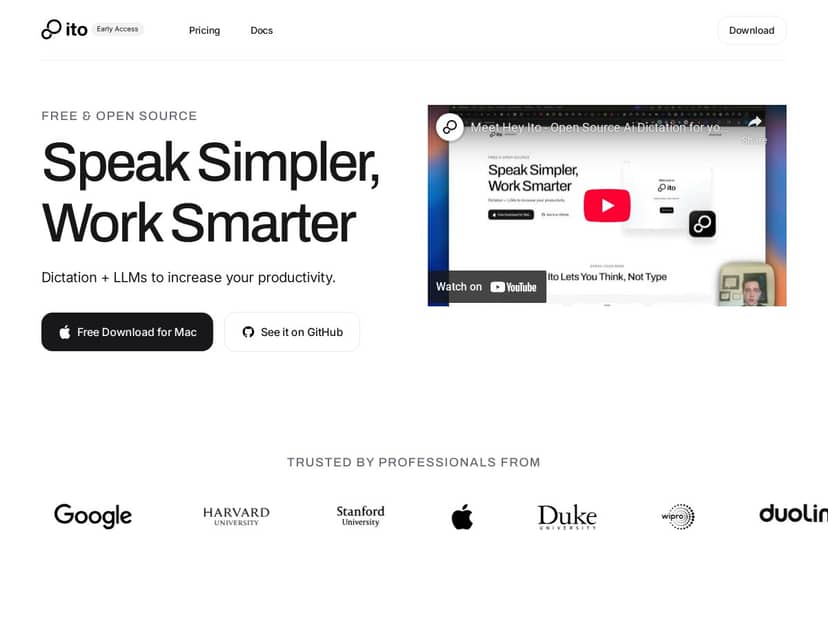
If you’ve ever stared at a blinking cursor on your Mac thinking, “I could’ve typed this faster if I just talked,” I get it. I recently tested Hey Ito, an AI voice-to-text app that’s designed to turn your speech into something you can paste into your notes, docs, and messages.
I’m going to be straight with you: it’s easy to use, and when the audio conditions are decent, the text comes out surprisingly clean. But it’s not magic. If you mumble, speak too fast, or you’re in a noisy room, you’ll still need to edit.
Quick context on my test: I used a MacBook Air (M1) running macOS Sonoma (14.x). I tested with (1) my built-in Mac microphone while sitting about 12–18 inches from the laptop and (2) a simple wired headset mic for the “clean audio” scenario. I also tried a “real world” case—typing a message in a room with a fan running in the background—just to see where it breaks.
For workflow, I used the hotkey activation and dictated into two places: a Google Doc and Slack. That matters, because some voice tools work great in one app and feel annoying in another (usually due to focus/typing behavior). Ito held up pretty well.
Hey Ito Review: How Well Does It Actually Transcribe on Mac?
Here’s what I noticed right away: Ito is built around a hotkey workflow. You focus the app you want to type into (Doc, Slack, etc.), hit the hotkey, speak, and it dumps the transcript right where your cursor is.
That sounds basic, but it’s the difference between “voice tool I tried once” and “voice tool I actually use daily.” I used it for short dictation blocks (1–3 paragraphs) and it stayed responsive.
Transcription examples (before/after)
Below are a few quick examples from my tests. I’m not claiming 100% perfect accuracy—speech recognition is always a little situational—but the output was often close enough that I only needed minor edits.
Example 1 (quiet room, clean mic)
What I said: “Hey Ito, today I’m testing voice to text on my Mac. Please format it like a short note with three bullet points.”
What I got: “Hey Ito, today I’m testing voice to text on my Mac. Please format it like a short note with three bullet points.”
Editing needed: basically none. I didn’t have to fix punctuation or weird word swaps.
Example 2 (technical terms, without custom vocabulary)
What I said: “I’m writing about vector databases, embeddings, and RAG pipelines for developer docs.”
What I got: “I’m writing about vector databases, embedings, and RAG pipelines for developer docs.”
Editing needed: I corrected “embedings” to “embeddings”. That’s the kind of error you can live with, but it’s exactly where custom vocabulary helps.
Example 3 (technical terms, with custom vocabulary)
What I said: “I’m writing about vector databases, embeddings, and RAG pipelines for developer docs.”
What I got: “I’m writing about vector databases, embeddings, and RAG pipelines for developer docs.”
Editing needed: none on those terms.
In my workflow, I added technical words/phrases in Ito’s vocabulary settings and then dictated again in the same session. The improvement was noticeable immediately—especially for multi-word terms like RAG pipelines. One caveat: I didn’t test whether the vocabulary persists across every restart indefinitely, so if you rely on a custom list long-term, it’s worth checking the app’s settings behavior after closing/reopening.
Hotkey behavior in real apps (Google Docs vs Slack)
I tested the hotkey in:
- Google Docs: Ito inserted text cleanly at the cursor. When I stopped dictating, typing resumed normally. No weird “double paste” behavior.
- Slack: It worked, but Slack can be a little picky about focus. If the message box wasn’t active, the transcript didn’t go where I expected. Once I clicked into the input field first, it was solid.
So if you’re going to use this for meetings or quick chat replies, my tip is simple: click the target field first, then hit the hotkey. It saves you from that “why didn’t it type?” moment.
Accuracy: what improved it, what hurt it
Accuracy wasn’t evenly good in every scenario. The biggest factors were:
- Distance from the mic: being 12–18 inches away was okay; pushing farther made errors creep in.
- Speaking pace: faster speech increased mistakes (especially with longer words).
- Background noise: with a fan running, I saw more misheard words and occasional missing words—nothing catastrophic, but enough to require a quick scan.
Also, Ito didn’t “auto-fix” everything in my tests. It’s more like: it gives you a strong first draft, then you do the final polish.
Key Features That Matter (Not Just the Marketing List)
- AI-powered dictation that turns speech into text you can paste immediately.
- Hotkey-driven workflow so you can dictate across apps without switching tools.
- Custom vocabulary for technical terms (this was one of the biggest quality upgrades in my tests).
- Open-source approach that makes it easier to understand what’s going on and encourages community improvements.
- Voice recognition tuning (what I can confirm from my use is that settings like vocabulary and how you speak affect results a lot; I didn’t verify any “continual learning” in the sense of permanently training on your voice like a personal model).
Pros and Cons From My Actual Use
Pros
- Fast to start thanks to the hotkey workflow. I could go from “cursor in the document” to dictation in seconds.
- Custom vocabulary helped immediately. Words like “embeddings” were much more reliable once I added them.
- Good output quality for short notes. In quiet conditions, I often needed little more than a quick punctuation check.
- Works across common apps (Google Docs and Slack in my testing) as long as the right input field is focused.
- Open-source, so it doesn’t feel like you’re trapped in a black box.
Cons
- Mac-only. If you’re on Windows, you’ll need to look elsewhere.
- Background noise and speed matter. In a noisier room, accuracy dropped and I had to edit more.
- Hotkey setup can be a learning curve. If you’ve never used global hotkeys before, plan a few minutes to get it feeling natural.
- Language support may be limited. My testing and results were English-only, and the app didn’t feel like it was designed for multi-language work out of the box.
Pricing Plans (Is It Really Free?)
Ito is free to download and use on Mac. I didn’t run into any “surprise” paywalls during setup or dictation. That matches the general expectation of an open-source tool.
If you want to double-check the current situation, I recommend confirming via the official project page/repo (license + any notes about optional donations or extra model downloads). With open-source apps, sometimes the core app is free but you may need to download certain assets depending on how the project is packaged.
My verdict: who should use Hey Ito?
If you write a lot on your Mac—notes, docs, meeting summaries, Slack messages—Hey Ito is worth trying. It’s especially useful if you’re dictating short-to-medium chunks and you’re willing to do light editing.
On the other hand, if you need perfect accuracy in a noisy environment or you’re expecting it to “learn your voice forever” without you doing anything, you might be disappointed. It’s still speech-to-text, not a guaranteed mind-reader.
Still, for a free, hotkey-based dictation tool with vocabulary customization, I found it genuinely practical. Once I got my workflow down (click input field first, then dictate), it became one of those tools I reach for without thinking.