Table of Contents
Start a new paragraph whenever the speaker changes, and indent the first line just as you would in the rest of your story. For a standard submission manuscript following Shunn format, use a 0.5-inch (1.27 cm) first-line indent. If a publisher gives you different instructions, follow those.
The indent goes at the beginning of the paragraph, even when that paragraph starts with an action. You don't need another indent before the quotation marks. Finished novels can use a smaller indent or leave chapter openings flush left; we'll get to those differences after a few examples.
Start a new paragraph when the speaker changes
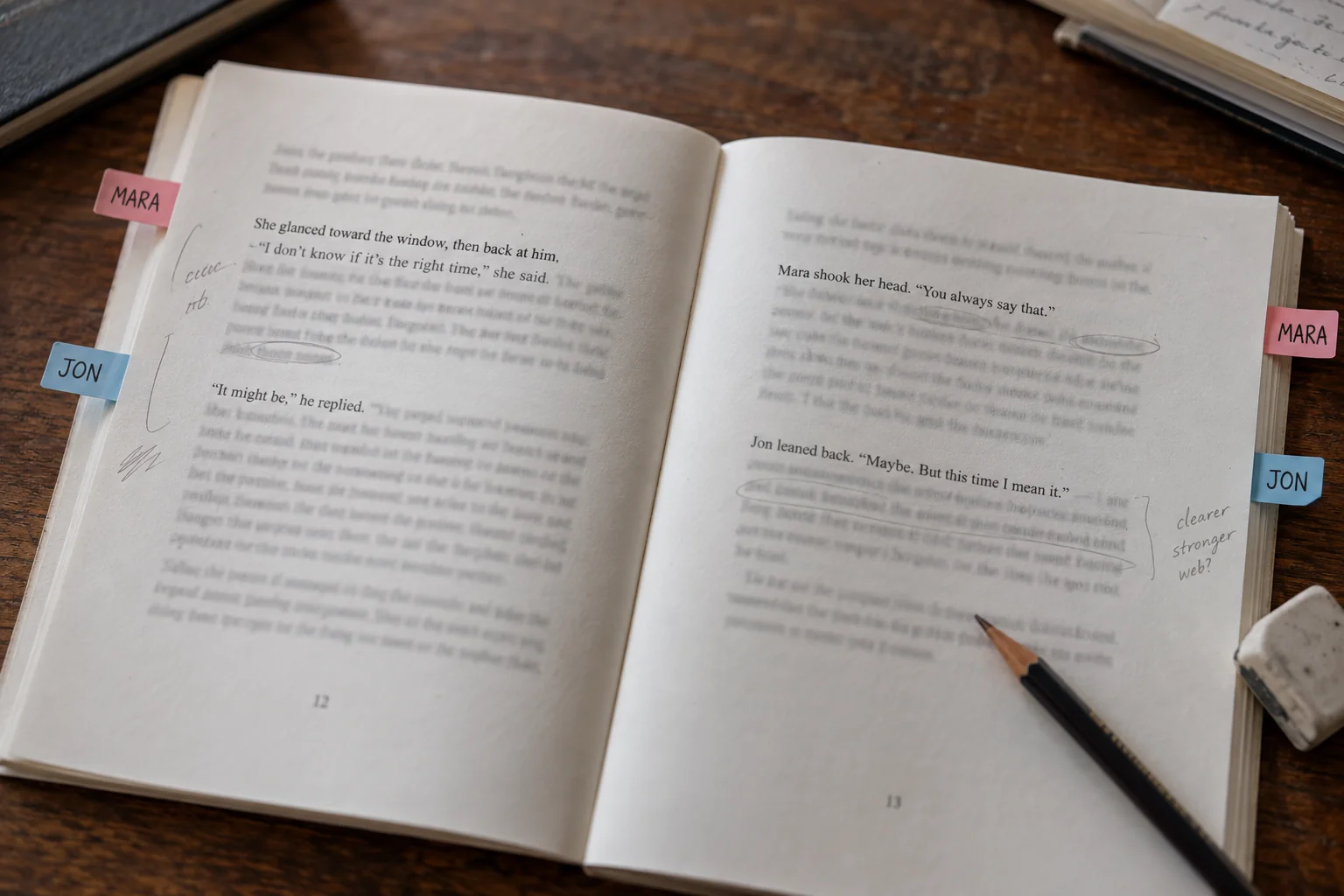
Here's a short conversation between Mara and Jon. Each change of speaker gets a new paragraph, which lets you follow the exchange without a name attached to every line. This is the traditional convention described by the Chicago Manual of Style.
"The west gate is still open," Mara said.
Jon checked the station clock. "Not for long."
"Then carry the blue case."
He looked at the case but did not touch it. "You never said what was inside."
Jon's first turn starts with “Jon checked the station clock,” so the indent belongs before Jon. His next turn starts with “He looked at the case,” so it belongs before He. The action and the words stay together because they belong to the same speaker.
Now look at exactly the same conversation with the paragraph breaks removed:
"The west gate is still open," Mara said. Jon checked the station clock. "Not for long." "Then carry the blue case." He looked at the case but did not touch it. "You never said what was inside."
You can still read the words, but keeping track of the speakers takes more effort. Moving the first line half an inch to the right wouldn't solve that problem. You need to put the breaks back before worrying about how far the paragraphs sit from the margin.
In the broken-up version, Mara's “Then carry the blue case” is clear because the turns alternate. A longer interruption or a third person entering the conversation can break that pattern. Add a name or a short identifying action when a reader might reasonably wonder who has the next line.
Dialogue indentation at a glance
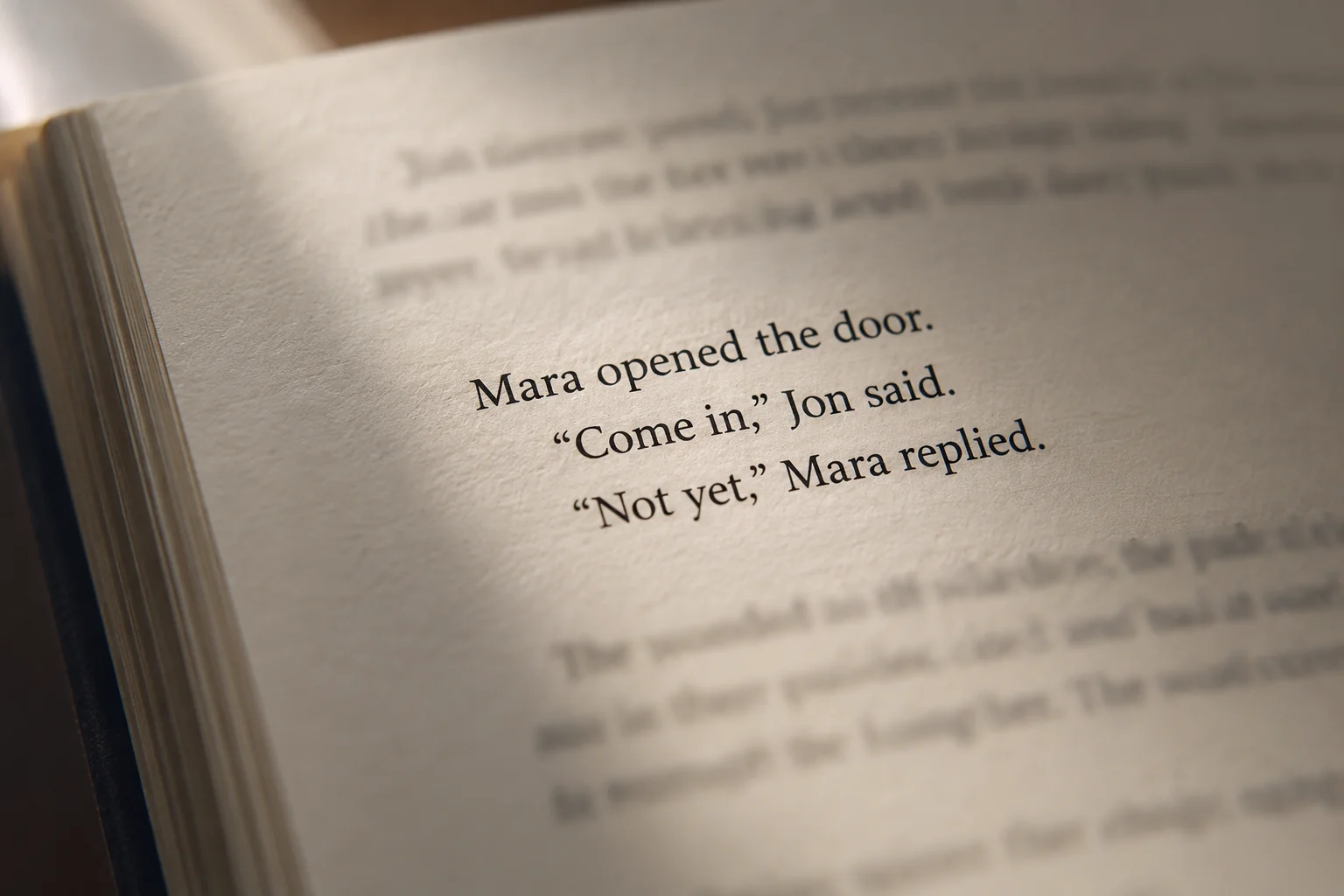
Choose a first-line indent for ordinary dialogue. It moves the opening line inward while the remaining lines return to the left edge. A left indent moves the whole paragraph, and a hanging indent leaves the first line out while moving the later lines in. Those settings do different jobs, as Microsoft's indentation guide shows.
A useful way to remember the rule is that you're indenting a paragraph, not a quotation. Your character can put down a bag, say something, and reach for a key in the same paragraph. Even if they speak twice, there's still only one paragraph opening to indent.
| Situation | Paragraph decision | Indent decision |
|---|---|---|
| Another character speaks | Begin a new paragraph | Apply the usual body-paragraph style |
| The speaker pauses for a short action, then continues | Usually keep the action and speech together | Indent only the paragraph's first line |
| A scene begins with speech | Make it the scene's opening paragraph | Use the chosen opening style, whether indented or flush left |
| One uninterrupted speech needs several paragraphs | Break at meaningful changes of idea | Apply the appropriate paragraph style to each paragraph |
| The text presents a letter, message, or document | Treat it as an extract where appropriate | Use the extract's design rather than automatically copying dialogue formatting |
The table covers the common cases, but don't start a fresh paragraph every time you see an opening quotation mark. A character who pauses for a brief action may still be taking the same turn. Check who is speaking and what the paragraph is doing before splitting it.
Use the paragraph ownership test
When an action makes the formatting confusing, ask yourself: whose turn am I showing here? If the paragraph begins with one character speaking and ends with someone else reacting and answering, that handoff usually needs a break. This simple question catches a lot of dialogue that looks correctly punctuated but reads awkwardly.
| Text pattern | Keep together? | Editing reason |
|---|---|---|
| Speech followed by a tag identifying its speaker | Yes | The tag belongs to the line it attributes |
| A speaker's brief action followed by that person's line | Usually | The action can introduce the turn |
| One character's speech followed by another's reaction and reply | Separate the turns | The reaction introduces the responding character |
| Several actions by one character, with no reply | Use judgment | A new idea or change of pace may justify a break |
For example, Lina's denial and Marco's silent reaction are easier to follow on separate lines:
"I never touched the ledger," Lina said.
Marco narrowed his eyes.
If Marco answers, place his words after “Marco narrowed his eyes.” His reaction already introduces his turn. If Lina speaks again instead, give her a new paragraph. Either version lets Marco's silence register before the conversation moves on, rather than making his reaction look like part of Lina's delivery.
That doesn't mean every mention of Marco needs a paragraph break. In “Lina watched Marco reach for the ledger,” we're still following Lina's observation. Keep connected narration together. The aim is to stop readers attributing a line to the wrong person, not to chop a scene into tiny pieces whenever two names appear.
Separate paragraph structure from dialogue punctuation
Paragraph breaks tell us who is speaking. Punctuation tells us how the spoken words connect to the surrounding sentence. A dialogue tag such as “Inez said” belongs to the speech sentence; an action such as “Inez folded the map” is a sentence of its own. Editor Katie Chambers explains the distinction in her guide to tags and action beats.
| Pattern | Example | Why it is punctuated this way |
|---|---|---|
| Tag after speech | "Leave the lantern here," Inez said. | The comma connects the speech to its attribution |
| Action after speech | "Leave the lantern here." Inez placed it beside the map. | Placing the lantern is a separate action sentence |
| Tag interrupting one spoken sentence | "If the bridge is clear," Inez said, "we can reach the mill before dark." | The same spoken sentence resumes after the tag |
| Action between spoken sentences | "The bridge looks clear." Inez folded the map. "We should still take the lower path." | Speech, action, and further speech are three complete sentences |
All four examples belong in a single paragraph each because Inez keeps the turn. The final example contains speech, an action, and more speech. It still needs just one first-line indent. Splitting it before “We should still take the lower path” could suggest that another character has started talking.
For a question followed by a tag, write “Did you lock the gate?” he asked. The question mark replaces the comma, but he stays lowercase because the tag continues the sentence. A name such as Jon keeps its normal capital. Chicago's explanation of quoted questions covers this point.
These examples use US punctuation and double quotation marks. Your publisher may prefer another convention. Whatever the house style, make two separate passes: one for the punctuation and one for speaker changes. Fixing a comma won't help if the reader thinks the wrong person said the line.
One speaker can continue across several paragraphs
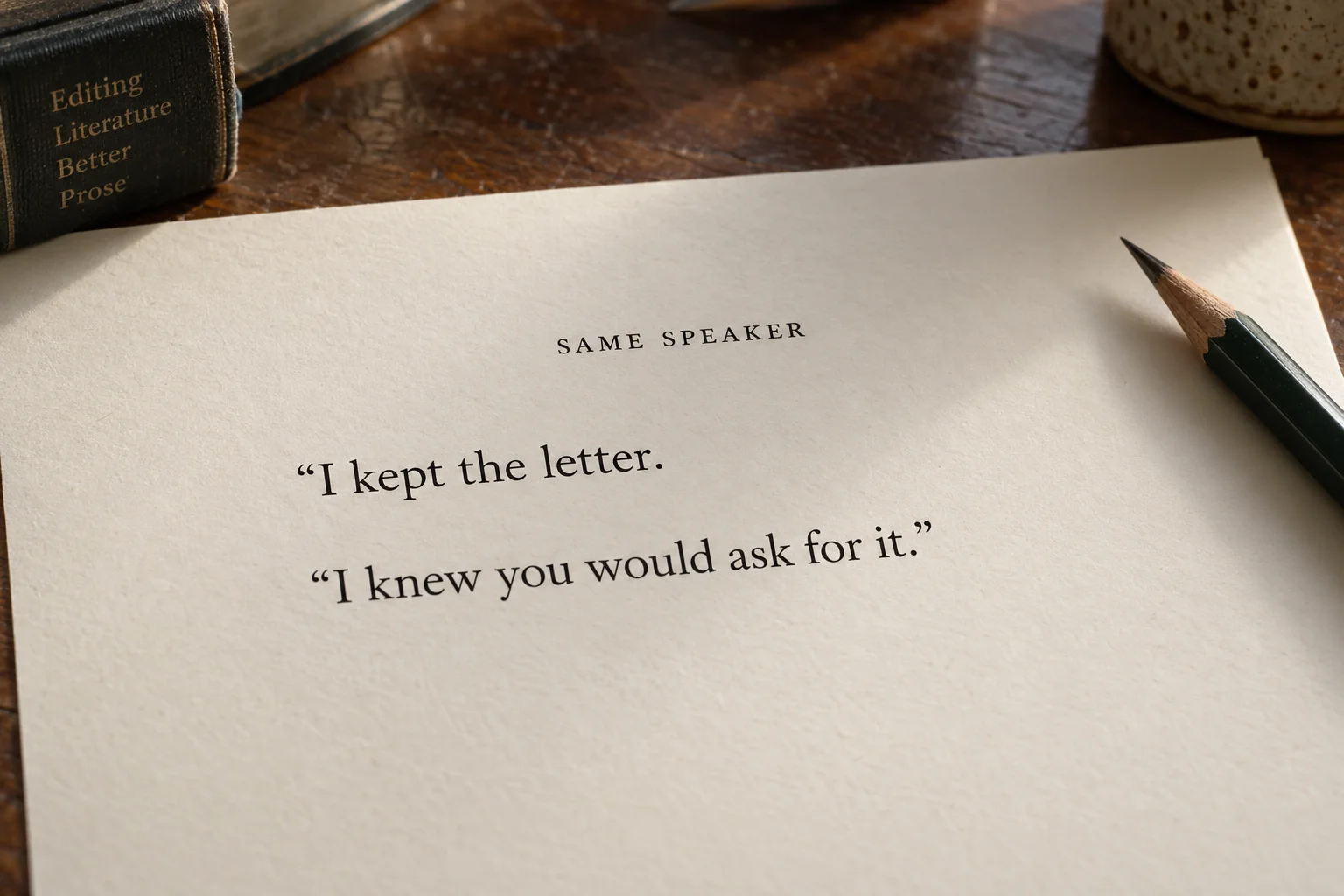
When one person speaks for several paragraphs, open each paragraph with a quotation mark and close only the final one. You can give a long speech breathing room without making it sound as though another speaker has taken over. The MLA Style Center describes this convention.
"The archive was not built for visitors. The first room stores maps, and the second stores the names removed from them.
"If you reach the stairwell, wait beside the green cabinet. I will meet you there."
The first paragraph explains the archive. The second tells the listener what to do when they get there. Those are different enough ideas to deserve separate paragraphs, even though the same person says both. Apply your normal paragraph style to each, including any first-line indent.
The missing closing quotation mark after “them” is deliberate. It signals that the speech continues into the next paragraph. If you're cleaning up the manuscript with search-and-replace or accepting automated punctuation suggestions, read the whole passage before adding what appears to be a missing mark.
An actual interruption changes the situation. If Jon speaks halfway through the archive explanation, close the current speaker's quotation and give Jon his own turn. Likewise, a full paragraph of narration between two remarks needs a clear transition; you shouldn't leave the reader inside an apparently continuous speech while the narrator takes over.
For a quick check, read the speech without thinking about punctuation first. Find the point where the speaker genuinely finishes. Then check that each of their paragraphs opens with a quotation mark and that the final one closes it. You can preserve sensible breaks without squeezing a long account into a wall of text.
Manuscript format and book-interior format are different decisions
A half-inch indent is a manuscript setting, not a rule for every printed novel. The file you're preparing determines the right treatment. A manuscript needs to meet submission instructions; a book interior needs a consistent, readable design; an ebook needs formatting that survives changes in font size and screen width.
- Submission manuscript: use the recipient's specifications. As a concrete example, William Shunn's classic manuscript format specifies a 0.5-inch first-line indent for every paragraph. That is a manuscript-format instruction, not a universal measurement for published novels.
- Print interior: plan a body style and, if wanted, a flush-left opening style. Apply the opening style because a paragraph begins a chapter or scene, not because it contains dialogue. Compare the result on a full page rather than judging an isolated line.
- Reflowable ebook: keep each paragraph as a separate text element and use CSS for its appearance. Amazon's Kindle paragraph-formatting guidance allows paragraph distinction through indentation or additional spacing.
Shunn's classic manuscript format gives the half-inch measurement for all paragraphs. For your own print interior, compare a full page of short replies with a page of longer narration before choosing the indent. If one-word answers seem stranded in the middle of the page, the setting may be too deep for that layout.
The first line of a scene follows the scene-opening style, even when it's dialogue. “Where is the case?” can sit flush left at a chapter opening in a published book. In a submission manuscript that requires every paragraph to be indented, the same line gets an indent. Dialogue doesn't need a separate exception.
Set dialogue indentation in Microsoft Word
In desktop Word, put the first-line indent in a paragraph style so you can apply it throughout the manuscript. That saves you from adjusting hundreds of paragraphs individually. Microsoft's styles guide explains how changes to a style update the text that uses it.
Save a copy before cleaning up a document assembled from several drafts. Pasted passages may bring their own styles, tabs, or spacing. Start with one ordinary body paragraph whose speaker breaks are correct, then use it to set the style for the rest of the narrative and dialogue.
- Select a body paragraph and identify its style in Home > Styles.
- In desktop Word for Windows, right-click that style and choose Modify.
- Open Format > Paragraph. Under indentation, choose Special: First line and enter the required amount in By.
- For ordinary body text, check that a separate left indent is not also moving the whole paragraph.
- Apply the body style to the appropriate narrative and dialogue paragraphs.
- If your interior design uses flush-left openings, create and apply a separate opening style. Make later global changes through the styles rather than individual paragraphs.
Those steps describe desktop Word for Windows. The menu arrangement can differ on a Mac or in Word for the web, but you're looking for the same First line paragraph setting. Microsoft's paragraph settings reference also distinguishes it from the left indent that shifts the entire paragraph.
If a paragraph is indented twice, reveal the formatting marks before changing the style again. A typed tab may be sitting in front of a paragraph that already has a first-line indent. Remove that extra tab from a sample and check the result. Don't delete every tab in the book: tables or other intentionally arranged material may still need theirs.
Set the paragraph structure in Google Docs
On a computer, select your paragraphs in Google Docs and go to Format > Align & indent > Indentation options. Set the first-line indent there instead of typing spaces or pressing Tab at the start of each reply. Google's indentation instructions identify the menu and its special-indent controls.
- Select the paragraphs that should share the same indentation, excluding headings and deliberate exceptions.
- Open Indentation options and choose First line under Special indent.
- Enter the amount required for your document and select Apply.
- Check a wrapped paragraph: only its first line should start inward. Format scene openings separately if your design requires them to remain flush left.
For a Shunn-style manuscript, enter 0.5 inches, or 1.27 cm if your document uses metric measurements. Leave headings and deliberate scene-opening exceptions out of the selection. Google's paragraph formatting help covers the related spacing and style controls if those also need attention.
Before sending the whole manuscript, export a small sample with a scene opening, a short reply, and a paragraph long enough to wrap onto several lines. Open it in the receiving program. That gives you a chance to spot formatting changes while the problem is still easy to isolate.
If every line moves right, look for a left indent. If only the first line moves too far, look at the first-line value and any spaces or tabs before the text. Correct the source document and export the sample again; fixing the exported file alone leaves the original problem waiting for your next revision.
Use CSS for dialogue indentation in a reflowable ebook
For a reflowable ebook, put each speaker's turn in its own paragraph element and use CSS text-indent to control the first line. Amazon's text guidelines recommend relative units, advise against fixed points or pixels for indentation, and limit body-paragraph indents to 4 ems. Here's a smaller example:
p.body {
  margin-top: 0;
  margin-bottom: 0;
  text-indent: 1.2em;
}

p.scene-open {
  text-indent: 0;
}
The 1.2em value is a starting choice for this example, not a required Kindle measurement. Because it uses a relative unit, the indent relates to the text size. You could apply the two styles to the opening of Mara and Jon's conversation like this:
<p class="body scene-open">"The west gate is still open," Mara said.</p>
<p class="body">Jon checked the station clock. "Not for long."</p>
The opening paragraph has both classes. It gets the body spacing, then the later scene-open rule removes the indent. Jon's reply uses only the body class, so its first line is indented. Neither paragraph needs leading spaces or a tab in the actual text.
Preview short replies and long speeches at several font sizes and screen widths. Watch for extra gaps, shifted wrapped lines, and double indents from copied spaces. If another CSS rule overrides your paragraph style, fix that conflict in the stylesheet. Adding spaces to compensate usually creates a new problem at a different reading size.
Diagnose indentation failures
When one paragraph looks wrong, compare it with a nearby paragraph that looks right. Check the speaker break first, then the style, indent settings, and leading characters. Working through that order helps you distinguish a writing problem from a formatting problem before changing the whole book.
The table below gives you a place to start. Try the likely repair on one complete scene, including its opening and any long dialogue, before applying it everywhere. Several settings can produce similar symptoms, so changing one thing at a time makes the result easier to judge.
| Symptom | What to investigate | Suggested repair |
|---|---|---|
| Wrapped lines also sit too far right | A left indent, block setting, or container margin | Restore the body paragraph's left edge, then set its first-line indent |
| Some opening lines extend farther right than others | Leading tabs or spaces, differing styles, or direct formatting | Remove confirmed redundant characters and standardize the paragraph settings |
| A reply seems to belong to the wrong character | A missing turn break or misleading neighboring action | Separate the turns and clarify attribution before adjusting appearance |
| Scene openings are indented against the intended design | An opening style that is missing, unapplied, or overridden | Define and apply the intended opening style; retain indents if the format requires them |
| An ebook indent behaves unexpectedly | Fixed units, inherited CSS, conflicting selectors, or copied spacing | Inspect the paragraph's effective CSS and remove redundant source formatting |
| A long speech appears to switch speakers | Missing opening marks, premature closing marks, or unclear interruptions | Read the complete speech and restore marks to match its structure |
An ebook will wrap differently from a printed page, and that is expected. You're looking for clear paragraph starts and consistent speaker turns, not identical line endings. A line that moves when you enlarge the font is fine; a reply that appears attached to the wrong character still needs fixing.
Final dialogue-formatting check
For the final pass, read just the spoken lines to check that every turn has a clear speaker. Then read the actions around them. An action attached to the wrong paragraph can quietly undermine an exchange even when every quotation mark and indent is in place.
- Identify the speaker of every quoted line.
- Confirm a paragraph break at each speaker change.
- Keep tags with their speech and check action beats as separate sentence structures.
- Review opening and closing marks in every multiparagraph speech.
- Apply the appropriate body and opening styles.
- Inspect tabs, repeated spaces, and nonbreaking spaces before removing any that are redundant.
- Preview the print PDF at its intended page size, including dialogue near page boundaries.
- Preview the EPUB with more than one font size and screen width.
Include both kinds of example from this guide in your check: a quick back-and-forth conversation and one speaker's longer account. In the first, actions should stay with the right replies. In the second, the quotation marks should make it clear that the same person continues across the paragraph break.
If you're editing in Automateed, the chapter-editing guide explains where to make your changes. Open the resulting DOCX, PDF, or EPUB before sending it on. A clean editor view is a useful start, but the file your reader receives is the one that matters.