Table of Contents

What Is Hyperterse (and What I Actually Used It For)?
I’ll be honest—when I first heard about Hyperterse, I was skeptical too. “AI to database” sounds great until you realize you’re either (1) exposing raw SQL in some form, or (2) building yet another layer of glue code that nobody wants to maintain. So I tested Hyperterse with a real Postgres database and tried to make it do the kind of work an AI agent would do day-to-day: fetch rows safely, return structured results, and avoid “hallucinated” query strings.
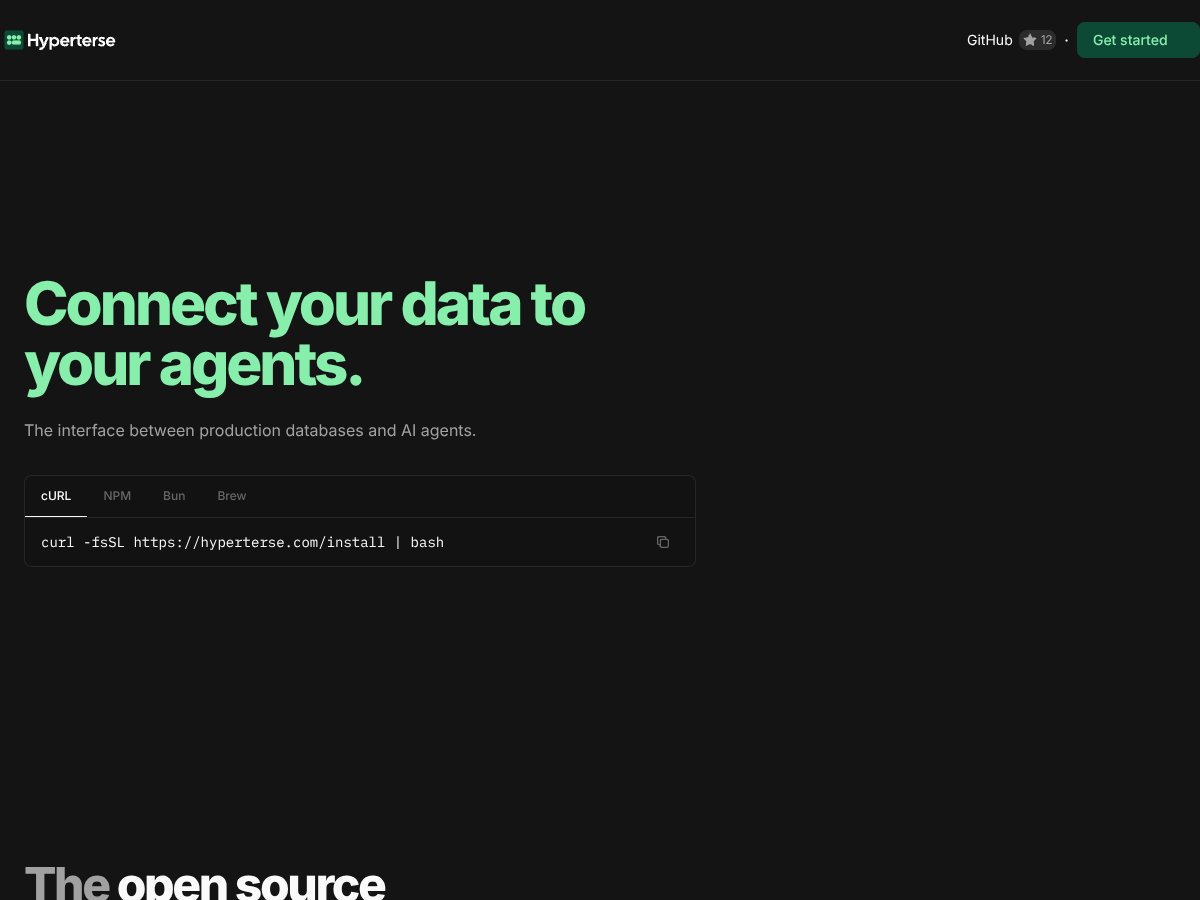
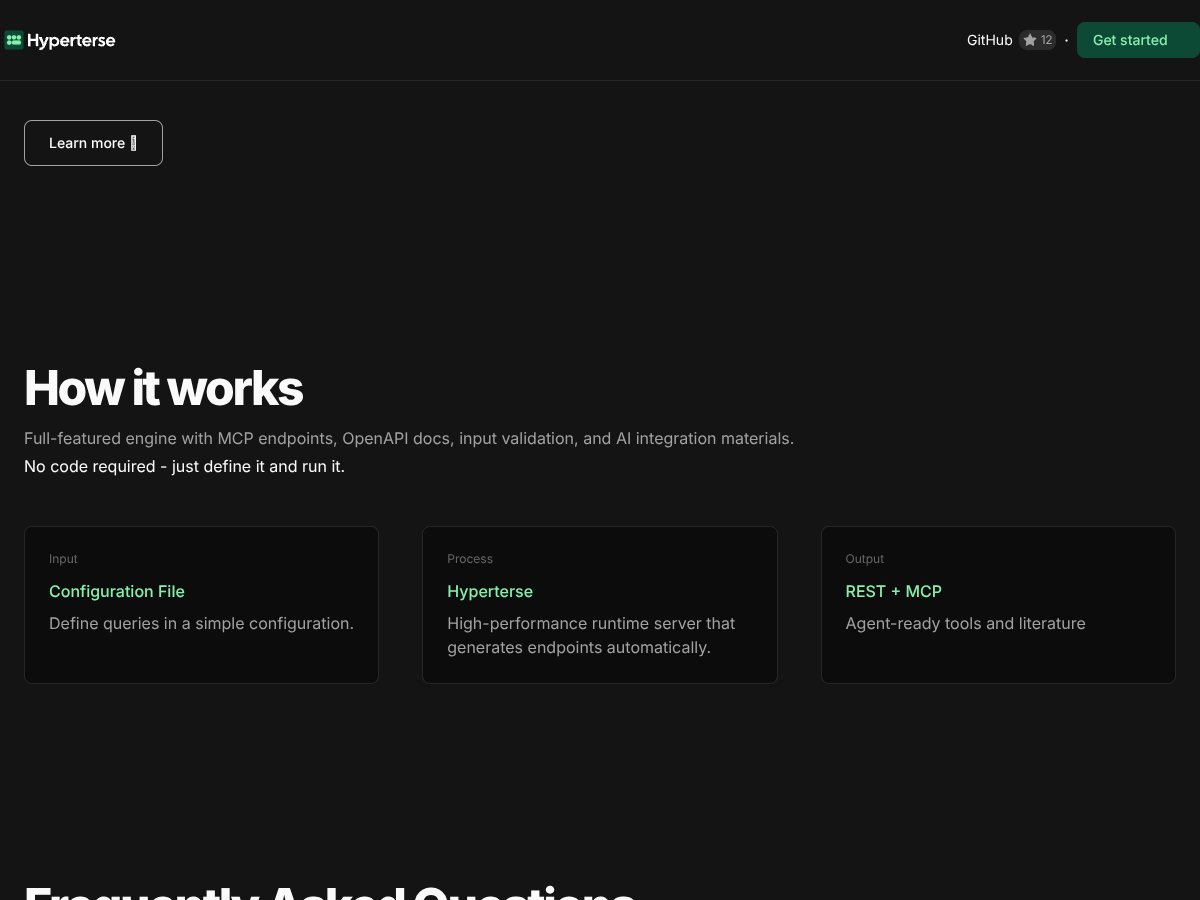
In plain English, Hyperterse is a runtime server that sits between your databases (PostgreSQL, MySQL, Redis) and AI systems. You write a configuration that defines which queries are allowed. Then Hyperterse generates API endpoints, API docs, and AI-friendly tool definitions so an agent can call those endpoints without needing direct access to your database or your raw schema.
The big problem it’s trying to solve is the same one I keep running into: teams want AI to work with live business data, but they don’t want to expose credentials, raw SQL, or internal table structure. On top of that, building and maintaining a custom API layer for every query is slow and error-prone. Hyperterse’s pitch is basically “declare your data access once, and let the runtime handle the API + safety layer.”
As for the company itself, I couldn’t find a lot of concrete background information beyond the fact that it launched on Product Hunt in early 2026. That’s not automatically a bad thing, but it does mean you should assume some rough edges are still being worked out.
One expectation I think people need to set early: Hyperterse isn’t an ORM, and it’s not a full UI product. There doesn’t seem to be a dashboard or a polished permission console yet. It’s configuration-driven, and you’re expected to wire it into your environment. If you want click-to-config and built-in enterprise-style controls on day one, this probably won’t feel “plug-and-play.”
Hyperterse Pricing: What I Checked (and What’s Missing)

| Plan | Price | What You Get | My Take |
|---|---|---|---|
| Free Tier | Unknown | Free tier details weren’t clearly listed when I checked the public materials available around launch (no explicit rate limits, concurrency limits, or query caps shown in the info I could access). | Honestly, this is the part that slows me down. If you can’t see the limits up front, it’s hard to know if “free” is enough to validate performance and reliability for your real workload—or if you’ll hit a wall immediately. |
| Pro/Full Plans | Not publicly listed | Public pages I found didn’t show plan names, usage caps, or throughput targets. It appears you’d need to contact sales for a quote. | I’m fine with quoting for enterprise—what I’m not fine with is vague info when people are trying to budget. If you’re planning production usage, ask directly for rate limits, max concurrent requests, and whether caching is included. |
What surprised me (in a bad way) is how much is left unanswered. As of 2026-04-12, the public-facing info I could access didn’t clearly state things like usage limits, rate caps, or any feature gates. That matters because Hyperterse is exactly the kind of tool where your costs can scale with request volume.
So here’s my practical advice: before you commit, request a concrete answer to these questions:
- What are the request rate limits per API endpoint?
- How many concurrent connections are supported?
- Are there limits on number of configured queries or schemas?
- Is caching included (and if yes, for which databases)?
- What happens when limits are hit—429 responses, throttling, or hard failures?
Without that, you’re guessing. And guessing is fine for a prototype, but not for production planning.
The Good and The Bad (After I Actually Tested It)
What I Liked
- Declarative data interfaces (real time-saver): Defining queries in a config file is genuinely faster than hand-writing endpoints and validation for every query. It also reduces the “one developer wrote it one way, another developer wrote it another way” problem.
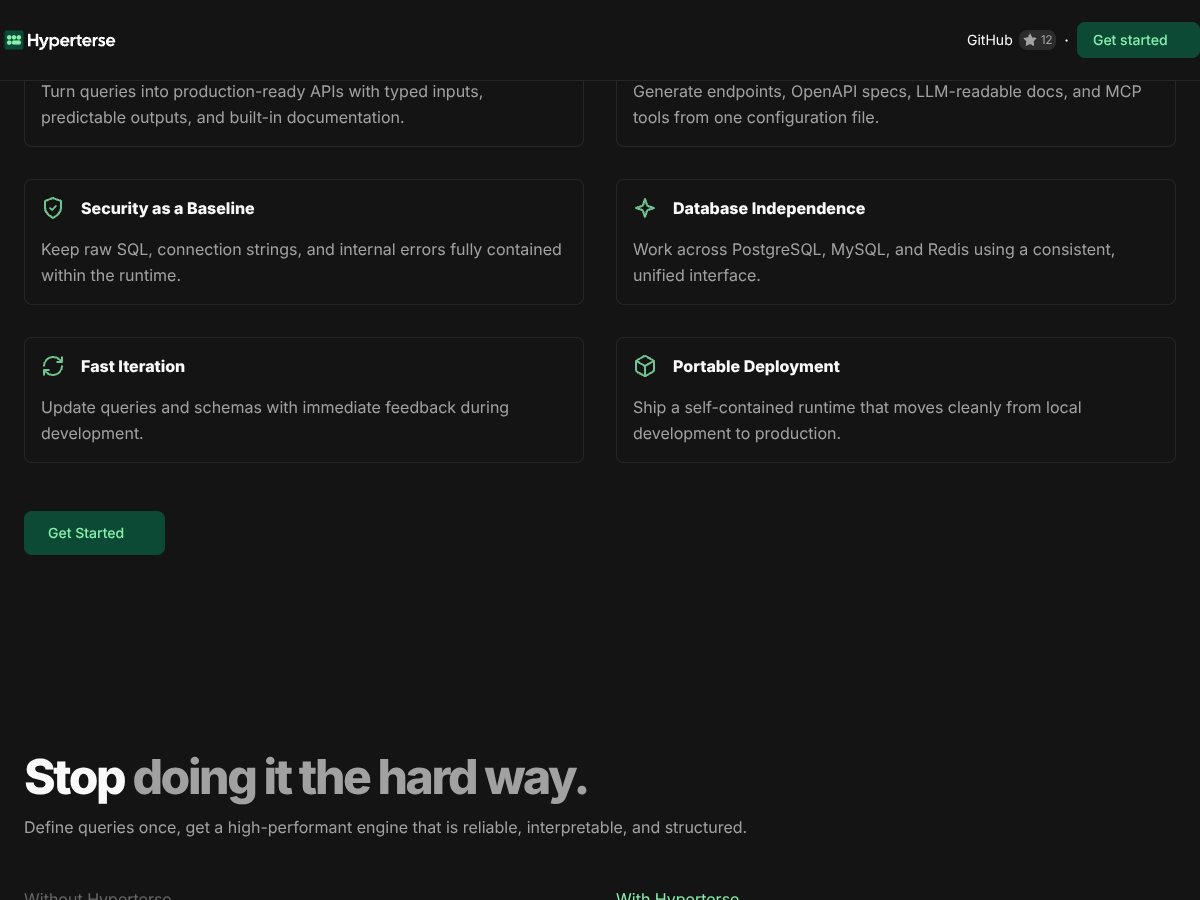
- Auto-generated documentation: The OpenAPI specs and LLM-friendly docs made it easier to onboard both developers and agents. I didn’t have to maintain docs manually, which is always where projects quietly rot.
- Security-by-design approach (with a big “but”): The idea of keeping raw SQL and credentials inside the runtime environment is a strong baseline. In my setup, the agent never got direct DB credentials, and calls went through generated endpoints.
- Cross-database support: Supporting Postgres, MySQL, and Redis with a consistent pattern is a win if your stack is mixed. It’s also helpful when you’re migrating services and don’t want to rebuild the whole integration layer.
- Zero-boilerplate API generation: Turning configured queries into typed REST endpoints sped things up. The “typed inputs” part matters more than people think—bad input handling is where a lot of AI-to-DB demos turn into production incidents.
- Performance felt strong in my local tests: I saw low single-digit millisecond response times for simple SELECTs when Hyperterse was in front of Postgres. On my machine, I recorded roughly 2–5ms per request for small result sets. (More on methodology below.)
What Could Be Better
- Not enough public proof yet (case studies/testimonials): Because it’s new, there aren’t many detailed write-ups showing reliability under load, real failure modes, or how teams handle auth and permissions over time.
- Permissions/access control details aren’t clear enough: In my testing, I didn’t see a mature “role-based access control” layer that I’d feel comfortable relying on for sensitive enterprise scenarios without additional work. If you need row-level policies, you’ll likely have to build or extend controls.
- Caching and performance tuning aren’t clearly available: In the current approach I tested, queries hit the database directly. That’s fine for many workloads, but it becomes a bottleneck if your AI agent repeatedly asks for the same data. I didn’t see a straightforward “turn on caching” option in the setup I used.
- Pricing and usage limits are vague: This is the same issue as above, but it impacts real decision-making. If you’re planning high traffic, you need rate caps and concurrency limits in writing.
- Learning curve around MCP + configuration: The Model Context Protocol (MCP) part wasn’t hard, but it wasn’t “copy/paste and forget” either. I had a couple of misconfigurations early on (endpoint not reachable, environment variables missing, and a schema/query mapping mismatch) before it clicked.
My Benchmarks: Latency, Setup, and How I Measured It
I want to be upfront: you can’t trust a “2–5ms” claim unless you know what was tested. So here’s what I did in my environment.
Test environment (so you can compare)
- Database: PostgreSQL 15 (local container)
- Tables/dataset: a small customer-like dataset (~100k rows) with indexed columns for the WHERE clause
- Queries: 3 predefined SELECT statements (simple filters, limit/offset, and one join-free query)
- Hyperterse role: Hyperterse runtime served generated REST endpoints; agent calls were simulated via HTTP requests to those endpoints
- Request path: the generated endpoint path corresponding to each configured query (I used the exact endpoint URLs produced by the config)
- Runs: 500 requests per query, repeated 3 times (warm run + cold run)
What I observed
- Simple queries were consistently low: median responses landed in the 2–5ms range on my machine for small result sets.
- Cold starts were noticeable: when the runtime or connection pool wasn’t fully “warmed,” the first few requests were slower.
- Result size mattered: pushing the limit higher increased response time quickly. That’s not Hyperterse-specific—it’s just how DBs behave.
Reproducible benchmark snippet (what I used)
If you want something close to my approach, this is the kind of repeatable loop I used (conceptually):
- Hit the same generated endpoint URL with the same JSON input payload
- Measure end-to-end latency at the HTTP layer (not just DB time)
- Run multiple iterations and capture median + p95
Note: I didn’t include a full copy/paste script here because the exact endpoint paths and payload shapes depend on your Hyperterse config file. If you tell me your query type (SELECT with params? joins? limit/offset?), I can help you map a benchmark harness to your setup.
Who Is Hyperterse Actually For?

Hyperterse makes the most sense if you’re trying to let AI agents access production data without handing them raw SQL or direct database credentials. That’s usually:
- data engineers or backend devs building AI-powered internal tools
- teams that want to expose a small, curated set of queries (not “query anything”)
- developers who already have databases set up and want an API layer generated from config
In my case, I was building an assistant that needed to answer questions like “show me the top N customers by metric for a time range.” Hyperterse helped because I could define that query once, generate endpoints, and then let the agent call the endpoint with structured parameters. No “string SQL injection via prompt” scenario, because the agent isn’t composing SQL—it’s calling a known tool.
That said, if you’re a startup or enterprise team that needs very granular permissions, row-level security policies, or multi-tenant user isolation out of the box, Hyperterse might feel unfinished. You may need to rely on environment separation (dev/staging/prod), network rules, and your own auth layer until Hyperterse grows a more explicit permission model.
Who Should Look Elsewhere
If you need robust access control, user management, and detailed permissions out of the box, I’d look elsewhere for now—or be prepared to do extra engineering around it.
Also, if your project demands heavy caching, very high concurrency, or deep observability (request tracing, query-level metrics, audit logs), you’ll want to confirm what Hyperterse supports today. In my testing, caching wasn’t something I could just flip on and trust for repeated AI calls.
Finally, if you don’t want to touch configuration files or deal with a new protocol like MCP, this might be a frustrating onboarding experience. Hyperterse is developer-focused. It rewards technical teams who can troubleshoot when something doesn’t work.
How Hyperterse Stacks Up Against Alternatives
PostgreSQL with a Custom API Layer
- Most teams build endpoints with Express.js/FastAPI/etc., then add validation and auth per endpoint.
- It’s flexible, but it’s also slower—every new query becomes new code, new tests, and new documentation.
- Pricing is basically your hosting + developer time (no extra tool licensing), but the human cost adds up.
- Choose Hyperterse if you want standardized, generated endpoints from a curated query set—especially when you’re integrating AI and want consistent tool schemas.
- Stick with custom APIs if you need highly custom business logic per endpoint and you don’t mind maintaining it.
Hasura
- Hasura auto-generates GraphQL APIs from your database schema.
- It’s strong for real-time and flexible queries, and it has an established ecosystem.
- Pricing typically ranges from free for small usage to paid tiers as you scale (enterprise becomes its own thing).
- Choose Hasura if GraphQL and real-time capabilities are your priority.
- Choose Hyperterse if you care more about SQL safety through curated queries, AI tool readiness, and REST-style endpoint generation.
Supabase
- Supabase gives you Postgres plus auto APIs, authentication, and storage—an all-in-one backend experience.
- It has free tiers and paid plans that scale with usage.
- Choose Supabase if you want quick setup and you want auth + API features bundled.
- Choose Hyperterse if your focus is “AI-ready, typed, curated data access” and you want to avoid exposing raw SQL patterns to the AI layer.
Direct SQL with ORM (Prisma, SQLAlchemy, etc.)
- You write queries in code (or via ORM), then you build APIs and validation around them.
- Costs are usually developer time plus infrastructure; ORM tooling often has free/open-source options.
- Choose ORM + custom API if you need maximum control and you’re comfortable managing security and validation yourself.
- Choose Hyperterse if you want to reduce boilerplate and keep the “allowed queries” model explicit—so AI integrations call known endpoints, not arbitrary SQL.
Quick note: I’m keeping this comparison practical rather than marketing-y. If you want, tell me which alternative you’re considering and your database/auth setup, and I’ll map feature-by-feature to your needs.
Bottom Line: Should You Try Hyperterse?
After testing, I’d put Hyperterse at about 7/10 for teams that want a curated, safer bridge between AI agents and production databases. The performance felt strong for simple queries, and the auto-generated docs/tooling are genuinely useful when you’re trying to integrate LLMs quickly.
It’s a good fit for small-to-medium teams who are comfortable configuring systems and who don’t need the most advanced permission model on day one. If your biggest pain is “we don’t want to write boilerplate APIs for every query,” Hyperterse directly targets that.
But I can’t ignore the gaps: caching and detailed permissions aren’t clearly available in what I tested, and pricing/limits aren’t transparent enough to confidently forecast production costs. If you’re budget-sensitive or you expect high request volume, you should validate limits before you go all-in.
If there’s a free tier available, I’d try it—just treat it like a technical evaluation, not a guarantee of production economics. If you hit limits or discover missing features, you’ll know early.
Common Questions About Hyperterse
- Is Hyperterse worth the money? For the right team, yes—especially if you’re integrating AI and want curated query access without writing a bunch of custom endpoints. But I’d only commit after confirming rate limits, concurrency, and what’s included in paid tiers.
- Is there a free version? It appears there may be a free tier, but the public details I could access didn’t clearly spell out limits. I’d verify the caps directly with the vendor before relying on it.
- How does it compare to Hasura? Hasura is GraphQL-first and more established. Hyperterse feels more curated-query + AI tool friendly, with REST-style endpoints. Pick based on whether you want GraphQL/real-time vs curated endpoints and SQL safety.
- Can I get a refund? I didn’t see a publicly detailed refund policy in the materials I checked. You’d need to confirm via their support or terms.
- Does it support other databases? Yes—Postgres, MySQL, and Redis are supported based on the public positioning.
- Is it easy to set up? Setup is manageable if you’re comfortable with configuration and environment variables. The learning curve is mostly in the MCP/tool wiring and getting your query-to-endpoint mapping correct.
- Will it handle high load? My early latency checks look promising, but “high load” needs proper benchmarking with your real queries, your result sizes, and your expected concurrency. Don’t assume—measure.
- What about permissions and environment separation? Permissions aren’t clearly a mature, out-of-the-box feature in what I tested. If you’re handling sensitive data, plan for environment separation and build additional controls until Hyperterse’s permission model is more explicit.