Table of Contents
Over 50% of viewers dropping a series because the opening doesn’t hook them sounds dramatic… but I couldn’t find a solid, dated source I trust off-hand. So I’m not going to lean on that number. What I can say from watching how audiences react is simple: if your first scene doesn’t raise a question, show a problem, or make the reader feel “something is about to go wrong,” they’ll bounce fast.
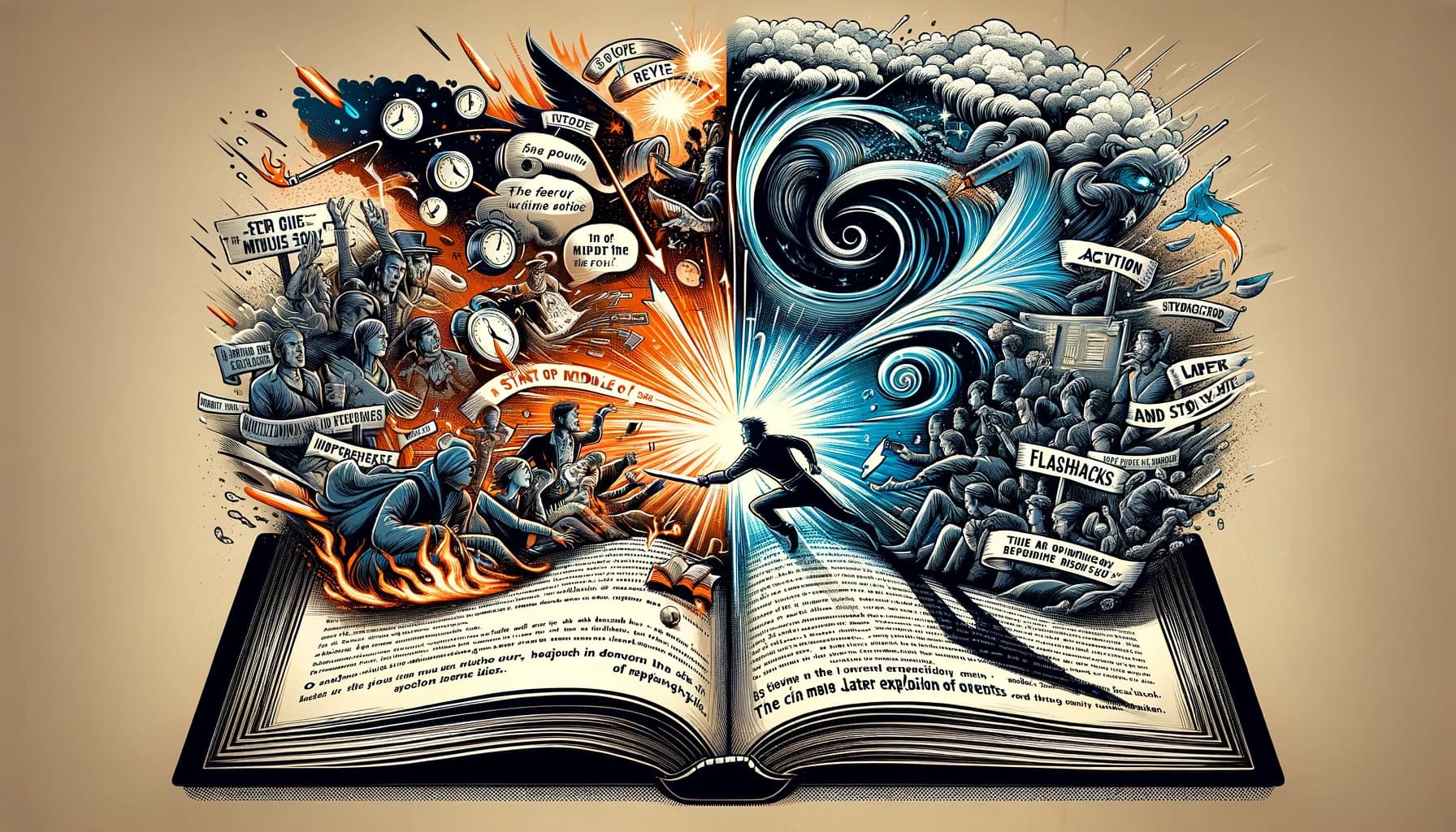
That’s exactly why in medias res works so well. Instead of starting at the beginning, you jump straight into the middle of the action—right at the moment where the stakes are already real. It’s an ancient technique (Homer used it centuries ago), but it still feels fresh because it respects one thing: attention.
⚡ TL;DR – Key Takeaways
- •In medias res drops readers into a high-stakes moment, so engagement starts immediately.
- •You balance action with just enough clarity, then reveal backstory in small, relevant pieces.
- •Pick a start point near the inciting incident or the first major irreversible consequence.
- •Avoid early overload: too much history too soon feels like a speed bump.
- •Cold opens and “start mid-crisis” structures show up across thrillers, dramas, and even games for a reason: they create immediate momentum.
1. What Is In Medias Res and Why Use It?
1.1. Definition and Historical Origins
In medias res is Latin for “in the middle of things.” The idea shows up in classical storytelling long before modern marketing or streaming algorithms. Critics have long pointed to epic poetry—especially Homer’s Iliad and Odyssey—where the story opens after the conflict is already underway.
Instead of “here’s how everything started,” these works go, “here’s where things hurt right now.” The audience then fills in the earlier events through later narration, flashbacks, or characters explaining what happened.
What I like about this approach is that it feels less like a lecture and more like discovery. You’re not forcing the reader to wait for the interesting part—you’re tossing them into it.
1.2. Core Characteristics and Mechanics
At its core, in medias res means you start after the ordinary setup has already happened. You begin on a conflict-rich scene: a chase, a confrontation, a betrayal, a negotiation that can’t be undone, a discovery with consequences.
Here’s the practical mechanic: you withhold most background at first, but you don’t leave the reader stranded. You still give them:
- Who (at least one character with a name or clear role)
- Where (sensory grounding + a few concrete details)
- What’s happening right now (a visible action or decision)
- Why it matters (stakes, threat, cost, or urgency)
Then you drip-feed the “how did we get here?” through clues—dialogue, a tense reaction, a remembered phrase, an object with history, or a brief internal realization. No big exposition monologues in the first scene. Not unless you want your readers to skim.
1.3. Why Use In Medias Res Today?
Modern storytelling is full of “cold opens” for a reason: people decide whether to stick around almost immediately. In medias res is basically the literary version of that same instinct.
In genre fiction especially (thrillers, crime, sci-fi, fantasy with high stakes), starting mid-crisis helps you avoid the slow “getting to the point” stage. The reader feels the pressure first, then learns the context second.
And honestly? It’s also just efficient. If your story has a dramatic question—Will they survive? Can she trust him? Who’s lying?—why make the reader wait for that question to appear?

2. Key Principles for Effective In Medias Res Openings
2.1. Start at a Genuinely Consequential Moment
This is where a lot of openings fail—not because the author can’t write, but because they choose the wrong “middle.” Not every exciting scene is consequential.
Pick a moment where the outcome is uncertain and the consequences are immediate. Examples that usually work:
- A character discovers evidence that can’t be unseen
- A deal is happening under threat (and someone knows more than they’re saying)
- A rescue attempt goes wrong in the first minutes
- A confession is interrupted by the real danger
Quick self-check: if you cut everything before this scene, does the story still make sense as a “problem in motion”? If yes, you’re closer. If no, you may be starting mid-action but not mid-story.
2.2. Orient the Audience Quickly (Without Explaining Everything)
Your opening needs a fast orientation. In the first 1–3 paragraphs, I’d aim for:
- One clear character (name, job, or something they do)
- One clear location cue (sound/smell/visual detail)
- One immediate goal (escape, hide, negotiate, retrieve, stop)
- One visible obstacle (a pursuer, a rule, a betrayal, a timer)
Instead of “they were in trouble,” try something like: the character is running, bleeding, bargaining, or hiding—then let the reader infer the rest.
When you orient well, the reader doesn’t need the full backstory yet. They just need to feel grounded enough to care.
2.3. Drip Backstory Strategically (Use “Relevance,” Not “History”)
Backstory should answer a question the reader already has. If it doesn’t, it’s probably decorative.
A simple rule I follow: only reveal backstory that changes how the current scene is understood. That could mean:
- What the character fears (because of what happened before)
- Why they react a certain way to a person, object, or phrase
- What they know that others don’t
Practical micro-technique: use sensory triggers or dialogue friction to slip in context. For example, a character might flinch at a nickname, recall a rule they learned the hard way, or realize the “safe” door is the one that betrayed them last time.
And please don’t do the classic mistake: dumping a whole biography right after the action starts. That’s when momentum dies. Readers don’t mind mystery; they mind being paused.
2.4. Maintain Clear Timeline and Pacing
In medias res doesn’t mean “messy chronology.” If you jump around, you need rails.
Use timeline markers when you shift time, such as:
- “Two months earlier”
- “The night before”
- “After the trial”
- Scene breaks that clearly separate viewpoint/time
Also, pace matters. If you open with a high-tension scene, keep the first beats tight: short actions, quick decisions, minimal wandering. Then, when you reveal backstory, do it in a way that still feels like part of the story—like a pressure release, not a separate essay.
3. Examples of In Medias Res in Classic and Modern Media
3.1. Literary Classics
Homer’s Odyssey doesn’t start with Odysseus sailing for the first time. It starts with him stranded on Calypso’s island—already deep into the consequences of earlier events. The earlier adventures come later through storytelling and flashbacks.
Virgil’s Aeneid similarly opens with Aeneas shipwrecked after fleeing Troy. The fall of Troy isn’t the first page; it’s something the narrative fills in as the journey unfolds.
What these classics teach is pretty transferable: start where the emotional situation is already real. Then work backward only when it deepens stakes or character motives.
3.2. Modern Films and TV
Think of how many shows begin with a crisis: a body discovered, a deal going sideways, a chase mid-sentence. That structure is basically the screen version of in medias res—hook first, explain later.
For example, Star Wars: A New Hope opens with a space battle, not a “here’s the history of the Empire” lecture. Big Little Lies starts after a mysterious death, then uses flashbacks to reveal how everyone got there.
The takeaway isn’t “copy the exact format.” It’s that the opening scene gives you a question and a tone instantly.
4. Practical Tips for Writing In Medias Res Openings
4.1. Identify the Right Moment (Use a Start-Point Worksheet)
Instead of guessing, try this quick worksheet. Write 5 candidate opening scenes (just one paragraph each). Then score each one:
- Stakes: What’s the cost in the next 5 minutes of the scene?
- Uncertainty: Can the character fail?
- Clarity: Can a reader tell what’s happening without needing 10 pages of context?
- Backstory potential: What detail can you reveal that makes the scene richer?
- Cut test: If you remove everything before the scene, does the story still launch?
Pick the scene that wins most of those categories. That’s usually your best in medias res opening point.
4.2. Create Immediate Engagement (Aim for “Question + Motion”)
Here’s a pattern that consistently works: question + motion.
- Question: Will they get caught? Who’s responsible? What’s hidden?
- Motion: A chase, a negotiation, a decision, a discovery—something changes every few lines.
If your opening is all feelings and no movement, readers feel safe enough to put it down. If it’s all chaos with no readable goal, they feel lost. You want tension, not confusion.
Beta readers can help, but here’s what to ask them specifically: “Did you understand what was happening in the first paragraph?” and “What question were you most curious about?” Their answers tell you whether your hook is landing.
4.3. Balance Action and Clarity (A Simple First-Page Checklist)
Before you finalize, read your first page like a stranger would. Can they answer these?
- Who is the main character in this scene?
- Where are they, in a way that feels concrete?
- What are they trying to do right now?
- What’s stopping them?
- What’s the worst likely outcome?
If you can’t answer those, you’re probably relying on backstory to do the job that the scene should be doing.
4.4. Test and Revise Openings (Rewrite With “Before/After” Clarity)
Revision is where in medias res either clicks or collapses. Try this approach:
- Before: Identify the exact moment your current opening loses momentum (often after 150–250 words).
- After: Rewrite that section so the scene continues moving while backstory arrives in one or two targeted beats.
Also, consider doing a “cut and replace” pass: remove one paragraph of exposition and replace it with a concrete action that reveals the same information indirectly.

5. Common Challenges and How to Overcome Them
5.1. Reader Confusion and Disorientation
Confusion usually comes from missing basics: the reader doesn’t know who, where, or what the character is doing.
Fix it fast by front-loading identifiers:
- Use a name or role early (“Mara, the courier…”)
- Anchor location with sensory details (“oil-slick street,” “stale hospital air”)
- State the immediate goal through action (“she shoved the key into the lock”)
If you’re shifting time, don’t rely on vibes. Use explicit markers like “the next morning” or “two days earlier.” Readers shouldn’t have to decode your timeline.
5.2. Starting with Irrelevant Chaos
This is the “it’s intense but it’s not connected” problem. A random explosion might feel cinematic, but if it doesn’t impact your main plot question, it’s just noise.
Use the cut test: if the opening scene can be removed and the story still works, it probably isn’t the right start point. Your opening should be causally tied to the central conflict.
5.3. Dumping Backstory Too Soon
Backstory is useful, but too much of it too early feels like you’re stalling. Instead of “here’s everything you need to know,” try “here’s why this moment hurts.”
Practical fixes:
- Replace exposition with a reaction (fear, anger, hesitation)
- Reveal history through an object or phrase
- Limit yourself to one backstory “reveal” per scene beat early on
If you’re writing a thriller, for instance, the reader cares about motives because of what’s happening now. Make the backstory explain the current risk, not the entire past.
5.4. Mis-matching Genre Expectations
Some genres need world cues in the same breath as the action. Epic fantasy and sci-fi can’t always afford “mystery about the setting” in the first minutes. If readers don’t understand the rules of the world, they can’t measure danger.
Solution: embed world-building clues naturally inside the scene:
- Technology signals (“signal dampeners,” “burn codes”)
- Social cues (“you don’t bow to that house,” “only captains carry keys”)
- Environmental constraints (“the air is breathable only with masks”)
You don’t need to explain the whole universe. Just enough to make the scene’s stakes legible.
6. Industry Trends and Best Practices for 2026
6.1. In Medias Res in Film and TV
Cold opens are everywhere now—because they work. Many series open by showing the “big event” first, then reverse-engineer the context through flashbacks or later reveals.
Rather than chasing a specific “drop-off” statistic, I’d focus on what these openings have in common: they answer three things quickly (tone, stakes, and a central question). If your opening can do that, you’re competing with the best.
6.2. In Medias Res in Literature and Gaming
Thrillers and crime fiction often begin with a crime scene, a threat, or a moment of moral compromise. The reader gets a problem immediately, and the narrative spends the rest of the book explaining how the character ended up there.
Games do something similar with mid-mission starts and environmental storytelling—logs, NPC dialogue, and artifacts that fill in lore as you move. That’s a useful reminder: in medias res doesn’t have to be one big exposition dump. It can be interactive, pieced together, and earned.
6.3. Tools and Resources for Writers in 2026
Most writers don’t need “more structure.” They need better clarity at the exact point where readers decide to keep going. That’s where tools that support outlining, pacing checks, and editing can be genuinely helpful—especially if they help you spot:
- where backstory starts to crowd out action
- where timeline markers are missing
- where your opening stops raising questions
If you’re looking for writing support, you can explore Automateed Features to see how it’s positioned to help with formatting and workflow.
7. Conclusion: Mastering In Medias Res for Compelling Storytelling
In medias res is one of those storytelling tools that never really goes out of style. It keeps your opening from feeling like a warm-up act. Instead, it treats the first page like it matters—because it does.
If you want this to work consistently, remember the core formula: start in a consequential moment, orient the reader quickly, and reveal backstory only when it changes how the scene is understood. Do that, and your story won’t just start strong—it’ll keep pulling people forward.
- In medias res begins in the middle of the action, not at the chronological start.
- It originates from classical epic poetry, notably Homer’s Iliad and Odyssey.
- The technique creates immediate tension and heightens engagement.
- Effective openings start at a crucial, conflict-rich moment.
- Clear orientation helps prevent reader confusion in complex scenes.
- Backstory should be revealed gradually, not dumped all at once.
- Markers like “two months earlier” help maintain a clear timeline.
- Modern media like film and TV often rely on cold opens for rapid engagement.
- Genre fiction frequently opens with a scene that exemplifies in medias res, such as a crime or battle.
- Tools and resources can help writers structure and format openings, but the storytelling craft still matters most.
- Common challenges include disorientation, irrelevant chaos, and early over-exposition.
- Solutions involve clear cues, causally linked scenes, and strategic drip-feeding of backstory.
- Studying successful examples helps you spot what readers respond to.
- Understanding genre expectations helps tailor the opening so the stakes land fast.
Do the work on that first scene, and you’ll feel the difference immediately. Your audience gets hooked earlier—because the story finally starts where it should: right in the middle of the problem.