Table of Contents
Kindle Unlimited paid a reported $0.0047976 per page in the US for July 2026—roughly half a cent. That works out to about $4.80 for 1,000 eligible pages, or $1.44 when someone reads all 300 KENP of a book. The figures come from The Author Helper Suite’s July 2026 volunteer-submitted royalty data, checked September 12, 2026. Rates change each month and differ by country, so use this as a recent reference rather than a promised payout.
For the same month, the tracker lists £0.0032611 per page in the UK and €0.0029096 in Germany. Your KDP report will show what your own reading earned. Below, we'll turn those report figures into a per-page rate, work through a few earnings examples and explain when the money should arrive.
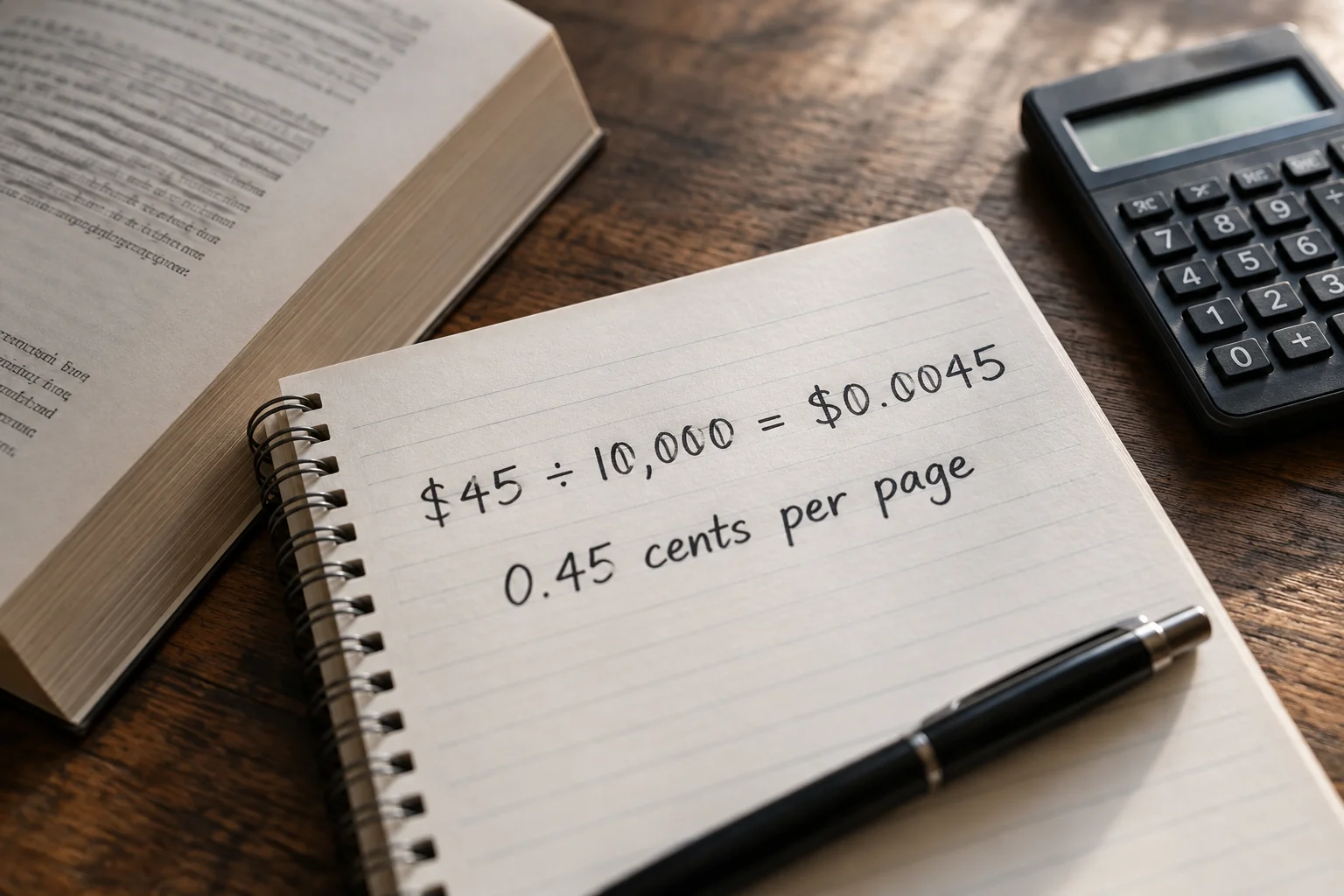
The calculation you need is simple: KU royalties ÷ eligible pages read = payout per page. If a report shows $45 from 10,000 pages, the rate is $0.0045, or 0.45 cents per page. Match the month, marketplace, title and currency, and keep bonuses out of that calculation. We'll show where to find both numbers.
That calculation measures what your reported reading earned; it does not establish a guaranteed future rate. Amazon distributes the monthly KDP Select Global Fund according to eligible reading and country allocations rather than promising one worldwide price per page. Its official pages displayed $71.0 million in total KDP Select author earnings for July 2026 when reviewed on September 11, 2026. That program-wide disclosure is not an individual author's payout rate. (kdp.amazon.com)
It helps to follow three numbers through the month: pages people read, royalties those pages earned and money Amazon sent you. They won't always appear at the same time. Watch reading activity as it happens, use the finalized royalty report for your calculation and check the payment report when you're matching the bank deposit.
Kindle Unlimited payout in one formula
Your KU royalty represents your share of eligible reading within the relevant fund allocation. Amazon's Royalties in Kindle Unlimited page explains the underlying mechanism. A practical mathematical representation is:
KU royalty for a market and month = allocated fund for that market and month × your eligible KENP read ÷ total eligible KENP read in that market and month
Country allocations reflect factors including exchange rates, local subscription pricing and reading behavior. Amazon's illustrative example assumes a $10 million fund, 100 million total pages and 10,000 pages for one author: $10,000,000 × 10,000 ÷ 100,000,000 = $1,000. These are teaching figures, not an observed market rate. (kdp.amazon.com)
For your own earnings, start with the royalty report and work backward. The global fund total doesn't tell you how much was allocated to your marketplace or how many pages everyone there read. It can show the program's size, but it can't tell you what your next 1,000 pages will earn.
KENPC and KENP read are not the same number
KENPC measures a book's normalized length; KENP read measures eligible reading activity. Amazon's documented system is KENPC v3.0, which uses standardized formatting rather than a reader's device settings. Reading is measured from the Start Reading Location, usually chapter one; images, charts and graphs can contribute. The normalized count can differ from the retail page count. Find it under Promote and Advertise in your Bookshelf. (kdp.amazon.com)
Only a customer's first reading of a page earns credit; rereading that page does not pay again. Amazon caps eligible reading at 3,000 KENP per title per customer. A borrow without reading therefore produces no page-read royalty. (kdp.amazon.com)
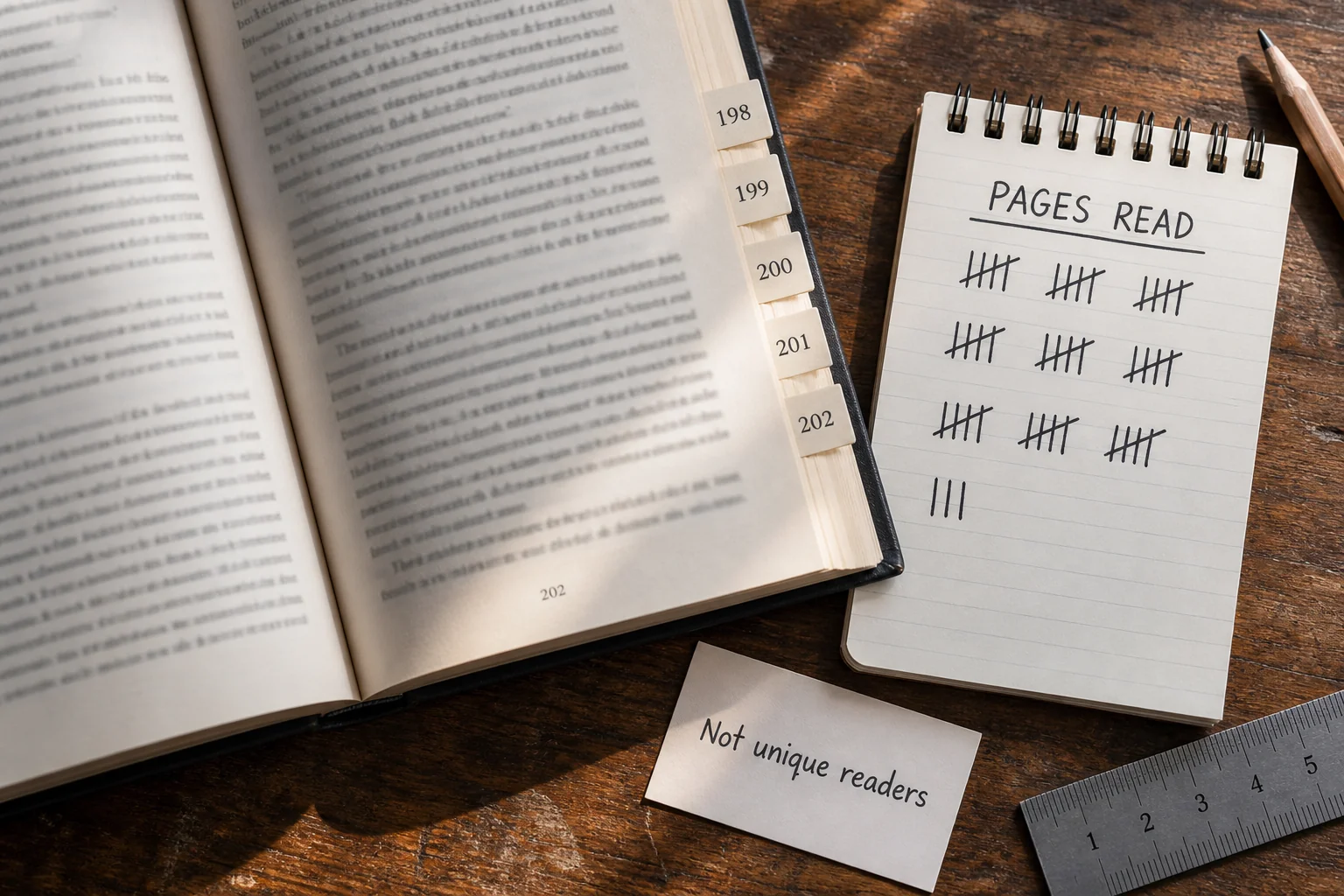
Say your book is 300 KENP long and your report shows 20,000 pages read. Dividing 20,000 by 300 gives about 66.7 complete-book equivalents. That's a useful way to picture the amount of reading, but it doesn't mean 67 people finished your book. Some readers may have finished while many others read only part of it.
You can use complete-book equivalents to compare reading across a short book and a long one. Keep the label clear so you don't accidentally turn page totals into reader counts. KDP's total doesn't identify the individual borrowers, tell you how many reached the ending or reveal which chapter made someone stop.
Who is eligible for KU royalties?
For a self-published Kindle ebook to participate in KU through KDP, enroll it in KDP Select. The KDP Select program operates in 90-day terms and includes access to Select promotional tools. (kdp.amazon.com)
Under Amazon's enrollment requirements, you must control exclusive rights to the primary content; public-domain content is not eligible. The ebook must remain exclusive to the Kindle Store during enrollment, with the help page expressly allowing distribution through public libraries. Print, audio, video and other formats can remain available elsewhere. Do not leave the same ebook for sale at another retailer or your own storefront during the term. (kdp.amazon.com)
Enrollment renews automatically unless you opt out. Turning off renewal prevents another term; it does not release the current one. Amazon allows cancellation within three days of the enrollment period's start and directs authors to support afterward. Enrolled preorders cannot be canceled until release. Check the actual start and end dates rather than treating cancellation and nonrenewal as interchangeable. (kdp.amazon.com)
Leaving Select also does not necessarily end all subsequent KU income immediately: Amazon says eligible reading can still earn after enrollment ends. Keep those later earnings in their actual earning month, rather than moving them back to the month when you enrolled or exited. (kdp.amazon.com)
Why the rate changes by month and country
A usable KENP rate needs a month, marketplace, currency and finalization status. Without those boundaries, two quoted rates may describe different things. Amazon reviews the fund monthly, allocates it by country and finalizes monthly KENP near the following month's 15th. (kdp.amazon.com)
- Month: Record the earning period, not the date a forum post or payment appeared.
- Marketplace: Keep a single-market calculation distinct from a portfolio containing several markets.
- Currency: Write USD, GBP or the applicable currency beside the result. A bare decimal is incomplete.
- Finalization: Label estimates as estimates and replace them with completed-period data when available.
On September 11, 2026, for example, August has ended, but that alone does not establish that its KENP has been finalized. Amazon's stated timing points to approximately September 15, 2026—not a guarantee of an exact release time. September 2026 is still an incomplete earning month. (kdp.amazon.com)
Check whether you're looking at royalties alone or a total that includes an All Stars bonus. Adding a bonus before dividing by pages makes the apparent rate higher. That's fine if you're calculating total income per page, but it won't tell you the payment for page reading itself. KDP separates those figures in its report. kdp.amazon.com
Find your own payout per page
Download the finalized Prior Months' Royalties Report and divide its KU royalty by its corresponding KENP total. Amazon records page-read earnings under the KENP Read transaction type, separately from Standard ebook transactions. (kdp.amazon.com)
- Select a completed earning month. Wait for finalization rather than mixing a live estimate with an older royalty.
- Download the Prior Months' Royalties Report. Save an unchanged copy before building your worksheet.
- Filter the records. Match the month, title or ASIN, marketplace, currency and KENP Read transaction type.
- Collect the matching amounts. Use KU royalty, excluding separately reported bonuses, and the eligible KENP for those same records.
- Divide and label. Record the result as currency per KENP, with its month and marketplace attached.
Effective payout per KENP = finalized KU royalty ÷ finalized KENP read
If the page count is zero, leave the rate blank. If you see royalties beside zero pages, check the filters and rows you've selected. You may be looking at different periods or types of earnings. When several matching rows belong together, add their royalties and their page counts first, then divide the totals.
Keep dollars, pounds and euros in separate calculations. If you want one overall figure in your home currency, convert each amount using a recorded exchange rate and date. The result is useful for your own budget, but it's a combined rate across your books and markets, rather than a rate Amazon promises in any one country.
Example: $45 from 10,000 pages
Let's use $45 earned from 10,000 KENP. Divide 45 by 10,000 and you get $0.0045 per page. In cents, that's 0.45 cents. It's easy to misplace the decimal and read it as 4.5 cents or $0.45, which would make your earnings estimate much too high. These are example figures so you can check the arithmetic.
| Field | Example value | How it is used |
|---|---|---|
| Scope | One finalized month, title and marketplace | Match the royalty and page records |
| Currency | USD | Keep the unit attached to the result |
| KENP read | 10,000 | Denominator |
| KU royalty | $45 | Numerator |
| Separate bonus, if any | Excluded | Track in another column |
| Effective payout | $0.0045 per KENP | Equivalent to 0.45 cents per KENP |
Now imagine you also received a $10 bonus. Dividing the full $55 by 10,000 gives $0.0055 per page. Nothing is wrong with the division; it simply answers a different question. You've calculated earnings including the bonus. Keep that result separate from the $0.0045 rate if you're comparing page-read payments between months.
The Prior Months' Royalties Report documentation identifies KENP, royalty, bonus and total-earnings information and says the report is generated near the 15th. Use the field definitions to decide what belongs in each worksheet column. (kdp.amazon.com)
Where to find KENP and royalty data in KDP
Use activity reports for monitoring, Prior Months' Royalties for earned income, and the Payment Report for transferred money. The Sales and Royalties Report guide describes a KENP read tab summarizing reading for the selected period, while the prior-month report supplies historical earnings. (kdp.amazon.com)
A dashboard total is useful for noticing changes, but do not treat an estimated royalty as a finished statement. Amazon also notes that reporting views can temporarily disagree because of update delays. Before investigating a discrepancy, compare the same date range and filters. (kdp.amazon.com)
When you download the monthly report, work through this short check before entering the numbers in your worksheet:
- Do royalty and KENP cover the same earning month?
- Do the title or ASIN, marketplace and currency match?
- Have you selected KENP Read rather than Standard transactions?
- Have you excluded bonuses from the page-read rate?
- Are the inputs finalized rather than current estimates?
- Have you kept the original download so you can retrace the calculation?
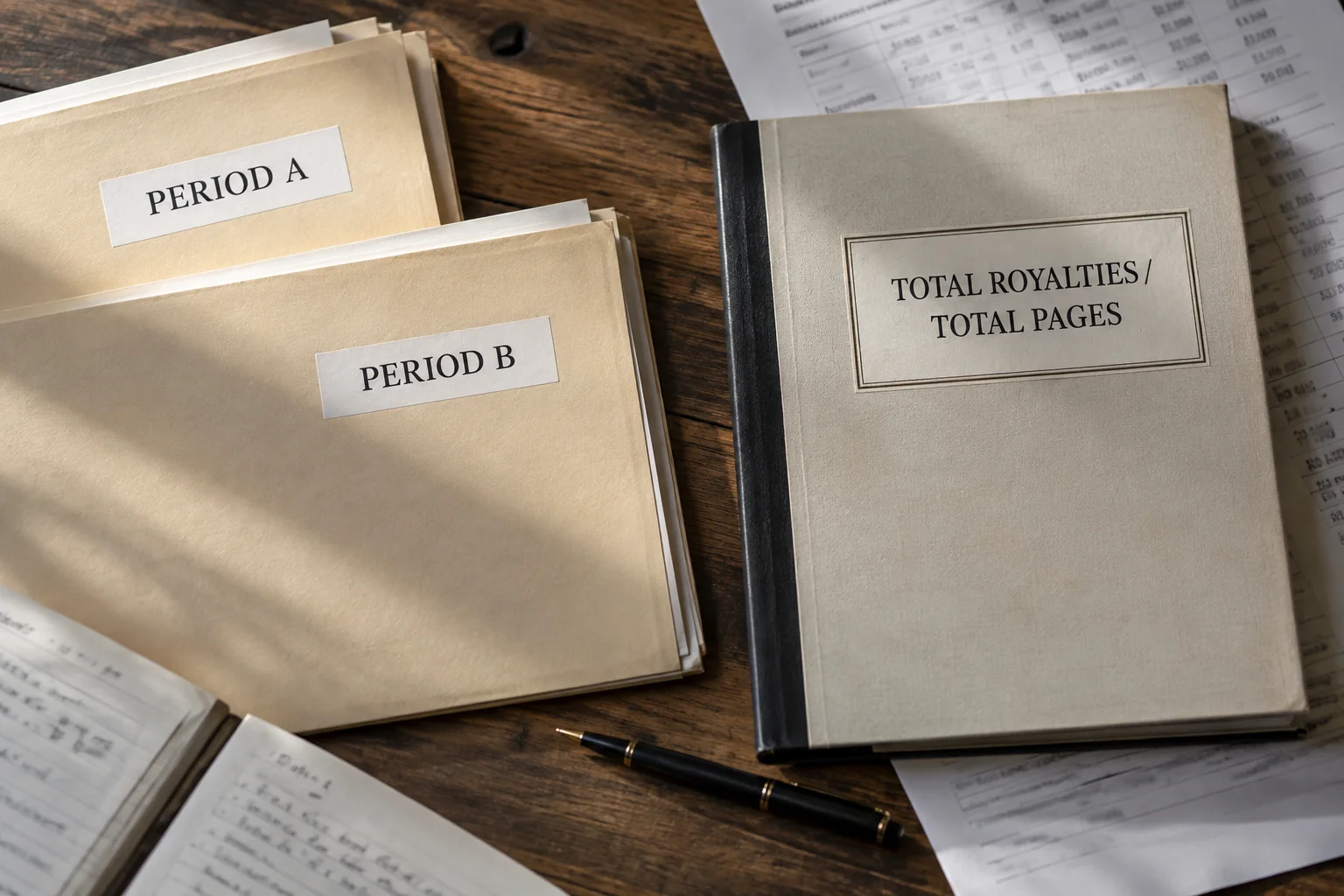
When combining completed periods in one currency, divide total royalty by total pages. For example, 10,000 pages earning $45 plus 5,000 pages earning $20 gives $65 ÷ 15,000 ≈ $0.00433 per page.
Why not average the two rates instead? The $0.0045 rate applies to twice as many pages as the $0.0040 rate. Giving both equal weight produces $0.00425 and understates what those pages earned together. Adding the dollars and pages first gives the useful overall figure, although neither method can tell you next month's rate.
When do KU royalties reach your bank account?
KU follows KDP's normal payment schedule: approximately 60 days after the earning month's end, subject to applicable payment requirements. For July 2026 earnings, the schedule points to the end of September 2026; receipt timing also varies by payment method. Finalization near midmonth and payment later are separate events. (kdp.amazon.com)
The Payment Report includes accrued royalty, withholding, adjustments, currency conversion and payment status information. A bank deposit is therefore not automatically the right numerator for your page-rate calculation. Reconcile it against the matching earning period and payment source instead. (kdp.amazon.com)
A simple fix is to keep two columns: “royalties earned” and “cash received.” Put each amount under the month it belongs to. Then a late transfer or a currency conversion won't look like your books suddenly earned less per page, and you'll find it easier to follow up on a missing payment.
What can change KU earnings?
KU earnings change when eligible reading changes, the applicable effective rate changes, or both. The underlying program inputs are reading share and fund allocation; borrowing alone is not the earning event. (kdp.amazon.com)
- Catalog participation: Track which titles participated and when, rather than comparing unlike catalogs.
- Reader activity: Compare actual eligible pages, not an assumed number of reads per borrow.
- Book length: A longer normalized count offers more possible pages, not proof that those pages will be read.
- Marketplace mix: Separate market results before interpreting a change in a blended portfolio rate.
- Monthly allocation and reading totals: Distinguish a rate change from a volume change.
Here's how to spot what changed. At an example rate of $0.0045, 10,000 pages earn $45. If reading rises to 12,000 pages at the same rate, you earn $54. If reading stays at 10,000 but the rate drops to $0.0040, you earn $40. Compare pages and rate separately before deciding why your income rose or fell.
The documented reports summarize activity; they do not supply chapter-level abandonment data. Treat a falling page total as a reason to investigate, not evidence that readers quit at a particular chapter. The report fields cannot substantiate that conclusion. (kdp.amazon.com)
KU royalty versus an ebook sale
A Kindle sale earns under the applicable 35% or 70% royalty option; KU earns through eligible page reading. Amazon's Digital Book Pricing guidance explains sale calculations, including territory, price, tax and applicable delivery-cost rules. Standard sales and KENP earnings have separate transaction types, so an enrolled title can produce both without the two calculations becoming interchangeable. (kdp.amazon.com)
A KU borrow doesn't pay the ebook's cover price. Track paid-sale royalties, KU royalties and bonuses in separate columns, then add them when you want the book's total earnings. This makes a promotion easier to assess because you can see whether readers bought the book, read it through KU or did some of each.
For example, an ad might increase paid sales while your KU page count stays the same. The book earns more, but the KU rate hasn't improved. Another campaign might lift page reads while paid sales fall. Look at both sources of income before deciding whether the promotion worked or which audience you should try to reach next.
How to decide whether KDP Select is worth the exclusivity
To decide whether Select is worth it, compare what the book earns after promotion costs with what you could reasonably earn selling the ebook elsewhere. Use a full enrollment term if you can. Note launches, advertising changes and seasonal effects so a busy release month doesn't make the distribution choice look better than it really is.
- KU: Record royalties and eligible pages by marketplace.
- Kindle sales: Include paid-sale income earned during the same term.
- Costs: Subtract advertising and other relevant promotional spending.
- Foregone distribution: Estimate what the ebook could realistically have earned through other stores or direct sales.
- Catalog effects: Examine later-title earnings without assuming aggregate page totals identify the same readers.
Suppose a term brings in $600 from KU and $240 from Kindle sales, and you spend $180 promoting the book. That leaves $660 before other costs. Compare that with what wider distribution would leave after retailer deductions and similar promotion costs. Comparing $660 with another store's gross sales would give you a misleading answer.
Your starting point matters. A debut with no sales history elsewhere faces a different choice from a backlist title already selling steadily on several stores. Use those existing earnings when you have them. Where you don't, write down your assumptions and test them over time rather than assuming every book in your genre will perform the same way.
If you choose wider distribution, disable automatic renewal and confirm the current term's end in Manage KDP Select before restoring ordinary ebook sales elsewhere. Keep those dates with the worksheet; turning renewal off does not end the existing commitment. (kdp.amazon.com)
Still weighing Kindle Unlimited against selling elsewhere? Our video follows a first-time mystery author planning a 90-day KDP Select test. It explains the ebook exclusivity commitment, the renewal setting and what to record during the term so you have something useful to compare at the end.
Watch on YouTube: KDP Select vs Wide: Which Is Better for Your First Book? (2026) (5:08)
Promote your book without paying for page reads
Do not offer customers compensation or rewards in exchange for KU reading. Amazon's prohibition covers money, gift certificates, bonus content, contest or sweepstakes entry, discounts, extra products and other gifts tied to reads. (kdp.amazon.com)
You can invite people to discover your book without rewarding them for generating pages. An ad describing the story does that. A gift for reading a certain number of KU pages does something else. Calling the offer a reading challenge or launch celebration doesn't change the condition the reader must meet to get the reward.
Read the ad, landing page and promotion rules together before launching. Does someone have to read through KU to receive a benefit? If so, remove that incentive. You want readers who are interested in the story and choose to keep reading, rather than people opening pages to qualify for a prize.
Use the payout scenario calculator
Enter matching finalized royalty and KENP figures, then multiply the resulting effective rate by your forecast pages. For the worked example, choose USD, enter 10,000 finalized KENP and $45 royalty, and use 20,000 forecast pages. The arithmetic is ($45 ÷ 10,000) × 20,000 = $90.
The $90 result assumes the example rate stays unchanged. Save the reference month and marketplace with the calculation so you know where the rate came from. Leave bonuses out, and don't enter a made-up rate if the historical page count is zero. Once you have a completed month, you'll be able to compare the estimate with actual earnings.
Try 15,000, 20,000 and 25,000 forecast pages at the same example rate. You'll get $67.50, $90 and $112.50. This shows what more or less reading would mean without guessing a new payout rate. You can then judge whether your promotion budget makes sense across several possible outcomes, rather than relying on the most optimistic one.
The calculator can't reveal an unannounced rate or tell you how many people will finish the book. When the next report is finalized, enter its actual royalties and pages, calculate the new rate and keep your earlier estimate beside it. Over several months, that record will be much more useful than a single headline about the global fund.
Your KU effective-rate calculator
Use finalized KDP reporting for one marketplace, month, and currency. Exclude bonuses. Starting values are an illustration, not a reported payout rate.