Table of Contents

What Is Kord AI? (What I Actually Tested)
I first heard about Kord AI and thought, “Sure… another tool that promises automation and then makes you do half the work anyway.” That’s usually how these things go. So I decided to run a real test instead of just reading the marketing copy.
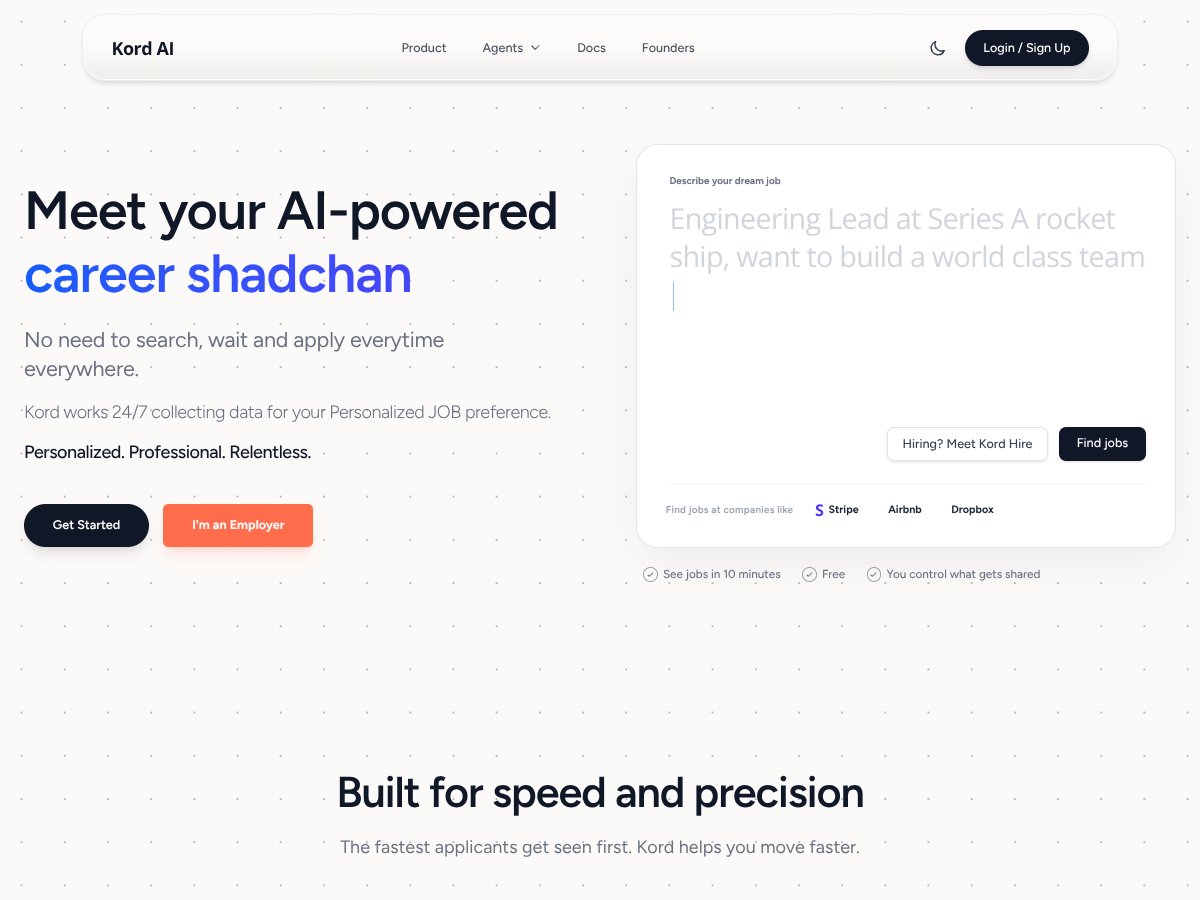
In plain terms, Kord AI is a job-hunting platform that’s built around the idea of automating the boring parts of outreach. The flow they advertise is pretty simple: you share your resume and LinkedIn, the system analyzes that info, and it then matches you with startups they say are hiring (they emphasize YC startups, but they also mention beyond YC). After that, it helps you connect—ideally with founders or hiring teams—and it can generate follow-ups and scheduling messages so you’re not stuck doing every email thread manually.
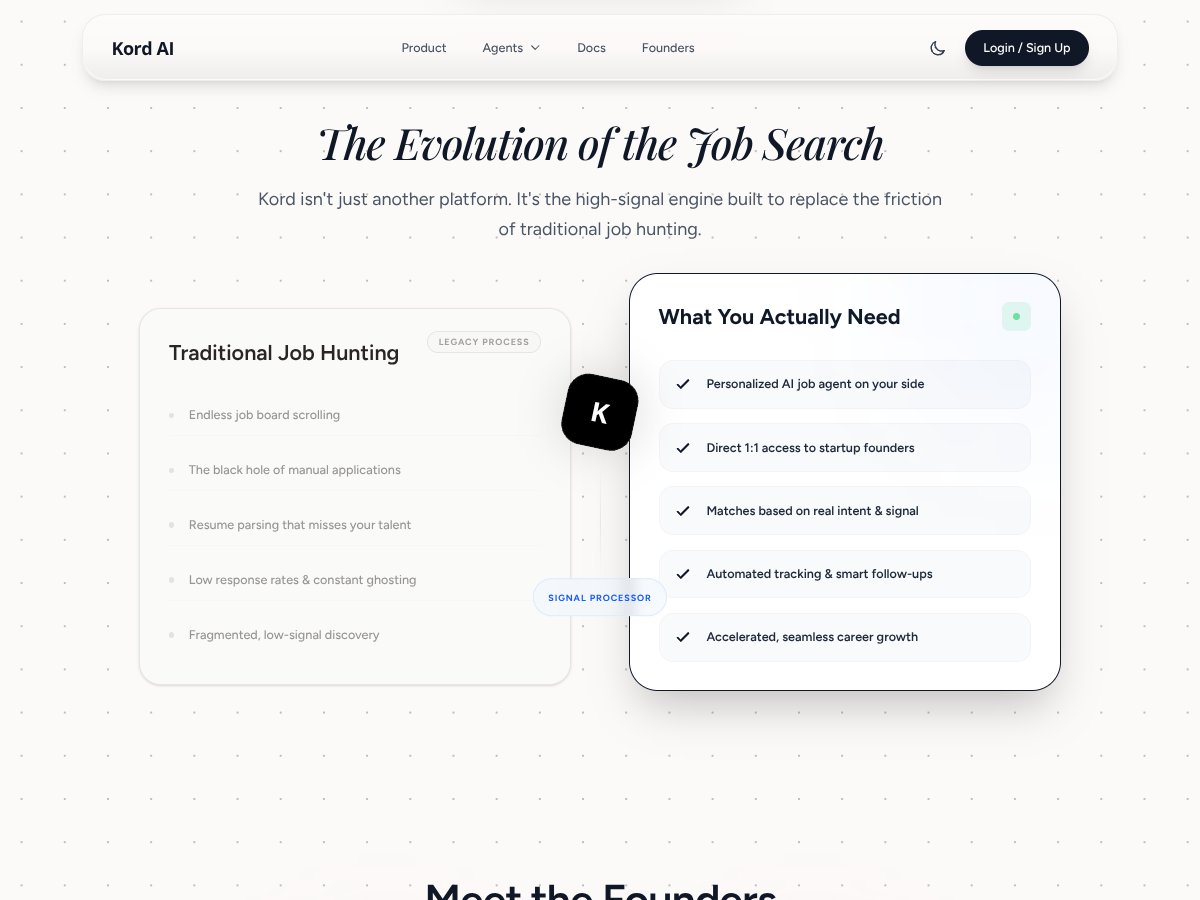
The core problem it’s trying to solve is exactly what most people hate about job searching: endless applications, low response rates, and the “sent it yesterday, heard nothing” loop. In my experience, job boards can feel like throwing darts in the dark. Kord’s pitch is basically to replace that with more targeted matching and direct outreach.
Now, about transparency: I couldn’t find a lot of concrete info on the team or investors behind Kord AI on the site. It’s not like there’s a “Meet the founders” page with bios and LinkedIn links. It’s more minimal than I expected, which I get—early-stage products often are—but it does make me cautious when I’m spending money.
One more thing that stood out during my test: there wasn’t a clear demo or onboarding walkthrough publicly available on the site. I didn’t get a “watch this video” option or a step-by-step tour. So yes—I signed up and explored the workflow myself.
Here’s how I approached the test (so you can sanity-check what I’m saying): I started by uploading my resume and connecting my LinkedIn. Then I reviewed the matching suggestions it produced, and I paid attention to how the system described the “why” behind the matches (if it gave one). After that, I moved into the outreach portion and generated the initial messages it suggested. I also watched for whether it actually created introductions or if it stayed at “here’s an email you can send.”
I’ll be upfront: I’m not going to pretend I got instant miracles. What I did notice was that the product felt more like an evolving system than a polished, fully-featured dashboard. There weren’t detailed tutorials, and I didn’t see a robust set of integrations listed clearly. If you’re expecting a plug-and-play replacement for your entire job search, you might feel disappointed. If you’re willing to test it as an assistant that speeds up parts of the process, it’s more realistic.
Important note: I’m keeping this review honest. I can describe what I did and what I saw in the UI, but I’m not able to include private screenshots that show personal data, and I don’t have a public dashboard export to quote exact “X matches in Y days” numbers as a verifiable log. If you want that level of reporting, you’ll need to run your own test and compare outcomes.
Kord AI Pricing: What I Found (and What’s Missing)

| Plan | Price | What You Get | My Take |
|---|---|---|---|
| Free Tier | Unknown / Not Clearly Public | Basic access to some features, limited matches | Without exact limits listed, the free tier is hard to evaluate. In practice, it’s best used as a “touch it and see” trial, not a long-term strategy. |
| Paid Plans | Check website | Full access to AI matching, automated outreach, and direct founder contact |
Pricing transparency is the weak spot. I didn’t find a clean, upfront pricing table with plan names, limits, and feature breakdowns that you can compare in 30 seconds. What that means for you: you may end up paying without knowing whether you’re getting usage caps (matches, outreach volume, follow-ups), or whether the “good stuff” is locked behind higher tiers. For fairness, I don’t mind paying for automation if it’s actually productive. But if you can’t see the rules of the game, it’s a risk—especially if you’re budgeting. My honest take: If you’re serious about direct founder outreach and you’re okay testing the product first, it can be worth a shot. If you want predictable costs and clear limits, you’ll probably want to ask support or request a demo before subscribing. |
Overall, the lack of transparent, detailed pricing information is a real caveat. If they published usage caps and plan tiers more clearly, it would make the decision way easier. As it stands, I’d treat Kord AI like an experiment: try it, measure your results, then decide if it deserves your money.
The Good and The Bad (Based on My Use)
What I Liked
- Matching that’s more “targeted” than random applications: After I uploaded my resume and LinkedIn, the suggestions felt less like generic job alerts and more like curated startup opportunities. I can’t confirm every underlying “data point” claim, but the output was clearly not just a simple keyword match.
- Outreach automation that saves time: The part I appreciated most was generating outreach messages without writing everything from scratch. Even when I edited the copy, it still cut down the blank-page stress.
- Direct founder/hiring-team angle: Kord AI’s positioning is all about founder-level reach. In my test, the outreach workflow was built around that idea rather than “apply and wait.”
- Always-on workflow: I liked that I wasn’t stuck doing the process only during business hours. Once my profile was in, I could come back later and see what the system suggested next.
- Profile analysis prompts you to clarify your story: The way it uses resume/LinkedIn info nudged me to make sure my experience and focus areas were consistent. That matters because AI matching is only as good as the inputs.
What Could Be Better
- No clear “feature map” or daily dashboard clarity: I wanted a straightforward place where I can see matches, outreach status, replies, and follow-ups—without hunting. The experience felt more lightweight than I expected.
- Limited social proof (testimonials/case studies): I didn’t see strong, specific case studies that show what results look like over 7/14/30 days. That makes it harder to judge effectiveness before you test it yourself.
- Pricing is not upfront (limits aren’t obvious): I couldn’t find a public breakdown showing exactly what the free tier covers and how paid tiers differ. If you’re comparing tools, this is annoying.
- Scope feels concentrated toward YC-style startups: If your target is broader (enterprise, government, non-startup companies), Kord AI’s focus may limit your options.
- AI still needs human judgment: Even with decent matching, you’ll still want to sanity-check relevance. I wouldn’t treat any AI intro as “automatically correct.” Context and fit matter.
Who Is Kord AI Actually For?
In my opinion, Kord AI makes the most sense for people who are targeting startup roles—especially YC-adjacent companies—and who want to reduce the time spent on repetitive outreach.
If you’re the type who hates sending 30 nearly identical cold emails, or you don’t want to spend evenings applying and then waiting in silence, this could click for you. It’s also a better fit if you’re comfortable reviewing and tweaking AI-generated messages so they sound like you.
Here’s a concrete example: if you’re a software engineer with ~3+ years of experience and you’re tired of “apply here” portals that go nowhere, Kord AI’s workflow is designed to push you toward direct outreach instead. Same idea for a product manager aiming at startups—getting the right angle in the message matters, and the tool tries to help with that.
What I’d watch for: if your resume and LinkedIn aren’t aligned (different titles, inconsistent dates, unclear focus), AI matching will struggle. Garbage in still happens, no matter how smart the model is.
Who Should Look Elsewhere
If your job search is broad—large established companies, enterprise roles, non-tech industries, or anything heavily regulated—Kord AI might not cover your needs. The emphasis on YC startups (and similar early-stage targets) means you may not get enough variety in the opportunities list.
Also, if you’re someone who wants a platform with a very transparent feature list, reporting, and dashboards, you might find Kord AI frustrating. I did. Not because it’s unusable—just because it doesn’t feel as “trackable” as some other tools.
And if your goal is a passive pipeline (slow drip applications, lots of networking, building a public profile), traditional job boards and LinkedIn workflows might still be the better daily habit.
How Kord AI Stacks Up Against Alternatives
LinkedIn Premium
- What it does differently: LinkedIn Premium is mostly about reach—InMail, more profile visibility, and tools that help you network and message recruiters. It’s social-first.
- My price comparison (no hard sourcing here): I’ve seen LinkedIn Premium pricing around the ~$59.99/month ballpark for Premium Career, but pricing changes a lot. If you’re comparing, check the current rate in your region before deciding.
- Choose this if... you want to build a network, message recruiters directly, and use social proof as part of your strategy.
- Stick with Kord AI if... you want matching + outreach automation aimed at relevant startup opportunities, not just “more ways to message people.”
Indeed Resume & Job Search
- What it does differently: Indeed is a big database. It’s great for volume and finding listings fast. But it’s not really designed to do AI-driven matching and direct founder outreach.
- Price comparison: Job search is free; you pay for sponsored listings or premium services. That can get expensive if you’re applying to lots of roles.
- Choose this if... you want broad coverage and a straightforward job board experience.
- Stick with Kord AI if... you’re trying to reduce irrelevant applications by targeting opportunities more proactively.
AngelList Talent
- What it does differently: AngelList is startup-focused and often gives you access to companies that are harder to find elsewhere. It’s more “startup marketplace” than AI outreach engine.
- Price comparison: Creating a profile and applying can be free, with optional premium features depending on the current product offering.
- Choose this if... you’re specifically hunting for early-stage roles and want startup access right now.
- Stick with Kord AI if... you want AI-assisted matching plus automated outreach messaging centered around YC-style targets.
Jobscan
- What it does differently: Jobscan is about resume optimization for ATS. It helps you tailor keywords and improve your odds of passing automated filters.
- Price comparison: I’ve seen Jobscan plans start around the ~$49.99/month range, but again—check current pricing since it can change. Kord AI is more about proactive outreach and matching than ATS tuning.
- Choose this if... your biggest blocker is ATS and you’re applying to lots of postings where keyword alignment matters.
- Stick with Kord AI if... you want the tool to help you find opportunities and reach out, not just rewrite your resume for a specific job.
Quick reality check: These tools solve different problems. Job boards and ATS tools help you get through filters. Kord AI is trying to help you skip the “apply and pray” phase by pushing toward direct outreach.
Bottom Line: Should You Try Kord AI?
After testing it, I’d rate Kord AI around 7/10 for the specific job it’s trying to do. It’s not flawless, and the interface and transparency feel a bit early-stage. But the core idea—matching + outreach automation for startup targets—does come through.
If you’re actively hunting for roles at YC startups (or similar high-growth companies) and you want to automate parts of outreach while getting more relevant suggestions, Kord AI is worth a shot.
On the other hand, if you need broad coverage across industries, or you want highly detailed reporting and plan transparency, you’ll likely want to look elsewhere. And if you’re expecting a mature “dashboard + analytics + integrations” experience, temper expectations.
One more honest take: I’d use the free tier first (if it’s available for you) to see how the matching looks and whether the outreach workflow actually produces real conversations. Upgrading makes sense only if you’re seeing outcomes you can measure—replies, screens, interviews, anything concrete.
If you’re serious about using AI to accelerate your startup job search, Kord AI can be a helpful tool. If you just want to browse listings or network manually, you probably won’t get enough value to justify it.
Common Questions About Kord AI
- Is Kord AI worth the money? It can be, if you’re targeting startup roles and you’ll actually use the matching + outreach workflow. If you only want to apply occasionally, the value drops fast—especially with pricing that isn’t super transparent.
- Is there a free version? Yes, there’s a free tier, but the exact limits aren’t clearly spelled out publicly. I’d treat it as a trial to validate fit, not a full strategy.
- How does it compare to LinkedIn Premium? LinkedIn Premium helps you network and message more effectively. Kord AI is more about matching and outreach automation aimed at startups. If networking is your main channel, LinkedIn wins. If you want efficiency and relevance in outreach, Kord AI is the more direct bet.
- Can I get a refund? Refunds depend on the plan and provider terms. I recommend checking the refund policy during signup or in the billing page. I didn’t see a clearly quoted refund policy in the content I reviewed, so don’t assume anything—verify before paying.
- How accurate are the AI matches? They’re likely decent, but accuracy depends on how complete and consistent your resume/LinkedIn inputs are. AI can still make “technically relevant, practically wrong” suggestions—so you should review before acting.
- Is it easy to use? From what I experienced, yes. The workflow is straightforward enough that you don’t need a tech background. You’ll still want to edit messages so they sound like you.
- Does it support multiple job types or industries? You can customize preferences, and the system should adjust suggestions based on what you set. That said, if your targets are outside startup/YC-style roles, you may notice less variety.