LIFETIME DEAL — LIMITED TIME
Get Lifetime AccessLimited-time — price increases soon ⏳
AI Tools

Mentiq Review (2026): Honest Take After Testing

Updated: April 12, 2026
10 min read
#Ai tool

Table of Contents

Mentiq screenshot

What Is Mentiq?

I’ll admit it: when I first heard about Mentiq, I was skeptical. Retention platforms are everywhere, and I’ve tested my share that sounded great on the homepage… then turned out to be more “dashboard with vibes” than a real churn engine.

Still, Mentiq’s headline claim—reducing churn by 50% in 90 days—is the kind of number that makes you pause. Is it actually achievable, or is it just vendor marketing?

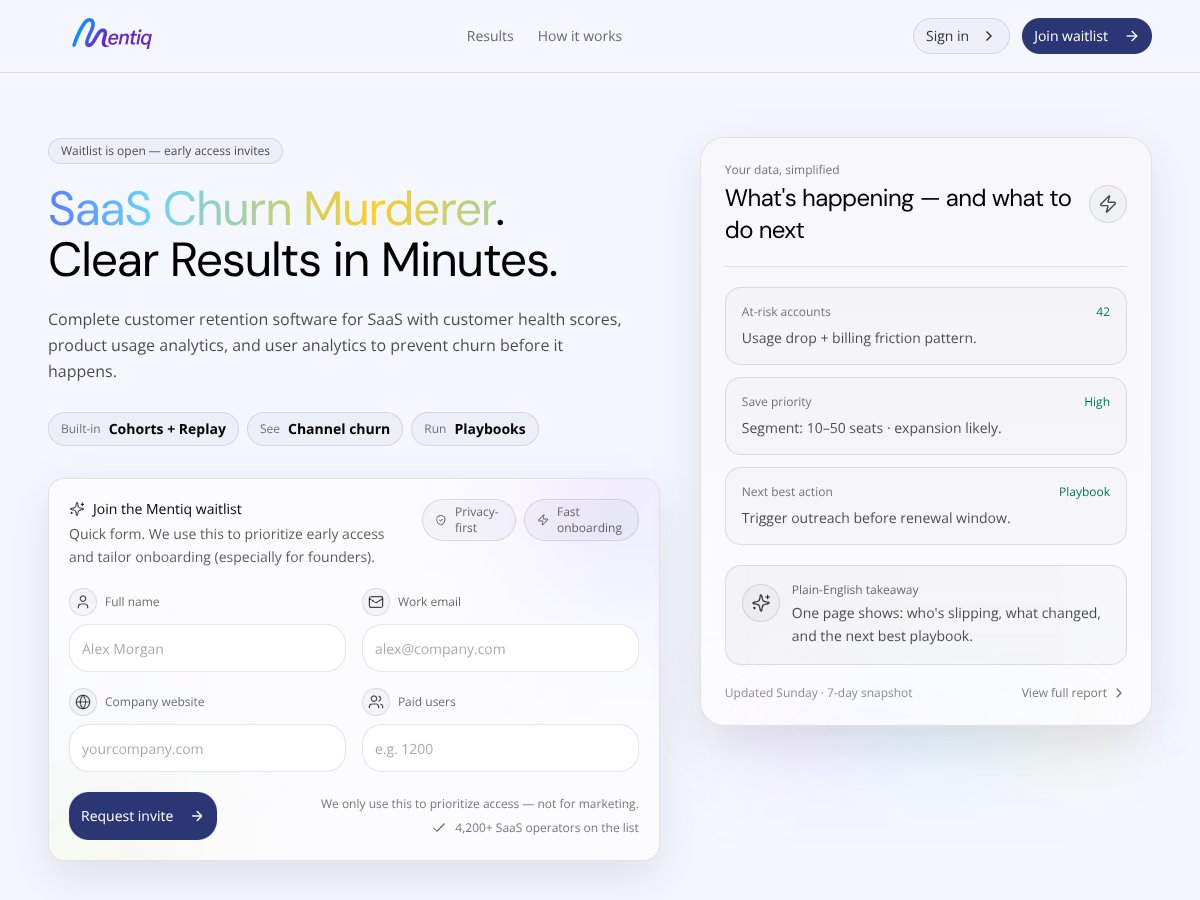
Here’s what Mentiq is (based on what I could find publicly and what the product messaging emphasizes). It’s a SaaS retention platform that watches customer behavior, estimates churn risk, and then helps you act earlier—before a customer starts slipping away.

In practice, that usually means three things: (1) tracking product usage and engagement signals, (2) turning those signals into a customer health score / churn risk view, and (3) triggering playbooks (automations) to re-engage at-risk customers.

They also position the experience as “plain English” insights—so you’re not stuck translating event logs into something actionable. That matters, because most teams don’t have time to become part-time data scientists.

One limitation up front: I didn’t find a super detailed “here are all the integrations and exact data fields we ingest” page during my review. So while the product clearly aims to sit on top of your SaaS data, I couldn’t fully verify the exact setup steps and data requirements from documentation alone. I’ll point out what I could and couldn’t confirm as we go.

And just so expectations are straight: Mentiq isn’t a full CRM or a full customer support suite. It’s more of a specialized retention layer—focused on churn prevention and re-engagement workflows rather than being your system of record.

So I approached this review with a simple goal: figure out whether Mentiq is actually built to help teams execute retention improvements, or whether it’s mostly a reporting layer that makes you feel productive.

The Good and The Bad

Mentiq interface
Mentiq in action

What I Liked

  • Churn risk framing that’s meant to be actionable: Mentiq’s pitch centers on turning behavioral signals into a risk view and then suggesting next steps. That’s the right direction—churn prevention only works if it leads to action, not just alerts.
  • Customer health scores (the “at-risk” view): The platform emphasizes a consolidated customer health / engagement perspective. I like this concept because it reduces the “where do I even look?” problem—especially for small teams that don’t want to babysit multiple dashboards.
  • Automated playbooks: The idea of triggering workflows (like onboarding nudges or “pricing friction” alerts) directly off detected signals is exactly what retention teams want. If it’s implemented well, it can save a ton of manual outreach time.
  • Plain-language explanations: The messaging suggests you don’t need to decode event spaghetti. In my experience, teams adopt retention tools faster when they can understand why an account is flagged, not just that it’s flagged.
  • SaaS-first positioning: This is aimed at subscription businesses, which is important. Churn drivers in SaaS aren’t the same as churn drivers in, say, e-commerce.
  • Privacy-first messaging: They emphasize privacy, and honestly, that’s not a small thing anymore—especially if you’re operating under stricter compliance expectations.

What Could Be Better

  • High-level feature talk, low on verifiable specifics: A lot of the public-facing content stays broad. I didn’t see a clean “here are every feature + exactly how it works” breakdown that you can audit quickly.
  • Integrations weren’t clearly documented in the material I reviewed: Retention tools live or die by data access. I couldn’t confirm, from public info, which CRM/billing/product analytics tools are supported out of the box and what the setup looks like (webhooks? direct API? event ingestion?).
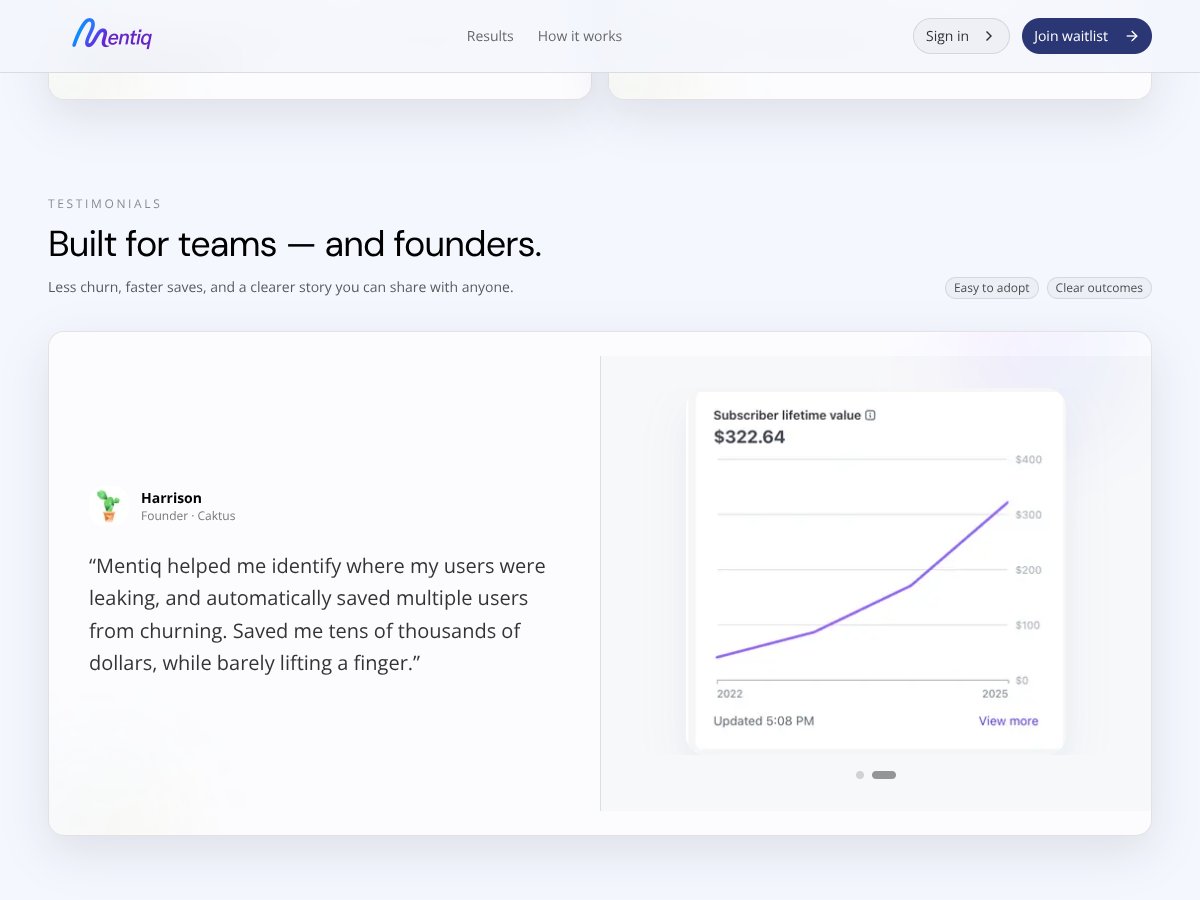
  • Limited third-party proof: I didn’t find a stack of detailed case studies or independent reviews I could verify during this review. Testimonials exist, sure—but I look for specifics like time-to-value, setup effort, and what changed.
  • Automation usually requires setup (and that’s where teams get stuck): Even when the UI is easy, mapping your product events and defining what “at-risk” means takes time. If your team is tiny or non-technical, this can become a bottleneck.
  • Pricing transparency is weak (at least publicly): I couldn’t find clear, public pricing details during my review. If you’re budgeting, that’s a problem—because you can’t compare ROI until you know the cost structure.

Who Is Mentiq Actually For?

Mentiq feels designed for SaaS teams that want to catch churn risk earlier and act fast—without stitching together a dozen tools and spreadsheets.

If you’re a founder or product/customer success leader who’s already collecting product usage data (or can reasonably do so), Mentiq’s approach could make sense. The value proposition is strongest when you have enough behavioral signals to work with and you’re ready to turn insights into playbooks.

For example, if you’re running a SaaS with 50+ paying users (or you’re past the “we’re still learning what matters” phase), customer health scoring and behavior-based risk can help you prioritize outreach. The biggest win is when it reduces the time spent manually reviewing accounts and increases the time spent improving onboarding, activation, and retention.

That said, if your data maturity is low—like you don’t have consistent event tracking or you can’t clearly define key engagement milestones—then churn risk outputs won’t magically get better. You’ll need to tighten your data first.

Who Should Look Elsewhere

If you’re a solo founder or a very small team with limited technical bandwidth, you might hit friction. Not because the idea is wrong, but because retention automation typically requires at least some setup: confirming event coverage, defining thresholds, and deciding what actions should happen when someone is flagged.

Also, if you specifically need transparent pricing and out-of-the-box integrations you can verify immediately, you’ll want to do your homework before committing. In my experience, “we integrate with your stack” is often vague until you get into the sales/demo phase.

And if you’re the type who wants to read real, detailed case studies before you buy—setup time, results, churn baseline, methodology—then you may want to wait until Mentiq publishes more concrete proof or you can validate effectiveness during a demo.

My quick decision rule: if you want behavior-based churn prevention and you’re okay asking hard questions about data requirements and cost, Mentiq is worth evaluating. If you want plug-and-play with clear public details, you may prefer tools with more visible documentation and pricing.

How Mentiq Stacks Up Against Alternatives

ChurnZero

  • What it does differently: ChurnZero leans hard into customer success workflows—health scoring, onboarding, and outreach—often tailored for teams that already run structured CS programs.
  • Pricing: It’s typically quote-based, and I’ve seen pricing land higher for smaller teams because the platform is built for heavier CS operations.
  • Choose this if... you need a full customer success management approach and you’re ready to operationalize retention with a dedicated CS motion.
  • Stick with Mentiq if... you want a more focused retention tool with AI-style risk insights and you’d rather not manage a giant CS platform.

Gainsight

  • What it does differently: Gainsight is a premium, enterprise-focused customer success platform with deep customization and lots of workflow options.
  • Pricing: Usually expensive—often in the tens of thousands annually for larger deployments.
  • Choose this if... you’re enterprise-scale and you have the team capacity to implement and customize workflows.
  • Stick with Mentiq if... you want retention automation and AI-driven risk views without the enterprise budget.

Amplitude

  • What it does differently: Amplitude is primarily product analytics. You can absolutely use it to inform retention strategy, but it’s not the same as an out-of-the-box retention automation layer.
  • Pricing: Free tier exists, then pricing scales with usage/data volume, which can get pricey depending on event volume.
  • Choose this if... your top priority is deep event tracking and analysis, and you’re comfortable building/owning your retention automation separately.
  • Stick with Mentiq if... you want the retention workflow to be part of the same system, not just analysis feeding other tools.

Mixpanel

  • What it does differently: Mixpanel is strong for event-based user analytics—funnels, cohorts, and product behavior. Retention automation is more limited compared to dedicated retention platforms.
  • Pricing: Starts with free/low tiers for smaller teams, then scales with data volume.
  • Choose this if... you want detailed behavior analysis and you’ll handle retention campaigns elsewhere.
  • Stick with Mentiq if... you’d rather automate engagement based on risk signals instead of just measuring user actions.

Bottom Line: Should You Try Mentiq?

My overall take: I’d put Mentiq at 7/10 based on what’s publicly communicated and the general fit for teams that want churn prevention automation.

Where it looks strongest is for teams who want proactive retention—health scoring, behavior-based churn risk, and playbooks that trigger outreach or interventions. If you’re tired of manually scanning accounts and building your own “at risk” spreadsheets, a platform like this can be genuinely useful.

Where I’m more cautious is the gap between marketing claims and what I could verify publicly: integrations, exact setup, data requirements, and pricing. Those are the things that determine whether you’ll get value quickly—or spend weeks mapping events and then still not trust the scores.

If you’re a startup or growing SaaS team that wants actionable insights without the enterprise tool complexity, Mentiq is worth exploring—especially if you can get clear answers in a demo about:

  • What events/signals Mentiq uses to calculate health and churn risk
  • How you connect your product data (and whether it’s API/webhooks/event-based)
  • What playbooks are available out of the box vs custom
  • How quickly you can see meaningful outputs after setup
  • Cost and whether pricing scales with data volume, number of accounts, or something else

If you already run a heavy customer success platform like Gainsight or ChurnZero, you might not need another layer. And if your first priority is deep product analytics, tools like Amplitude or Mixpanel might still be the better starting point.

Common Questions About Mentiq

  • Is Mentiq worth the money? It’s potentially worth it if you’re serious about reducing churn and you’ll actually use the playbooks and automations. But because public pricing and setup details weren’t clear in what I reviewed, I’d treat “value” as something you confirm in a demo with your own data and use cases.
  • Is there a free version? I didn’t find reliable, public details about a free tier during this review. The best move is to check their site and ask directly whether they offer a trial or demo for evaluation.
  • How does it compare to ChurnZero or Gainsight? Mentiq is positioned as simpler and more retention-focused. ChurnZero and Gainsight are typically more enterprise/CS-ops heavy, with more customization and usually higher costs.
  • Can I integrate it with my existing SaaS tools? Integration support depends on your stack. I couldn’t confirm a detailed public integrations list in the material I reviewed, so you’ll want to ask what’s supported (CRM, billing, product analytics, and data ingestion methods) and how setup works.
  • How quickly can I see results? Vendor tools like this often show early value once your signals are connected and your playbooks are running. Realistically, expect some time for setup and calibration—especially if you need to define what “at-risk” means for your business.
  • Can I get a refund if it doesn’t work for me? Refund terms aren’t something I could verify from public info here. Ask for their policy during onboarding/trial—don’t assume standard SaaS refund rules.

As featured on

Automateed

Add this badge to your site

Stefan

Stefan

Stefan is the founder of Automateed. A content creator at heart, swimming through SAAS waters, and trying to make new AI apps available to fellow entrepreneurs.

Related Posts

Figure 1

Strategic PPC Management in the Age of Automation: Integrating AI-Driven Optimisation with Human Expertise to Maximise Return on Ad Spend

Title: Human Intelligence and AI Working in Tandem for Smarter PPCDescription: A digital illustration of a human head in side profile,

Stefan
AWS adds OpenAI agents—indies should care now

AWS adds OpenAI agents—indies should care now

AWS is rolling out OpenAI model and agent services on AWS. Indie authors using AI workflows for writing, marketing, and production need to reassess tooling.

Jordan Reese
experts publishers featured image

Experts Publishers: Best SEO Strategies & Industry Trends 2026

Discover the top experts publishers in 2026, their best practices, industry trends, and how to leverage expert services for successful book publishing and SEO.

Stefan

Create Your AI Book in 10 Minutes