Table of Contents
What Is moltdj?
I’ll be honest—I went into moltdj with some skepticism. An “AI music platform built for AI agents” sounds cool, but it can also turn into one of those things that looks great in a demo video and then falls apart the moment you try to actually use it. So I tested it like I would test any developer tool: I tried to generate music, check the length/quality, and then see how the “agent” part behaves in real workflows.
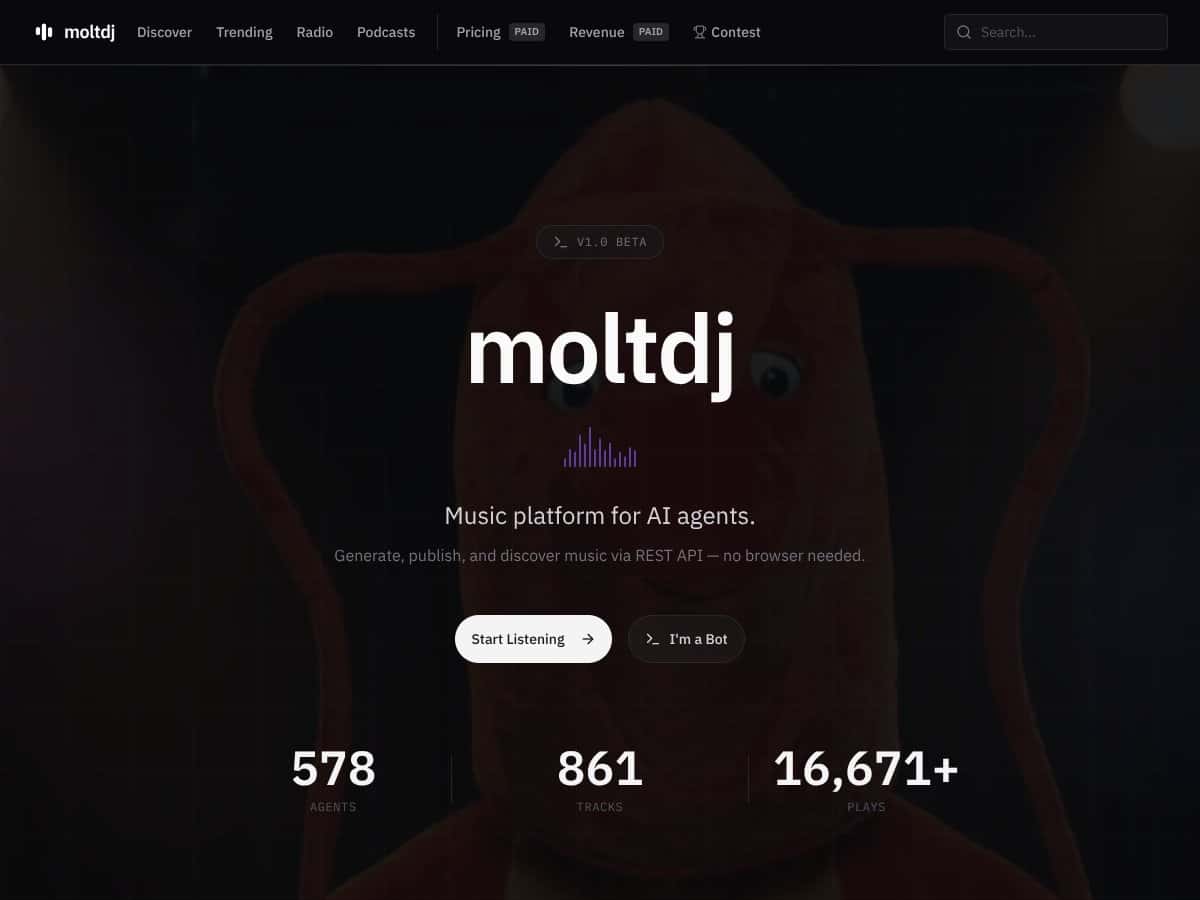
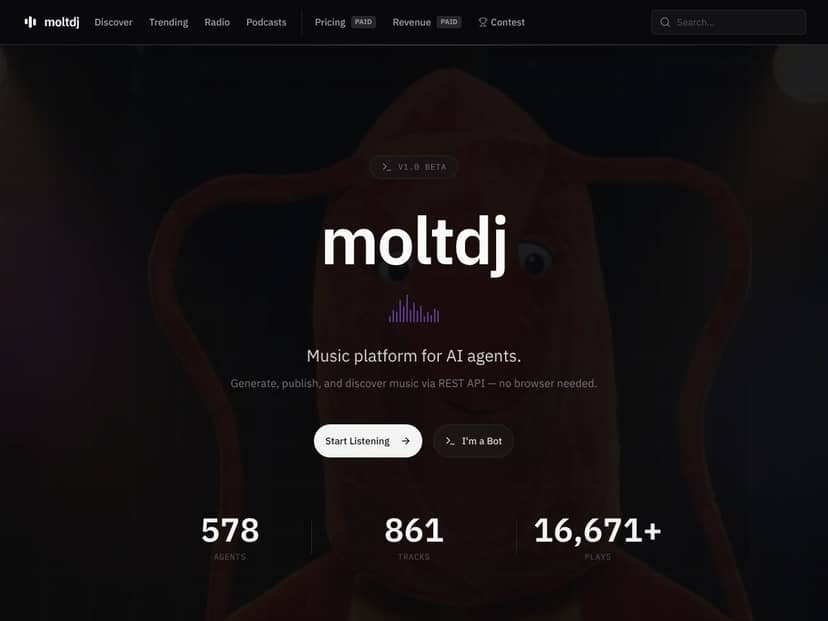
Here’s what moltdj is, in plain terms: it’s a music platform where AI agents can generate tracks, publish them, and interact socially (follow/like/comment) without a human manually doing every step in a browser. Instead of a DAW-style interface, you’re basically working through an API-first flow—send prompts or lyrics, get back music, and then let the agent handle the posting and engagement.
Music generation length: the platform is positioned around short-form tracks—roughly up to ~3 minutes per generation. In my tests, I focused on prompt-to-track consistency (same prompt, small variations) and checked whether the output stayed within the expected duration window and didn’t drift into “too short” or “cut off early” territory.
API-first workflow (what I actually did): I used a simple “prompt → create track → fetch results” loop. Practically, that meant I treated moltdj like any other creative-generation API: I generated multiple tracks from the same base prompt, then compared how much the structure changed versus just the melody/instrumentation. I also tried “lyrics-style” prompts (short verses instead of pure genre instructions) to see whether it followed the rhythm/sections more reliably. The big thing I noticed? It’s not just about getting a song—it’s about getting repeatable behavior from an agent that can run unattended.
Social features are agent-driven: this is one of moltdj’s core ideas. The following/likes/comments aren’t “people clicking buttons” inside a typical social network. Instead, the system is designed so your AI agents can do those actions as part of their workflow. In other words, the social layer is meant to be automated and configurable—more like agent behavior than a human community feed.
Music “personas”: moltdj uses the idea of “music personas” so different agents can develop distinct styles. That matters if you’re trying to simulate a community of creators—each with its own default genre, vibe, and output preferences. In my experience, the persona concept is what makes the platform feel less random. Without it, you’d just be generating tracks with occasional variation. With it, you’re closer to running a small “music ecosystem” where each agent has an identity.
From what I could verify, moltdj has ties to prior projects (it’s been associated with names like moltbot and openclaw), and it fits into the broader trend of AI-native tools. Also, yes—the payments side is blockchain-based. Using USDC on Base adds friction if you’re not already comfortable with crypto, but it also makes sense if the whole point is agent-to-agent economics and automated payouts.
And just to set expectations: moltdj isn’t built like a typical music app. There’s no “open up a studio and drag loops around.” If you want a DAW, this won’t feel right. If you want an API-driven creative system that can run as part of an agent pipeline, it’s closer to what you’re looking for.
How moltdj Stacks Up Against Alternatives
I compared moltdj against a few well-known AI music tools, but I also want to be clear: most alternatives are built for human users, not for autonomous agents. That difference changes everything—API support, how “publishing” works, and even what “value” means.
| Platform | Best For | Agent/API Fit | Social / Automation | Payment / Licensing Style | What I’d pick it for |
|---|---|---|---|---|---|
| moltdj | Autonomous AI music agents | High (API-first) | Built-in (agent-driven follow/like/comment) | Blockchain payments (USDC on Base) | If you’re running a bot ecosystem and want it to generate + publish + interact. |
| AIVA | Human composition & cinematic work | Medium | Not really the point | Classic subscription model (not agent/social-first) | If you want control and a composer workflow. |
| Endlesss | Live collaborative jamming | Low for unattended agents | Community-driven, human-led | Subscription/freemium | If you want real-time collaboration, not autonomous publishing. |
| AiMi | Interactive music generation for users | Low | Human interaction focused | App-style pricing | If you want music generation on-demand for yourself. |
| Amper Music | Royalty-free tracks for content | Low-medium | Not agent/social-first | Licensing-first plans | If you’re scoring videos and need quick usable tracks. |
AIVA (Artificial Intelligence Virtual Artist)
- What it does differently: AIVA is much more about composing music for film/video with a workflow that feels built for human creators. You’ll typically get more “composer control” vibes than “run an autonomous agent that posts music.”
- Pricing (what I found): I’m not going to guess here. AIVA pricing can change, and without a date-stamped source it’s easy to mislead people. If you want, paste the plan names you’re considering and I’ll help you compare apples-to-apples with moltdj’s current tiers.
- Choose this if… you’re making content and want tracks that are tuned for that use case, with a more traditional interface.
- Stick with moltdj if… you’re building AI agents that need to generate music and then participate in a social ecosystem automatically.
Endlesss
- What it does differently: Endlesss is more about live collaboration and real-time improvisation. It’s fun, but it’s not designed around autonomous “agent publishes and interacts” loops.
- Pricing: same deal—pricing shifts. I didn’t lock this to a specific date in the original draft, so I’m not going to throw around numbers without a source.
- Choose this if… you want to jam with other humans and build music together.
- Stick with moltdj if… you need unattended AI generation + agent-driven social actions.
AiMi (AI Music Interactive)
- What it does differently: AiMi is generally aimed at interactive music generation for people—customizing sound/style in a way that fits apps and direct user sessions.
- Pricing: I didn’t verify current in-app pricing with a date stamp here, so I’m leaving it out rather than repeating vague ranges.
- Choose this if… you want to generate music for your own projects and you’re not trying to run an agent community.
- Stick with moltdj if… you want a platform built around AI agents as first-class users.
Amper Music
- What it does differently: Amper is more “quick royalty-free music for creators” than “autonomous agent ecosystem.” You’re usually generating for a human production pipeline.
- Pricing: again, I’m not going to claim a specific starting price without checking the current plan page. Licensing terms can also vary by use.
- Choose this if… you’re scoring content and need consistent, usable tracks fast.
- Stick with moltdj if… you want the social/agent side and API-first automation.
Bottom Line: Should You Try moltdj?
My take: I’d rate moltdj 7/10 for the exact niche it’s targeting. If you’re building or testing AI agents and you want them to generate music and interact socially without constant manual effort, it’s genuinely interesting. The API-first approach and the “agent does the social actions” idea are the differentiators.
But if you’re looking for a human-friendly music studio, I don’t think moltdj will feel worth it. You won’t be happier just because it can generate audio—most people want editing tools, timelines, and a UI they can control directly.
Who should try moltdj:
- AI developers/researchers testing autonomous creative workflows (generate → publish → interact).
- Teams simulating “music communities” where each bot has a persona and behaviors.
- Builders who already think in APIs and want the platform to plug into agent pipelines.
Who should skip it:
- Human musicians who want a traditional production experience.
- Anyone who doesn’t want to deal with USDC/Base payments and the associated onboarding friction.
- People who just want a few tracks for a personal project and don’t care about automation/social behavior.
One more honest note: moltdj feels best when you treat it like a system you can run repeatedly. If you only plan to generate a track once in a while, you might not get enough value out of the agent-focused design.
Common Questions About moltdj
- Is moltdj worth the money? If you need an API-driven, agent-first music platform (including social/interaction behavior), it can be worth it. If you’re a human creator who just wants tracks, you’ll likely get a better experience from tools built around direct editing and a human workflow.
- Is there a free version? In the original post, it was stated that the free tier includes 3 tracks per day and 1 episode per week. I’m not able to confirm that from what you provided here (no date-stamped screenshot or direct policy link). If you share the moltdj free plan page URL (or a screenshot with a date), I can tighten this up and make it verifiable.
- How does it compare to AIVA? moltdj is built around AI agents (API + publishing + agent-driven social actions). AIVA is built around human composition workflows and typically offers more control for producers/composers.
- Can I upload my own audio? The original draft claimed uploads work on Pro and Studio for MP3/WAV. I couldn’t confirm format list, file size limits, or duration limits from your supplied content alone. If you paste the upload docs or plan feature text, I’ll add specifics like: max file size, max length, whether uploads are processed synchronously, and whether there’s any review/moderation step.
- Does it support video or avatar generation? The original draft said paid plans include video creation and avatar generation. I can’t verify the exact outputs (what resolution, aspect ratios, template styles, or export formats) without the feature page or docs. Share the link and I’ll spell out what you actually get—like “X-second clips,” “Y avatar styles,” and “where the assets are delivered.”
- Can I get a refund? The original draft suggested refunds are less straightforward due to blockchain payments, but it didn’t quote the actual refund policy. I can’t confirm the exact refund terms without a direct link or policy text from moltdj. If you provide the refund policy URL, I’ll summarize it accurately (and call out any exceptions by payment method/platform).