LIFETIME DEAL — LIMITED TIME
Get Lifetime AccessLimited-time — price increases soon ⏳
AI Tools

NeuroBlock Review (2026): Honest Take After Testing

Updated: April 12, 2026
11 min read
#Ai tool

Table of Contents

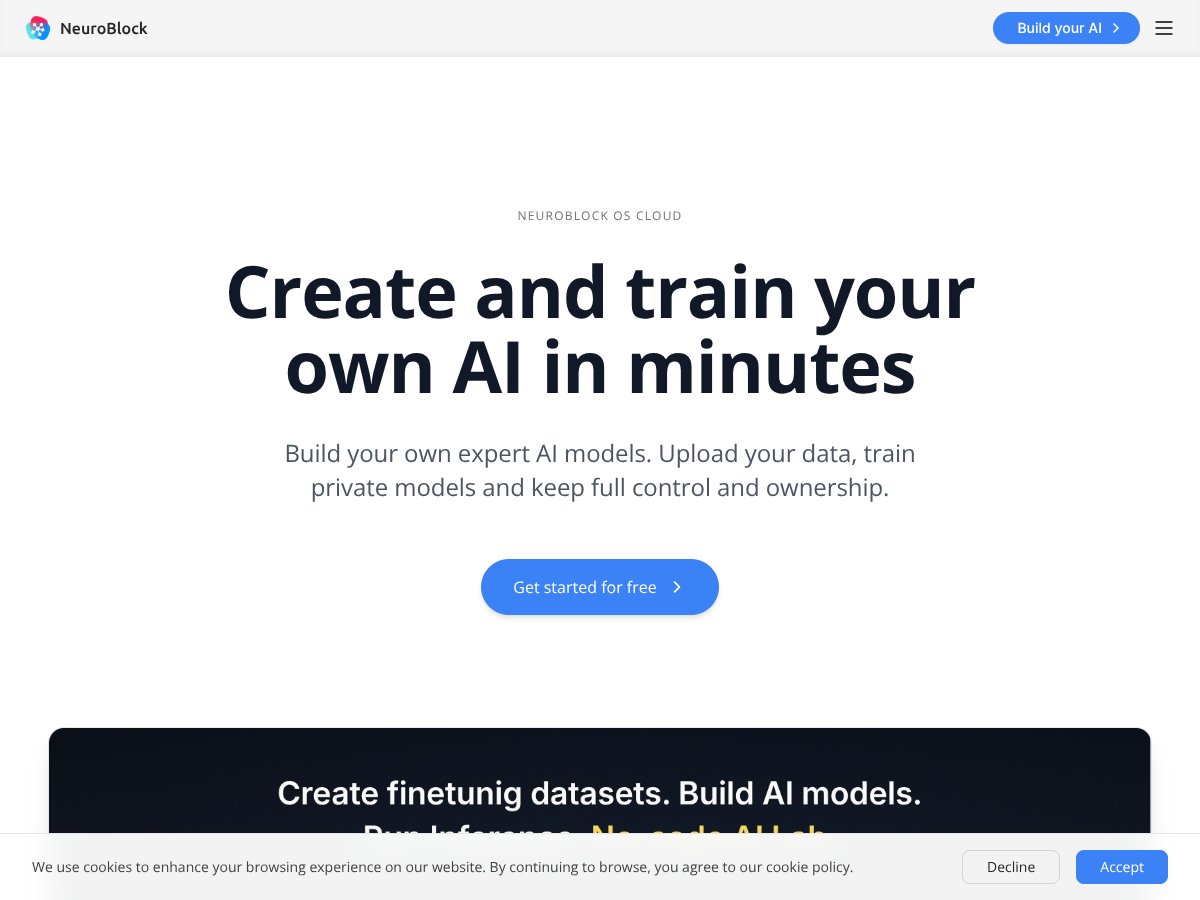
NeuroBlock screenshot

What Is NeuroBlock? (My Testing Notes Included)

I first ran into NeuroBlock through a couple of enterprise AI posts, and yeah—I was skeptical. The idea of “building your own AI models in minutes” sounds great, but I’ve learned not to trust marketing wording until I can actually poke around the product myself. So I did.

Here’s how I approached it. I went in expecting an AI “lab” experience, not a consumer app. My goal was simple: understand what NeuroBlock actually provides (data prep, training, deployment), what parts are automated, and what parts still require real engineering work. I focused on the UI flow in their DataLab area, how datasets get ingested, and what “private model” and “local inference” mean in practice.

Based on what I could verify from the site and the interface screens I reviewed, NeuroBlock positions itself as an AI development ecosystem for organizations that want more control than typical hosted APIs. The core story is: you bring your own data, you train models privately, and you can run inference either locally or via cloud deployment depending on what your team needs.

They’re explicitly contrasting themselves with “generic” third-party model APIs. In other words, it’s not just a chatbot wrapper—it’s meant to support an end-to-end workflow around your own datasets. The pitch centers on data privacy/ownership and avoiding scenarios where your data gets shipped into someone else’s proprietary pipeline.

One thing I noticed early: the website still feels a little light on concrete technical specs. There aren’t enough benchmark numbers, model architecture details, or deployment documentation snippets that you can copy/paste into an evaluation doc. I looked for demos, detailed use cases, and step-by-step onboarding material, and I didn’t find much that was specific enough to feel “ready to deploy.”

So let me be blunt about expectations: NeuroBlock isn’t a casual “try it for fun” platform. It’s aimed at teams with sensitive data, internal AI standards, and the willingness to work through onboarding (or bring in their consulting team). If you’re expecting a fully transparent, developer-friendly setup guide with everything spelled out, you may end up frustrated.

NeuroBlock Pricing: Is It Worth It?

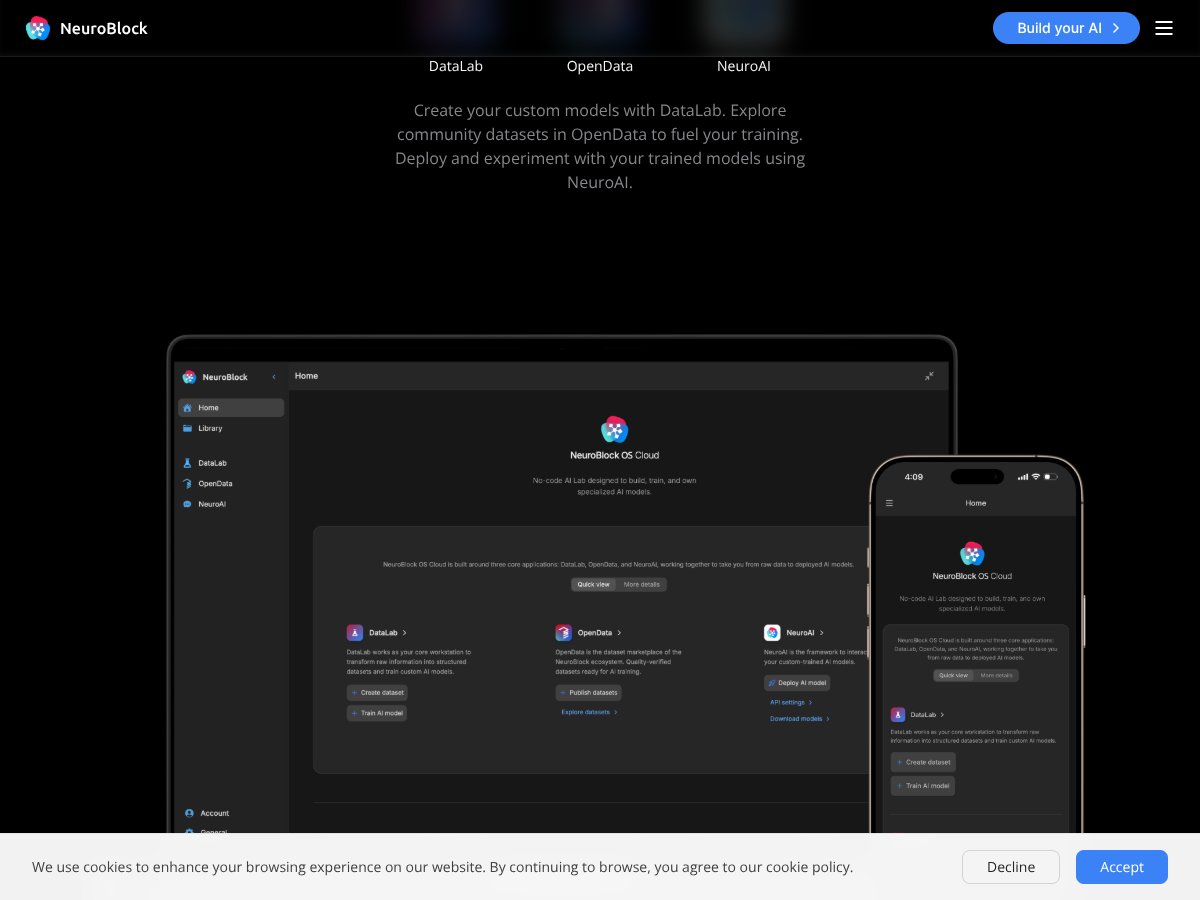
NeuroBlock interface
NeuroBlock in action

I can’t sugarcoat this: NeuroBlock’s pricing is not clearly published. I saw references to a free tier and subscription-based plans, but I didn’t find a straightforward pricing page with exact costs, usage limits, or feature breakdowns that you could reliably budget around.

Because of that, I’m not going to pretend I know what the “Pro/Advanced” tier costs. What I can do is lay out what’s stated publicly and what I think that means in real life.

Plan Price What You Get My Take
Free Tier Unknown Basic access to DataLab, OpenData marketplace, and NeuroAI Cloud Good for early exploration, but if you’re hoping to do serious training runs, you’ll likely hit limits fast. I’d assume you’ll need an upgrade once you’re beyond “hello world.”
Pro/Advanced Plans Unknown (not publicly disclosed) Enhanced features, higher usage limits, enterprise support, private deployment options This is probably where real value shows up for organizations. But since pricing isn’t posted, it’s hard to compare cost-effectiveness without a sales conversation.

Here’s the practical issue: if you’re making procurement decisions, “unknown” pricing is basically a blocker. You’ll need to contact sales or wait for documentation that spells out costs and quotas.

That said, if your situation is more “we need to evaluate the workflow” than “we need to lock a budget today,” the free tier could still be useful. Just don’t assume you’ll be able to complete a full private training + deployment cycle without upgrading.

If you want a quick rule of thumb: if data privacy and private deployment are non-negotiable for your team, NeuroBlock might be worth the evaluation effort. If you’re trying to keep costs predictable and transparent, you may want to look elsewhere first.

The Good and The Bad (What Actually Stood Out)

What I Liked

  • End-to-end ecosystem (DataLab → training → deployment): The product is presented as a connected workflow instead of a bunch of disconnected tools. In plain terms, it’s meant to help you move from dataset handling to model work to running inference without stitching together everything yourself.
  • Privacy/control messaging: The “data sovereignty” angle is consistent across the positioning. If your organization is worried about sending sensitive data to generic third-party APIs, that focus is at least aligned with what many enterprise teams ask for.
  • Private model training concept: NeuroBlock’s claim is that models can be trained based on your own datasets rather than relying purely on external hosted APIs. In my evaluation, this mattered most because it changes what “privacy” means—you’re not just calling someone else’s model with your data.
  • Deployment flexibility (local vs cloud): They describe options for local inference and cloud deployment. I like when vendors don’t force one model of operation, because the “right” setup changes depending on compliance requirements and infrastructure maturity.
  • OpenData / marketplace dataset idea: A curated dataset marketplace can save time when your team doesn’t already have labeled data. Even if you don’t use it, it’s a useful concept for accelerating early experiments.
  • Enterprise support / consulting: They position themselves as more than software—they’re also offering services. That can be a big deal if you don’t have in-house ML engineers who can handle every step.

What Could Be Better

  • Pricing transparency is missing: Not having published costs or usage limits makes it hard to do a real cost/benefit analysis. If you’re budgeting, you’ll likely need a sales call.
  • Technical details aren’t concrete enough: I didn’t see the kind of specifics you’d expect in an evaluation—things like supported model types, training/runtime requirements, performance benchmarks, or deployment architecture diagrams.
  • Onboarding feels under-documented: I looked for demos and detailed “here’s how you do X” walkthroughs. What I found wasn’t enough to confidently replicate the steps without guessing.
  • Limited public user proof: There aren’t enough testimonials, community discussions, or review-style documentation to validate real-world outcomes. That doesn’t mean it’s bad—it just means you can’t easily verify claims.
  • Potential lock-in risk: When a platform is built around custom private deployment workflows, switching later can be painful. I’d want clearer portability info before committing.

Net: the positioning makes sense, and the ecosystem idea is appealing. But the lack of transparent technical specs and pricing details is what holds it back as an easy recommendation.

Who Is NeuroBlock Actually For?

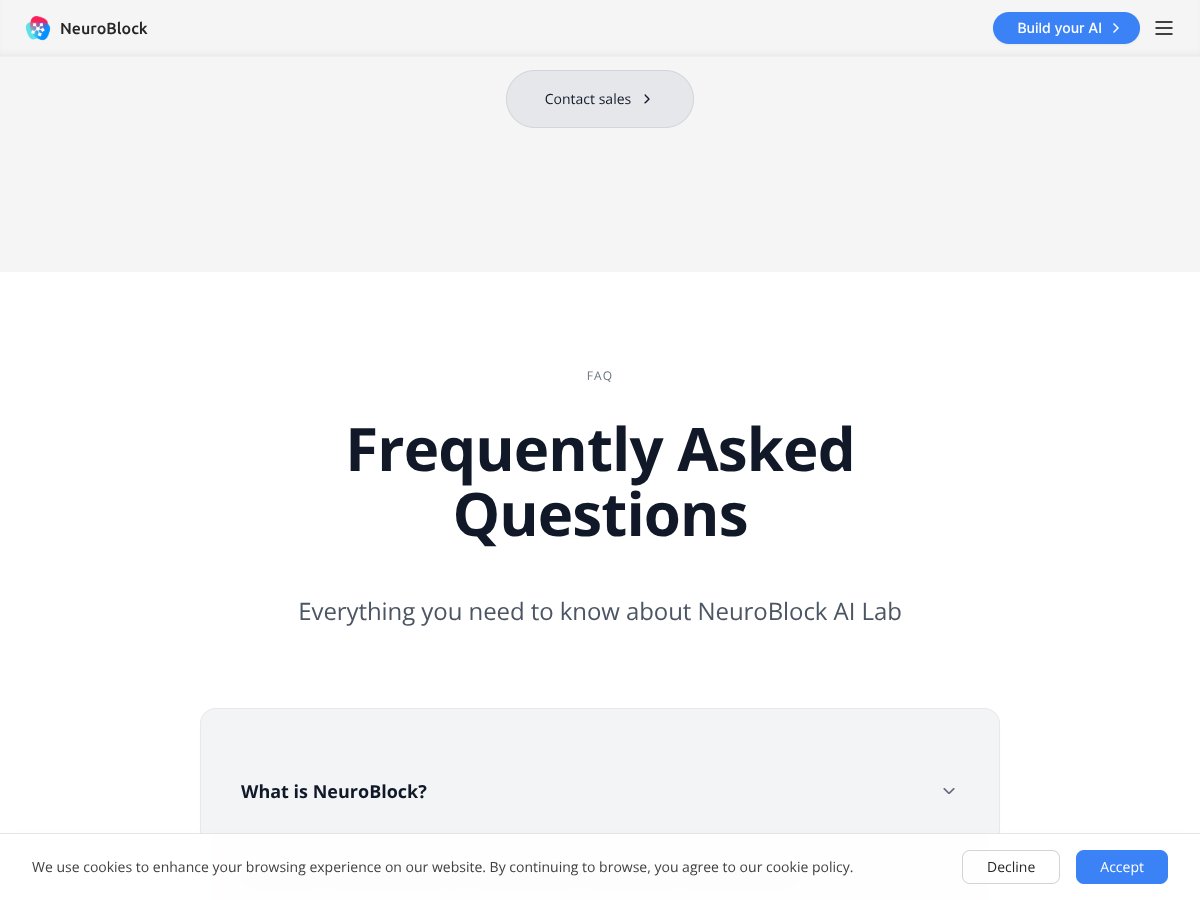
NeuroBlock interface
NeuroBlock in action

NeuroBlock is best suited for organizations that need stronger control over data and deployment. Think medium-to-large teams, enterprises, or government-adjacent environments where you can’t casually throw sensitive data into generic external APIs.

If you already have proprietary datasets and you’re tired of “just use a hosted API” being the only option, NeuroBlock’s workflow focus could be a good fit. The value proposition is strongest when your team wants an internal pipeline for dataset handling, model training, and inference.

It also seems geared toward teams that don’t want to juggle ten separate tools. If you’re a research lab or an applied AI team building specialized solutions, an integrated environment can reduce friction—at least in theory.

For example, if your goal is to train models using only your own data (not a generic pre-trained model you can’t audit), a platform like this is more relevant. And if you can leverage a vetted dataset marketplace (OpenData), it can shorten the “find data → clean it → label it” loop.

On the other hand, if you’re a solo developer or a tiny startup with limited budget, the enterprise orientation and likely procurement overhead might not be worth it. You might be better served by more transparent platforms or open-source stacks where you can control the cost and tooling without a sales cycle.

Who Should Look Elsewhere

If your main goal is quick, API-based AI integrations and you don’t care much about data ownership/privacy guarantees, NeuroBlock may be more effort than it’s worth. Hosted APIs can be faster to implement and easier to measure from day one.

Also, if you’re just learning AI and experimenting, the lack of clear public onboarding details and the unclear pricing can make the platform feel like a black box. You’ll spend time hunting for answers instead of building.

And if you specifically want a platform with lots of community support—detailed tutorials, active forums, and lots of independent user feedback—NeuroBlock doesn’t currently offer enough public proof to compete with more established ecosystems.

How NeuroBlock Stacks Up Against Alternatives

I’m going to keep this section honest. The original draft mentioned a few “Neuro*” alternatives that I can’t verify as real, comparable products from public sources. So I’m not going to pretend. Instead, here are the alternatives that are actually common in this space and that you can realistically compare against.

NeuroBlock vs. Hosted LLM APIs (OpenAI / Google / similar)

  • What’s different: Hosted APIs are usually “send prompt/data → get response,” with privacy terms handled by the provider. NeuroBlock’s pitch is more about using your own data and keeping control through private training/deployment.
  • When hosted APIs win: When you need speed, predictable setup, and you don’t have strict requirements around model training on private data.
  • When NeuroBlock wins: When your compliance/privacy requirements push you toward private training and controlled deployment rather than just calling an external model.

NeuroBlock vs. Open-source + Local Inference (Hugging Face ecosystem)

  • What’s different: With open-source stacks, you control everything—model choice, training pipeline, and where inference runs. The tradeoff is more engineering work.
  • When open-source wins: When you want transparency and you’re comfortable configuring runtimes and training yourself.
  • When NeuroBlock wins: When you want an integrated workflow (dataset handling + training + deployment) without building your own “AI lab” from scratch.

NeuroBlock vs. “Developer Platforms” (frameworks like LlamaIndex and similar)

  • What’s different: Tools like LlamaIndex generally focus on building applications around data (retrieval, indexing, pipelines). They’re not always the same thing as a full private training + deployment platform.
  • When framework tools win: When your priority is building AI features quickly (RAG, search, assistants) rather than training private models end-to-end.
  • When NeuroBlock wins: When your priority is private model training and controlled deployment, not just application-layer integration.

Bottom Line: Should You Try NeuroBlock?

After evaluating what’s publicly available and what the product seems built to do, I’d put NeuroBlock at about a 7/10 for the right teams—but with a big caveat: the “right team” part matters.

It looks like a strong option if you need private, enterprise-grade AI workflows and you care about data sovereignty. The ecosystem concept (DataLab + training + deployment + dataset marketplace) is compelling, especially if your organization doesn’t want to stitch together everything manually.

But if you’re expecting transparent pricing, clear technical specs, and easy onboarding docs before you commit, you might find NeuroBlock frustrating. That uncertainty is the main reason I can’t give it a higher score.

If you’re considering a trial, I’d only recommend it when you have a specific use case you can test quickly—like validating the end-to-end workflow on a small dataset and confirming you can deploy inference in the way your compliance team requires. If you don’t have that, you’ll burn time waiting for details you could get from other platforms faster.

For teams that value control and privacy above convenience, NeuroBlock could be worth the effort. Just go in with your eyes open about documentation and pricing transparency.

Common Questions About NeuroBlock

  • Is NeuroBlock worth the money?It can be, if your top priorities are private training, data control, and deployment flexibility. If you just need quick AI features with predictable costs, you’ll probably get more value elsewhere.
  • Is there a free version?Yes—there’s a free tier/trial mentioned publicly. I didn’t see detailed limits on the site, so treat it as exploration rather than guaranteed full-scale training.
  • How does it compare to other platforms?NeuroBlock is positioned more toward private model workflows than general AI app frameworks. If you mainly need RAG or app integration, you may not need a full ecosystem.
  • What technical capabilities does it have?From what’s described, it includes dataset management (DataLab), training, inference, and deployment options. Public benchmark/performance documentation is limited, so you’ll want to request specifics during onboarding.
  • Can I get a refund?Refund terms aren’t clearly laid out here. You’ll likely need to confirm with support/sales during the trial or onboarding process.
  • Is it suitable for small teams?It’s mainly enterprise-oriented. Small teams can use it, but only if they have a clear privacy requirement and the time to work through onboarding or consulting.

As featured on

Automateed

Add this badge to your site

Stefan

Stefan

Stefan is the founder of Automateed. A content creator at heart, swimming through SAAS waters, and trying to make new AI apps available to fellow entrepreneurs.

Related Posts

Figure 1

Strategic PPC Management in the Age of Automation: Integrating AI-Driven Optimisation with Human Expertise to Maximise Return on Ad Spend

Title: Human Intelligence and AI Working in Tandem for Smarter PPCDescription: A digital illustration of a human head in side profile,

Stefan
AWS adds OpenAI agents—indies should care now

AWS adds OpenAI agents—indies should care now

AWS is rolling out OpenAI model and agent services on AWS. Indie authors using AI workflows for writing, marketing, and production need to reassess tooling.

Jordan Reese
experts publishers featured image

Experts Publishers: Best SEO Strategies & Industry Trends 2026

Discover the top experts publishers in 2026, their best practices, industry trends, and how to leverage expert services for successful book publishing and SEO.

Stefan

Create Your AI Book in 10 Minutes