Table of Contents
The Pixar Story Spine helps you outline a story in eight sentences: introduce a character, show their normal life, upset it, and follow what happens because of that change. It starts with “Once upon a time” and ends with “Ever since then.” The middle is where you work out how one event leads to the next.
It's useful when you have a great premise but don't know where to take it, or when a draft has plenty of action but still feels disconnected. Kenn Adams created the exercise in 1991; Pixar later taught it through Pixar in a Box. Below, you'll find the template and three versions of one original story to show how to use it.
The Story Spine template
Finish each starter with one main event or situation. You don't need polished prose yet. You're trying to see the shape of the story on a single page. These are Adams's eight starters, with a short explanation of what to put in each line:
- “Once upon a time…” Introduce the character and the situation they inhabit.
- “Every day…” Establish the routine that makes this situation stable.
- “But one day…” Introduce a disturbance that the routine cannot absorb.
- “Because of that…” Show the first consequential response or result.
- “Because of that…” Make that result change the next available action.
- “Because of that…” Bring the developing problem toward a decisive confrontation.
- “Until finally…” Resolve or culminate the central struggle.
- “Ever since then…” Establish the condition that follows the outcome.
Try all eight lines on your first attempt. If the story later needs another “Because of that” to connect two events, add one. The exercise isn't telling you to write eight chapters, three middle acts, or a particular number of scenes. Those repeated words are there to make you ask why the next thing happens.
When the sequence makes sense, remove the starters and read it as a short synopsis. Can you still follow how an attempted solution creates trouble, forces a decision, and changes the outcome? If the connections disappear with the labels, go back to the events themselves. “Because of that” can't do the work on its own.
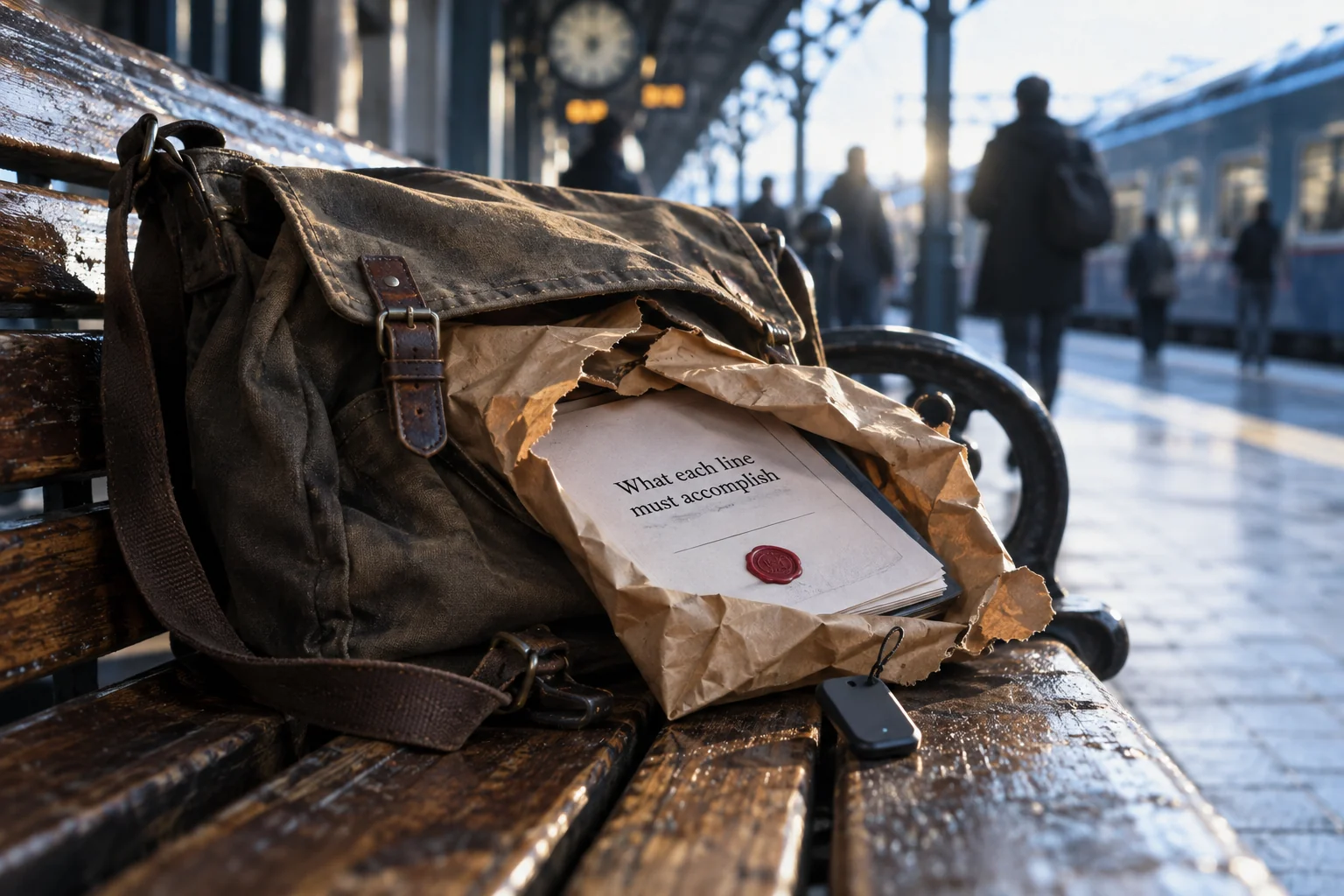
What each line must accomplish
Think of the opening as a pattern, the disturbance as something that breaks it, and the ending as the pattern left afterward. In between, characters respond and make things better, worse, or simply different. That gives each line something useful to do instead of turning the outline into a list of exciting moments.
Your ending doesn't have to be happy. A habit might become destructive, a town might learn something it wishes it didn't know, or a stubborn character might change everyone around them. If you're writing a personal transformation, show what the character protects at the start and what finally makes them question it. You don't need to invent an inner flaw for every kind of story.
| Spine line | Structural job | Weak version | Revision question |
|---|---|---|---|
| Once upon a time | Locate the story in someone’s particular circumstances | A history lesson without a person to follow | Whose situation makes this disturbance matter? |
| Every day | Show the established pattern and what sustains it | A schedule with no meaningful function | What does this routine preserve, protect, or prevent? |
| But one day | Make the existing pattern inadequate | A surprising event everyone can ignore | What now prevents an uncomplicated return? |
| Because of that | Carry an action or discovery into a consequence | Another event connected only by timing | Why does the preceding beat produce this one? |
| Until finally | Bring the central struggle to its decisive outcome | A solution unrelated to the preceding struggle | What action, failure, or confrontation settles the central question? |
| Ever since then | Demonstrate what the outcome leaves behind | Loose-end cleanup without a changed condition | What can no longer happen in the old way? |
For example, “Every day, she rode across the city” gives us a schedule. “Every day, she delivered sealed packages without asking what was inside” gives us a rule the story can test. Both describe routine, but the second makes a forbidden package matter before it even arrives.
Same premise, three worked spines
Let's build around this premise: a bicycle courier receives a package addressed to herself, sent from tomorrow. It's an intriguing hook, but it doesn't tell us what the courier will do or why the ending will matter. These original examples try three answers: a basic chase, a costly act of accountability, and a story about learning to trust.
Version A: event chain without character change
- Once: Nia was the fastest courier in a city of sealed districts.
- Every day: she delivered packages without opening them or questioning their instructions.
- But one day: she received a parcel from tomorrow warning that a bridge would collapse.
- Because: she raced to the bridge.
- Because: guards chased her.
- Finally: she stopped the traffic.
- Ever since: the bridge was safer.
There's a race against time here, but several links are missing. Why do the guards chase Nia when she reaches the bridge? How does she stop traffic while they're pursuing her? And does stopping traffic save people, or somehow make the bridge itself safer? The final line promises a result the earlier lines haven't explained.
Her habit of obeying delivery instructions also drops out of the story. You could write a fun, short rescue adventure without an inner transformation. But if you want the story to be about obedience, her decision to obey or refuse needs to affect the rescue. Adding three more chase scenes wouldn't fix that missing connection.
Version B: stronger causality
- Once: Nia carried sealed evidence in a city that punished couriers for knowing what they transported.
- Every day: she protected herself by refusing to read an address twice or question a sender.
- But one day: a parcel addressed to her, dated tomorrow and written in her own hand, warned her not to deliver her next assignment.
- Because: she opened that assignment and discovered suppressed inspection records predicting a bridge collapse.
- Because: the broken seal triggered a tracking alert that named her as a suspected saboteur, making her unsupported warning easy to dismiss.
- Because: she headed for the official who had buried the report: his receipt terminal could authenticate and publish the evidence, but only if she signed for delivery.
- Finally: she signed and released the authenticated report and tracking record, enabling a bridge closure while proving her own offense.
- Ever since: she read every address twice and required senders to share recorded responsibility for their deliveries.
Now Nia's choice creates the problem she has to solve. Opening the package gives her the information needed to save people, but it also makes her a suspect. Simply shouting a warning won't work. To make the evidence believable, she must sign for it and admit what she's done.
The receipt terminal gives the climax a clear mechanism: completing the delivery makes the evidence public. Show that function during an ordinary delivery earlier in the story so it doesn't appear just when Nia needs rescuing. Also decide who sent tomorrow's warning and why. It might be advice she must reject, but if the mystery draws readers in, they need either an answer or a deliberate reason it remains open.
Version C: shared emergency, different inner arc
- Once: Nia believed that perfect speed could make her indispensable.
- Every day: she accepted impossible routes and refused help, dismissing a slower courier who served streets missing from official maps.
- But one day: tomorrow’s package arrived addressed to her, containing five receipts signed by couriers who had disappeared.
- Because: she abandoned her assigned route to retrace their deliveries.
- Because: she discovered that officials planned to use a bridge collapse to conceal the disappearance of contract workers and erase them from the registry.
- Because: warning every district before the collapse required a relay through unregistered streets, she shared the evidence and let other couriers choose their own routes.
- Finally: she entrusted the original package to the slowest courier, whose neighborhood knowledge carried the warning through the last unmapped district.
- Ever since: the couriers planned routes collectively, and Nia judged a successful day by who arrived with her.
This version keeps the bridge emergency but asks something different of Nia. She can't finish the job by being faster or more determined. She has to hand over the package to someone with knowledge she lacks. The habit that once made her successful—trying to be indispensable—now puts other people at risk.
Give the slower courier a chance to show that knowledge early. Perhaps a delivery takes longer because they stop for residents the official routes overlook. Then the final handoff recognizes a strength we've already seen. Make the receipts matter to the warning too, so passing on the actual package has a purpose beyond symbolizing trust.
The “because” test
Read two middle lines together: “This happened; because of that, this happened next.” Then explain the connection without repeating the phrase. Did someone make a choice, lose an option, learn something, or provoke a response? If you can't say what carries one beat into the next, you've found a useful place to revise.
You can put the beats on separate cards or lines in a document and move them around. When a pair doesn't connect, look for one of these three missing pieces. You may only need a sentence to supply it, rather than a whole new subplot:
- Decision: identify the response that turns the previous event into the next action. A choice by an antagonist or ally can count; the protagonist need not cause everything.
- Pressure: specify what has become harder, more costly, or unavailable. An apparent setback that changes nothing may not belong among the major beats.
- Information: explain how a discovery changes someone’s understanding or plan. Receiving a fact and acting on it are different beats unless you deliberately combine them.
Suppose a storm interrupts Nia's journey. The weather can happen independently of her choices. But the next obstacle becomes more convincing if the city sends autonomous traffic to block her because she broadcast her location. Now her attempt to get help exposes her route, and the opposition has a reason to arrive there.
Another useful question is: would the later event happen the same way if I removed the earlier one? If yes, you may have left the connection out of the summary, or the events may genuinely be unrelated. A coincidence can start trouble. Be more careful about letting a convenient coincidence solve a problem the character has struggled with all along.
Use the spine at three stages
You don't have to wait until an outline is finished to try this. Adams describes the Story Spine as both storytelling practice and an outlining aid in his account of the exercise. You can use it before a draft, during revision, and after a major change, with a slightly different question each time.
Before drafting
Before drafting, try changing the first important choice. What if Nia opens the package? What if she refuses it? What if she delivers it unread? Follow each answer far enough to see what it reveals or prevents. If all three versions produce the same chase, the choice probably isn't shaping the plot yet.
Pick the version whose difficult decision you most want to write. A climax about admitting responsibility will feel different from one about trusting another courier, even if both happen near the same bridge. Keeping the outline short helps you compare those possibilities without getting attached to pages of description.
Put unanswered worldbuilding questions beside the outline. You can work out the city's history later, but a rule that makes the next event possible needs attention now. The terminal's ability to publish a receipt matters to Nia's decision. A complete account of how the districts were sealed can wait until you know whether the story needs it.
During revision
During revision, build a new spine from the story you've actually written. Don't copy the plan you started with. After each major sequence, note what someone did and what changed as a result: their knowledge, resources, relationships, or available choices. This often reveals where a lively chapter has left the story standing still.
Nia could discover several frightening facts about the bridge without changing her next move. If she was already riding there and continues for exactly the same reason, the discovery may be less important than it sounds. It becomes a turning point when it makes her divert traffic, seek proof, or abandon a delivery she previously thought she had to complete.
Don't cut a chapter just because it doesn't fit neatly into one line. It might establish a relationship, plant a clue, or show readers something Nia doesn't know. Read its scenes before deciding. Sometimes you need to move the information; sometimes the character needs to react; sometimes the short summary has simply missed what the chapter contributes.
After structural edits
After a structural edit, compare the opening routine with the ending. What action earns the difference between them? If you're aiming for a story about trust but Nia still solves everything alone, adding a final sentence about teamwork won't make the change convincing. Look for a decision that lets the reader see it.
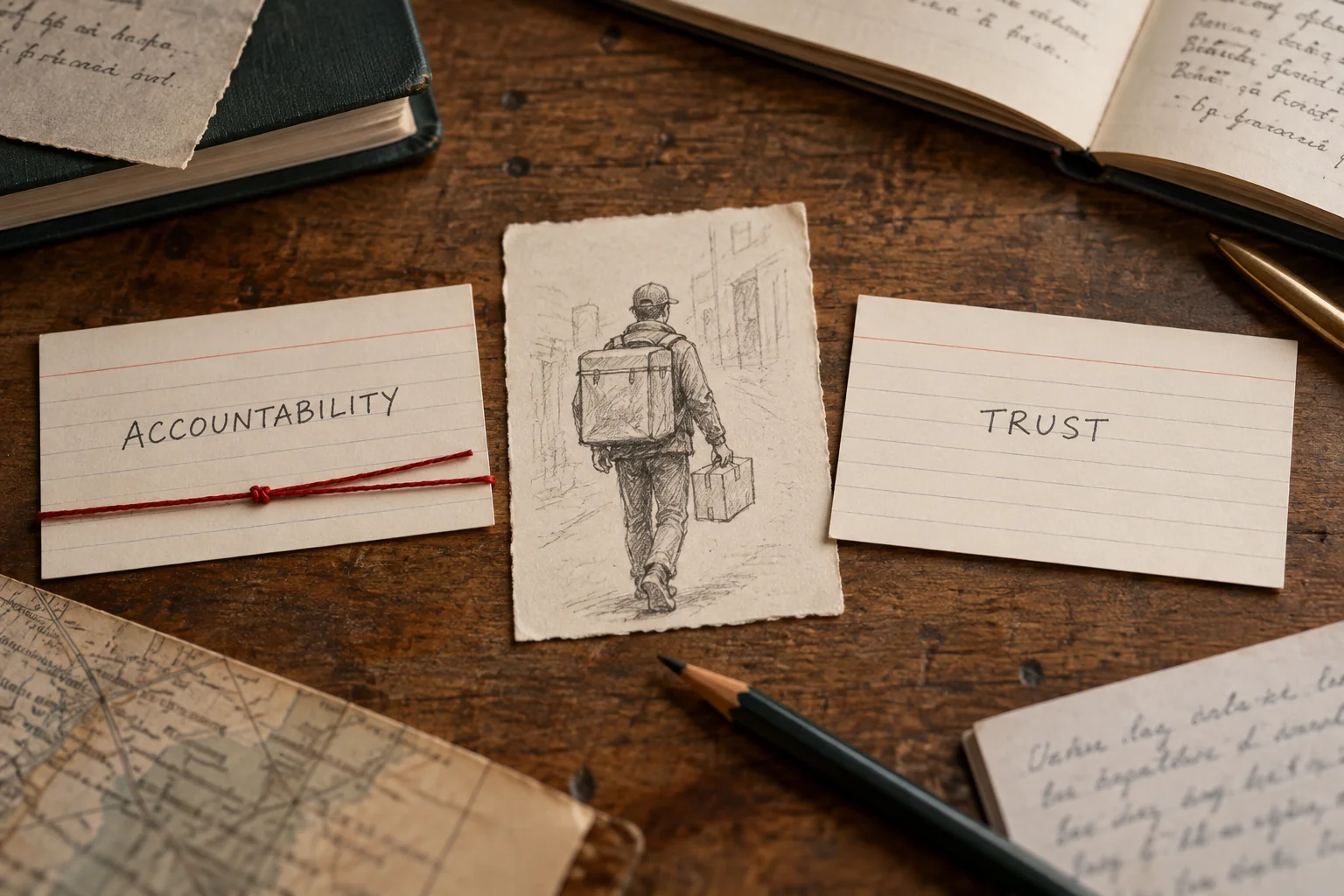
In the trust version, Nia might turn down a prestigious solo assignment so a newcomer can learn the route beside her. In the accountability version, she might ask the sender to record responsibility before accepting a parcel. These are small actions, but they show two different lessons carried into ordinary life.
Then follow the consequences of any moved or replaced scene. If Nia is detained after signing, the next sequence must account for her absence. If you cut the early neighborhood delivery, you still need another way to establish the slower courier's knowledge. A stronger ending often requires adjustments well before the final chapter.
Spine-to-scene expansion
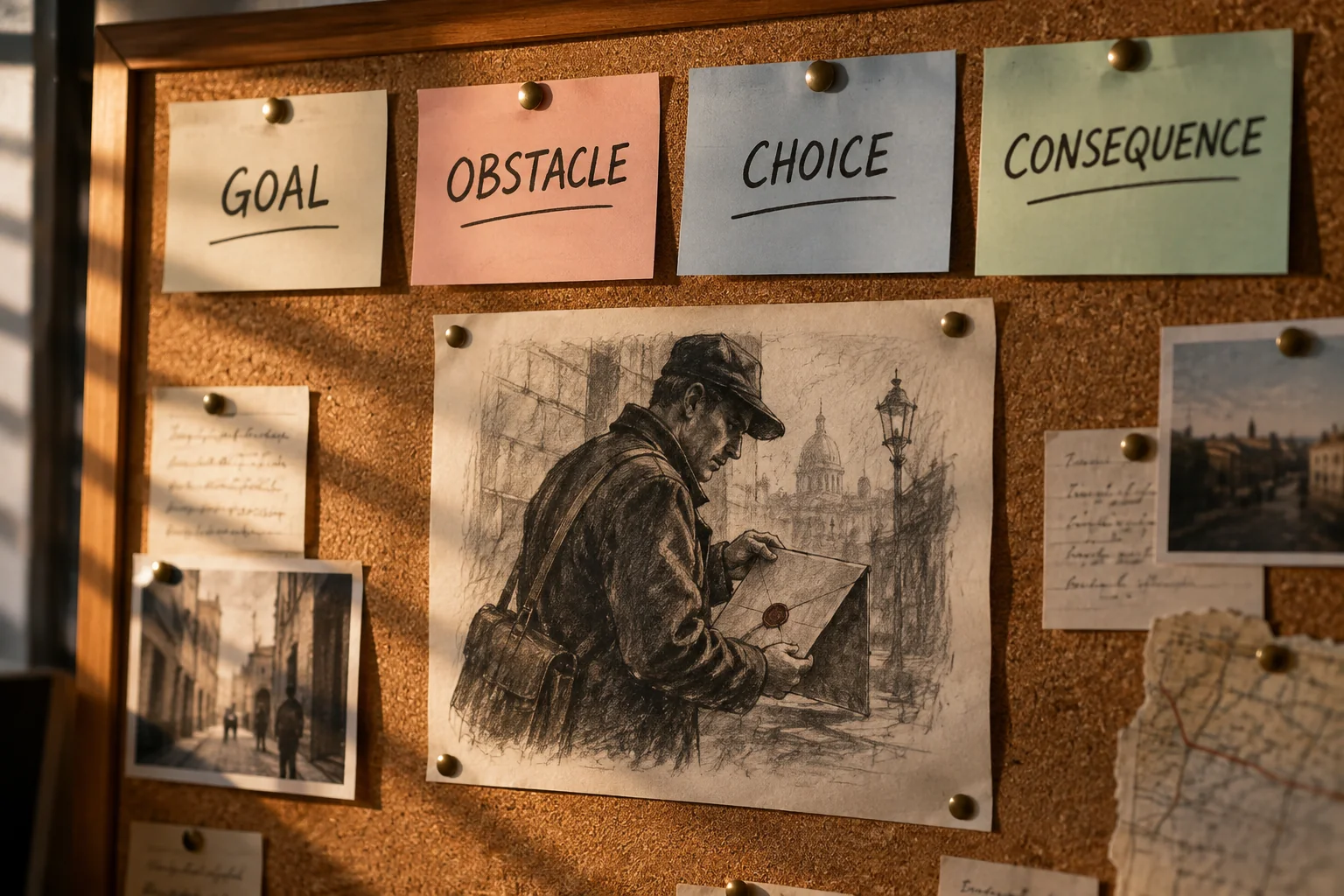
A spine line gives you the main event; a scene makes us experience it. “Nia exposes the report” is a result. Put her at a public delivery counter, give her two minutes before the terminal closes, and place a guard beside it. Now she has a goal, an obstacle, and a decision to make in front of us.
- Goal: What visible result does the viewpoint character want before the scene ends?
- Obstacle: Who or what prevents that result now?
- Choice: What action commits the character to a risk, loss, or responsibility?
- Residue: What changed condition must the next scene inherit?
These four questions are a way to expand our example, rather than extra lines in Adams's template. A single beat might need several scenes: learning how the terminal works, reaching it, and deciding whether to sign. One scene might also contain several beats. Give the moment enough room for its choices and consequences to be clear.
| Scene element | Courier example | What it contributes |
|---|---|---|
| Goal | Authenticate the bridge inspection before the terminal closes | A result the reader can recognize and a deadline |
| Obstacle | The terminal requires Nia’s identifiable courier signature | The evidence cannot become credible without exposing her |
| Choice | She signs while a guard watches | She accepts the personal cost of the solution |
| Residue | The report becomes public and Nia is detained | The warning can spread, but she cannot deliver the next message herself |
Signing does two jobs at once. It authenticates the warning, and it gives the guard grounds to detain Nia. You don't need an unrelated threat to burst through the door afterward. As you write, make it clear that she could still refuse, what refusal would protect, and who would remain in danger if she walked away.
The outline leaves plenty of room for voice. Nia might stall with jokes, try a quiet bargain, or sign without speaking. Those choices change the experience of the scene even when the main events stay the same. Dialogue, viewpoint, pacing, and physical detail turn a clear sequence into something a reader wants to spend time inside.
When not to force the framework
If one eight-line summary distorts your story, try a smaller part of it. Write a spine for one relationship, one character's thread, or one sequence. For an ensemble, make separate versions and mark where one person's choices affect another. There's no need to invent a single hero just to make the page look tidy.
A nonlinear story can have a chronological spine even when readers encounter the events in another order. Use it to check what caused what, then decide how you want to reveal that information. With a cyclical ending, ask what the repetition now means or costs. With an unresolved ending, identify what has changed permanently even though a question remains unanswered.
You can also practice on a story you know well before trying your own. Pixar's activity on story beats accompanies its story-structure lesson. For the creator's perspective, listen to NPR's interview with Kenn Adams. The exercise helps you examine a story; it doesn't replace all the decisions involved in writing one.
Revision checklist
Read your completed spine aloud, then use these questions to choose your next revision. A weak answer points to somewhere worth looking, not a verdict that the whole story is broken. You may discover that the scene already supplies the cause and the outline needs updating, or that an important choice never made it onto the page.
- Does “Every day” establish a meaningful pattern rather than a neutral timetable?
- If an inner arc is intended, does that pattern reveal what the character protects or misunderstands?
- Does the disturbance make returning to normal difficult for a specific reason?
- Can each middle transition truthfully follow “because of that,” with a named mechanism?
- Does the protagonist cause some important consequences rather than only receive instructions?
- Does the climax resolve the central struggle through an earned action, confrontation, or failure?
- Have the resources or abilities used in the resolution been established beforehand?
- Does the ending demonstrate the resulting pattern, including any continuing cost?
- Have you kept unresolved questions intentionally, rather than forgotten promises made by the premise?
- Is Kenn Adams credited when you teach or reproduce the Story Spine?
Make the next change specific. Show why the guards pursue Nia. Introduce the terminal rule earlier. Give the slower courier a scene that proves what they know. Those fixes do more than adding action at random: they help the next choice make sense and give the ending something solid to grow from.