
Table of Contents
I’m not going to pretend picking a print-on-demand (POD) company is simple. When you’re trying to launch a store, it’s easy to get distracted by “cool designs” and forget the boring stuff—like whether the prints actually come out crisp or whether shipping tracking shows up on time.
In my experience, the right POD partner feels almost invisible: orders move, products look like the samples, and customer support doesn’t ghost you when something goes sideways. So this guide is built around what I’d check (and what I’d ask) before I ever put my brand on a product.
Ready? Let’s go through the key things to look for in a print on demand company and how to compare them without guessing.
Key Takeaways
Key Takeaways
- Match the POD catalog to your niche (apparel vs. mugs vs. wall art) and confirm they can print your exact file types and sizes.
- Compare true landed cost (base price + shipping + any handling fees). Don’t ignore packaging and returns costs.
- Demand real shipping expectations: production time + carrier transit + tracking. Ask for typical SLAs, not marketing promises.
- Prioritize integrations that sync orders correctly (Shopify/WooCommerce/Etsy). Fewer manual steps means fewer mistakes.
- Test support like a customer: contact them with 3 questions and time the response. Then check refund/reprint policies.
- Validate scalability: ask about peak-season capacity, international fulfillment, and whether quality drops with volume.
- Request samples and score them with a simple rubric (color accuracy, sharpness, seam/bleed, material feel, durability).
- Check sustainability claims with specifics: inks, materials, packaging, and any certifications you can actually verify.
- Look at market growth data to understand competition and customer expectations—especially around shipping speed and product variety.
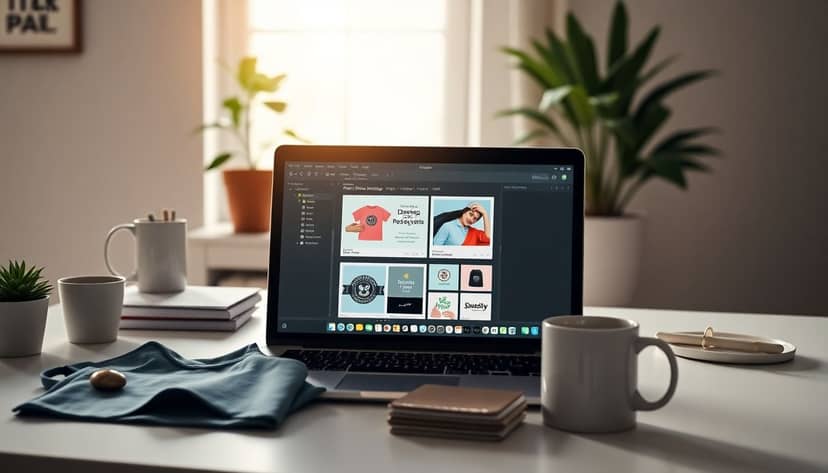
Step 1: Identify What to Look for in a Print-On-Demand Company
Choosing a print-on-demand (POD) company can make or break your online business. The trick is to start with your product plan, not the vendor’s homepage.
First: confirm they actually support the products you want to sell. Some POD companies are great for apparel (DTF/DTG-style workflows, good color matching on shirts). Others are stronger for posters, phone cases, or mugs. If your catalog is mostly t-shirts and hoodies, don’t pick a vendor that only “also does apparel” on the side.
Second: get clarity on file requirements and proofing. Ask what they accept (PNG, JPG, PDF, SVG) and what resolution they recommend for print. If they can’t tell you how they handle color profiles (sRGB vs. CMYK) or how they prevent blurry prints, that’s a red flag. I’ve seen “looks fine on my screen” turn into washed-out colors because the workflow wasn’t consistent.
Third: compare true pricing. A lot of vendors advertise low base pricing, but the landed cost (shipping + handling + packaging + any surcharges) is what determines your margin. I usually build a quick spreadsheet with:
- Product base price
- Shipping cost to my main customer regions
- Any per-order fees
- Expected return/refund handling cost (at least estimate it)
Fourth: don’t accept “fast shipping” as an answer. Ask for a production timeline and a shipping timeline separately. For example: “How many business days for production?” and “How many business days in transit for US orders?” If they can’t give ranges, you’ll end up guessing—and customers will feel the guesswork.
Fifth: integration matters more than people think. If you’re using Shopify, WooCommerce, or Etsy, you want order sync to be automatic and accurate. Mis-matched variants (wrong size/color) can cause refunds, and refunds cost you twice: the product and the customer trust.
Sixth: customer support is not just “nice to have.” It’s part of your operational risk. I like to test it early by sending a few targeted questions before I commit.
Seventh: scalability. If you expect growth, ask what happens when order volume increases. Do they keep the same print quality on higher throughput? Do they have backup production capacity? This is where “great for startups” can quietly turn into “slow during busy weeks.”
Market growth is another reason you should be picky. The print-on-demand industry is projected to be valued at $6.59 billion in 2024 and reach $19.06 billion by 2029, according to market research reporting (for example, sources like Fortune Business Insights and similar industry analysts). What does that mean for you? More competition, more storefronts, and customers who expect faster shipping and better product presentation—so your POD partner needs to keep up. (If you’re curious, you can find overlapping market sizing coverage across multiple industry reports such as those published by Fortune Business Insights: https://www.fortunebusinessinsights.com/.)
About AI “features”: yes, some POD companies are using AI to improve print accuracy and reduce mistakes, but you shouldn’t take it on faith. Ask what the AI actually does and how you can verify it. What to look for during onboarding:
- File pre-flight checks (detect missing bleed, low resolution, wrong dimensions)
- Automated color management (consistent color output across product types)
- Proofing workflow (do they offer previews or “print-ready” confirmations?)
- Order routing automation (ensures the right production line gets the right job)
Then validate it. Send the same design to two vendors (or two product types) and compare the sample output. If the “AI” can’t show up in the results, it’s just a buzzword.
Finally, if you want a broader view of tools and store platforms, you can also compare how POD apps integrate into your stack by reviewing the relevant platform documentation (for example Shopify app integrations: https://shopify.dev/). The reason I mention this is simple: integrations affect how reliably orders, variants, and tracking data move—so your “POD choice” is really a “POD + platform workflow” choice.

5. How to Evaluate the Customer Support of a Print-On-Demand Company
Customer support is where you learn the truth. Anyone can look good when things go smoothly—what matters is what happens when they don’t.
Here’s how I evaluate POD customer support in a way that’s more useful than reading reviews:
- Test response time: email them with 3 questions and time how long it takes to get a real answer (not an auto-reply).
- Ask about file issues: “If my design is missing bleed / low-res / wrong format, what happens?”
- Ask about order mistakes: “If a size/color variant is wrong, what’s the reprint process and who pays shipping?”
- Ask about refunds and replacements: “What’s the policy for damaged items? Do you require photos? What’s the timeline?”
- Check how they communicate: do they provide tracking updates, ticket numbers, and clear next steps?
Also, don’t just read “they’re helpful” in reviews. Look for reviews that mention specifics like “replaced my order within X days” or “resolved a printing error quickly.” If all the reviews are vague, you won’t know what kind of support you’ll actually get.
One thing I’ve learned the hard way: if support is slow during onboarding, it won’t magically get faster when you’re dealing with a rush order or a complaint.
6. Fulfillment Capacity and Scalability for Growing Businesses
Scaling isn’t just about getting more orders. It’s about avoiding quality drops and shipping delays when demand spikes.
When I’m evaluating fulfillment capacity, I ask questions like:
- Production throughput: “What’s your typical production time for 1–5 orders vs. 50–200 orders?”
- Peak season handling: “What changes during holidays? Do you temporarily adjust SLAs or add capacity?”
- International fulfillment: “Do you have local production or shipping partners for major regions?”
- Order routing: “If I sell internationally, how do you decide where the order is fulfilled?”
- Large-format products: “How do you handle posters/canvas/other large items—any special packaging or extra days?”
What you’re trying to confirm is consistency under load. Even a great POD company can struggle during busy weeks, and that’s when customers start leaving lower ratings.
As a practical benchmark, I like vendors that can keep production within a predictable range—often something like 1–3 business days for many products and longer for specialty items. The exact number varies by product type, but the key is whether the vendor can explain their timelines clearly and consistently.
And if you’re thinking about scaling quickly, ask about pricing tiers or bulk discounts. Some vendors lower costs at higher order volumes, but others don’t—so you’ll want to know before your margin gets squeezed.
7. Quality Control and Consistency in Printing and Products
Quality is the whole game. One bad batch can sink your reviews, and returns can eat your margin faster than you expect.
Before committing, request samples. Not just one “best seller,” either. I recommend sampling the products that represent your highest-volume sales and your hardest-to-print designs.
When you get samples, score them with something like this:
- Color accuracy: do the colors match your design, or are they washed out / oversaturated?
- Sharpness: zoom in on text and fine lines—does it look crisp or fuzzy?
- Coverage: are there white gaps, streaks, or uneven ink distribution?
- Bleed/seams (for apparel): check edges and seams. Does the print align properly or look cropped?
- Material feel: does the shirt/fabric/paper feel like a product people would actually pay for?
- Durability: check for cracking, fading, or poor finishing (especially on dark fabrics or high-contrast art).
Here’s what I noticed when comparing vendors: the “same” design can look totally different across product types. A vendor might nail a poster but struggle with shirts, or they might do great with light colors and lose detail on darker garments. That’s why samples matter.
Also ask how they handle defects. Good vendors have a clear process: what qualifies as a defect, what evidence they need (photos), and how replacements are processed. If they don’t have a straightforward approach, you’ll be stuck in back-and-forth when something goes wrong.
Finally, if sustainability is part of your brand, quality control should include material selection too—eco inks and recycled materials can still be high quality, but you should verify it with samples rather than trusting claims.
8. Shipping Options, Delivery Times, and International Fulfillment
Shipping is one of those areas where customers don’t care about your vendor’s excuses. They care that the package shows up when they expect it.
Here’s what I check:
- Production time: how many business days before it ships?
- Carrier transit time: what’s typical for your main markets?
- Tracking: do they provide tracking automatically, and does tracking update within 24 hours?
- Shipping methods: do they offer standard and express options?
- International logistics: do they handle customs documentation properly?
For international sales, ask about duties/taxes and how they’re handled. Customers in some regions may get surprise charges, and that can lead to “refused delivery” or negative reviews even when the product is great.
I also like to ask whether they use regional fulfillment for certain countries. If they fulfill locally, transit times can improve and costs can drop. If they ship everything from one location, delivery times can swing wildly.
Quick reality check: even top POD providers can have occasional delays. The difference is whether they communicate proactively and whether the tracking experience is reliable.
9. Integration and Automation Capabilities
Automation isn’t just about convenience. It’s how you avoid mistakes.
When I evaluate integration and automation capabilities, I look for:
- Order sync accuracy: variants, sizes, colors, and SKUs match the customer’s order.
- Automatic production triggers: the order should move to print without manual confirmation.
- Tracking sync: tracking numbers should flow back to your store quickly.
- Inventory handling: if you have multiple channels, does inventory update correctly?
- API access (if you’re advanced): can you customize workflows or build custom reporting?
Some vendors offer official apps/plugins for Shopify or WooCommerce. Others rely on manual uploads or CSV workflows. If you’re doing more than a handful of orders, manual workflows can turn into a daily headache.
AI-driven automation can also help—like auto-preparing print files or estimating costs—but the key is still validation. Ask for examples of how they prevent common issues (wrong dimensions, missing bleed, incorrect color settings) and then test it with a small batch order.
10. Sustainability and Eco-Friendly Practices
Sustainability sells, but it has to be real. Customers can smell vague marketing.
If sustainability matters for your brand, look for specifics:
- Inks: water-based inks, low-VOC options, or certified eco inks (ask for details).
- Materials: recycled paper, sustainable cotton blends, or responsibly sourced components.
- Packaging: recycled or minimal packaging, and whether they reduce plastic where possible.
- Certifications: any third-party certifications you can verify (don’t settle for “eco-friendly” with no backing).
One more thing: eco-friendly options can sometimes cost more. That’s not a deal-breaker, but you should price accordingly. In my opinion, it’s worth it only if the quality is there—otherwise you’ll get returns and bad reviews, and sustainability won’t help you.
Transparency is a good sign. If a vendor explains their process clearly (and can point to documentation), they’re more likely to be trustworthy.
11. Market Trends and Industry Growth Data
The print-on-demand market is expanding fast, and there’s data behind that momentum.
Many industry reports estimate the market at about $6.59 billion in 2024 with growth to $19.06 billion by 2029 (and other analysts forecast larger numbers depending on methodology and region). You’ll also see broader projections for the US and global markets—for example, US-focused projections sometimes place the market around the high tens of billions by the early 2030s, with global figures reaching much higher over the next decade.
Why should you care? Because growth changes customer expectations. When more sellers enter the market, customers start comparing shipping speed, product photos, and review quality more aggressively. A POD partner that can’t keep up with those expectations will cost you sales.
Also, with more competition, differentiation matters. That’s where better integrations, stronger quality control, and faster fulfillment become your advantage—especially if you’re trying to launch a niche brand rather than selling generic designs.
FAQs
Start by matching their catalog to your niche. If your store is heavy on apparel, don’t pick a vendor that’s mostly mugs and phone cases. Also check whether they support the specific product types you’ll likely add later (hoodies, posters, canvas, etc.) so you don’t have to switch partners mid-growth.
It’s everything. Quality affects reviews, repeat purchases, and returns. I’d rather have slightly higher per-unit costs with consistent print sharpness and durable materials than chase the cheapest option and deal with refunds.
Ask for production time and shipping time separately, plus typical ranges for your main regions. Production time is usually the biggest variable, and shipping delays are where customer complaints tend to spike.
Compare landed cost, not just base product price. Include shipping, any handling fees, and your expected return/replacement costs. If the total cost eats your margin, you’ll feel it fast once sales volume increases.