LIFETIME DEAL — LIMITED TIME
Get Lifetime AccessLimited-time — price increases soon ⏳
AI Tools

PrivAI– AI search engine with sources Review (2026): Honest Take After Testing

Updated: April 12, 2026
13 min read
#Ai tool

Table of Contents

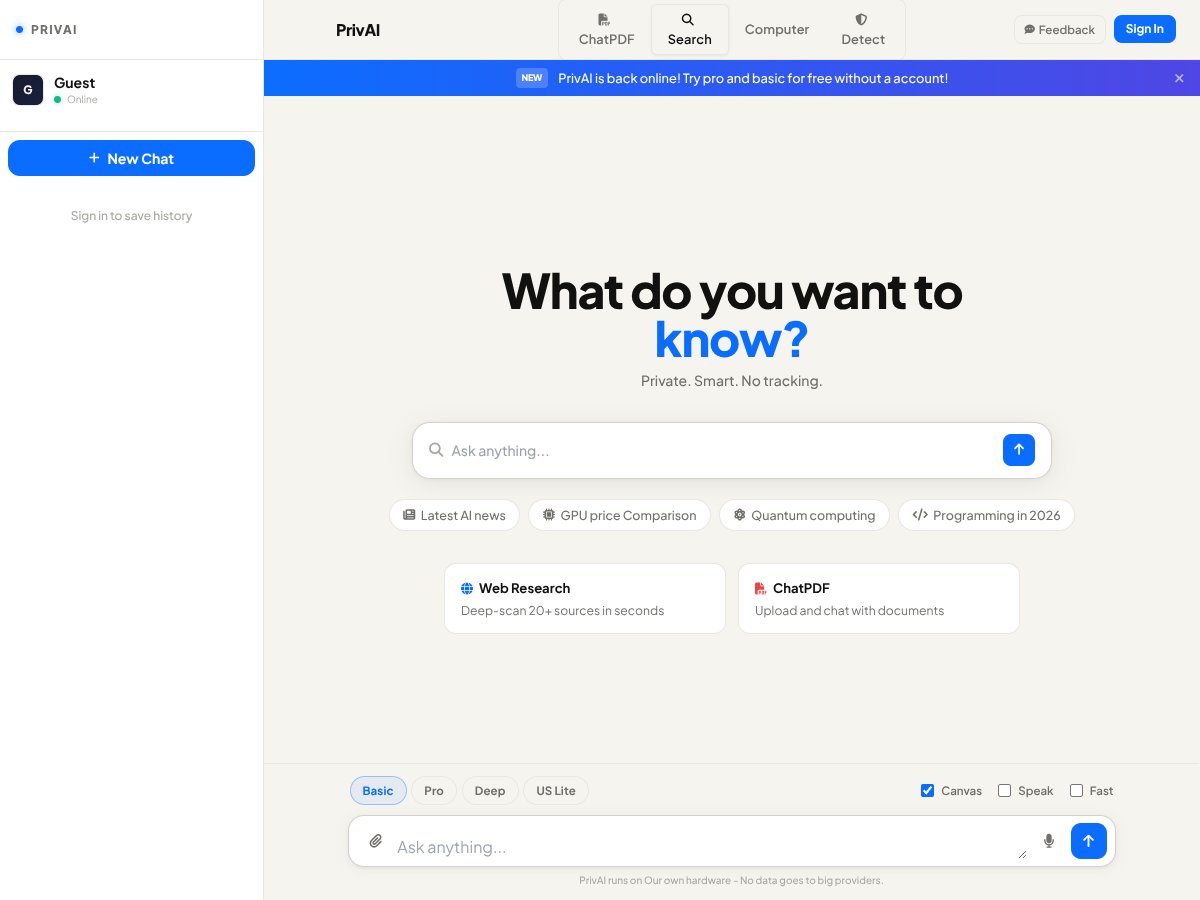
PrivAI– AI search engine with sources screenshot

What Is PrivAI– AI search engine with sources? (After actually testing it)

I first heard about PrivAI and thought, “Cool idea… but is it real or just marketing?” So I tried it myself, not just once, but enough to see where it shines and where it gets shaky.

What it’s supposed to do: PrivAI positions itself as a private AI search and chat tool that answers questions using multiple sources, and it can also work with your own documents (like PDFs or text files). The big promise is source transparency—so you can see where the answer is coming from instead of blindly trusting the model.

What it looks like in practice: You type a question, and it replies in a chat-style interface. When I tested it with document chat, it offered to work with uploaded files, and the responses came back quickly enough that it didn’t feel “laggy” like some early AI tools. The UI itself is pretty simple—no confusing menus or “hidden” settings to hunt down.

And yes, it emphasizes privacy. That’s the reason I kept testing longer than I normally would. If a tool is going to claim it doesn’t track you, I want to see what that means in the real world—what’s actually stored, what’s sent where, and how clear the wording is.

Here’s the part I checked closely: in my session, I looked for details on (1) how sources are displayed, (2) what counts as a “source,” (3) whether it shows citations consistently, and (4) whether there’s any clear explanation of how web access works.

In my experience, it can be a solid “AI with citations” experience when it’s working properly. But it also felt more like an evolving product than a fully documented one. If you’re the type who wants to understand the mechanics behind the curtain, you may feel a little boxed in.

How PrivAI– AI search engine with sources Handles Documents and Web Results

PrivAI’s core workflow is basically: ask a question, then it answers based on either (a) web content (when web access is enabled) or (b) your uploaded documents.

Document chat (PDFs/text): When I uploaded a couple of PDFs, the tool responded in a way that suggested it was actually reading the content rather than just generating generic text. The responses referenced my prompt context, and it seemed to follow up when I asked narrower questions.

What I noticed about citations in document mode: sometimes the output felt more “summary-like” than “quote-backed.” In other words, it might give you a useful answer, but the citations weren’t always as granular as I’d want for strict verification (like “this sentence comes from page 14”). If you’re doing anything high-stakes—fact checking, citations for publishing, academic work—don’t assume it’s automatically perfect.

Web access (live answers): The site claims it can fetch live web information for real-time answers. In my tests, it did produce answers that looked web-informed, but the transparency around how many sources it pulled and what those sources were wasn’t always as clear as I expected from a “sources” product. I could see citation-style references in the response, but I still had questions about how complete those references were.

Also, I couldn’t find a straightforward “source retrieval” explanation in the places I’d normally expect—more on that below.

What I Couldn’t Verify (and why it matters)

I went looking for the kind of details that separate a trustworthy tool from a flashy one. Specifically, I checked:

  • Whether there’s a dedicated documentation page explaining how sourcing works
  • An FAQ section that clarifies citation behavior (are they always shown? are they clickable? do they correspond to every claim?)
  • The settings/privacy area for what “no-tracking” actually includes
  • Any mention of limits like daily caps, document size limits, or how long content is retained

Here’s what I found: the product experience is friendly, but the deeper “how it works” documentation is thin. I couldn’t find detailed, easy-to-find explanations for things like source access mechanics and web fetching behavior. That doesn’t automatically mean it’s bad—but it does mean you’re taking more on faith than you should.

PrivAI– AI search engine with sources Pricing: Is It Worth It? (As of my check)

Pricing is where I got the most frustrated. When I looked, the site didn’t give me clean, public numbers I could confidently quote in a review. That matters because if I’m going to recommend a subscription, I want the reader to know what they’re signing up for.

What I saw: there’s a Free Tier, plus paid plans (Basic and Pro), but the exact prices and limits weren’t clearly listed in a way I could verify without signing up.

Plan Price What You Get My Take
Free Tier Unknown / not clearly specified on the public page I reviewed Limited usage (exact limits not clearly stated publicly) I can’t tell if it’s a true “try it and decide” free tier or more of a teaser. If you want to test seriously, plan on signing up.
Basic Check website (not publicly listed clearly) Core search + document chat features (limits not clearly stated) The lack of upfront numbers makes it hard to judge value. If you’re budget-conscious, you’ll want to confirm caps before committing.
Pro Check website Includes live web access and more advanced research-style tools (exact limits not clearly stated) It’s frustrating when “Pro” is supposed to be the powerful tier, yet pricing and usage caps aren’t spelled out. That’s a budgeting problem.

My honest take: If you’re the kind of person who needs transparent pricing before you spend money, PrivAI might not feel “safe” yet. I’d rather recommend something where limits are written clearly, because surprises are what get people angry later.

The Good and The Bad (based on my testing)

What I liked

  • Privacy-first positioning: It repeatedly leans into the idea that it’s not sending your data to big tech in the usual way. That’s exactly what I want to see from an “AI search with sources” tool.
  • Document chat is genuinely usable: Uploading PDFs and asking follow-up questions felt smooth enough that I didn’t feel blocked. It’s not just a demo gimmick.
  • Source-focused answers: The whole point is citations and references. In my tests, the responses did include source-style information often enough to be meaningful.
  • Multiple modes (at least conceptually): The site hints at different “modes” for quick Q&A vs deeper research. The experience isn’t overly complicated, which I appreciate.
  • Web access for research-style prompts: When I tried questions that benefited from current info, the web-informed answers were better than what you’d get from a document-only tool.
  • Speed felt reasonable: Responses came back quickly in my session, which matters if you’re doing iterative research and asking 5–10 follow-ups.

What could be better

  • Source transparency isn’t always as precise as it should be: I sometimes wanted more granular citation mapping (like specific page references for PDFs). It’s helpful when citations show up well, but it’s not consistently “verification-grade.”
  • Documentation is hard to find: I couldn’t locate detailed explanations for how it accesses web data, how source retrieval works, or how citations are generated in a predictable way.
  • Pricing and limits are vague: You may need to sign up to discover actual caps. That’s not ideal for a tool built around trust.
  • Usage caps aren’t clear (based on what I could find): I saw references to limits like “3/day” for certain advanced features, but it wasn’t clear how other plans compare or whether other features have different caps.
  • Integrations/API aren’t obvious: If you’re hoping to plug it into your workflow via an API, I didn’t find clear public documentation.
  • Fewer social proof signals: No strong case studies or user testimonials that clearly show real outcomes. That makes it harder to trust “deep scanning over 20 sources” claims without seeing actual example outputs.

My test results: did the “20+ sources in seconds” claim hold up?

I tried prompts where I expected multiple sources to matter—for example, questions that require comparing viewpoints, defining a concept, or verifying a specific claim from different angles.

What I noticed: the tool often returned answers with multiple referenced sources, but the “20 sources” part felt more like a marketing number than something I could confirm as a consistent behavior. In my outputs, I didn’t always see a clean, countable list of 20 distinct sources tied to every answer.

So here’s what I’d recommend: if you care about “how many sources” you’re getting, don’t assume it automatically means 20+ citations every time. Test a few prompts and check whether the citations are actually diverse and relevant—not just a handful of references.

That’s also why I’m cautious about recommending it for strict academic citation workflows unless you’re comfortable double-checking key claims yourself.

Who Is PrivAI– AI search engine with sources Actually For?

PrivAI makes the most sense for people who want source-backed answers and care about privacy at the same time.

In my mind, that includes:

  • Researchers who want a faster way to summarize and compare information across documents and web sources
  • Privacy-conscious professionals who don’t want their queries floating around the usual ad-tracking ecosystem
  • Students who need help understanding sources and organizing research questions (as long as they verify citations)
  • Journalists or fact-checkers who want citations visible during the process

If you regularly work with PDFs and you want an AI assistant that can chat with them, PrivAI’s document mode is the strongest “fit” I saw.

But if you’re expecting polished enterprise-grade documentation, predictable limits, and a fully transparent sourcing pipeline, you might feel like you’re missing pieces.

Who Should Look Elsewhere

If you want a tool with clear pricing, deep integrations, and tons of public documentation, you may not love PrivAI yet.

Also, if your priority is just quick search results with minimal setup, you might be better off with established mainstream options. PrivAI isn’t trying to be a “replace Google tomorrow” product—it’s closer to an AI research/chat layer with privacy and citations as the selling points.

And if you’re on a tight budget, the vague pricing and unclear caps can be a dealbreaker. I’d rather pay for something where the limits are spelled out than guess what I’ll get after signup.

How PrivAI– AI search engine with sources Stacks Up Against Alternatives

ChatGPT (with browsing capabilities)

  • What it does differently: ChatGPT can browse and answer in a conversational way, often with strong follow-up reasoning. It’s more “assistant” than “search engine.”
  • Price reality: ChatGPT Plus pricing is typically listed publicly (I’ve seen $20/month commonly), but the exact plan details can change—so check the official pricing page before relying on any number.
  • Choose this if… you want a flexible chat experience and you’re okay with a subscription model.
  • Stick with PrivAI– AI search engine with sources if… you want a more source-forward workflow where citations are part of the experience, and privacy is a top priority.

Bing AI

  • What it does differently: Bing AI is integrated into the Bing search flow, so you get AI answers alongside familiar search results.
  • Price reality: Bing AI is generally free to use with a Microsoft account, though advanced features can vary. Again, check Microsoft’s current plan details.
  • Choose this if… you’re already living in the Microsoft ecosystem.
  • Stick with PrivAI– AI search engine with sources if… you care more about privacy posture and source transparency than seamless integration.

Perplexity AI

  • What it does differently: Perplexity is known for giving sourced answers with links, which makes it feel more “search-like” while still being conversational.
  • Price reality: Free tier exists, and paid tiers are often in the ~$5–$10/month range depending on the plan. Don’t treat that as fixed—pricing changes.
  • Choose this if… you want fast, sourced answers without heavy setup.
  • Stick with PrivAI– AI search engine with sources if… you want privacy-forward positioning and a workflow centered on citations and document chat.

Neeva

  • What it does differently: Neeva has been marketed as privacy-focused and ad-light, with AI assistance layered into search.
  • Price reality: I’ve seen it described around $5/month after a trial in the past, but you’ll want to verify current pricing because these offers shift.
  • Choose this if… you specifically want privacy-first search with AI support.
  • Stick with PrivAI– AI search engine with sources if… you prefer a stronger emphasis on source citations and sovereign/privacy framing.

Google Bard / Gemini

  • What it does differently: Google’s assistant-style answers are powered by Google’s ecosystem and search index, which can be great for breadth.
  • Price reality: it’s typically free to use, but privacy and sourcing transparency aren’t always the main selling point.
  • Choose this if… you want quick, conversational info and you don’t mind being in Google’s ecosystem.
  • Stick with PrivAI– AI search engine with sources if… you want source verification and a privacy-first approach as the core experience.

Bottom Line: Should You Try PrivAI– AI search engine with sources?

If you want a privacy-respecting, source-focused AI search/chat tool—and you’re willing to double-check citations when accuracy matters—then yes, I think PrivAI is worth trying.

It works best for me in two situations: (1) when I’m chatting with uploaded documents and (2) when I want answers that include references instead of just vibes. It’s not perfect, though. The missing documentation, vague pricing, and sometimes less-than-verification-grade citation detail are real drawbacks.

If you need ultra-fast answers with clear limits and predictable pricing, or if you want an API/integration-ready product, you might be happier with a more established platform.

For everyone else? Try it on a few real questions. If you like how it cites and you feel comfortable with the transparency level, it could become a useful part of your research workflow.

Common Questions About PrivAI– AI search engine with sources

  • Is PrivAI– AI search engine with sources worth the money? It can be, especially if you care about privacy and you like having citations in the response. But because pricing and limits aren’t super transparent publicly, I’d only commit after checking the plan details and caps that apply to your usage.
  • Is there a free version? There’s a Free Tier, but the exact limits aren’t clearly spelled out on the public-facing info I reviewed. It’s still worth trying if you want to see how the citations and document chat feel.
  • How does it compare to Bing AI? Bing AI is great for integrated search and quick answers. PrivAI is more about source-forward responses and privacy positioning. Pick based on whether you value ecosystem convenience or privacy + citations.
  • Can I get a refund? Refunds depend on the platform’s terms. I didn’t see enough public clarity to promise anything here—check their support/terms before upgrading.
  • Does it support complex queries? Yes, it can handle detailed questions, especially when you keep the prompt clear and (if relevant) give it strong document context. Just don’t assume it will always produce verification-grade citations for every claim.
  • How secure is my data? PrivAI emphasizes privacy and reduced tracking compared to mainstream engines. In practice, the best way to judge is to review their privacy policy and settings, because the exact retention and data handling details matter.

As featured on

Automateed

Add this badge to your site

Stefan

Stefan

Stefan is the founder of Automateed. A content creator at heart, swimming through SAAS waters, and trying to make new AI apps available to fellow entrepreneurs.

Related Posts

Figure 1

Strategic PPC Management in the Age of Automation: Integrating AI-Driven Optimisation with Human Expertise to Maximise Return on Ad Spend

Title: Human Intelligence and AI Working in Tandem for Smarter PPCDescription: A digital illustration of a human head in side profile,

Stefan
AWS adds OpenAI agents—indies should care now

AWS adds OpenAI agents—indies should care now

AWS is rolling out OpenAI model and agent services on AWS. Indie authors using AI workflows for writing, marketing, and production need to reassess tooling.

Jordan Reese
experts publishers featured image

Experts Publishers: Best SEO Strategies & Industry Trends 2026

Discover the top experts publishers in 2026, their best practices, industry trends, and how to leverage expert services for successful book publishing and SEO.

Stefan

Create Your AI Book in 10 Minutes