Table of Contents
Introduction: Is Prompts Actually Useful (or Just Another AI App)?
If you write for a living, you already know the problem: you sit down with a plan, you get moving… and then something derails you. Maybe it’s writer’s block. Maybe you’re distracted by tabs. Or maybe you just forget what you were trying to say halfway through a paragraph.
I’ve tried the usual fixes—notes apps, “inspiration” prompts scattered across the web, and writing templates that look great but don’t help in the moment. So when I came across Prompts, I wanted to see if it’s genuinely different.
Here’s the catch: the original draft of this page mixes two different products. Part of it reads like a writing companion for iPhone + Mac, and another part talks about an enterprise-grade no-code AI platform with SOC 2, multi-tenant management, and RAG. Those are not the same thing, and I don’t want to pretend they are.
So in this rewrite, I’m keeping the focus on what the page’s actual content clearly describes: a writing companion experience for iPhone/Mac. If you want the enterprise AI platform review too, that should be a separate page with its own screenshots, pricing sources, and security links.
In the rest of the review, I’ll cover what Prompts does, how the prompt flow actually feels while you write, what it’s like to manage drafts, and where it falls short. I’ll also point out what I could verify from the page content you provided versus what would need official documentation to confirm.
What Is Prompts?
Prompts is positioned as a minimalist writing companion for creators who want help thinking while they write—not a full-on editor, not a generic notebook, and not a distraction-heavy “AI writing” tool.
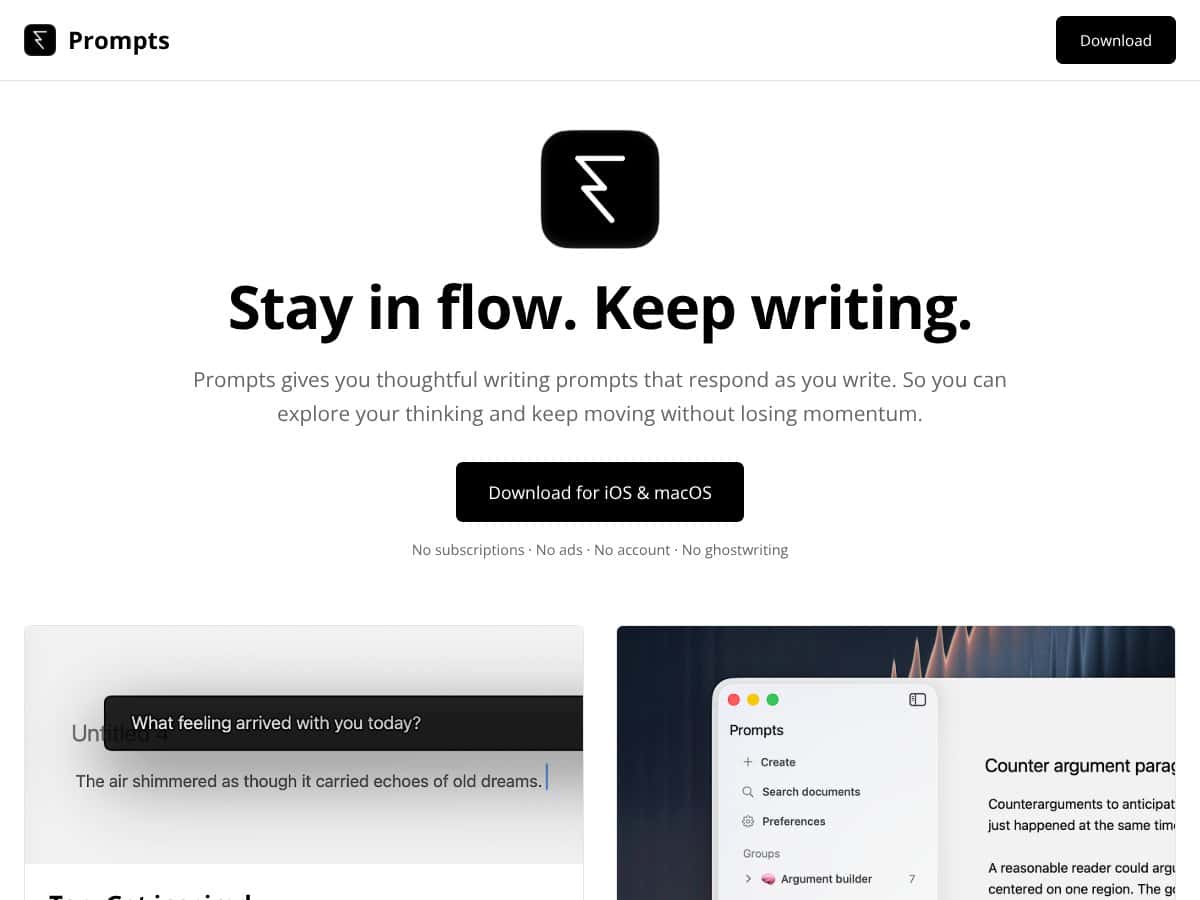
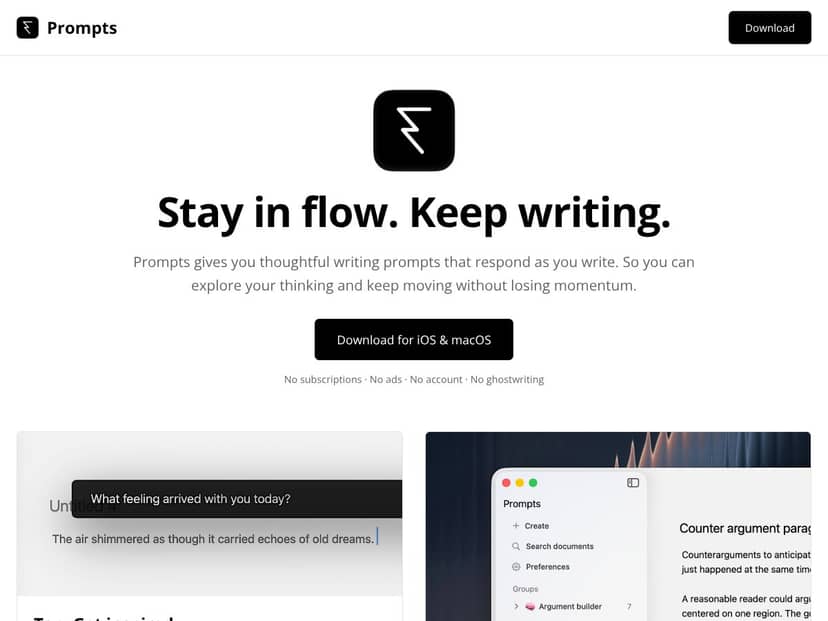
The core idea is simple: you type, and the app responds with prompts that show up as you go. The goal isn’t to rewrite your work for you. It’s more like a nudge—questions or suggestions that help you explore another angle, clarify a thought, or get unstuck without breaking your flow.
The page content you provided also credits the creator, Tanner Christensen, and emphasizes a design-first approach. I like that direction because most “AI writing” apps I’ve used either feel too heavy or too controlling. Prompts, at least based on the described behavior, aims to stay out of the way.
Important scope note: Everything in the sections below (offline behavior, iCloud syncing, iPhone/Mac UI, draft management) matches the writing companion framing. The enterprise platform claims (SOC 2, multi-tenant, RAG) don’t belong here unless you confirm that Prompts is truly the same product.
Key Features (In-Depth Analysis)
Real-Time Prompts That Show Up While You Write
This is the headline feature. As you type, Prompts “reads your text” and then offers relevant prompts—questions or suggestions designed to keep your thinking moving.
What I’d actually look for (and what the page implies) is that the prompts feel contextually tied to what you just wrote, not random inspirational lines. The key is timing: suggestions should appear while you’re still in the same thought, so you can act on them immediately.
In the provided content, it’s described as unobtrusive—you can accept, modify, or ignore prompts. That matters. If an app interrupts every sentence, it stops being helpful fast. If it only surfaces nudges when you stall, it can be genuinely useful.
Limitation to keep in mind: The page doesn’t include any details about prompt cadence, whether there’s a “prompt strength” setting, or how the app decides what to ask next. If you’re evaluating it, you’d want to test that behavior on a few different writing types (blog outline vs. fiction scene vs. email draft) and see how consistent it is.
Cross-Device Sync (iPhone + Mac via iCloud)
The review content says Prompts is available on iPhone and Mac and syncs drafts via iCloud. That’s a big deal for writers who start on mobile and finish on desktop.
In my experience, iCloud syncing is either smooth or frustrating depending on how the app handles conflicts. The page doesn’t mention conflict resolution, but it does say drafts stay accessible and up-to-date when you switch devices.
What to test in a real trial:
- Write a draft on iPhone, then open it on Mac a few minutes later.
- Make an edit on both devices at the same time and see what happens.
- Check whether formatting (themes/typography) carries over or resets.
Draft Management That Doesn’t Overcomplicate Your Workflow
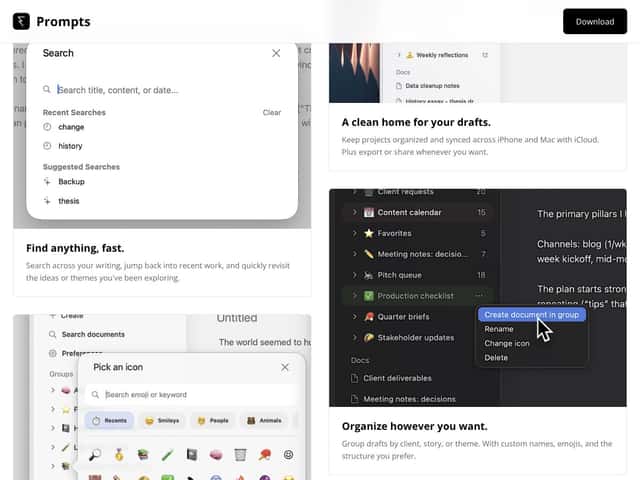
Prompts includes a “clean workspace” for managing multiple drafts. The page mentions you can group drafts by things like client, project, or theme, assign custom names, and even add emojis.
I like that kind of lightweight organization because most writing tools either force you into complicated tagging systems or they don’t give you enough structure. Emojis and simple folders sound small, but they’re exactly what I use to avoid losing ideas.
The one missing detail: the content doesn’t mention advanced search, tagging beyond folders, or export formats. If you rely on finding older notes quickly, you’ll want to confirm what search (if any) looks like inside the app.
Customizable Appearance (Themes + Typography)
Prompts lets you personalize the writing environment with themes and typography settings. That’s not glamorous, but it’s practical. I’ve found that the “right” font and spacing can make long sessions feel less exhausting.
Also, customization is one of those features that helps an app feel like it belongs in your routine instead of feeling like a temporary tool.
That said, the page describes the options as “basic.” So if you’re hoping for advanced editor controls (custom margins, line-height sliders, markdown mode, etc.), you might need to test before committing.
Offline Support + Privacy-Friendly Setup (No Account Required)
According to the page, Prompts is designed to work fully offline and it doesn’t require an account. That’s a strong privacy angle—especially if you write in places where connectivity is spotty.
What I’d want to confirm (and what the page doesn’t specify) is whether:
- prompt generation still works offline, or only the writing does
Still, “no account” is a clear advantage for anyone who doesn’t want yet another login.
Export and Sharing
Once you’ve got your draft, Prompts supports exporting or sharing so you can send work via email or move it into other workflows.
The page is a little light on specifics here—export formats (DOCX? PDF? plain text?) aren’t mentioned. That’s one of the first things I check in any writing tool because it determines whether you can actually use the output elsewhere without formatting headaches.
Practical tip: export one draft right away during your test and see if formatting survives. If it doesn’t, you’ll either lose time later or stop using the tool for real work.
How Prompts Works (From First Open to Finished Draft)
Getting started sounds painless, which is exactly what you want from a writing app. The page describes a minimal onboarding flow: you open the app and you’re prompted to create a new draft or open an existing one. No account means you can jump in quickly.
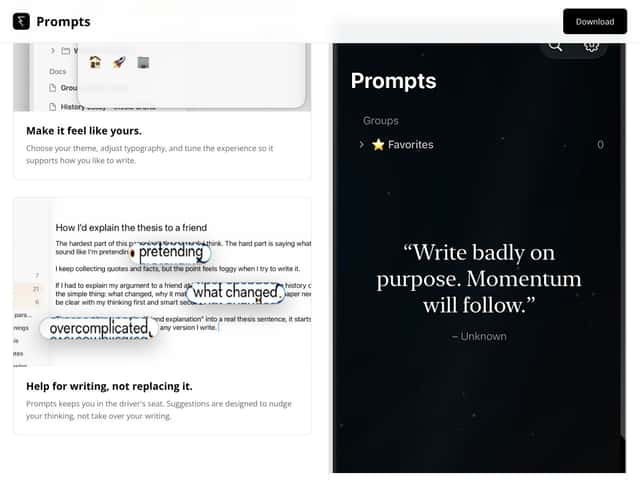
From there, you just start typing. The app continuously monitors your text and surfaces prompts related to your current flow. The suggestions appear without taking over—so you can accept them, edit them, or ignore them.
One thing I’d personally test: does the prompt change if you backtrack or rewrite earlier paragraphs? If prompts keep “chasing” old context, it can feel distracting. If they adapt to your latest direction, it feels like a real writing partner.
The page also mentions folders and themes as part of the workflow, which suggests the app tries to stay focused on writing—not building complicated project management around your words.
Overall, Prompts is framed as a distraction-free companion that helps you explore ideas through responsive prompts, with privacy and offline use as key selling points.
Pricing (What’s Clear vs. What’s Missing)
Your provided content doesn’t include a pricing table for the writing companion experience. It also includes a completely separate “enterprise AI platform” pricing section, which doesn’t match the iPhone/Mac writing tool framing.
So here’s what I can say without making stuff up: the writing-companion description you included states “no subscriptions, no ads, no account required”. If that’s accurate for the current app, it’s a big differentiator.
If you want, I can help you rewrite the pricing section properly—but you’ll need the official pricing source (App Store listing, official pricing page, or release notes) for the writing app specifically.
Pros and Cons (Honest Assessment)
Pros
- Prompt nudges that aim to keep you writing: The real value is that prompts appear while you’re actively drafting, instead of forcing you to stop and search for inspiration.
- Works across iPhone and Mac: iCloud syncing is a practical feature for anyone who drafts on mobile and edits on desktop.
- Simple draft organization: Folders, custom names, and emoji labeling are the kind of lightweight structure that makes older ideas easier to revisit.
- Privacy-friendly by design: Offline-first and no-account setup (as described) reduce the friction and risk for writers who don’t want extra tracking.
- Comfortable writing experience: Themes and typography options help the app feel more personal than a plain text editor.
Cons
- Not enough detail on how prompts are generated: The page doesn’t explain whether prompts are rule-based, model-based, or how consistent they are across writing styles.
- Export options aren’t specified: Without knowing export formats and formatting behavior, it’s hard to judge whether it fits professional workflows.
- No mention of search or advanced retrieval: If you write a lot, you’ll want to know how you’ll find drafts quickly later.
- Scope confusion in the original content: The enterprise AI platform claims appear elsewhere in the page. That’s a content quality issue and can mislead readers.
Best Use Cases
- Getting unstuck during drafting: When you hit that “blank page” moment, prompts that show up in context can help you move forward without switching apps.
- Long-form writing sessions: If you’re working for an hour or two, the app’s goal is to keep momentum going instead of letting your brain stall.
- Mobile-to-desktop workflow: Start on iPhone, refine on Mac—iCloud syncing is the practical reason this category matters.
- Writers who care about privacy: Offline operation and no-account setup make it easier to use in sensitive or low-connectivity environments.
- Idea capture and lightweight organization: Folder grouping + emojis are great for “I’ll sort this later” moments.
Who Should Not Use Prompts?
If your needs are very specific—like you want a full editor with advanced formatting controls, deep version history, or heavy collaboration—Prompts may feel too lightweight.
Also, if you’re looking for the enterprise no-code AI platform experience described elsewhere in the original page (SOC 2, multi-tenant management, RAG pipelines), you shouldn’t use this writing-companion review as your decision source. That’s a different product category entirely.
For writers who want a simple, private, offline-friendly companion that helps with idea flow, Prompts sounds like a good match. For teams needing compliance, admin controls, and scalable AI agent deployments, you’ll need to evaluate the correct platform separately.
Prompts vs Alternatives (Writing Companion vs “Enterprise AI Platform”)
One thing I’d change about the original comparison section: it mixes enterprise AI tools with a writing companion. If you’re evaluating Prompts for writing, compare it to other writing assistants and offline note/workflow apps. If you’re evaluating the enterprise AI platform, compare it to agent builders and RAG platforms.
Promptly / Prompts
- What it does differently: The enterprise-style positioning in the original content (no-code agent building, templates, integrations, security) sounds like a different product path than a simple iPhone/Mac writing companion.
- Price comparison: The page claims Prompts has custom enterprise pricing in one section, but also claims “no subscriptions” in another. That contradiction needs a source check before you rely on it.
- When to choose it OVER Prompts: If you truly need managed, multi-tenant AI agent deployment, you’re comparing against the wrong category unless Prompts is confirmed to be that platform too.
- When Prompts is the better choice: If you want in-the-moment writing prompts on iPhone and Mac with offline/privacy-first behavior, a writing companion should be your comparison set.
Botpress
- What it does differently: Botpress is typically evaluated as a bot builder with more developer/control options, not a writing companion.
- Price comparison: Open-source hosting can be free to start, but operational costs show up later.
- When to choose it OVER Prompts: If you’re building customer-facing conversational systems and need flow control, Botpress-style tools fit better.
- When Prompts is the better choice: If your goal is personal writing momentum, not production chatbot deployment.
Voiceflow
- What it does differently: Voiceflow is often used for designing conversational experiences (especially voice/chat UX), which is a different job than helping you draft.
- Price comparison: It’s usually subscription-based with transparent tiers, unlike the “contact sales” style mentioned in the enterprise section.
- When to choose it OVER Prompts: If you’re designing a guided conversation experience.
- When Prompts is the better choice: If you need writing-time prompts for your own documents.
Stack AI / Langflow
- What it does differently: These tend to be visual orchestration tools focused on node-based pipelines.
- Price comparison: Many setups start free but require technical work if you self-host.
- When to choose them OVER Prompts: If you want maximum control over architecture and deployment.
- When Prompts is the better choice: If you want something simpler and writing-focused without infrastructure management.
Builder.ai / Retool AI
- What it does differently: These are broader app-building/internal tool platforms where AI is one component.
- Price comparison: Usually tiered subscriptions with enterprise options.
- When to choose them OVER Prompts: If you’re building internal dashboards/tools with AI embedded.
- When Prompts is the better choice: If you want dedicated writing support with prompts while drafting.
Quick takeaway: If you’re using Prompts as a writing companion, compare it to writing tools. If you’re building agent workflows with RAG and enterprise security, compare it to agent platforms—and make sure you’re looking at the right product.
Note on Pricing & Verification
The original content includes enterprise claims (SOC 2, multi-tenant management, RAG capabilities, and a pricing table). Those need official links to verify. If you want, share the URLs to Prompts’ official product page, pricing page, and security page, and I’ll align the review with verified sources.
Summary
Prompts (as a writing companion) makes sense for writers who want a calm, privacy-friendly tool that nudges them forward while they draft. The biggest strengths described here are the real-time prompts, iCloud sync across iPhone/Mac, and offline/no-account behavior.
Just don’t let the enterprise AI platform content elsewhere in the page confuse your decision. For that, you’ll need a separate, properly sourced review.
Next Steps (What I’d Do Before Committing)
- Test it on 2–3 different writing types (outline, email draft, long-form paragraph).
- Check prompt behavior: does it help or does it interrupt?
- Export one draft and confirm formatting looks right in your destination app.
- Try switching between iPhone and Mac to see how reliable the sync feels.
Ready to try Prompts? Visit Prompts to get started.