Table of Contents
I’ve tried a bunch of automation tools over the years, and most of them fall into two buckets: either they’re powerful but a pain to set up, or they’re easy but don’t actually handle real workflows. Runable is aiming squarely at the middle—no-code, AI-assisted automation that still feels practical. After testing it, here’s what I actually automated, what was smooth, and where I hit friction.
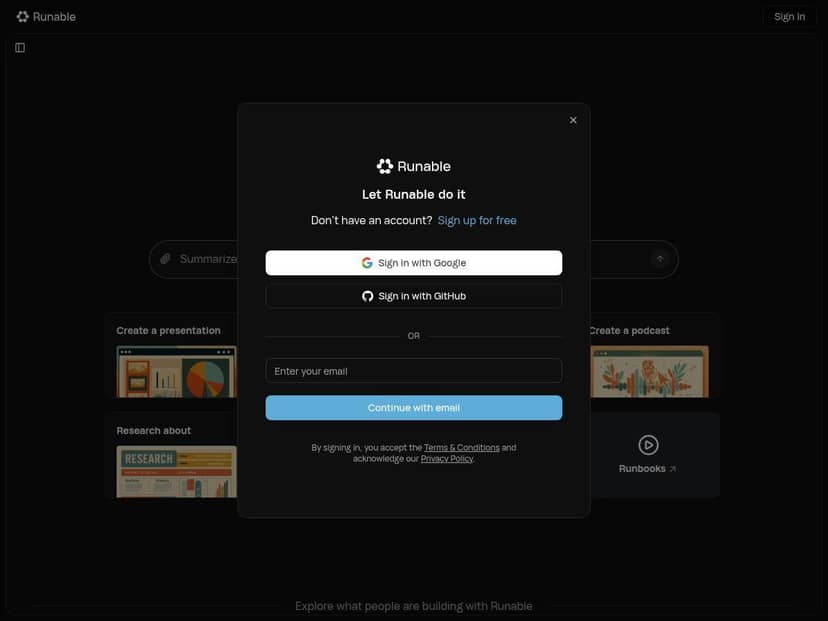
Runable Review: what I automated (and what surprised me)
When I say “no-code,” I don’t mean “no thinking.” I still had to be clear about triggers, outputs, and what counts as a successful run. But Runable did a lot of the heavy lifting with natural-language setup, which is honestly what I wanted.
My baseline workflow was pretty typical: copy info from one place, paste it into another, then follow up with an email or a note. It wasn’t “hard,” but it was repetitive. My goal with Runable was simple: build a couple of automations that would save me time every day without breaking every time something changed.
Automation #1: turn incoming info into a structured entry
- Trigger: new item received (in a connected app)
- Action: extract the key fields and format them into a consistent record
- Output: create/update the target entry so I didn’t have to manually retype details
What I noticed: the AI part helped me translate “what I want” into a workflow that actually matched the fields I cared about. In my test, I was able to get a working version faster than I usually can in more technical automation tools. Still, I had to tweak the mapping once or twice—garbage in, garbage out, right?
Automation #2: email follow-ups based on the message content
- Trigger: email matches a condition (like a keyword/topic)
- Action: draft a response or generate a follow-up message
- Output: send-ready text (and in some setups, a created task/note)
This is where Runable felt genuinely useful. Instead of me writing the same “quick follow-up” over and over, I could generate a draft and then quickly approve/edit. The speed was good enough that I didn’t feel like I was waiting around for automation to catch up.
Automation #3 (quick test): connect multiple tools without hand-building everything
Runable’s integrations are a big deal here. The pitch is that it supports 2,500+ apps, and in practice that matters when you’re trying to connect, say, a browser workflow to a productivity tool and then to a communication channel. I didn’t test all 2,500 (who has time for that?), but I did find that common tools were available quickly during setup.
Setup time (realistic): For my first couple of workflows, I spent roughly 30–45 minutes getting from “idea” to “it runs.” After that, building variations was faster. If you’re brand new to automation, expect some trial-and-error with field mapping and conditions. But it didn’t feel like I needed to learn a programming language to get value.
One limitation I ran into: when I tried to get too clever too early (overly specific conditions + multiple steps + lots of formatting), the workflow needed more tuning than I expected. The AI suggestions were helpful, but you still have to validate the output. If you’re automating something mission-critical, don’t set it and forget it—at least not on day one.
Key Features I actually used in Runable
- Natural-language workflow building
- I typed what I wanted in plain English (trigger → what to extract → where to send it). Runable then translated that into a usable workflow. That’s the part that feels “AI-powered,” and it’s also why this tool is approachable if you don’t want to build everything from scratch.
- Lots of integrations (2,500+ apps)
- Instead of forcing everything through one ecosystem, I could connect different tools into one workflow. In my tests, this reduced the “how do I move data between these apps?” problem, because the connections were available without jumping through hoops.
- Templates you can start from
- Runable includes prebuilt templates (marketing, sales, research, and more). I didn’t just use one template blindly—I opened it, checked the trigger/action steps, and then swapped in my own connected accounts and field names. That made it less scary than starting from a blank page.
- Cross-platform support
- It’s designed to work across desktop, browser, Linux, and mobile. I didn’t fully stress-test every platform, but the setup experience was consistent enough that I didn’t feel like I’d be locked into only one environment.
- Team collaboration + workflow management
- If you’re working with other people, this matters. I checked how workflows are shared and how updates flow. The big win is that it’s easier to keep everyone aligned on what the workflow does—especially when you’re iterating.
Pros and Cons (straight from my test notes)
Pros
- Beginner-friendly setup: I didn’t need coding, and the natural-language approach helped me get to a working workflow quickly.
- Automation feels practical: the workflows I built weren’t just demos—they handled real “copy/reformat/respond” type tasks.
- Wide integration coverage: connecting common apps was straightforward, and that’s usually the biggest blocker in automation projects.
- AI assistance reduces friction: it helped with field mapping and drafting responses faster than starting from scratch.
- Team workflow management: sharing and updating workflows was easier than the “everyone has their own automation” chaos.
Cons
- Pricing details aren’t super transparent: I didn’t see clear, fixed plan pricing during my test, and it looks like some options may require contacting sales. If you need exact numbers up front, you’ll want to verify before committing.
- Complex workflows take tuning: the more steps and conditions you add, the more you’ll need to validate outputs.
- Some advanced features have a learning curve: not because it’s “hard,” but because you need to understand how triggers/fields/outputs behave.
- Don’t blindly trust generated output: for anything important, you’ll want a review step at least initially.
Pricing Plans: what I could confirm and what to check
Runable has a free tier that’s useful if you just want to test the workflow builder and build a couple of automations. For paid plans, the model is usage-based—meaning your cost scales with how much you run and what you connect.
That said, I couldn’t rely on a neat “here are the exact prices” breakdown in the same way I can with some competitors. In my view, that’s the one thing you should verify early. Before you subscribe, I’d check:
- How “automation runs” are counted (per workflow, per step, per action?)
- Whether connections/integrations affect your limits
- Limits on AI-assisted features (drafting, extraction, etc.)
- What’s included on the free tier versus paid (especially team features and workflow management)
If you’re evaluating for a team, it’s also worth asking about higher-volume usage and any admin controls. Even if you don’t need enterprise right now, you’ll want to avoid surprises later.
Wrap up
After using Runable, my take is pretty simple: it’s a strong option if you want automation without the usual “learn a platform first” headache. The natural-language workflow builder helped me get working automations faster, and the integrations made it easier to connect the tools I actually use.
Just don’t assume AI means “no review.” I still had to adjust field mapping and validate outputs when the workflow got more complex. If you’re the type who’s willing to test, tweak, and then let it run—Runable will feel like a real time-saver.
For the latest plan details and any enterprise options, check their official website via the link above and confirm the exact limits for your use case.