Table of Contents
What Is Seda (and What I Actually Saw)
When I first heard about Seda, I’ll admit I was skeptical. I’ve seen a lot of “research-first” products that basically end up being another feed with different branding. So I went in expecting the usual—short posts, vague claims, and not much that you could verify.
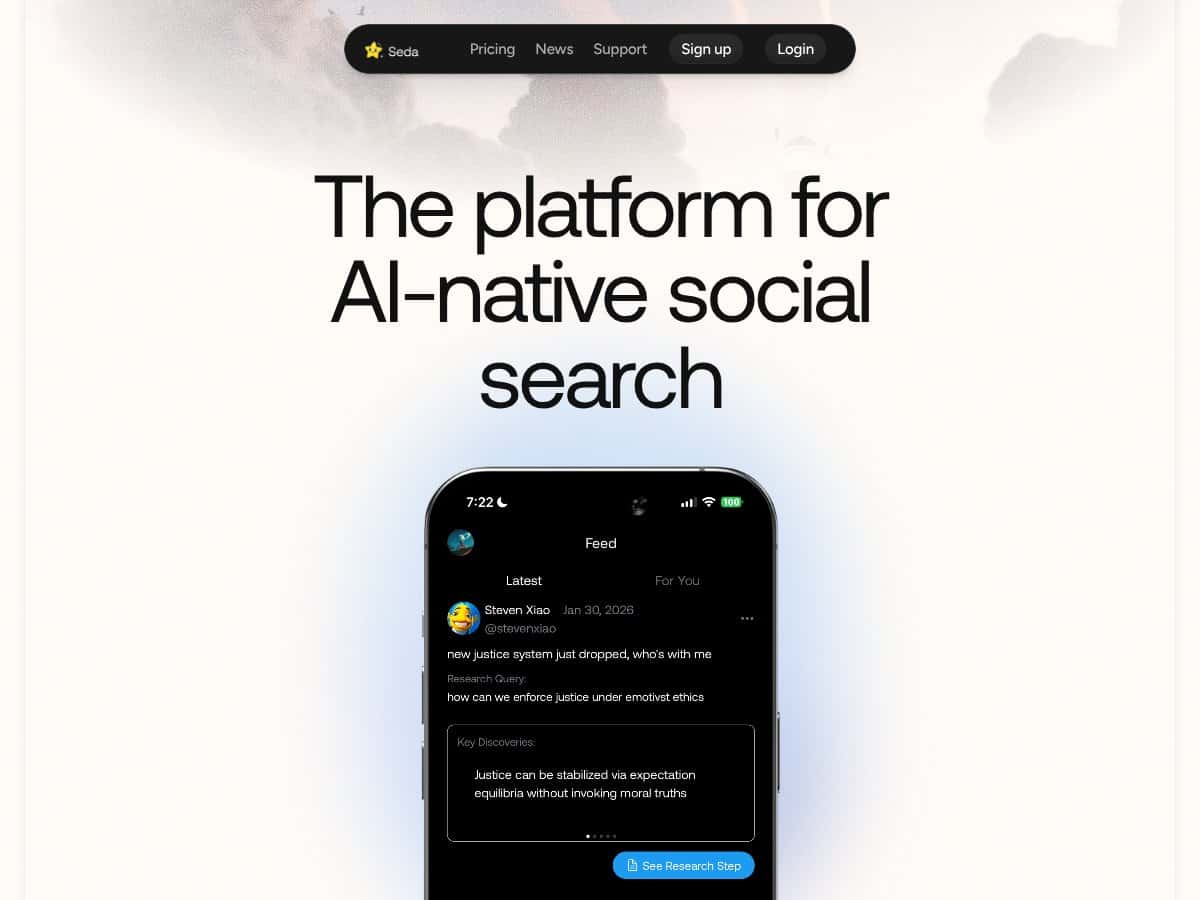
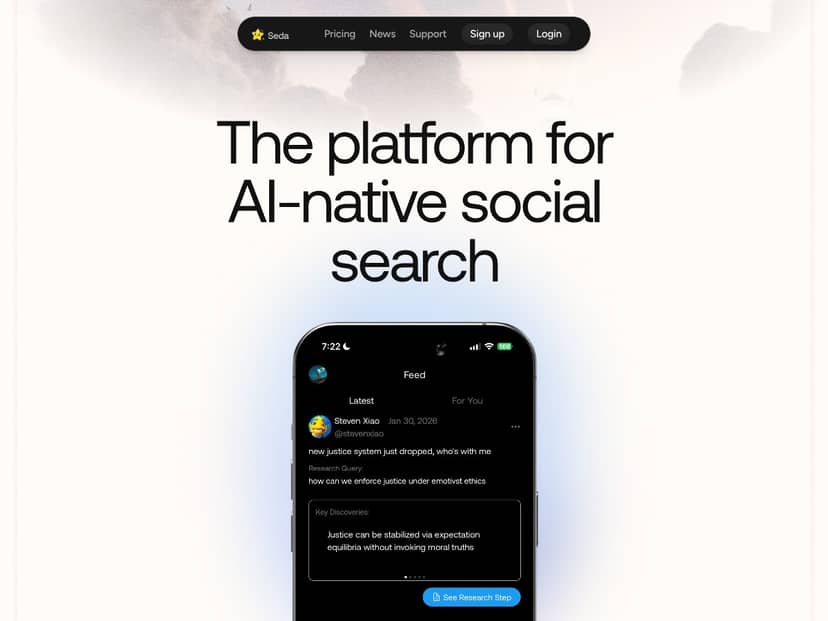
What I noticed during testing is that Seda really does push you toward a research workflow instead of just posting hot takes. The interface has a clear “pick a topic → run research → share what you found” vibe. It’s not subtle about it. Even the way the posting flow is laid out feels built for evidence and citations rather than pure opinion.
For example, when I tried a topic like AI policy, I didn’t just get a generic paragraph. The AI research output was structured in a way that made it easy to turn into a post. I could see the research results, then package them into something other users could read and react to. That “read → comment → build on it” loop is the core promise here.
Seda also leans into the idea of forking—not in a metaphorical way, but in a “you can build on someone else’s research thread” way. The experience felt closer to GitHub-style iteration than a classic social timeline. If someone posts a research-backed write-up, I can follow their direction and take it somewhere else instead of starting from scratch.
Now, here’s where I’m going to be straight with you: Seda is still early. I didn’t run into a huge amount of active discussion while I was testing. That means it’s harder to fully stress-test the “community debate” part of the platform. You can see the model they’re aiming for, but the volume just isn’t there yet.
So what is Seda not? It’s not a Twitter clone. It’s not an encyclopedia. And it’s not a peer-reviewed journal. It’s more like a hybrid—social posting meets collaborative research. If you’re expecting a polished, high-traffic network with tons of people arguing in real time, you might feel disappointed.
Seda Pricing: What’s Free, What’s Pro, and What I’d Watch
- 100 research credits/month
- Basic access to research and posting features
- Limited to core features, no verification badge
- 1,000 research credits/month
- Access to the most powerful deep research engine
- Verification badge for your account
- Potential early access to upcoming features like trading on research
| Plan | Price | What You Get | My Take |
|---|---|---|---|
| Free | Free | Good for trying the research workflow without committing. You’ll still be able to post and test how “evidence-first” feels. | |
| Pro | Price undisclosed | It’s aimed at serious users—but the fact that pricing isn’t clear makes it hard to judge value until you see the actual cost. |
Here’s the part that matters: the free tier is actually usable. During my testing, 100 research credits per month felt like enough to run several real topic attempts and see whether the research outputs are worth your time.
Where things get annoying is the Pro plan pricing. The page/table I saw doesn’t give a concrete number. It tells you what you’d get (more credits, deeper research, verification), but not what it costs. That’s a dealbreaker for some people—especially if you’re comparing Seda to other tools where pricing is clear upfront.
Fair warning: if you plan to do heavy research every week, credits can become the real “price.” Even if the free tier is fine at first, you’ll want to know what Pro costs so you can estimate whether this fits your budget.
The Good and The Bad (After Testing)
What I Liked
- Fast AI research (and it felt practical): Seda markets AI-powered deep research in the 5–30 second range. In my tests, it wasn’t instant like a calculator, but it was quick enough that I didn’t feel like I was waiting around. The real win was that I could go from “topic idea” to “something I could post” fast.
- The workflow is built for posting research: I didn’t have to translate raw AI output into a post from scratch. The structure made it easier to turn research results into a shareable write-up.
- Fork-and-build is a real differentiator: The “build on others” approach felt more collaborative than typical social platforms. It’s the closest thing I found to “community knowledge building” without requiring everyone to start from zero.
- Evidence-first posts (at least in how they’re presented): Seda’s posts are designed around context and reasoning, not just opinions. When I looked at what I produced, it was easier to see how the output was meant to be supported by research rather than vibes.
- Multi-topic coverage: I tried topics outside of one narrow niche (policy-style questions and more “researchy” subjects), and the platform didn’t feel locked to one category.
- QR code sharing: This is one of those small features that I actually appreciate. It makes sharing a specific research post or page frictionless, especially if you’re sending it to someone who doesn’t want to hunt for it.
What Could Be Better
- Pro pricing isn’t disclosed: I couldn’t find an actual Pro price figure during my review. That makes it hard to decide if the “most powerful deep research engine” is worth paying for.
- Moderation details are thin: Seda talks about evidence-backed posts, but I didn’t see clear, concrete guidance on how misinformation is handled at scale (for example: what gets flagged, who reviews reports, what actions happen after a report, or how often it’s enforced). I looked for specifics in the areas you’d expect (help/docs/community rules), and what I found wasn’t detailed enough for me to feel totally comfortable.
- User base is still small: While I was testing, the platform felt quiet. That doesn’t mean the idea is bad—it just means it’s harder to see lively debate, diverse perspectives, and active fork chains.
- Feature gaps depending on what you need: I didn’t see obvious advanced search/filter options, and integrations with tools like Notion or Slack weren’t something I could confirm. If you rely on those ecosystems, you might feel boxed in.
- Trading on research raises questions: Seda hints at “trading on research” as an upcoming feature. I’m not against incentives in theory, but I want safeguards. During my testing, I didn’t find enough clear explanation about how trading would work (what gets traded, what assets exist, how conflicts of interest are handled, and what prevents manipulation). If that feature matters to you, dig into the rules—or wait until it’s actually live with clear documentation.
Who Is Seda Actually For?
If you like research, debate, and building on ideas, Seda could fit you really well. It’s especially appealing if you want a place where your posts aren’t just “here’s my opinion,” but “here’s what I found, and here’s how I’m thinking about it.”
In my experience, it’s a good match for people who:
- Want to explore complex topics (policy, science-adjacent questions, emerging tech governance)
- Prefer asynchronous discussion—read, respond, fork, iterate
- Care about evidence presentation more than viral engagement
Where it’s less ideal is if you’re looking for a big, lively social network right now. Since the community is still small, you may not get the kind of response volume you’d expect from mainstream platforms.
Who Should Look Elsewhere
If your main goal is quick entertainment—likes, memes, and scrolling for dopamine—Seda probably won’t scratch that itch. It’s not built for casual browsing in the same way.
Also, if you’re expecting a “plug-and-play” social platform with tons of integrations and mature moderation tooling, you might feel like you’re beta-testing a concept. I didn’t find strong evidence of broad integrations (like Slack/Notion/Evernote workflows), and moderation specifics weren’t as transparent as I’d prefer.
Fair warning: if you want a polished, feature-rich experience with extensive community controls, you may find Seda feels incomplete. If you’re okay with that—and you’re genuinely interested in research-first social—then you’ll likely enjoy experimenting.
How Seda Stacks Up Against Alternatives
ResearchGate
- ResearchGate is built for academics: paper sharing, formal collaboration, and question-asking.
- It can be free for core features, but some content/tools can depend on access (and costs can show up through institutional subscriptions).
- Where Seda differs: Seda feels more like public, social research threads you can fork—less “formal academic network,” more “collaborative discovery with AI outputs.”
- Reddit is huge and topic-diverse, but it’s more community opinion driven than evidence structured.
- Moderation quality varies a lot by subreddit, and you can absolutely find misinformation mixed in with good-faith discussion.
- Where Seda differs: Seda’s posts are structured around research-style outputs, which changes the conversation shape. It’s not automatically “more correct,” but it’s designed to be more evidence-oriented.
Discord
- Discord is real-time chat and community servers. Some servers are research-focused, but it’s often informal and conversation-heavy.
- Most servers are free, with some communities adding paid tiers for extra perks.
- Where Seda differs: Seda is more asynchronous and post-based. The “fork” model is more about building written research than live chat spontaneity.
Quora
- Quora is question-and-answer with moderation and varying answer quality.
- Some features/content can be paywalled (Quora+).
- Where Seda differs: Seda’s focus is research outputs that you can turn into posts and iterate on, rather than short-form expert explanations.
- LinkedIn is professional networking first. You can share insights, but it’s not designed for deep, source-driven research threads.
- It’s mostly free, with premium tiers for analytics/messaging.
- Where Seda differs: If you want evidence-backed research posts and collaborative building, Seda’s model is much closer to that than LinkedIn’s feed.
Bottom Line: Should You Try Seda?
I’d rate Seda about 6.5/10 based on what I experienced. The upside is real: the workflow is research-first, the “fork and build” concept is genuinely interesting, and the outputs are structured in a way that makes posting easier than a typical AI chat tool.
But it’s not perfect. The platform is still early, the community feels quiet, and the details around Pro pricing and moderation enforcement aren’t as clear as I’d like. If you’re sensitive to misinformation handling, that’s a big one.
My practical advice: try the free tier first. That gives you 100 research credits per month to test whether the research outputs and posting experience fit your style. If you end up using it heavily and the Pro cost makes sense for you, then consider upgrading—but I’d wait until pricing is clear so you can estimate your real monthly spend.
If you’re excited about evidence-first research and collaborative knowledge building, Seda is worth a shot. If you just want quick opinions or a big social scene, you’ll probably be happier elsewhere.
Common Questions About Seda
Is Seda worth the money?
It can be, but I don’t think you should decide based on hype alone. Since Pro pricing isn’t clearly disclosed, I’d treat the free tier as the real evaluation period. If you consistently use the deep research workflow and you like how posts are structured, then it may be worth paying later.
Is there a free version?
Yes. Seda offers a free plan with 100 research credits per month. That’s enough to test the core research and posting features before you commit to anything.
How does it compare to ResearchGate?
ResearchGate is more academic and paper-focused. Seda feels broader and more social/research-thread oriented, with AI research helping generate shareable posts. If you’re in academia, ResearchGate may fit better. If you want social discovery around research ideas, Seda is closer to what you’re looking for.
Can I get a refund?
I couldn’t find a clearly stated refund policy in the public info I reviewed. If you’re considering Pro, check directly with Seda’s support or the billing/terms pages inside the app so you know what applies to your account.
How secure is my data?
Seda collects personal info, including contact details, search history, and user content. If privacy is a concern for you, review the data/privacy policy before signing up. (During my review, I focused on whether those categories are explicitly listed, and they are.)
Does it support multimedia content?
Yes. You can post videos, and you can also share content via QR codes. That QR piece is genuinely handy if you want to share a specific research post quickly.
Is the platform suitable for collaborative research?
Yes. The fork/build model is the main reason I think it works for collaboration. It’s closer to iterative research threads than one-off posts, which makes it easier to build on what others have already produced.
What topics can I research?
Seda covers a wide range—policy, science, history, and more. The AI engine is designed to handle different kinds of topics, so you’re not stuck in one niche.