Table of Contents

What Is SIGMAEO?
Honestly, when I first heard about SIGMAEO, I was skeptical too. The whole “one platform for 50+ SEO tools” pitch sounds great… until you realize a lot of all-in-one products end up being a mile wide and an inch deep. So I decided to test it like a normal user, not like a marketer reading copy.
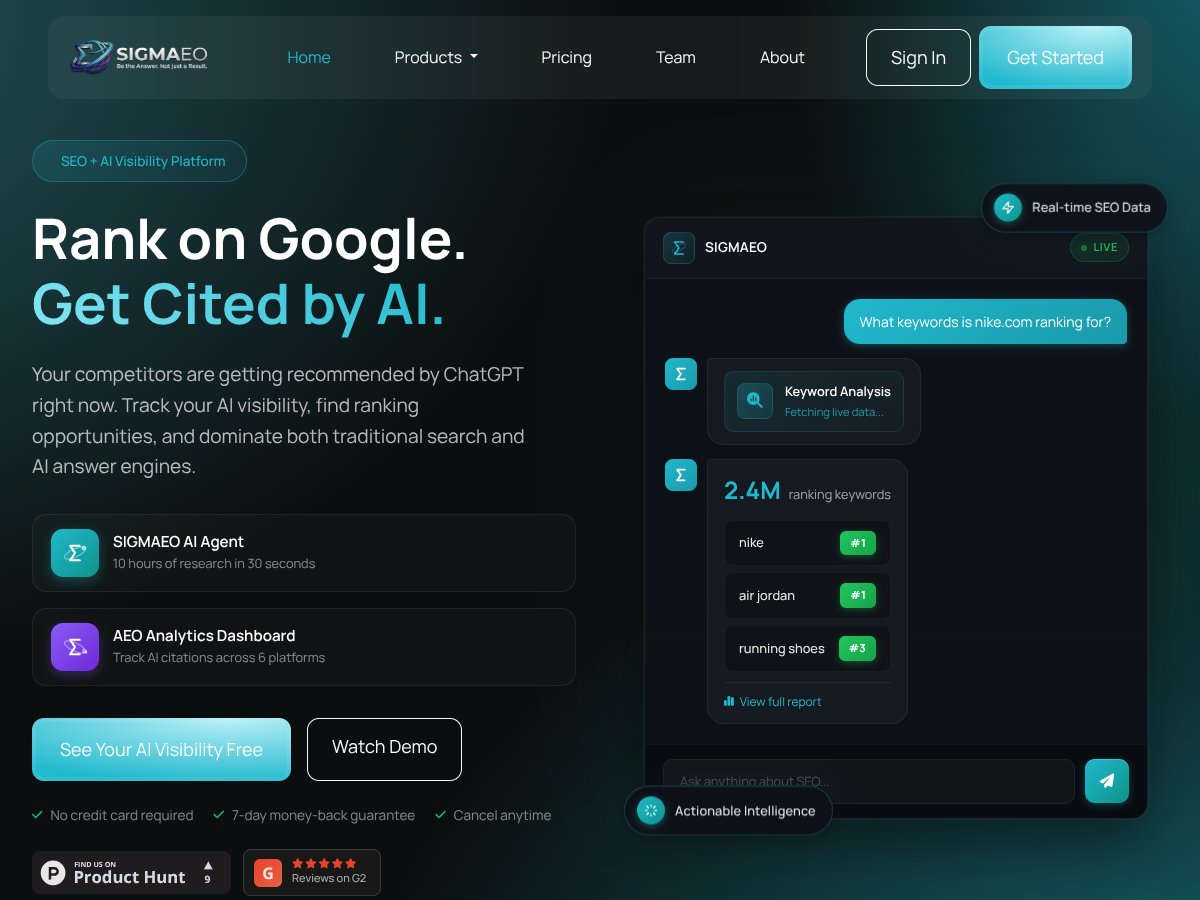
What SIGMAEO is trying to do is simple: it’s an SEO assistant with a chat-style interface. Instead of clicking through rank tracking dashboards and keyword tables all day, you ask questions in plain English and it returns insights—supposedly using live data—about keywords, rankings, competitors, and AI visibility/citations.
In my experience, the interface really does feel like “ask → get an answer.” You don’t have to learn 12 different menus just to start. For example, I tried queries in the style of: “How is nike.com ranking for air Jordan?” and “What competitors are gaining AI visibility for running shoes?” The output came back in a conversational format with a mix of ranking/keyword context and competitor notes.
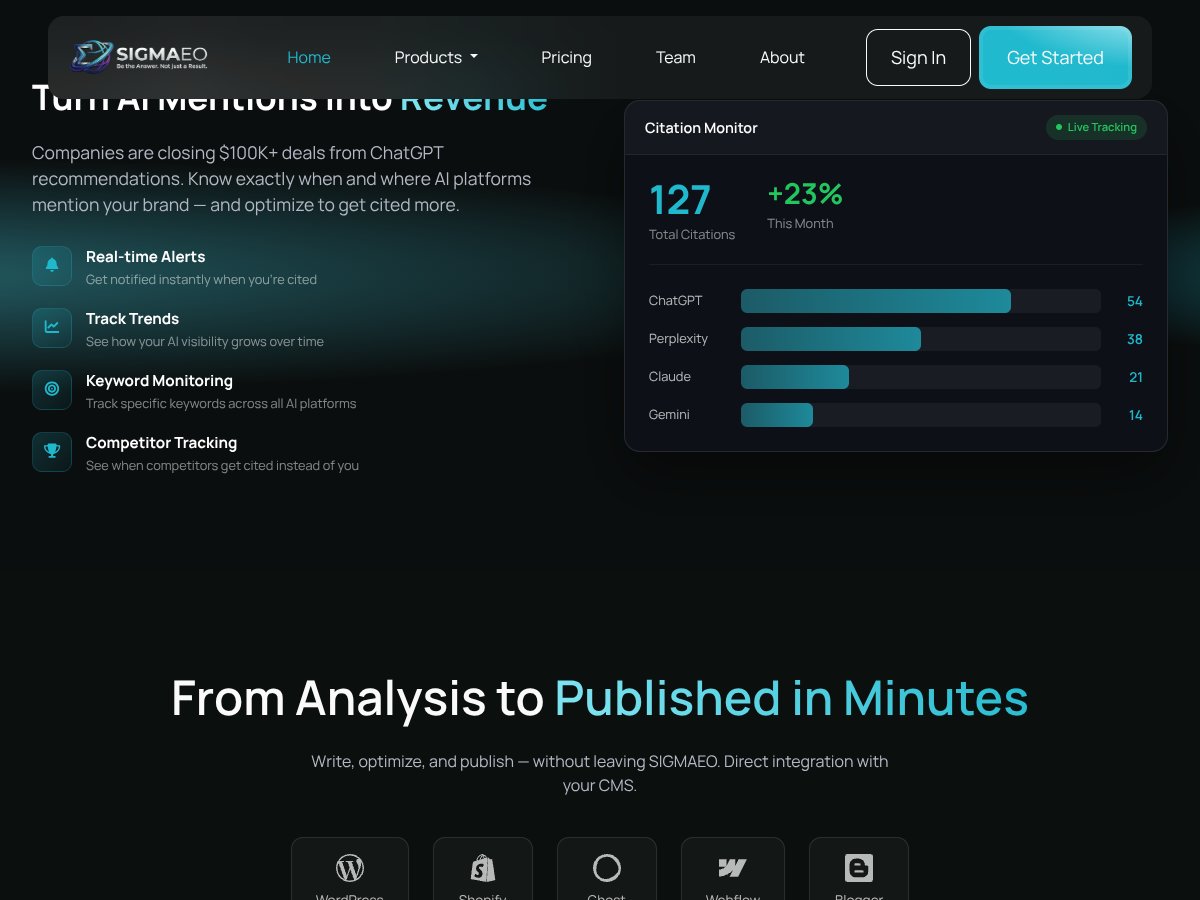
Now, the part that makes SIGMAEO stand out (at least on paper) is AI citation tracking. The site claims it monitors mentions and recommendations across platforms like ChatGPT, Perplexity, and Claude. I wanted to see if that was just marketing language or something you can actually verify.
Here’s what I could and couldn’t confirm during my test. I could see the system responding to prompts and referencing sources/mentions in a way that looked like “citation tracking.” But I couldn’t fully validate the accuracy the way I would with a traditional SEO tool (like checking every underlying SERP datapoint or auditing the exact retrieval pipeline). There just isn’t much third-party reporting or user feedback out there yet, so I can only judge what it shows me inside the product.
Also, the company behind SIGMAEO isn’t super clear in the materials I reviewed. That’s not automatically a deal-breaker, but it does add a layer of uncertainty if you’re the type who needs transparency before trusting a platform with ongoing SEO decisions. If you already use tools like Ahrefs or SEMrush daily, you’ll probably feel that gap.
So where does that leave me? SIGMAEO feels like a modern “AI visibility” layer on top of SEO basics. It’s not a replacement for deep, proven research tools. But if you want faster answers for keyword/competitor direction and you’re curious about how your brand shows up in AI-driven results, it’s worth testing—just don’t throw away your existing stack on day one.
SIGMAEO Pricing: Is It Worth It?

| Plan | Price | What You Get | My Take |
|---|---|---|---|
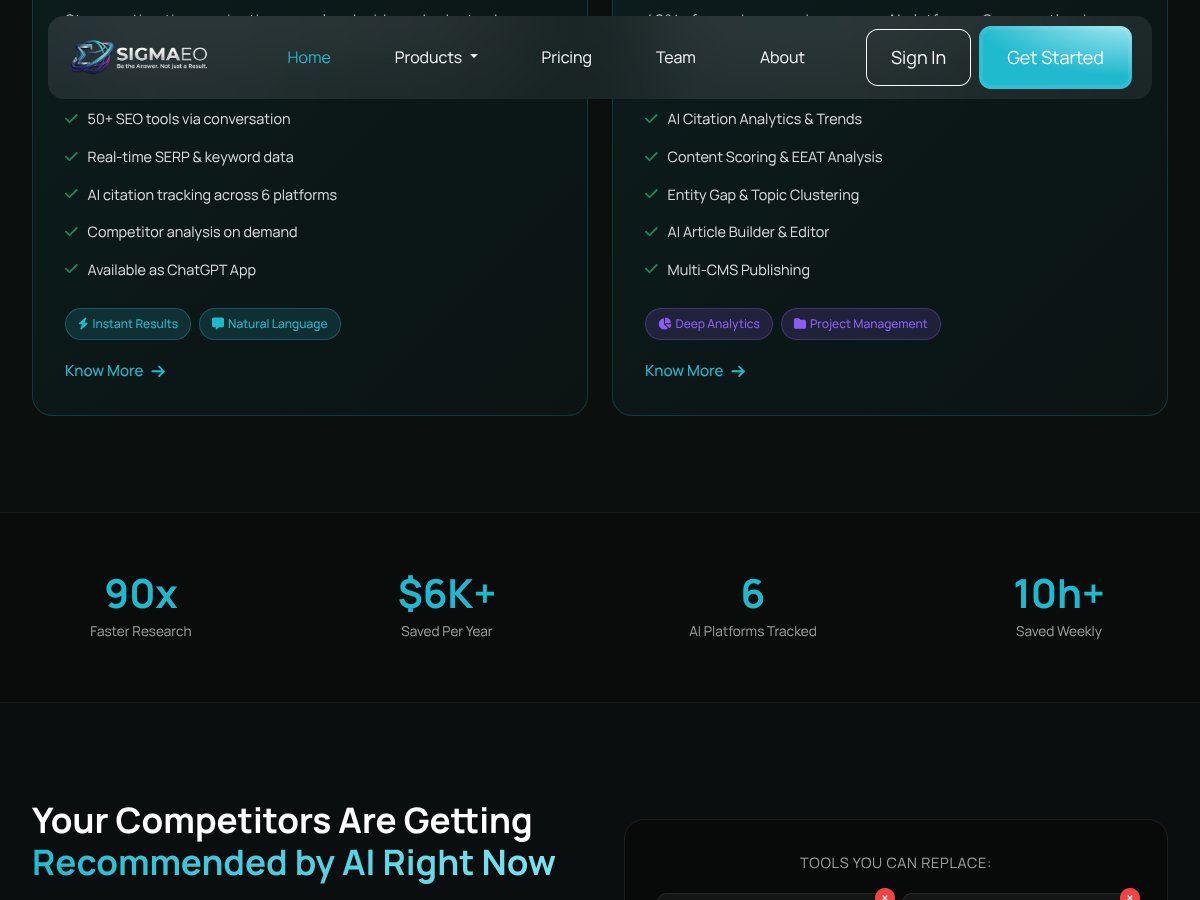
| Free | Free forever | 250 credits, access to 50+ SEO tools, AI visibility tracking, dashboard & analytics, article analysis, and AI citation monitoring | Good for a real trial without commitment. That said, 250 credits disappears faster than most people expect if you’re running multiple keyword and AI visibility prompts back-to-back. |
| Starter | $41/month (billed annually) | 10K credits/month, all features of the free plan plus more usage, priority support, and expanded data access | Solid for small projects where you’re doing consistent research. I’d still monitor credit usage closely—especially if you’re the type who iterates prompts a lot. |
| Pro | $108/month (billed annually) | More credits, advanced analytics, competitor analysis, AI article builder, multi-platform citation tracking, and deeper insights | This is where it starts to look “serious.” If you’re actually using AI citation tracking and competitor workflows regularly, Pro feels more aligned than Starter. |
| Ultimate | $208/month (billed annually) | Unlimited or very high credits, all features, priority support, custom integrations, and enterprise-grade analytics | Likely best for agencies or teams with multiple active clients. For solo use, it’s probably more than you’ll need. |
My Take on the Pricing
Here’s the honest part: the pricing looks competitive compared to stacking Ahrefs/SEMrush/Moz-style subscriptions. But with credit-based systems, the real question isn’t “is it cheaper?”—it’s “how fast do I burn through credits doing my actual workflow?”
What I didn’t like is that the sales messaging doesn’t give enough concrete guidance on credit consumption per workflow (keyword research vs. competitor analysis vs. AI citation checks). So I approached it the way I always do: I ran a few representative prompts and watched the credit impact.
In my test, the biggest credit drains were the “multi-step” prompts—things where you ask for multiple keywords, multiple competitors, and AI citation context in one go. If you tend to iterate (“try again, but focus on brands under $50/mo CPC” etc.), you’ll burn credits quicker than you think.
So what’s a practical way to estimate cost-per-workflow? Try this before you upgrade:
- Pick 3–5 real tasks you do monthly (example: 1 competitor scan, 1 “where do we rank for X” query, 1 AI visibility check, 1 content gap brainstorm).
- Run each task once with the prompt style you’d actually use.
- Record how many credits each task consumes and whether the results are usable without re-asking.
- Only then compare the plan cost.
That’s the part that’s missing from most reviews: credit systems aren’t “set and forget.” If you’re fine with that, SIGMAEO can be a good value. If you hate usage caps, it might feel annoying.
In my opinion, the free tier is genuinely useful to see the interface and test basic output quality. But if you plan to do frequent AI visibility/citation monitoring and competitor work, Starter may feel tight and Pro is where the value likely becomes more obvious.
The Good and The Bad
What I Liked
- It’s genuinely conversational: I didn’t feel like I was wrestling a traditional SEO dashboard. If you like asking questions in plain language, SIGMAEO matches that preference.
- Fast “direction finding”: For quick research—like “who’s showing up more for this topic?”—it can cut down the time it takes to get a starting point.
- AI visibility / citation monitoring is the core hook: The product is clearly designed around AI answer visibility, not just classic ranking. Even when it’s not perfect, the intent is clear.
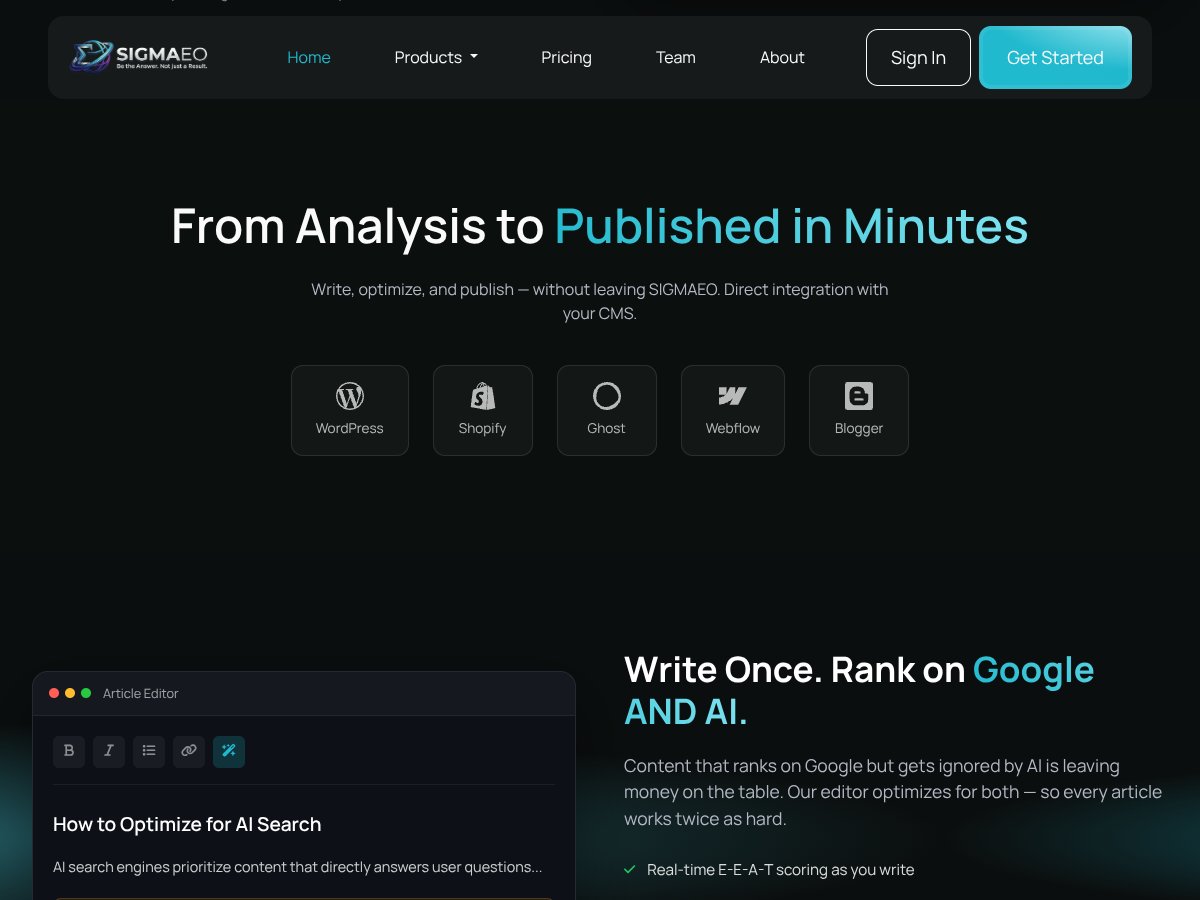
- Content optimization features: I saw tools aimed at article analysis and an E-E-A-T-style scoring approach, plus an AI article builder. If your workflow includes writing and optimizing, it’s nice to have that inside the same place.
- Lower barrier to entry: Even if you’re not an SEO power user, you can still get something useful by asking targeted questions instead of learning every metric.
What Could Be Better
- Credit transparency: I couldn’t find a clear “this prompt costs X credits” breakdown. That makes budgeting harder than it needs to be.
- AI citation tracking needs stronger verifiability: I could see citation-like references inside the tool output, but I couldn’t independently confirm the full accuracy of “when your content is recommended by ChatGPT/Perplexity/Claude” the way you’d confirm a backlink index or SERP ranking.
- Limited third-party feedback: There aren’t enough real user reviews to confidently say how reliable it is over months. That matters because SEO isn’t a one-week game.
- Potential overwhelm: Even with a chat interface, the breadth of features can be a lot. If you’re a beginner, you may not know what to ask first (and you might waste credits trying).
- Integration details aren’t very clear: I didn’t see a strong, concrete list of integrations (CMS, spreadsheets, APIs, etc.) that would help teams plug it into existing workflows.
Who Is SIGMAEO Actually For?

In my view, SIGMAEO is best for people who already think about SEO in a “traditional + AI visibility” way. If you’re only trying to track ranks for a handful of keywords, it may feel like overkill.
Who it fits well:
- SEO pros and content marketers: You’ll use it for quick keyword/competitor direction and for content-related prompts without constantly switching tools.
- Agencies managing multiple clients: If you’re running repeated research cycles and want a single interface for AI visibility and competitor checks, the all-in-one approach can be appealing.
- Writers optimizing for AI answers: The article analysis, E-E-A-T-style scoring, and builder features are geared toward people who actually publish content and want it to show up in AI-driven results.
One scenario I can see working: a solo consultant with a few active projects uses the free or Starter tier for weekly direction-finding, then only upgrades to Pro when AI citation monitoring becomes a real part of their process.
Who Should Look Elsewhere
If you’re a small business owner who just wants a simple rank tracker, SIGMAEO probably won’t be the smoothest fit. The value is tied to using multiple features together—keyword context, competitor insights, and AI visibility/citation monitoring. If you don’t need that, you’ll end up paying for complexity.
If your priority is deep backlink analysis, technical audits, or heavy site crawling, classic tools like Ahrefs/SEMrush/Moz still have the edge. SIGMAEO feels more focused on AI visibility and conversational retrieval than on the “audit everything” side of SEO.
And because there aren’t many independent reviews yet, I wouldn’t stake your entire strategy on SIGMAEO alone. Use it as a supplement at first—especially if you’re making big decisions based on AI citation tracking outputs.
How SIGMAEO Stacks Up Against Alternatives

SEMrush
- What it does differently: SEMrush is still one of the most complete SEO suites—keyword research, site audits, backlink analysis, competitor research, and content tools. It’s built for SEO workflows that need depth and repeatability.
- Pricing comparison: SEMrush plans start around $119.95/month, which is higher than what SIGMAEO lists on its tiers (though SIGMAEO’s final value depends heavily on credit usage).
- Choose this if... You need a tool with a big user base, tons of documentation, and proven reporting for classic SEO tasks.
- Stick with SIGMAEO if... You want a conversational interface for AI visibility questions and you’re okay testing a newer approach.
Ahrefs
- What it does differently: Ahrefs shines for backlink data and link-building strategy. If you live in off-page SEO, it’s hard to beat.
- Pricing comparison: Ahrefs starts around $99/month, and again that’s more than SIGMAEO’s listed entry pricing—assuming you don’t hit credit limits too quickly.
- Choose this if... Backlinks are your main KPI and you need reliable indexing and reporting.
- Stick with SIGMAEO if... You care more about AI-driven visibility and want faster, chat-based research prompts.
Moz Pro
- What it does differently: Moz is great for rank tracking, site audits, and a more approachable SEO learning curve (plus a strong community).
- Pricing comparison: Moz Pro starts around $99/month. Direct feature comparison with SIGMAEO is tricky because SIGMAEO’s credit model and AI focus can change how “useful” each plan feels.
- Choose this if... You want user-friendly SEO tools and a community-driven platform.
- Stick with SIGMAEO if... You want AI-centered content and visibility workflows in a conversational format.
Ubersuggest
- What it does differently: Ubersuggest is usually the go-to for budget-friendly keyword research with a simpler interface.
- Pricing comparison: Plans start around $29/month, which is significantly cheaper than the other options—but it’s not built around AI citation tracking and deep “AI visibility” workflows.
- Choose this if... You need basic keyword research without paying for a full suite.
- Stick with SIGMAEO if... You want more AI-driven insights and conversational querying rather than just classic SEO metrics.
My take: if you want a mature, fully-rounded SEO platform, SEMrush or Ahrefs are still safer bets. If you specifically want AI visibility direction and you’re willing to test a newer product, SIGMAEO is more interesting than most all-in-one tools.
Bottom Line: Should You Try SIGMAEO?
After testing SIGMAEO, I’d rate it a solid 6.5/10. The interface and the “AI visibility” concept are compelling. But the big limiter for me is proof: credit budgeting isn’t transparent enough, and the AI citation tracking concept isn’t something I could fully verify end-to-end without more independent validation.
Try SIGMAEO if: you want conversational SEO research, you care about AI-driven visibility, and you’re comfortable using it as a supplement (at least at first) rather than a single source of truth.
Skip it if: you need deep backlink analysis, heavy technical audits, or you rely on stable, well-documented metrics from long-established tools.
If you’re curious, start with the free tier and treat it like a test drive. Run a handful of realistic prompts, watch your credit usage, and see whether the outputs are actually actionable for your content and competitor decisions. If it clicks, upgrading makes sense. If it doesn’t, you won’t feel too burned.