Table of Contents
Honestly, I used to mix these two up. Stream of consciousness and fragmented narrative both mess with time and “normal” sentence flow, so it’s easy to assume they’re the same thing. But once you know what each one is trying to do to your brain as a reader, the difference gets pretty clear.
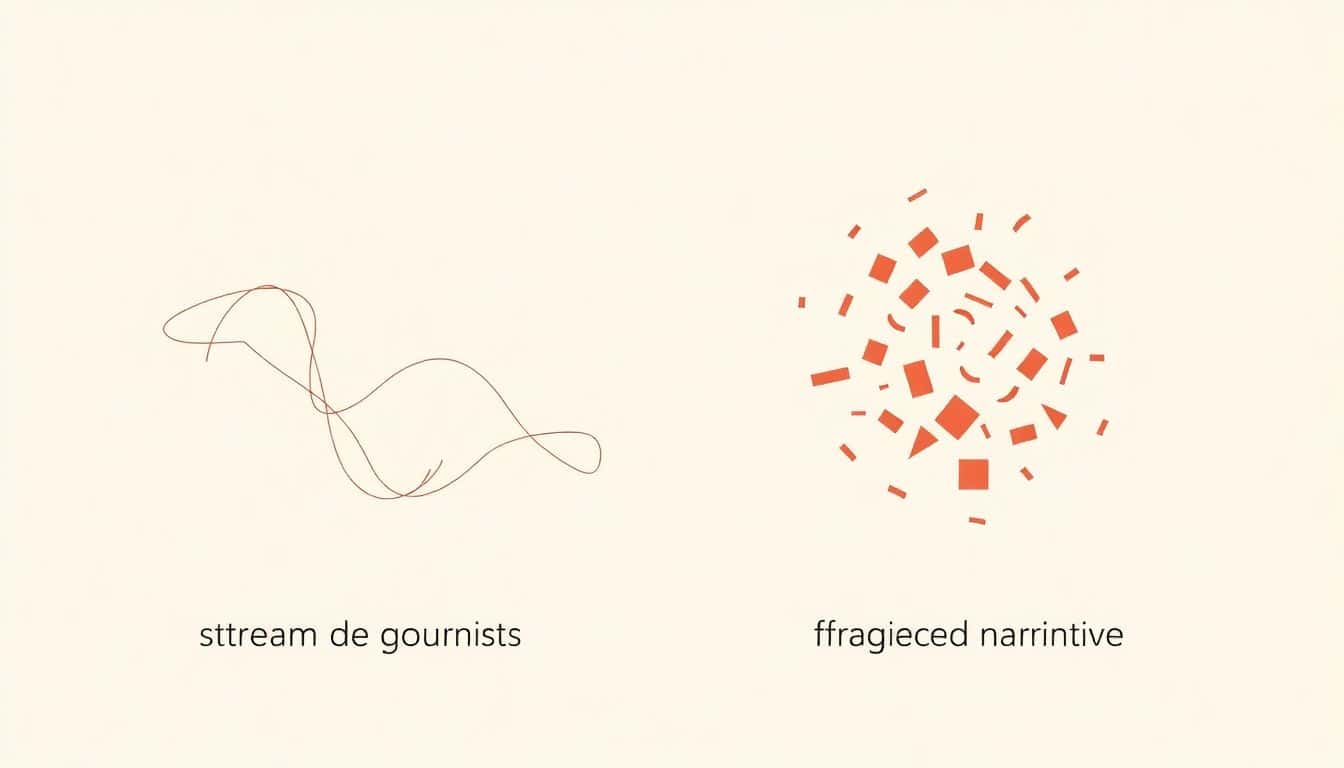
Here’s how I approach it: stream of consciousness tries to put you inside one character’s head. Fragmented narrative is more about breaking the story into pieces so the reader has to reconstruct meaning. Different goals, different reading experience.
Below, I’ll show you what each technique looks like on the page, where modern authors use it (with actual titles and what’s happening in the writing), and a few quick exercises you can run on your own drafts.
Key Takeaways
– Stream of consciousness aims to capture a character’s immediate thoughts, feelings, and sensory impressions as they pop up—often with long sentences, sudden associations, and messy logic that still feels “true.”
– Fragmented narrative disrupts story order (or scene order) using flashbacks, timeline jumps, viewpoint shifts, or broken “chunks” of information—so readers actively piece the narrative together.
– Stream of consciousness is about mind. Fragmented narrative is about structure and sequence (or lack of it).
– Both styles grew out of modernist experiments in the late 1800s/early 1900s and keep evolving as storytelling formats change—especially in interactive and digital media.
– If you want intimacy with a character’s inner life, lean stream of consciousness. If you want layered mystery, memory distortion, or “puzzle-box” reading, lean fragmented narrative. And yes, combining them can be powerful—when you control the transitions.
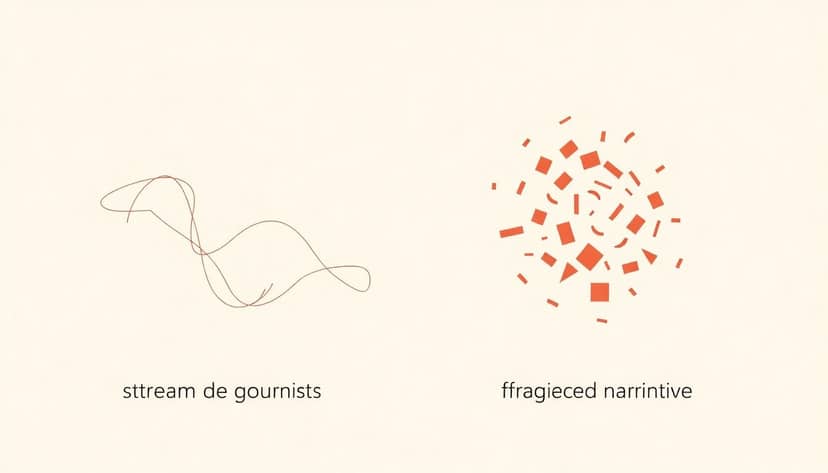
Stream of consciousness is a narrative style that tries to mimic the way a mind actually works—thoughts and sensations arriving in a continuous (or at least “flowing”) chain. It’s not just “inner monologue.” In my experience, the best stream of consciousness feels like the character is thinking while noticing: a smell triggers a memory, a memory triggers a fear, and the sentences keep rolling even when the logic gets a little sideways.
On the page, you’ll often see long, winding sentences, abrupt shifts in association, and details that feel slightly too immediate—like we’re getting raw perception before the character has time to label it. Virginia Woolf is the obvious reference point here, but writers like James Joyce also pushed hard on this style.
There’s also a temptation to explain stream of consciousness with neuroscience. I don’t love making up numbers, though. The brain does cycle through activity patterns on fast timescales, and those fluctuations can be loosely compared to how quickly attention and perception shift. But if you’re going to use timing claims in an article, you should tie them to a specific study (authors, journal, link). Otherwise, it reads like “science-sounding filler.”
So instead of treating those millisecond ranges as a writing rule, I treat them as an inspiration: when you write stream of consciousness, aim for moment-to-moment continuity and let associations happen quickly—without over-explaining them.
Fragmented narrative, by contrast, is about story order. The information arrives in pieces: out of sequence, from different angles, or interrupted so the reader has to do some work. You might get a scene in the present, then a flashback that doesn’t “announce” itself cleanly, then a viewpoint shift that reframes what we thought we knew.
This kind of structure shows up a lot in modernist and postmodern writing because memory and perception are rarely tidy. And it maps really well to contemporary life—feeds, notifications, and constant context switching. But again, the key is not “chaos for chaos’s sake.” It’s why the story is broken.
Fragmented narrative often serves themes like memory distortion, trauma, identity fragmentation, or cultural dislocation. It can feel mysterious, even when the prose is straightforward. The disorientation is structural: you’re not inside one mind—you’re building a picture from fragments.
Historically, both approaches came out of late 19th/early 20th-century modernism, when writers started questioning the old promise that novels should be clean, linear, and omniscient. Woolf and Joyce helped popularize stream-of-consciousness techniques in the 1910s–1920s. Fragmented narrative shows up across the same era and continues later in writers who focus on structure, memory, and perspective.
If you want a simple way to remember it: stream of consciousness is what the character is thinking; fragmentation is how the story is assembled.

11. The Neurophysiological Basis of Stream of Consciousness
Let me be upfront: you can’t directly “program” prose from brain scans. But you can use neurophysiology as a reality check for what your writing is trying to imitate.
Here’s the part that’s useful for writers: attention and conscious experience aren’t static. They shift rapidly as the brain updates perception, meaning, and emotion. That’s why stream of consciousness often works best when it treats thought as something that keeps restarting—one association leading to another before the character can fully summarize what they mean.
If you’re going to include a specific timing claim in an article, I recommend you cite the actual research (paper title, authors, journal, and a link). Otherwise, readers who know better will clock it immediately and assume it’s guessed.
In craft terms, my rule of thumb is simpler: don’t pause to “explain the transition.” Let the sentence jump the way attention jumps. If you notice you’re writing a polished paragraph that feels like an essay about feelings, you’ve probably drifted away from true stream of consciousness.
Quick micro-exercise (5 minutes): Write 200–250 words of a character entering a room. No backstory explanations. Only perception + association. If you catch yourself using phrases like “she wondered why” or “it made her think about,” replace them with what the thought actually feels like in the moment.
12. The Role of Technology in Evolving Narrative Techniques
Technology doesn’t “replace” these techniques—it changes the way they can be delivered. And that’s where things get interesting.
In my experience, interactive fiction and games naturally encourage fragmentation because the reader/player is constantly making choices and receiving information in non-linear ways. You might complete an objective, then unlock a memory later that reframes the entire scene. That’s fragmented narrative behavior, built into the format.
AI writing tools can also help writers experiment with non-linear drafts faster—especially when you’re trying to juggle multiple viewpoints, timeline jumps, or different “versions” of a scene. Just don’t outsource your judgment. The draft can be generated quickly; the craft decisions (what to reveal, when, and how) still have to be yours.
Virtual reality (VR) adds another layer. It can make the “fragment” feel embodied: you turn your head, you notice a detail, you miss something important because you weren’t looking. That’s not just style—it’s experience design.
On platforms that support interactive or multimedia publishing, fragmentation becomes more than text. A scene can be split across audio, image, and choice-driven navigation, so the reader assembles meaning across formats—not just sentences.
If you want to keep your projects publish-ready, it helps to know your options early. publish formats like these can influence how you structure fragmented scenes.
13. How to Choose Between Stream of Consciousness and Fragmented Narrative
Choosing between these styles isn’t about “which one is better.” It’s about what you want your reader to do.
If your goal is emotional intimacy—the reader should feel like they’re stuck inside one person’s perception—go with stream of consciousness.
If your goal is reconstruction—the reader should piece together the truth from incomplete or out-of-order information—go with fragmented narrative.
Decision checklist (use it on your draft):
- Where is the “confusion” coming from? If it’s inside the character’s mind, pick stream of consciousness. If it’s about sequence/structure, pick fragmentation.
- What should the reader feel? Intimacy and immediacy = stream. Mystery, dislocation, or active problem-solving = fragmentation.
- What’s the job of the timeline? If timeline is the theme (memory, trauma, aftermath), fragmentation usually fits.
- Can the reader track cause-and-effect? If they can’t, that’s fine—unless you’ve lost your plot entirely. Fragmentation should still have a “logic,” even if it’s non-linear.
Two quick prompts (pick one):
- Stream prompt: Write 250 words of a character hearing bad news. Keep it sensory (sound, body sensations, tiny observations). Don’t summarize. Don’t explain.
- Fragment prompt: Write 5 short scenes (each 80–120 words) that cover the same event from different times. Place them out of order by at least 2 time jumps. End each scene with a detail that only makes sense later.
14. Combining Techniques for a Richer Narrative
Mixing stream of consciousness and fragmented narrative can work really well—when you treat it like seasoning, not the whole meal.
Here’s what I noticed when I tried combining them in a short story: the first draft became “cool” but exhausting. Readers loved the intimacy, but they couldn’t tell what was happening externally. So I tightened the structure: I kept stream-of-consciousness passages for high-emotion moments, and I used fragmentation to control pacing and reveal.
One way to do this is: use stream-of-consciousness inside a fragmented container. The story can jump between timelines or perspectives, but when we land in a character’s immediate experience, the language can flow in that character’s voice.
For real-world examples, you can look at how writers blend internal thought with structural disruption. Virginia Woolf often leans into stream-of-consciousness intimacy (for example, in Mrs Dalloway), while William Faulkner in works like As I Lay Dying uses disordered structure and shifting viewpoints that make the reader assemble meaning from pieces.
What’s the “specific technique” to watch for? In Woolf, notice how a present moment triggers a chain of thoughts that keeps going—often without clean transitions. In Faulkner, notice how the narrative spreads across voices and times, so the emotional impact comes from what you learn after you’ve already felt something.
Practical combo plan (simple and repeatable):
- Pick 1 main character for stream-of-consciousness sections.
- Pick 2–3 time points for fragmentation (for example: before, during, after).
- Write the “during” scene in stream-of-consciousness style (continuous perception).
- Write the “before” and “after” scenes as fragmented chunks (out of order, viewpoint shifts, partial info).
- In revision, check that at least one detail repeats across timelines so the reader feels grounded.
15. The Future of Narrative Styles in Digital Media
Digital media is basically a playground for these styles. Not because it’s trendy, but because it supports non-linearity and interactivity.
In the near future, I expect more stories that adapt based on reader input—so fragmentation becomes a feature, not a limitation. Imagine a narrative where you choose what to look at, and the story “pays off” in different orders depending on your path. That’s stream-of-consciousness adjacent too, because the experience of “inside a mind” can be shaped by what the reader triggers and when.
AR and VR can also turn internal states into external sensations. A character’s anxiety might literally distort the environment. The story becomes less about describing the feeling and more about making you live it.
And yes, AI will keep showing up in workflows. It can help you prototype structures quickly—especially if you’re experimenting with viewpoint splits or fragmented timelines. But your taste still matters most. The best tech-assisted drafts are the ones where you decide the emotional timing and narrative clarity.
If you’re working on a novel, a script, or a multimedia project, keeping an eye on these trends helps you write in a way that feels current without chasing every gimmick.
FAQs
Stream of consciousness focuses on a character’s thoughts and perceptions as they happen, aiming for immediacy. Fragmented narrative disrupts the story’s sequence and structure (flashbacks, non-linear scenes, viewpoint shifts), so the reader pieces the events together.
It imitates the flow of thought: sensory details, sudden associations, emotional reactions, and sometimes “messy” logic. The goal is to make the reader experience the character’s inner life directly, not through neat summary.
It presents scenes out of order or in broken segments, often using flashbacks, timeline jumps, or multiple perspectives. The reader has to connect the dots, which can create suspense, disorientation, or deeper thematic resonance.
Stream of consciousness tends to feel intimate and immersive, pulling you into one mind. Fragmented narrative feels more interactive and puzzle-like, because you’re actively reconstructing events and meaning from partial information.