Table of Contents
What Is TeamOut AI? (And What It Promises)
I kept hearing about TeamOut AI because, honestly, planning corporate retreats can turn into a full-time job. You’ve got venue options, flight logistics, budget constraints, and then the fun part—getting everyone to agree. When an AI tool claims it can turn all that back-and-forth into something faster, I’m going to test it.
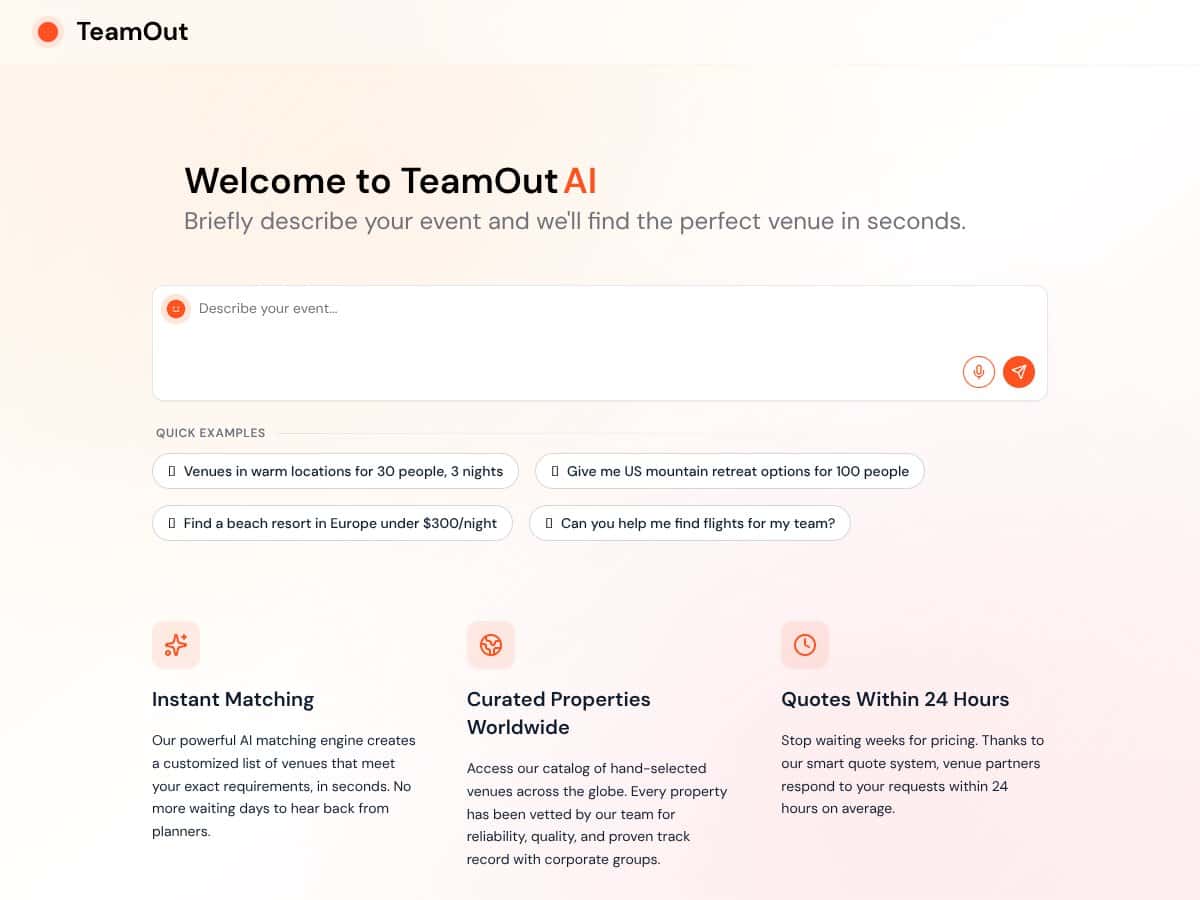
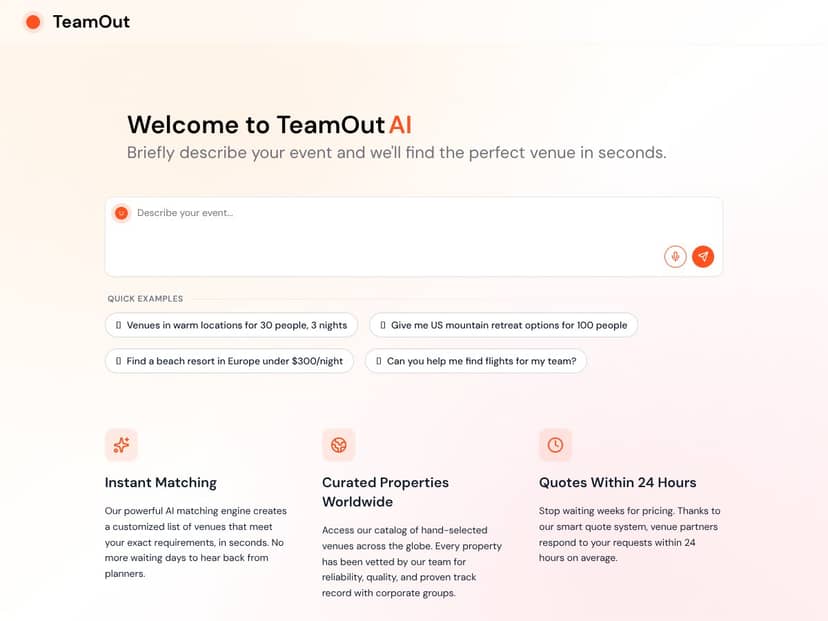
So here’s how TeamOut AI is positioned: it’s an AI planning assistant meant to help you shortlist venues, estimate travel costs, and (depending on what you choose) move toward booking. The pitch is basically “tell it what you need in a conversational way,” and it returns options you can work from—rather than starting from scratch with spreadsheets and endless email threads.
On the company side, TeamOut AI looks like it’s been around since about 2021 and has ties to Y Combinator, but the public info is pretty thin. I couldn’t find a lot of founder detail or a lot of transparent documentation that spells out exactly how the recommendations are sourced. That’s not automatically a deal-breaker, but if you like to verify everything before you trust it, you’ll feel that gap.
One more important reality check: this isn’t trying to replace full event management platforms like Cvent or Eventbrite. What it does best is getting you from “blank page” to “shortlist + rough budget” quickly. If you’re expecting deep attendee management, complex workflow automation, and full enterprise logistics out of the box, you’ll probably still need something else for the heavy lifting.
TeamOut AI Pricing: Is It Worth It for Real Budgets?
I’ll be straight with you—TeamOut AI’s pricing is not the clean, fixed-plan setup you’d expect from a lot of SaaS products. There’s a free tier, but the specifics aren’t presented in a way that makes it easy to predict what you’ll pay later. And for the paid packages, the cost seems to depend on things like destination and team size.
Because I didn’t get a public, date-stamped pricing table from their site that I could verify line-by-line, I’m treating the numbers below as what’s been broadly described in the materials I reviewed—not as something I can guarantee is still identical today. If you’re considering buying, I’d recommend you request a quote using your exact inputs so you’re not guessing.
| Plan | Price | What You Get | My Take |
|---|---|---|---|
| Free Tier | Unknown | Basic venue matching, limited integrations, no clear limits | Good for testing the vibe and seeing what kind of venue list you get. But if you need full travel estimates or lots of iterations, you may hit limits fast. |
| Standard/Pro Packages | $200-$700 per person per night | Access to vetted venues, real-time flight estimates, exclusive hotel deals, quick quotes, and some level of custom planning | This is where costs can jump. For larger teams or more expensive destinations, it can get hard to forecast without a quote. If you’re budget-conscious, ask for the total cost scenario up front. |
What I noticed in practice is that “per person per night” pricing sounds straightforward until you add variables like how many nights you want, how many travelers you have, and whether the tool suggests higher-end options. The time savings are real, but the spend can surprise you if you don’t set constraints early (like “3-star max,” “walkable area only,” or “budget cap per person”).
Here’s the way I’d decide: if you’re a small team testing whether this can produce a usable shortlist, start with the free tier. If you already know you’ll book within a couple of weeks and you want fewer back-and-forth emails, the paid packages can be worth it—but only after you run your exact scenario through the quote flow.
The Good and The Bad (After Using It)
What I Liked
- Fast venue shortlisting: The AI can generate a set of venue options quickly—way faster than doing manual searches and then comparing amenities one by one.
- Curated properties: In my experience, the venues it returned felt more “ready to consider” than random search results. I didn’t have to wade through as much noise.
- Travel cost estimates: It provides travel estimates alongside the planning suggestions, which helps you sanity-check budgets without jumping into separate tools immediately.
- Deal language around hotels: The platform claims preferred pricing or exclusive deals on hotel rates. I found this useful as a starting point, but I still recommend verifying final pricing when you’re actually ready to book.
- Iterative planning: When I changed requirements (like shifting priorities from “best location” to “lower cost” or adjusting the group size), the output updated without me restarting from scratch.
- Works for a range of group sizes: It’s positioned for small-to-mid sized team retreats. If your event is in that typical “corporate offsite” lane, it fits pretty well.
What Could Be Better
- Destination coverage can feel uneven: This is the biggest limitation I ran into. When I tried thinking in terms of “popular US cities vs. Europe,” the Europe-side options felt more constrained, and the venue variety wasn’t as flexible.
- Budget predictability isn’t great: Because pricing is quote-driven and plan details aren’t super explicit, it can be difficult to know whether you’re staying within your target spend until late in the process.
- Not every request comes back “perfect”: If your needs are very specific—think niche venues, unusual dates, or very high-end properties—the matches may skew toward “mainstream corporate retreat options.” You might still need to do some manual follow-up.
- UI and onboarding aren’t super guided: I didn’t feel like there was a clear, guided tour that explains every step. Expect some trial-and-error the first time you use it.
- Limited public proof: There aren’t many visible testimonials or detailed case studies that show real outcomes (like “saved X hours” or “cut costs by Y%”). That makes it harder to validate the bigger claims without running your own scenario.
Who Is TeamOut AI Actually For?
TeamOut AI makes the most sense for people who need speed and a structured starting point—not total control over every detail.
If you’re planning corporate retreats or team offsites and you’re typically coordinating for something like 10–100 attendees, I think it can be a strong fit. Why? Because that’s where a fast venue shortlist + rough travel budget can really reduce the “we’re stuck in planning limbo” problem.
In my view, it’s especially useful when you need to align multiple stakeholders. For example, if your leadership team cares about budget and location, while someone else cares about amenities and capacity, the AI can help you generate options you can compare side-by-side instead of arguing over vague ideas.
That said, if your event is luxury-focused, niche-heavy, or requires very specific venue characteristics (particular room layouts, very specialized facilities, or uncommon locations), you might find the recommendations too “safe” or too general. You’ll still be doing some legwork.
Who Should Look Elsewhere?
If you’re a solo planner—or you’re running events that require deep customization—TeamOut AI might feel limiting. The venue selection can skew toward vetted mainstream options, and the destination coverage (especially outside North America) may not match what you want.
Also, if you require very predictable, transparent pricing before you commit, this platform may frustrate you. Quote-driven costs are fine when you’re flexible, but if procurement needs fixed numbers early, you’ll want to plan around that.
And if your events are huge or complicated—think specialized logistics, extensive attendee management, and enterprise-level workflows—then you’ll likely be happier with a more comprehensive event platform or a dedicated event planning partner.
Bottom line: it’s a solid “get started fast” tool for mid-size corporate retreats. Just don’t expect it to replace a full-service agency or cover every edge case automatically.
How TeamOut AI Stacks Up Against Alternatives
Cvent
- What it does differently: Cvent is built for event operations—registration, attendee management, and logistics at scale. TeamOut AI is more about AI-driven planning and venue sourcing, not running the entire event lifecycle.
- Price comparison: Cvent pricing is typically custom and tends to land in enterprise territory. TeamOut AI’s model is more tied to per-person/per-night planning scenarios (based on the package descriptions I reviewed).
- Choose this if... You need a full operational system for conferences and large events.
- Stick with TeamOut AI if... You want faster offsite planning with venue and travel estimates, without building everything inside an enterprise workflow.
ClickUp
- What it does differently: ClickUp is a project management workspace. You can absolutely run an event plan there, but it won’t “source venues” or estimate travel costs the way a dedicated planning assistant can.
- Price comparison: ClickUp is generally low-cost per user compared to event-specific tools. TeamOut AI is more event-specific, so it can cost more per scenario—but you’re paying for the planning intelligence and sourcing.
- Choose this if... You already manage planning in ClickUp and want to keep everything centralized.
- Stick with TeamOut AI if... You want a dedicated AI layer that handles venue and travel planning, not just task tracking.
EventCreate
- What it does differently: EventCreate focuses on event websites and invitations, plus marketing/registration. It’s not aiming to solve venue selection and travel budgeting like TeamOut AI does.
- Price comparison: EventCreate tends to start around a monthly subscription model for websites and related features, while TeamOut AI is more “planning package” oriented for retreats.
- Choose this if... Your priority is making event pages and handling registrations.
- Stick with TeamOut AI if... You want an assistant that helps you plan the trip itself—venues, travel estimates, and shortlist building.
Boompop
- What it does differently: Boompop leans into team-building activities and engagement. It’s great if you already have the retreat location and you’re looking for experiences, but it’s not a venue/travel planning tool.
- Price comparison: Boompop pricing varies based on activities and team size. TeamOut AI is more about planning the retreat from the ground up (venue + travel planning).
- Choose this if... You care most about activities and engagement.
- Stick with TeamOut AI if... You want help with the “where do we go and what does it cost” part.
Bottom Line: Should You Try TeamOut AI?
I’d rate TeamOut AI a 7/10 based on how quickly it helps you get to a workable shortlist and how useful the planning iterations feel. It’s a time-saver—no question.
The tradeoff is that it’s not the cheapest option when you zoom out. If you’re planning in Europe, or you need very specific venue types, you might not get as much flexibility as you’d hope. And because pricing is quote-driven, budgeting takes a little more effort than you’d want.
If you’re a small-to-medium team trying to plan a retreat without drowning in logistics, I think it’s worth a shot—especially if you start with the free tier to see whether the output matches your style of planning.
But if your requirements are ultra-custom, your procurement needs strict pricing early, or you’re looking for full event management (not just planning support), I’d look at other tools first.
Common Questions About TeamOut AI
- Is TeamOut AI worth the money? It can be, if you want to reduce planning time and you’re okay with quote-based costs. If you’re extremely budget-sensitive, you may need to set strict constraints early.
- Is there a free version? Yes—there’s a free entry-level tier. It’s best for testing the core recommendations and getting a feel for how the planning flow works.
- How does it compare to Cvent? Cvent is more about event operations and registration/logistics at scale. TeamOut AI is more about AI-assisted planning and venue/travel shortlists.
- Can I get a refund? Refund details aren’t clearly laid out publicly in the materials I reviewed. If this matters to you, contact their support before buying higher-tier packages.
- Does it work outside the US? Yes, but the venue selection can be more limited depending on the region—especially in Europe.
- How accurate are the travel estimates? In my experience, the estimates are generally useful for planning decisions, but complex itineraries and premium scenarios can vary. I’d treat them as a strong starting point, then confirm when you’re ready to book.