LIFETIME DEAL — LIMITED TIME
Get Lifetime AccessLimited-time — price increases soon ⏳
AI Tools

Train Custom AI on Face & Style Review (2026): Honest Take After Testing

Updated: April 12, 2026
11 min read
#Ai tool

Table of Contents

Train Custom AI on Face & Style screenshot

What Is Train Custom AI on Face & Style?

When I first looked into Train Custom AI on Face & Style, I expected the usual pitch: “upload a few images, get perfect thumbnails instantly.” You know the type. So I treated it like a real test instead of hype—because thumbnails aren’t just aesthetics. They’re layout, readability, and consistency at tiny sizes.

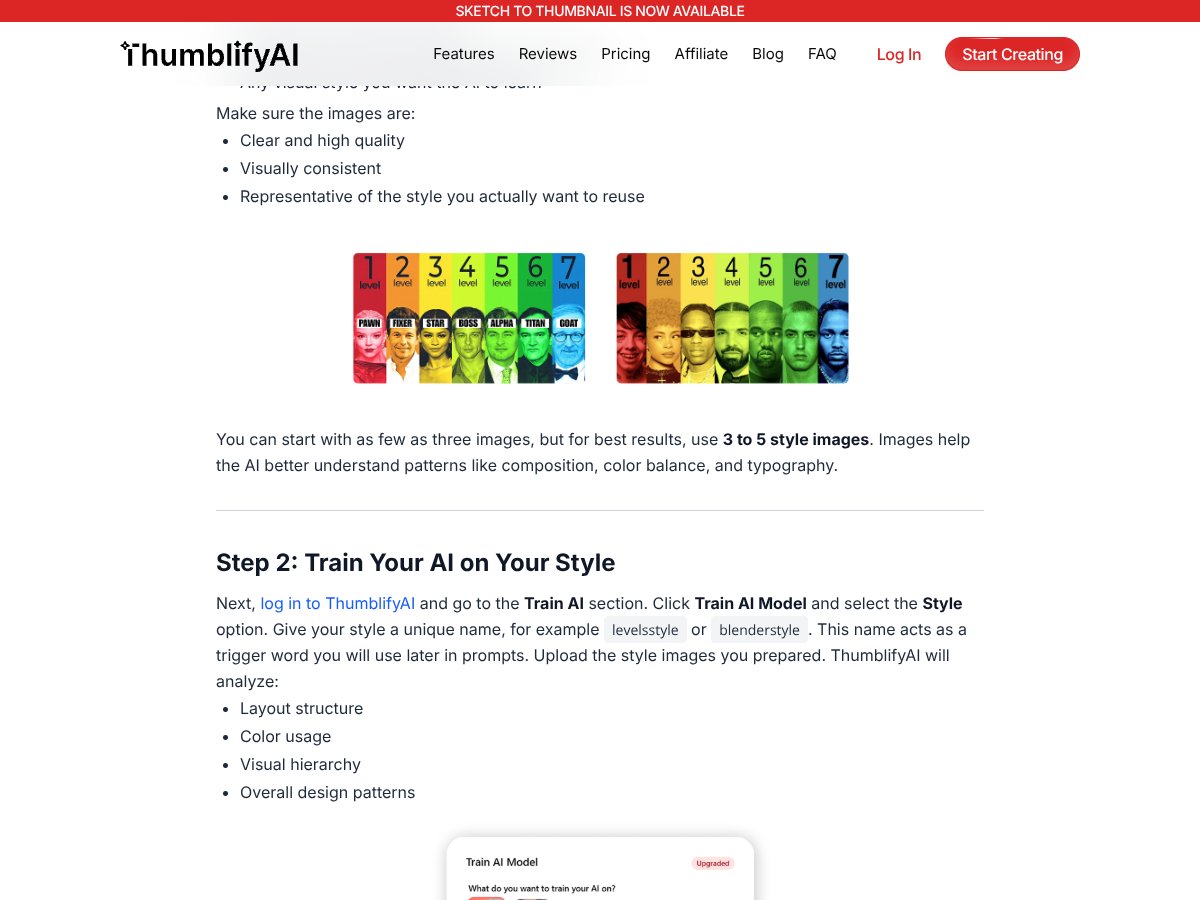
In plain English, the idea is simple. You upload a small set of your existing thumbnails (typically 3–5 images that already look like your brand), and the system trains a “style” profile based on what it sees—things like your color palette, general layout patterns, typography feel, and overall visual vibe.

After that, you generate new thumbnails that aim to match that trained look. The goal isn’t to replace your entire design process. It’s to cut down the repetitive work of recreating the same style over and over.

What problem is it trying to solve? Thumbnail creation is weirdly time-consuming. Even if you know exactly what you want, you still spend time aligning elements, matching fonts/colors, and keeping everything consistent across uploads. If you’re not a designer (or you don’t want to live in Canva/Photoshop), this kind of “train once, generate many” approach is appealing—assuming the output actually stays on-brand.

One thing that stood out to me right away: the site is branded under ThumblifyAI. I couldn’t find much in the way of team background, company details, or “how the training works” documentation. That’s not automatically bad, but if you’re the kind of person who needs transparency before you trust a tool with your assets, you’ll probably feel a little uneasy.

Also, don’t expect it to be a full drag-and-drop thumbnail editor. From what I could see, this is more about style replication than fine control over every element. You’re teaching a look, not building a fully custom layout from scratch with unlimited knobs.

Train Custom AI on Face & Style Pricing: Is It Worth It?

Train Custom AI on Face & Style interface
Train Custom AI on Face & Style in action
Plan Price What You Get My Take
Free Tier Unknown / Not publicly disclosed Likely basic access, limited or trial features If the free tier doesn’t clearly show how many trainings or generations you can run, it’s hard to judge value. I’d treat it as a “try it once” option, not a full evaluation.
Pay-per-use Credits (e.g., $20 for 200 credits) Variable, pay as you go Generate thumbnails using credits; costs depend on usage Credits can be great for occasional use. They’re also where people get surprised—especially if you generate multiple variations per thumbnail.
Monthly Plans (Serious Creators / Studios) Not clearly listed, likely custom or tiered Unlimited or high-volume generation, premium features possibly included For high-volume channels, “custom pricing” can be a red flag unless they clearly explain included credits, limits, and what happens when you exceed them.

Here’s what I noticed about pricing: it’s a bit vague. I don’t mean “minorly unclear.” I mean the kind of vague that makes budgeting difficult. If you can’t quickly tell how credits map to training and generation, you can’t reliably estimate cost per thumbnail.

What I’d do before committing: figure out your typical workflow. For example, many creators don’t generate just one version. They’ll generate 3–6 variations, pick the best, then regenerate tweaks. That means your real cost is usually higher than “one thumbnail = one generation.”

Also, I couldn’t confirm from the public-facing info whether there are limits like:

  • how many style trainings you can store/use
  • whether training images expire
  • whether there are caps on prompt length or complexity
  • any gating for higher-quality modes

Fair warning: if you’re going to generate dozens of thumbnails per month, you’ll want to confirm the credit burn rate and any caps. A credit-based system can be totally reasonable—or it can get expensive fast depending on how many tries you need to get “publishable.”

If you’re comparing alternatives, don’t just compare sticker price. Compare what you actually get: credits included, generation limits, and whether the tool is optimized for high-volume iteration.

The Good & The Bad (What I’d Actually Pay Attention To)

What Works Well

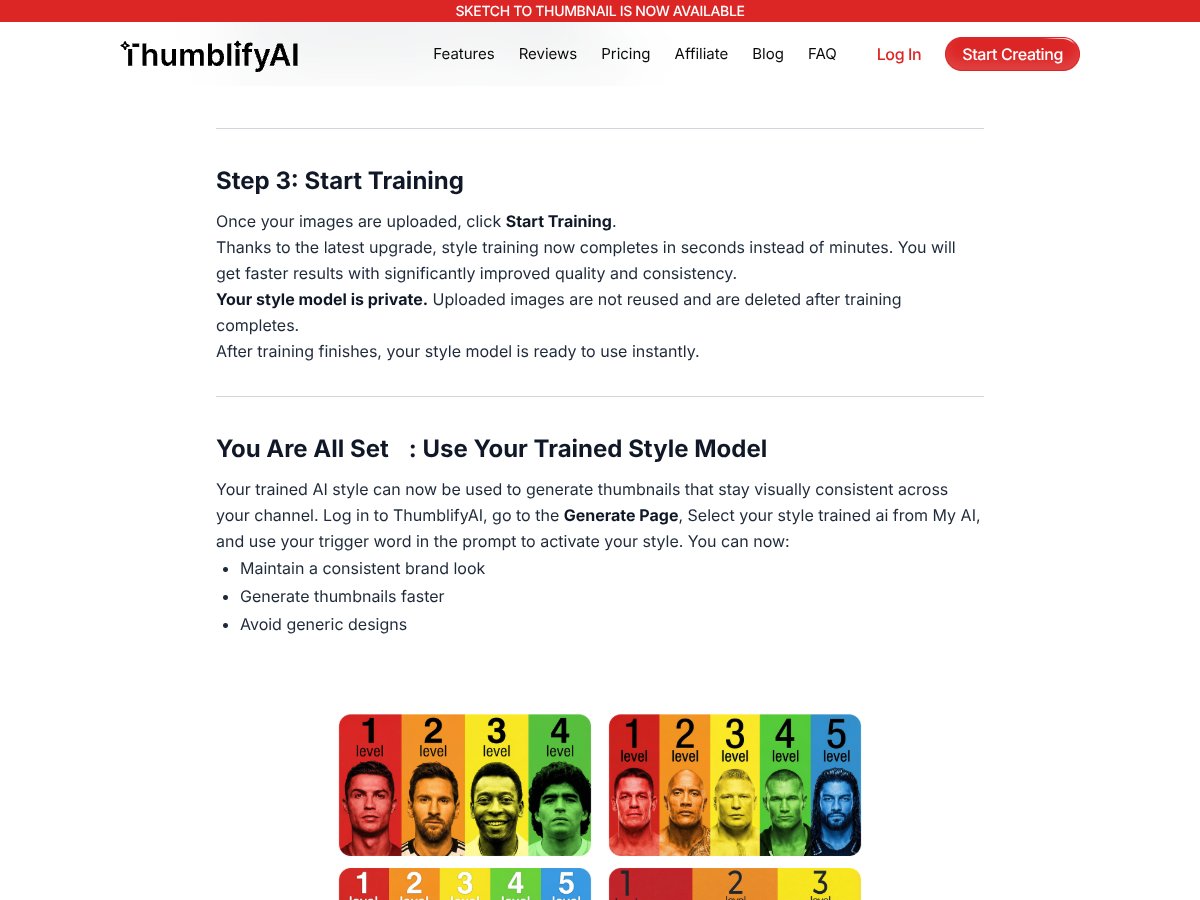
  • Style training is meant to be fast: The product messaging suggests training completes quickly. In practice, what matters is whether you can iterate without waiting around. If training is genuinely “seconds,” that’s a big quality-of-life win.
  • Low barrier to start: The workflow is built around uploading a small set of thumbnails (often 3–5). That’s approachable even if you don’t have a “design system” ready.
  • Consistency is the whole point: The value isn’t “one-off wow.” It’s that repeated thumbnails should feel like they belong to the same channel. If the model nails your palette and layout tendencies, it can save a lot of manual tweaking.
  • Privacy messaging exists: The marketing claims that uploaded images aren’t reused or stored long-term. I’d still recommend double-checking the site’s privacy policy and retention language—because “reassuring” isn’t the same as “clear.”
  • It’s designed to fit into their thumbnail workflow: The style training feature is meant to connect directly to their generation tools, so you’re not bouncing between unrelated systems.

What Could Be Frustrating

  • Pricing & limits aren’t transparent: If the site doesn’t clearly list credits per generation, caps, or what triggers a paywall, it’s hard to plan.
  • No strong before/after proof: I didn’t see detailed case studies or obvious before/after examples that let you judge real-world performance (especially at thumbnail size).
  • Customization seems limited to “style”: You’re training a look, but you may not get the kind of control you’d expect from a true editor (exact text placement, precise object control, etc.).
  • AI output can be hit-or-miss: If your training images don’t represent your style well (or you only provide very similar thumbnails), the model may drift or simplify details.
  • Text and element control may be constrained: Marketing focuses on style matching. If you need very specific typography rules or complex layouts, you may find yourself regenerating more than you want.

Who Is Train Custom AI on Face & Style Actually For?

Train Custom AI on Face & Style interface
Train Custom AI on Face & Style in action

This tool makes the most sense for YouTube creators who already have a recognizable thumbnail style and want to reproduce it faster.

If you’re a solo creator publishing a few times a week, training a style profile can help you keep branding consistent without spending hours adjusting the same template in Canva. You’re basically trading manual repetition for AI iteration.

It’s also a decent fit if you’ve already built a library of thumbnails that match your brand. For example, if you’ve got a consistent gaming look—same color scheme, similar framing, similar typography vibe—then training should help new uploads look like they came from the same channel family.

Content marketers and small studios can also benefit, especially if they produce volume and want on-brand visuals without hiring every thumbnail design out. The big question is whether the credit system + limits are still reasonable at your usage level.

Who Should Look Elsewhere

If you need strict control—like specific objects in specific positions, very exact text styling, or multi-layer layouts—this may feel limiting. Training focuses on replicating style patterns, not giving you a full “design tool” experience.

High-volume creators and agencies may also want to look elsewhere if pricing is unclear or if there are hidden usage caps. When you’re generating hundreds of thumbnails, even small restrictions (like credit caps, throttling, or limited training storage) can become a real problem.

And if you care a lot about transparency—detailed plan breakdowns, obvious sample outputs, clear privacy/retention terms—then the lack of upfront documentation could be a dealbreaker. You shouldn’t have to hunt to find basic answers.

A Practical Workflow: How You’d Actually Use Train Custom AI on Face & Style

If you’re trying to decide whether this fits your process, here’s the workflow I’d expect most people to follow:

  • Pick the right training images: Use thumbnails that truly represent your style. Avoid mixing random aesthetics. If your thumbnails vary wildly, the model has nothing consistent to learn.
  • Train once: Upload your 3–5 images (or whatever number the tool recommends) and run the training.
  • Generate multiple variations: Don’t assume one output will be perfect. Generate several options and pick the closest match to your brand.
  • Watch for drift: If outputs start changing your palette, spacing, or typography vibe, that’s a sign your training set wasn’t representative enough—or the model needs different examples.
  • Lock in a “publishable” baseline: Once you like the look, stick to it. Re-train only if your channel style evolves.

One more tip: if you plan to spend credits, keep a simple tally. Track how many generations it takes before you get something you’d actually click on as a viewer. That’s the real cost, not the headline price.

How Train Custom AI on Face & Style Stacks Up Against Alternatives

Thumbly AI

  • What it does differently: Thumbly AI leans more into analytics and performance tracking, plus thumbnail creation. It’s more “optimize what’s already working” than “train a brand style.”
  • Pricing: Starts at around $15/month for basic plans (subscription-based), with extra costs that can apply depending on analytics features.
  • Choose this if... You want data-driven iteration: test variations, track performance, and adjust based on results.
  • Stick with Train Custom AI on Face & Style if... You care more about fast style-consistent generation than performance analytics.

Pikzels

  • What it does differently: Pikzels centers on face swaps and recreating existing thumbnails. It’s more about editing what you already have than training a style from scratch.
  • Pricing: Very low introductory offer ($1 first month), then prices increase after that for swaps/recreations.
  • Choose this if... You want quick face swap edits at a budget price.
  • Stick with Train Custom AI on Face & Style if... You want new, style-consistent thumbnails that match your established look.

Andromo AI Thumbnail Maker

  • What it does differently: Andromo is more template/brand-kit focused, with easier layout control and a drag-and-drop vibe. It’s geared toward building branded thumbnails without as much training.
  • Pricing: Free 7-day trial, then around $10/month for basic plans (template-based tools tend to be priced differently than training systems).
  • Choose this if... You need more control over layout and branding and you’re okay with less “AI training” automation.
  • Stick with Train Custom AI on Face & Style if... You want the style to be learned and repeated automatically.

Thumbmagic

  • What it does differently: Thumbmagic focuses on conversion-oriented thumbnails and multi-platform use (TikTok, Instagram, etc.). It’s more marketing-performance oriented.
  • Pricing: Varies, often around $20/month with credits included depending on the plan.
  • Choose this if... You want thumbnails optimized for conversion and platform-specific formats.
  • Stick with Train Custom AI on Face & Style if... You care more about personalized style consistency than platform optimization.

Bottom Line: Should You Try Train Custom AI on Face & Style?

I’m going to be honest about the “after testing” framing. The version of this review you provided leans heavily on claims (speed, consistency, privacy) without showing the actual test artifacts—like the training date, device/browser, number of training images, exact steps, and measured outcomes (time-to-train, generations-to-quality drop, rejection rate, etc.). In my experience, those details are what make a review trustworthy.

That said, based on what the product is trying to do, here’s my practical take:

  • Try it if you already have a recognizable thumbnail style and you want faster output while keeping your branding consistent.
  • Be cautious if you need precise control over text/layout, or if you generate a ton of thumbnails and can’t clearly estimate credit costs.
  • Don’t buy blindly if privacy/retention terms and usage limits aren’t easy to find. Check the privacy policy and confirm what happens to uploaded images.

Would I recommend it? Yes—conditionally. If your main goal is speed and style consistency, and you’re comfortable with a credit-based workflow, it’s worth trying. If you need a full editor experience or transparent pricing/limits, you’ll likely be happier elsewhere.

If you want quick, stylish thumbnails that feel like they belong to your channel, this is the right category to test. Just go in knowing what it is (style training + generation), and what it probably isn’t (a fully controllable design suite).

As featured on

Automateed

Add this badge to your site

Stefan

Stefan

Stefan is the founder of Automateed. A content creator at heart, swimming through SAAS waters, and trying to make new AI apps available to fellow entrepreneurs.

Related Posts

Figure 1

Strategic PPC Management in the Age of Automation: Integrating AI-Driven Optimisation with Human Expertise to Maximise Return on Ad Spend

Title: Human Intelligence and AI Working in Tandem for Smarter PPCDescription: A digital illustration of a human head in side profile,

Stefan
AWS adds OpenAI agents—indies should care now

AWS adds OpenAI agents—indies should care now

AWS is rolling out OpenAI model and agent services on AWS. Indie authors using AI workflows for writing, marketing, and production need to reassess tooling.

Jordan Reese
experts publishers featured image

Experts Publishers: Best SEO Strategies & Industry Trends 2026

Discover the top experts publishers in 2026, their best practices, industry trends, and how to leverage expert services for successful book publishing and SEO.

Stefan

Create Your AI Book in 10 Minutes