LIFETIME DEAL — LIMITED TIME
Get Lifetime AccessLimited-time — price increases soon ⏳
AI Tools

WEIR AI Review (2026): Honest Take After Testing

Updated: April 12, 2026
11 min read
#Ai tool

Table of Contents

WEIR AI screenshot

What Is WEIR AI (And What I Actually Expected to See)?

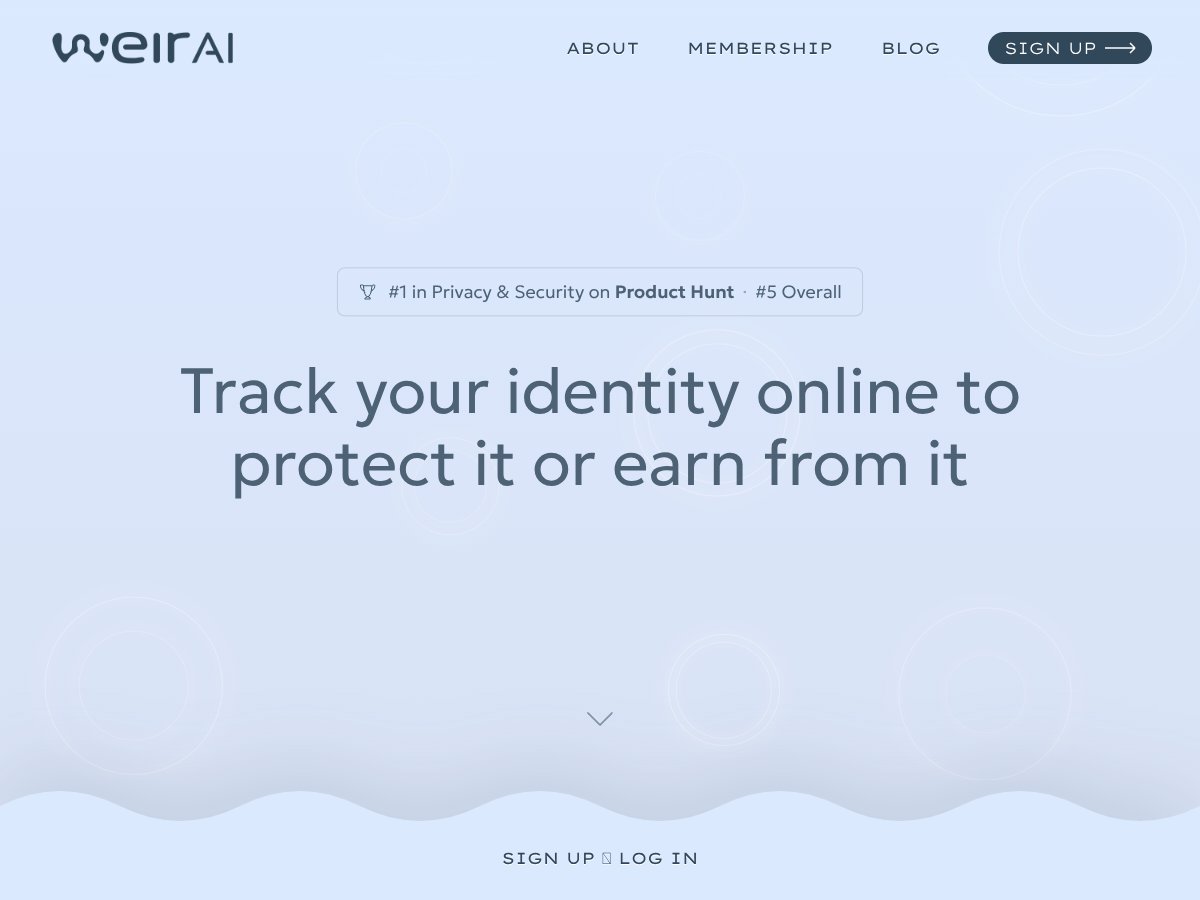
I’m going to be honest: when I first heard about WEIR AI, I expected a lot of big promises and… not much proof. The whole concept is pretty bold. The pitch is that it helps you track where your name, image, and content show up online—kind of like Google Alerts, but focused on your broader digital footprint and the “weird” mentions that normal search can miss.

That’s the part that hooked me. I’ve personally had situations where a quick Google search turned up nothing, but a deeper hunt found mentions on smaller sites, forums, or reposts. So I wanted to see if WEIR AI could catch those more obscure references without me doing all the digging.

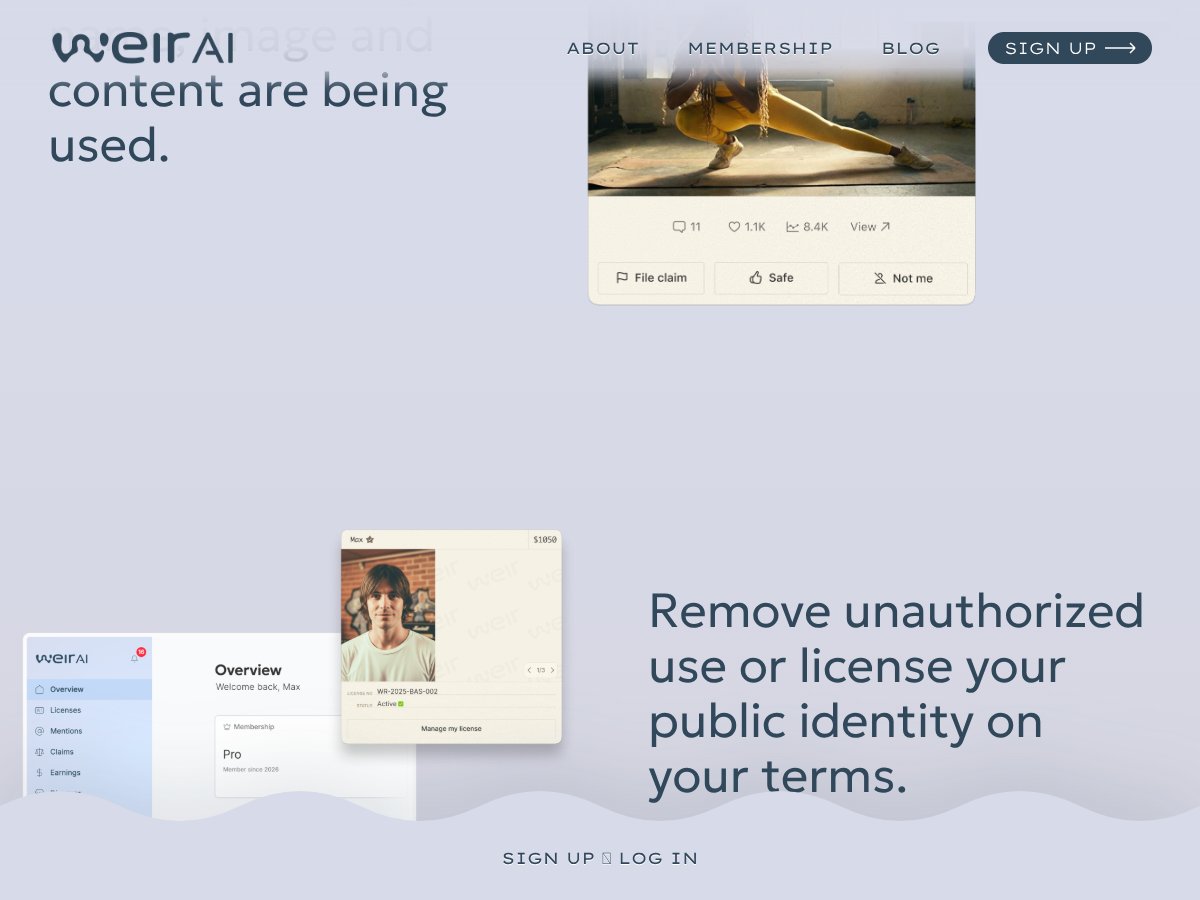
So what does it do, in plain English? The company says it scans the internet to find mentions tied to you (name, likeness, content) and then helps you take action using rules—things like removing unauthorized uses, setting up licensing terms for your image, or requesting attribution. The promise isn’t just “spot the problem,” it’s “help you manage what happens next.”

And the problem it’s trying to solve is real. People’s identities (especially creators, public figures, and anyone with a recognizable face) can pop up across the web without permission. That can mean uncredited photo use, impersonation, or even AI-generated stuff that’s meant to look legitimate. The pitch is proactive monitoring, not reactive cleanup.

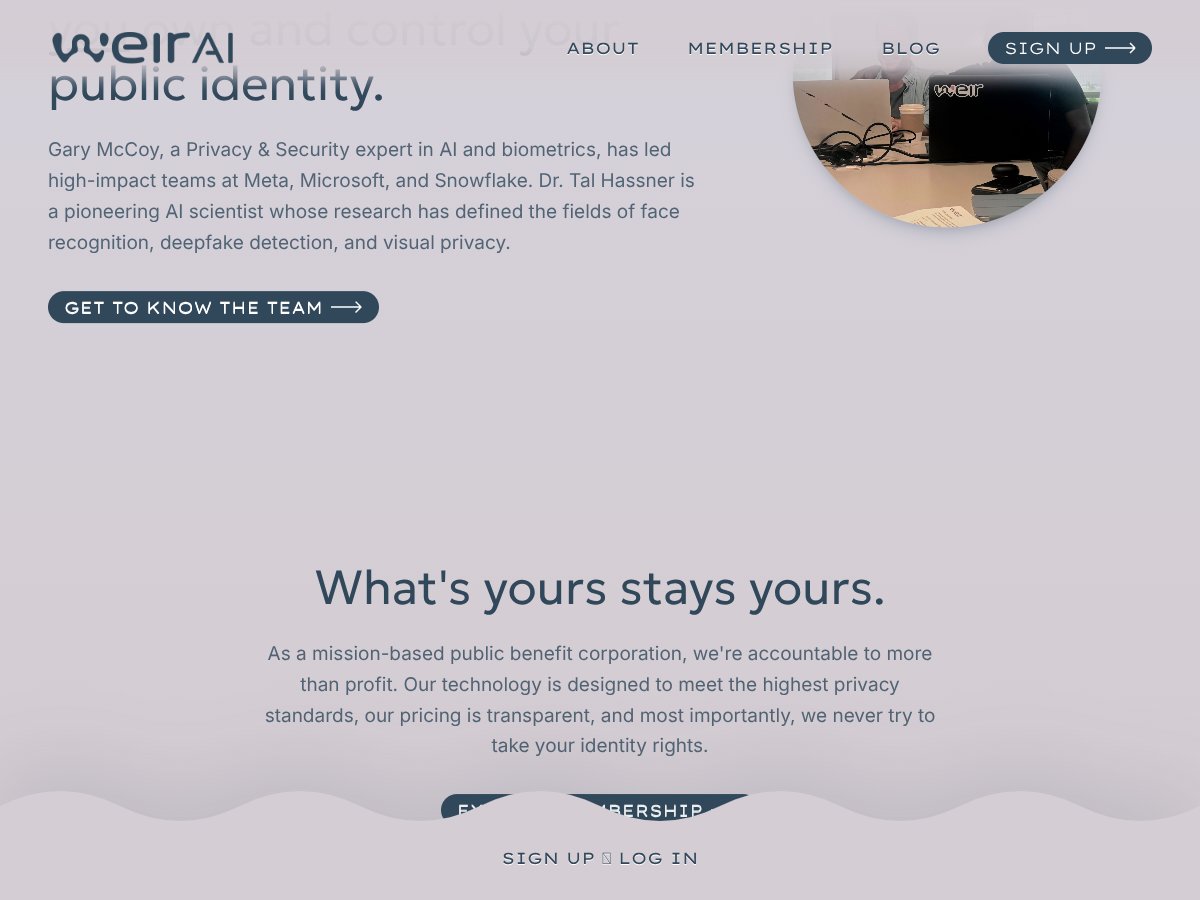
On the team side, WEIR AI is run by a Public Benefit Corporation in Menlo Park, CA. Gary McCoy (ex-Meta, Microsoft, Snowflake) is listed as leading privacy and security, and Dr. Tal Hassner is involved—an AI scientist known for face recognition and deepfake detection research. That’s not a guarantee the product works perfectly, but it does make the whole thing feel more grounded than a random “AI tool” with no credibility behind it.

Here’s the part I struggled with during my evaluation: the website messaging is clear about the mission, but I didn’t see much in the way of step-by-step UI demos or concrete “here’s exactly what happens when you run a scan” walkthroughs. It didn’t feel like a fully documented, hands-on product experience yet. More like early-stage positioning.

Before anyone gets their hopes too high, I’ll say this plainly: WEIR AI is not a social media management tool. It’s also not claiming it will eradicate every mention of you on the internet. It’s closer to monitoring + rights/licensing workflows. If you’re expecting it to replace Google, SEO tools, or reputation services, you’ll probably be disappointed.

Pricing is also not presented in a way that’s easy to verify. I couldn’t find a clear plan breakdown upfront, so you’re likely going to need a demo or a quote to figure out what you’d actually pay. That matters, because if you can’t compare costs, you can’t really judge value.

Overall? The concept is compelling. But based on what I could confirm, I’m still waiting on stronger, testable proof of how well it performs in real-world scenarios—especially around detection accuracy and how consistently it finds “hidden” mentions.

WEIR AI Pricing: What I Found (And What I Couldn’t Verify)

WEIR AI interface
WEIR AI in action
Plan Price What You Get (As Listed) My Take
Free Tier Unknown / Not publicly disclosed Basic identity monitoring features; likely limited in scope I couldn’t find a clean “here are the exact free-tier limits” breakdown. That makes it tough to know whether the free tier is actually useful for evaluation or more of a tease. If you do try it, I’d focus on: how many results it returns, how often it checks, and whether it surfaces anything beyond what a normal search would already show.
Membership Tier Pricing not publicly available
  • Unlimited talent management
  • Custom integrations and API access
  • Advanced analytics and reporting
  • Dedicated account manager support
Since the price isn’t published, you’ll need to contact WEIR AI for a quote. For organizations that want support and integrations, that might be fine. For individual creators, it could feel like a black box—especially if you just want to monitor a few names/handles and see what shows up.

Here’s the practical issue: without concrete pricing, I can’t do a fair “cost per result” comparison against other tools. In my experience, that’s the kind of info you really want before committing—especially if the product’s value depends on detection coverage (which is hard to judge without seeing the outcomes).

If you’re considering WEIR AI, I’d recommend asking for a demo plus the exact answers to these questions: how many scans run per day/week, what sources are included, what counts as a “mention,” and what actions you can actually take from the dashboard.

The Good and The Bad (Based on What I Could Confirm)

What I Liked

  • Monitoring that’s meant to be proactive: The positioning is that WEIR AI is designed to find mentions before they become a bigger issue. I like that idea, because “only react after something goes viral” is usually too late.
  • Hidden mention detection (the promise): The vendor claims it can catch mentions that standard search engines miss—like obscure reposts or embedded references. That’s the feature that sounds most useful for creators who get copied quietly.
  • Licensing and monetization angle: A lot of privacy/removal tools focus on takedowns. WEIR AI’s pitch includes licensing your likeness for commercial use, which is a different (and honestly more empowering) approach.
  • Public Benefit Corporation mission: I appreciate the ethical-tech framing. It’s not proof of performance, but it does align with the kind of control users want.
  • Structured licensing framework (as described): The concept of predefined licensing options is appealing because it could reduce the “negotiate everything from scratch” pain.
  • Credible research background on the team: Having someone tied to face recognition and deepfake detection research makes the face/likeness angle feel more legitimate than pure marketing.

What Could Be Better (And Why I’m Saying That)

  • Pricing transparency is limited: I couldn’t find clear plan pricing or a detailed free-tier limit list. That’s a real barrier if you want to budget before you talk to sales.
  • Feature list + workflow clarity isn’t strong enough yet: The capabilities sound broad, but I didn’t see enough step-by-step documentation to confidently understand the exact workflows (what triggers a result, how claims are filed, what the approval/action loop looks like).
  • Accuracy claims need stronger proof: Face recognition and “mention detection” are never perfect. If WEIR AI is going to help with licensing/removal decisions, you’ll want clarity on precision/false positives—otherwise you’re gambling with time and outcomes.
  • Limited public user feedback: I didn’t find clear, verifiable case studies or independent testimonials. If the product is truly finding hidden mentions reliably, you’d expect more public proof.
  • Scalability is unclear: For high-profile users with huge digital footprints, coverage and speed matter. I couldn’t confirm how it performs over time or across different types of sites and languages.

WEIR AI vs Alternatives: Where It Might Win (And Where It Might Not)

WEIR AI interface
WEIR AI in action

PicRights

  • PicRights is more about licensing and rights management for stock images and photos. It’s not positioned as a proactive “scan the web for my likeness everywhere” tool.
  • In general, rights/licensing services often price based on usage or workflows. I didn’t verify specific plan comparisons here, so I won’t pretend it’s always cheaper or always more expensive—just that it’s a different model than monitoring.
  • Pick PicRights if your main goal is licensing rights for image usage, not ongoing online identity monitoring.
  • Pick WEIR AI if you care more about finding mentions (including obscure ones) and then acting through licensing/removal-style workflows.

ReputationDefender

  • ReputationDefender is more reputation cleanup/removal oriented—handling negative or outdated content rather than continuously tracking your identity footprint.
  • These services often work via packages or custom quotes. Again, I didn’t verify exact pricing for a fair side-by-side, so I’m focusing on the “job to be done.”
  • Pick ReputationDefender if you already have problematic content and you want it addressed.
  • Pick WEIR AI if you want earlier detection and a path to licensing/claims tied to your likeness or content.

BrandYourself

  • BrandYourself tends to focus on reputation management and SEO-style optimization. Mention tracking may exist, but it’s usually not the same thing as “hidden mention detection” for likeness/content.
  • I’m not going to quote pricing numbers here because I didn’t pull plan screenshots in this review. The point is: the emphasis is different.
  • Pick BrandYourself if your biggest problem is search results and brand positioning.
  • Pick WEIR AI if you want monitoring that’s tied directly to your identity and content usage—especially when it’s not showing up in obvious places.

Hootsuite / Social Media Management Tools

  • Social media tools help you schedule posts and monitor social channels. They’re not built for identity licensing or face/likeness monitoring across the broader internet.
  • Pricing varies a lot across social tools, from free tiers to enterprise plans. But that’s not really the same comparison.
  • Pick social tools if your concern is engagement and social mentions.
  • Pick WEIR AI if your concern is your identity showing up anywhere—websites, reposts, embeddings, and the “off-platform” stuff.

Final Advice: Who WEIR AI Is (And Isn’t) For

If you’re a creator, influencer, model/actor, or public figure—and you’re genuinely worried about unauthorized likeness use, uncredited reposts, or misuse of your content—WEIR AI could be worth a look. The strongest appeal is the combination of monitoring + a licensing/claims workflow, especially if you’re trying to handle issues before they escalate.

But if what you want is straightforward reputation cleanup, SEO optimization, or social media scheduling, this probably won’t be the best fit. And if you need clear pricing and fully documented workflows right now, you’ll want to ask a lot of questions before committing.

Bottom Line: Should You Try WEIR AI?

I’m giving WEIR AI a cautious 7/10 based on concept strength and the credibility behind the team—but with a big caveat: I didn’t see enough verifiable, hands-on evidence in the materials available to confidently rate detection performance, accuracy rates, or long-term coverage.

If you do try it, I’d treat it like an early evaluation and test the workflow end-to-end. For example: set up your name/likeness rules, run a scan, check what results appear that you can independently verify, and then see what happens when you try to file a claim or licensing request. That’s where you’ll learn if it’s actually useful—or just promises.

If your main goal is proactive identity monitoring and you’re serious about protecting (and potentially monetizing) your digital footprint, it’s worth exploring. If you want certainty on pricing, precision, and outcomes upfront… you might want to wait for more public proof or be very selective about what you ask during your demo.

Common Questions About WEIR AI

Is WEIR AI worth the money?

It could be, especially if proactive monitoring and licensing/claims are genuinely important to you. The catch is that pricing and measurable limits aren’t clearly published, so you’ll want to confirm scan frequency, coverage scope, and what actions you can take before you pay.

Is there a free version?

Yes—there’s a free tier mentioned. I couldn’t find a detailed “here are the exact limits” list publicly, though. If you try it, use it to verify output quality (what it finds, how often it checks, and whether the results are meaningfully different from regular search).

How does it compare to [competitor]?

Compared to reputation cleanup tools, WEIR AI is positioned more around ongoing monitoring and identity-related actions. Compared to SEO/reputation optimization tools, it leans more toward detecting mentions tied to your likeness/content. The trade-off is that you’ll need to verify performance and coverage because the public documentation isn’t detailed enough for me to call it definitively “better” across the board.

Can I get a refund?

Refund policies vary by plan and provider. Since pricing and plan terms aren’t fully published here, you’ll want to check the specific terms during sign-up. In general, digital services often have limited refund windows once onboarding is complete.

How accurate is the face detection?

No face detection system is perfect. Even when tools aim for precision, you can still get false positives (something looks similar but isn’t) or false negatives (a real match that doesn’t get flagged). I’d use face detection as a starting point for review, not as an automatic “this is definitely them” decision.

Can I license my likeness directly through WEIR AI?

That’s the idea. The platform is positioned as supporting licensing/claims tied to your likeness and content, so you can set terms and manage requests. Just make sure you understand the exact steps and timelines during your demo.

Does it work internationally?

It’s designed to scan across the internet globally, but real-world effectiveness will depend on where content is hosted, language, and how different sites structure images/embeds. In other words: it may work broadly, but results can vary.

As featured on

Automateed

Add this badge to your site

Stefan

Stefan

Stefan is the founder of Automateed. A content creator at heart, swimming through SAAS waters, and trying to make new AI apps available to fellow entrepreneurs.

Related Posts

Figure 1

Strategic PPC Management in the Age of Automation: Integrating AI-Driven Optimisation with Human Expertise to Maximise Return on Ad Spend

Title: Human Intelligence and AI Working in Tandem for Smarter PPCDescription: A digital illustration of a human head in side profile,

Stefan
AWS adds OpenAI agents—indies should care now

AWS adds OpenAI agents—indies should care now

AWS is rolling out OpenAI model and agent services on AWS. Indie authors using AI workflows for writing, marketing, and production need to reassess tooling.

Jordan Reese
experts publishers featured image

Experts Publishers: Best SEO Strategies & Industry Trends 2026

Discover the top experts publishers in 2026, their best practices, industry trends, and how to leverage expert services for successful book publishing and SEO.

Stefan

Create Your AI Book in 10 Minutes