Table of Contents
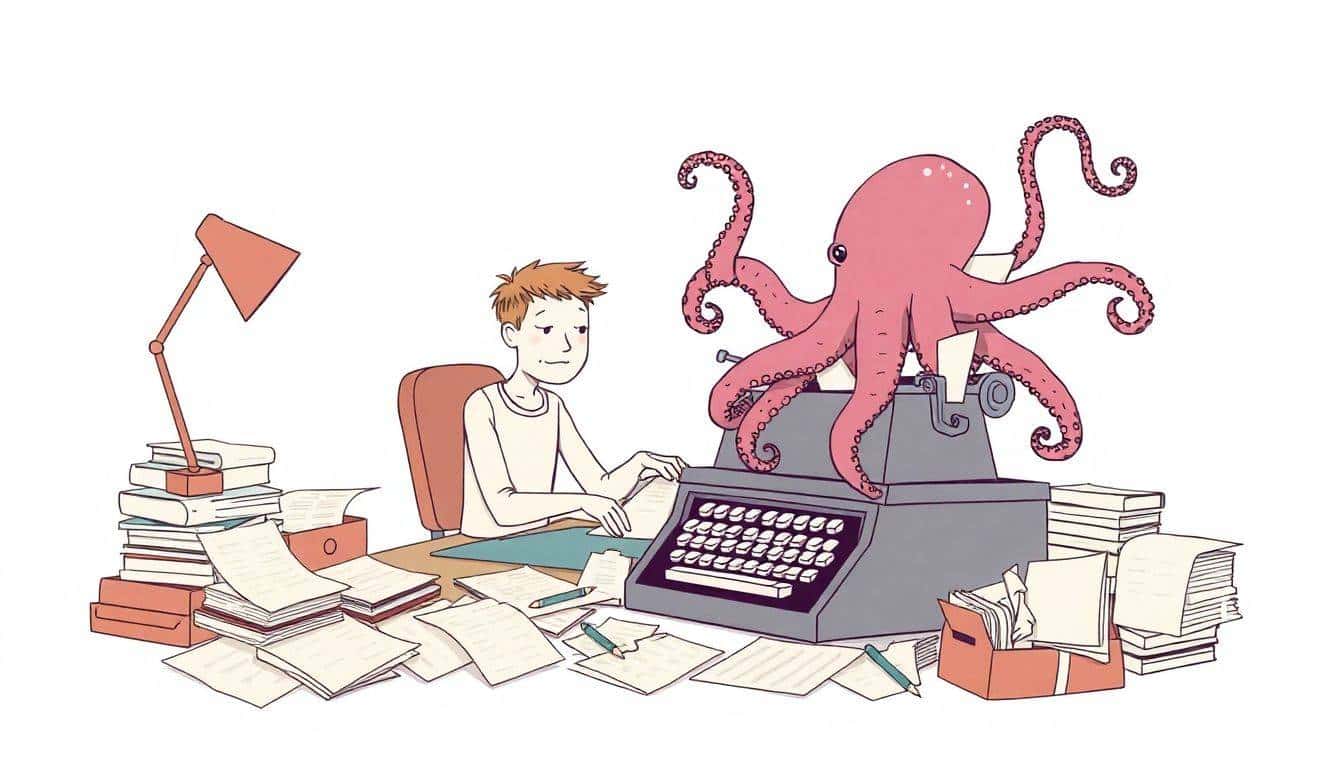
Revising your own writing can feel like wrestling an octopus—seriously. You fix one thing and suddenly there are eight more problems staring back at you. And yeah, that’s frustrating.
But I promise you’re not alone. I’ve been there where I thought, “This is basically done,” and then I reread it the next day and… wow. Not good. Not even close.
The good news? Revision doesn’t have to be a chaotic mess. I use a handful of practical strategies that make the whole process calmer, faster, and (dare I say) kind of satisfying when it starts clicking.
Below are 8 steps I actually rely on—fresh perspective, structure checks, flow improvements, and sentence-level polishing—so your final draft reads the way you meant it to.
Key Takeaways
- Take a break after writing so you can spot problems with fresh eyes.
- Use a reverse outline to quickly see structure, gaps, and repetition.
- Cut anything that doesn’t support your main point—no matter how “interesting” it is.
- Improve flow by making ideas connect clearly from one sentence/paragraph to the next.
- Revise in focused passes (clarity, structure, then wording) instead of trying to fix everything at once.
- Polish sentence-level issues like awkward phrasing, repetition, and unclear wording.
- Get feedback from someone else to catch blind spots you won’t notice yourself.
- Revisit your thesis and argument so your intro/conclusion match what your draft actually says.
1. Use Distance to Get a Fresh Perspective
Have you ever stepped away from something for a bit and then come back like, “Wait… what?” That’s exactly what you want to happen with your writing.
When you take a break, your brain stops “reading what you meant” and starts reading what you actually wrote. And that difference is huge.
When I do this, I usually catch three things fast: typos, awkward phrasing, and logic gaps. You know those moments where a paragraph feels fine while you’re writing it—but then falls apart on a reread? Distance helps reveal that.
So finish the draft, then give yourself a little runway. Walk around the block. Grab coffee. Watch one episode of something (just one). Or sleep on it—overnight is even better if you can.
Your future self isn’t being dramatic. They’re doing quality control.
2. Create a Reverse Outline for Better Structure
If your draft feels scattered, don’t start randomly deleting and rearranging. I’ve tried that. It turns revision into a mess.
Instead, make a reverse outline.
Here’s the simple method I use: read your draft once and write down the main idea of each paragraph (one short sentence per paragraph). That’s it.
Then look at your outline like it’s not your work. Do the paragraphs actually follow a clear order? Are you repeating the same point in two different places? Is there a paragraph that doesn’t “earn its spot”?
It’s like zooming out from the trees to see the forest.
And yes—often the fix is surprisingly straightforward. I’ll move a paragraph up to support an earlier claim, or cut a section that only makes sense because I was thinking about it while writing. Once it’s on paper, though, the reader doesn’t have that context.
If you’re building a narrative structure (or you just want a clearer framework), you might find this guide on how to write a one-act play useful for thinking in scenes and purpose, not just paragraphs.
3. Evaluate Your Content and Overall Structure
Time to put on your editor hat. Not the “fix commas” editor—the “does this belong here?” editor.
Ask: does every section support your main point? If you remove a paragraph, does the argument still hold?
Sometimes we keep details because they’re interesting, not because they’re necessary. I’ve done it. You learn a cool fact, you want to show it off, and suddenly your reader is stuck wondering why it matters.
Be okay with cutting. Focus beats clutter.
Also check the order of your points. Does paragraph three actually follow from paragraph two? Or is the reader being dragged along without a clear reason?
In my experience, swapping two sections can instantly make the argument feel more “inevitable.” Like the draft was always supposed to be that way.
Research backs this up too: students who made more meaning-related revisions produced higher-quality texts (source).
So don’t only chase surface-level fixes. Dig into what the writing is actually doing.
If you want ideas to strengthen what you’re saying (not just how it’s phrased), these winter writing prompts can help you find angles you didn’t think about the first time.
4. Improve Flow and Logical Progression
You know that feeling when you read something and it doesn’t quite click—like it’s almost right, but your brain keeps stumbling?
That’s usually flow.
Flow isn’t just “using transition words.” It’s whether each paragraph naturally leads to the next. Does the reader understand why they’re moving forward?
When I revise for flow, I do a quick check: read paragraph by paragraph and ask, “What is the job of this section?” If the job changes abruptly, I’ll add a sentence that bridges the gap—or reorder the paragraphs.
Transitional words help, sure, but I also like to make the connection explicit with a mini-sentence. For example:
Instead of: “This is important.”
Try: “This matters because it supports my main claim that…”
Also, don’t be afraid to rearrange. Sometimes the “logical progression” fix is literally moving a chunk of text to where it belongs.
There’s evidence that revision often involves more than tiny edits. Graduate students made an average of 22.4 immediate revisions per 100 words, focusing on higher-level changes (source).
So if your draft feels unclear, it’s not always your writing “style.” It might just be the path your reader is taking.
And if you’re writing a story, flow matters even more. A smooth progression can make your horror stories hit harder because the tension builds instead of stalling.
5. Make Focused Revision Passes
Trying to fix everything at once is how revision turns into a long, frustrating slog. I’ve done it, and honestly? It doesn’t work well.
Instead, I revise in passes. Each pass has one job.
For example:
- Pass 1: Clarity. Are the ideas understandable? Are there confusing sentences?
- Pass 2: Structure. Does the order make sense? Are paragraphs doing what they should?
- Pass 3: Flow. Are transitions smooth? Do points build logically?
- Pass 4: Sentence-level polish. Word choice, repetition, grammar, punctuation.
That targeted approach makes the whole thing feel manageable. Like you’re not drowning—you’re just doing one step at a time.
Studies show undergraduate students made an average of 13.9 immediate revisions per 100 words, often focusing on surface-level changes (source). The point isn’t to stay surface-level—it’s to start somewhere and then go deeper once the basics are solid.
If you’re working on something specific, targeted passes are even more useful. For instance, if you’re figuring out how to write in present tense, dedicate a pass just to verb consistency. Nothing ruins immersion faster than tense slipping in the middle of a scene.
6. Polish Wording and Sentence-Level Issues
Alright, now we get nitpicky. That’s a good sign, by the way—means your draft is close.
This is the stage where you fine-tune sentences so they read cleanly and naturally.
Look for things like:
- Awkward phrasing (sentences that sound “off” when you read them out loud)
- Repetition (same word or idea showing up too often)
- Run-ons or overly long sentences that could be split
- Vague wording (“things,” “stuff,” “it” with no clear reference)
Quick test I use: pick your longest sentence. Could it be two shorter ones? Often, yes—and it instantly improves clarity.
Also, watch for word choice. If there’s a stronger verb, use it. If a phrase is doing nothing, cut it.
In one study, children using speech-to-text made more surface-level revisions, including wording and spelling corrections (source). That’s not “bad revision.” Surface-level polishing matters, especially when it affects readability.
And if you want help catching issues you might miss, tools can be useful—like the best proofreading software. I don’t treat it as a replacement for reading, but it’s great for flagging problems fast.
7. Seek Feedback from Others
Two heads are better than one, right?
Getting feedback from someone else is one of the fastest ways to catch what you’ve been blind to. You’re too close to the draft. You know what you meant, so you don’t always notice when the reader won’t.
I like feedback that answers simple questions:
- Did you understand the main idea?
- Where did you get confused?
- Which parts felt repetitive or unnecessary?
- Did the ending make sense based on what came before?
And don’t be shy about asking. Just make sure you tell the person what kind of feedback you want. “Tell me what you think” is too broad. “Point out any places where the argument feels weak” is way better.
If you can, consider a beta reader. They can give you detailed insights you won’t find by self-editing alone.
One more thing: critique is about the work, not you. If someone says a paragraph isn’t landing, that’s not a personal attack. It’s information.
8. Revise Your Thesis and Argument
Wait—didn’t we already talk about this?
Yeah, but here’s the twist: revision often changes your draft. You start writing one way, then you discover better ideas, stronger evidence, or a clearer direction. Suddenly your thesis might not match what you ended up saying.
That’s normal. It happens to me all the time.
So revisit your thesis and ask: is it still accurate? Is it specific enough? Does it match the way your body paragraphs actually support the claim?
Then check your introduction and conclusion. Do they say the same thing your draft says in the middle? Or are they stuck in the “original plan” version of your paper?
If your focus shifted, update those sections. Readers notice when the beginning and end feel disconnected from the body.
If you’re working on framing a thesis and want some inspiration, these historical fiction writing prompts can help you shape a clearer angle and theme before you lock it in.
FAQs
A reverse outline is basically an outline you build after writing—so you can analyze what you actually did on the page. You go paragraph by paragraph and summarize each one, which makes structure problems (like missing support or repeated ideas) jump out fast.
Focus on coherence: make sure each paragraph follows from the previous one, and use transitions to show the relationship between ideas. If the connection feels shaky, reorder the paragraphs or add a sentence that explains why the new point matters.
Because you can’t easily see your own blind spots. A fresh reader can tell you where your ideas are unclear, where the argument feels weak, or where something doesn’t add up. Constructive feedback helps you tighten your message and improve overall quality.
Focused revision passes mean you revise one type of issue at a time—like clarity, structure, flow, or grammar—rather than trying to fix everything in a single sweep. It keeps you organized and helps you catch problems more thoroughly.