Table of Contents
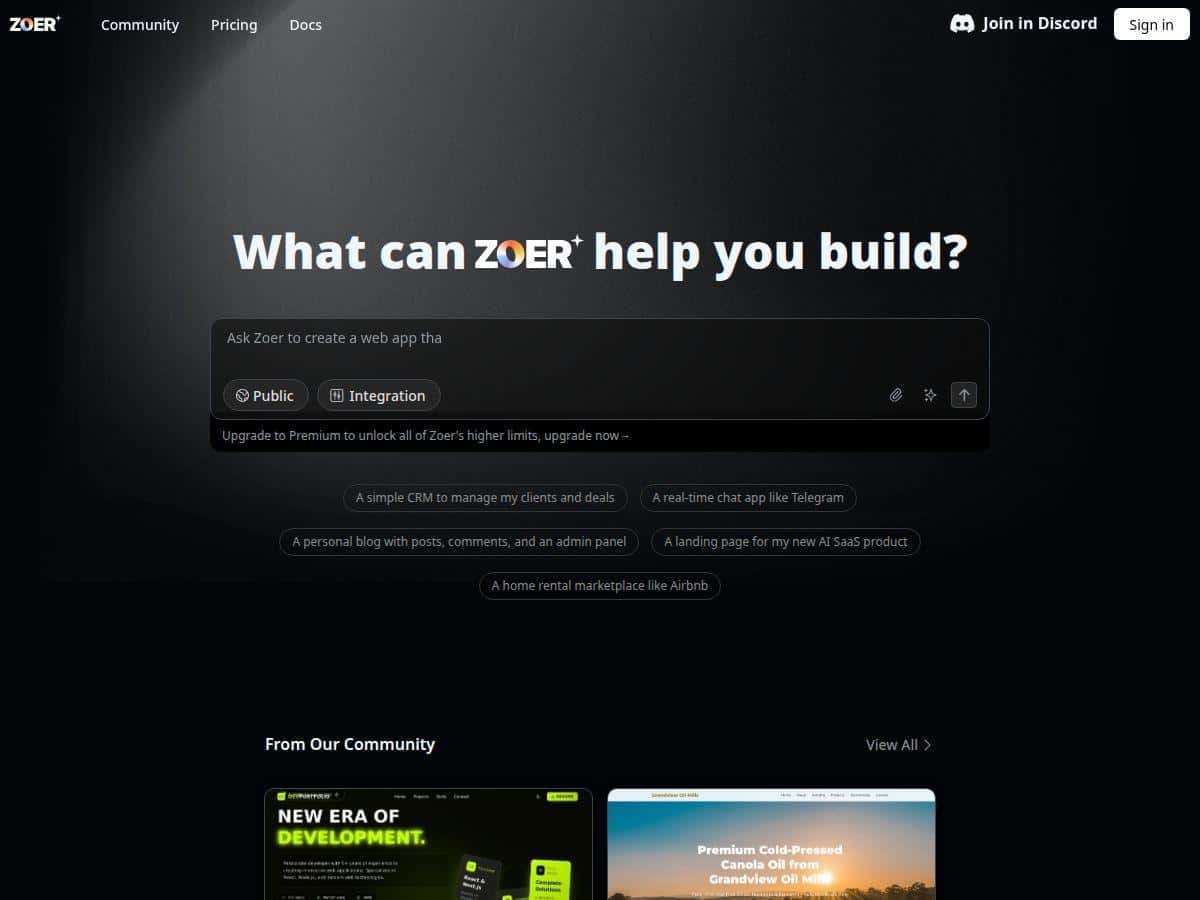
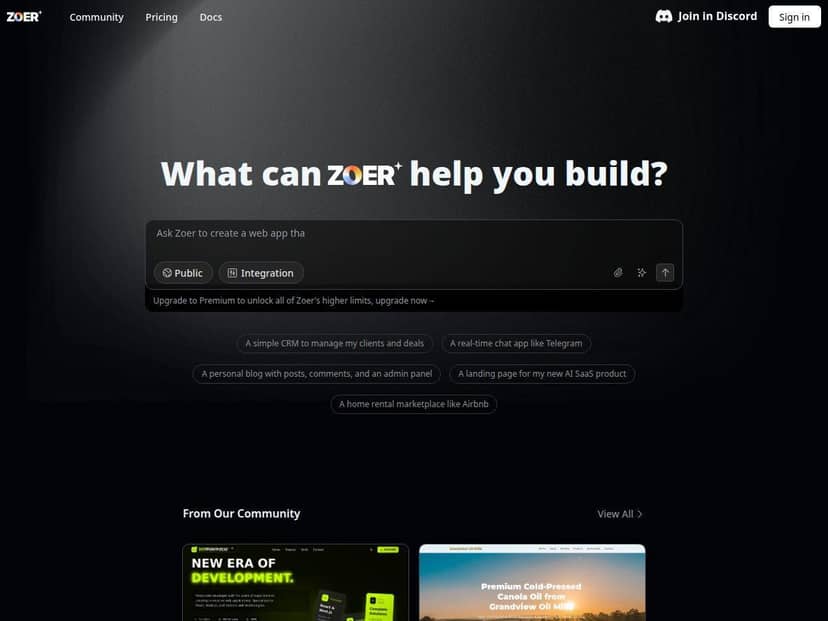
If you want to build a web app but you don’t want to start learning React, Node, databases, deployment… all of that, Zoer is the kind of tool that makes you stop and blink. It’s basically “describe it, get an app.” I tested it end-to-end with a few different prompts to see what actually works, what breaks, and how much you still have to clean up afterward.
Before anyone asks: yes, I got to a working web app without writing code. But it wasn’t magic—there were limits, and I had to adjust my expectations for anything beyond straightforward CRUD-style apps.
Zoer Review: What I Built (and Where It Got Stuck)
My testing wasn’t just one prompt and done. I tried a few setups because that’s where tools like this usually show their real strengths and weaknesses.
Test #1: A simple to-do app (first working build fast)
Prompt I used: “Create a to-do list web app. Users can add tasks, mark them complete, delete tasks. Include a clean dashboard with a list view and an input form. Use a simple modern UI.”
What happened: Zoer generated a working app layout with the expected pieces: a list of tasks, add-task input, and actions for complete/delete. I could also see the usual app structure you’d expect—frontend screens plus backend/data handling.
Time-to-first working version: It felt like “minutes,” not “hours.” I’m not claiming an exact stopwatch here, but from the moment I submitted the prompt to the moment I could interact with the app, it was quick enough that I didn’t feel like I was waiting around.
What I noticed: The conversational edits were the best part. When I asked for “filter completed vs active,” it added the UI control and the logic without me needing to explain how to wire it up.
Test #2: Login + private tasks (it works, but there are rules)
Prompt I used: “Add user authentication. Make tasks private per user. After login, show only the current user’s tasks.”
What happened: Zoer did add an auth flow and the app started behaving like a real multi-user app. However, I had to be a little more explicit about “private per user,” because the first pass treated tasks more like a shared dataset.
How it broke down: On my first attempt, when I simulated different users, the UI appeared to show items that weren’t fully isolated. After I followed up with a more direct instruction (basically “ensure database queries are filtered by user id”), it corrected the behavior.
My takeaway: Zoer can handle authentication, but you’ll want to validate data isolation. Don’t assume it’s perfect just because it “looks right.”
Test #3: A CRUD-style “Projects” app (custom fields were okay, complex workflows weren’t)
Prompt I used: “Build a Projects app with CRUD. Each project has: name, status (Planned/In Progress/Done), due date, and priority (Low/Med/High). Add a table view and a form to create/edit projects.”
What happened: This one came out pretty clean. The status and priority fields were represented in a way that made sense (dropdown-style selections), and the table view made it easy to test quickly.
Where it got limited: When I tried to go beyond basic CRUD—like adding a multi-step workflow (“if status changes to Done, require a completion note and timestamp”)—Zoer didn’t fully implement the conditional enforcement via the UI. I could get the fields added, but the “must fill these before allowing status change” rule didn’t always apply the way I expected.
What I ended up doing: I had to simplify the workflow or accept a “soft validation” approach (fields exist, but enforcement wasn’t always strict). If you’re used to coding, that’s the moment you’ll feel the gap: AI can generate the structure quickly, but it may not nail every edge-case rule without manual iteration.
So… is it actually “coding-free”?
For the basics? Yes. I didn’t write code. I described what I wanted, Zoer generated the UI and the backend/data wiring, and I was able to run the app in a usable state.
But if your idea involves complex business logic, strict validation rules, custom routing flows, or very specific integrations, you’ll likely spend time refining prompts and sometimes accepting compromises. That’s not a deal-breaker—it just means Zoer is best treated like a fast app prototype engine first, and a full production builder second (depending on your standards).
Key Features That Matter (Not Just the Marketing List)
- AI-driven development for frontend, backend, and database — I didn’t have to “connect” pages to data manually the way you might in a traditional builder.
- No coding needed — prompts are the main interface. The more specific you are, the better the first output tends to be.
- Built-in database and backend automation — CRUD screens and data persistence showed up quickly in my tests.
- Conversational AI assistant — the “change this” loop is fast. I asked for filters, extra fields, and UI tweaks and got responses without rewriting everything.
- Easy app publishing to a marketplace — if you want to share, it’s designed for that. (I didn’t publish publicly during my test, but the flow looked geared toward it.)
- Supports public and private apps — useful if you’re testing with a small group or iterating privately.
Pros and Cons (Based on My Actual Use)
Pros
- Very user-friendly for non-technical users — I could go from prompt to usable UI without needing to understand how the stack works.
- Fast iteration loop — adding filters/fields and adjusting the UI took follow-up prompts rather than rebuilding screens.
- Conversational control feels natural — “add a filter for completed tasks” or “make tasks private per user” is the kind of instruction that maps well to how the tool works.
- Built-in database + hosting-style workflow — it’s not just a frontend mock. The app actually stores and retrieves data.
- Starter plans are approachable — if you’re testing an idea, you don’t have to commit to a big subscription immediately.
Cons
- Customization can be limited for “real app” edge cases — I could add fields and basic CRUD reliably, but more advanced conditional logic (strict enforcement based on status changes) wasn’t always implemented correctly.
- Quality depends on the prompt — auth/data privacy needed a second attempt when I didn’t spell out “filter by user id.” If you’re vague, the output can be vague too.
- Complex apps may need manual cleanup — Zoer is great for building the skeleton. If you’re expecting every business rule to be perfect with zero tweaks, that’s where you’ll get disappointed.
Pricing Plans (Credits, Limits, and What I’d Watch)
Zoer’s plans are credit-based, which is important because AI tools often “spend” credits as you iterate. Here’s what they offer:
Free plan: 3 credits per month, up to 3 apps, and 100 AI queries. Good for testing whether it can generate what you imagine.
Starter plan: $15/month, includes 60 credits and 300 AI queries, plus additional features.
Premium options: higher limits and support for more extensive needs (including private apps and larger usage caps).
What I’d test during a free trial:
- Build one CRUD app from scratch and see how many prompt retries it takes.
- Add authentication and confirm data isolation (test with two “users”).
- Try one “conditional rule” feature (like requiring a note before status changes) and see how well it enforces it.
Wrap up
Zoer is genuinely impressive for getting a working web app out of plain language. In my experience, it’s strongest for prototypes, MVPs, and everyday business apps where CRUD + forms + basic auth are the main event.
But if your app depends on strict workflows, complex conditional validation, or very specific logic, you should expect some back-and-forth—and sometimes simplification. Still, for most people who want results fast without learning a full development stack, Zoer is worth a serious try.