Table of Contents
Ask an AI to surprise you and it will hand you the least surprising story it can compute. This week on r/WritingWithAI, a writer asked the question that sits under half the frustration with AI fiction: how do you get your stories to take unexpected creative turns? They had done everything right by the standard playbook — custom instructions demanding "unexpected twists and turns without derailing the plot," long chapter-by-chapter outlines — and still got two failure modes at once: prose that plays it safe, and a model that forgets the outline and "gives me something wrong and I have to go back 3 chapters to fix."
⚡ TL;DR – Key Takeaways
- •"Surprise me" prompts fail by design — language models generate the most probable continuation, and asking harder doesn't add variance, it just reworks the same safe middle.
- •New research quantifies it: given six versions of the same premise, the human-written story was the statistical outlier 57.8% of the time. The human signal is variance, not polish.
- •Reddit's fixes that actually work: negative constraints ("do not use genre conventions"), discussing individual scenes instead of demanding twists, and keeping the plot decisions human.
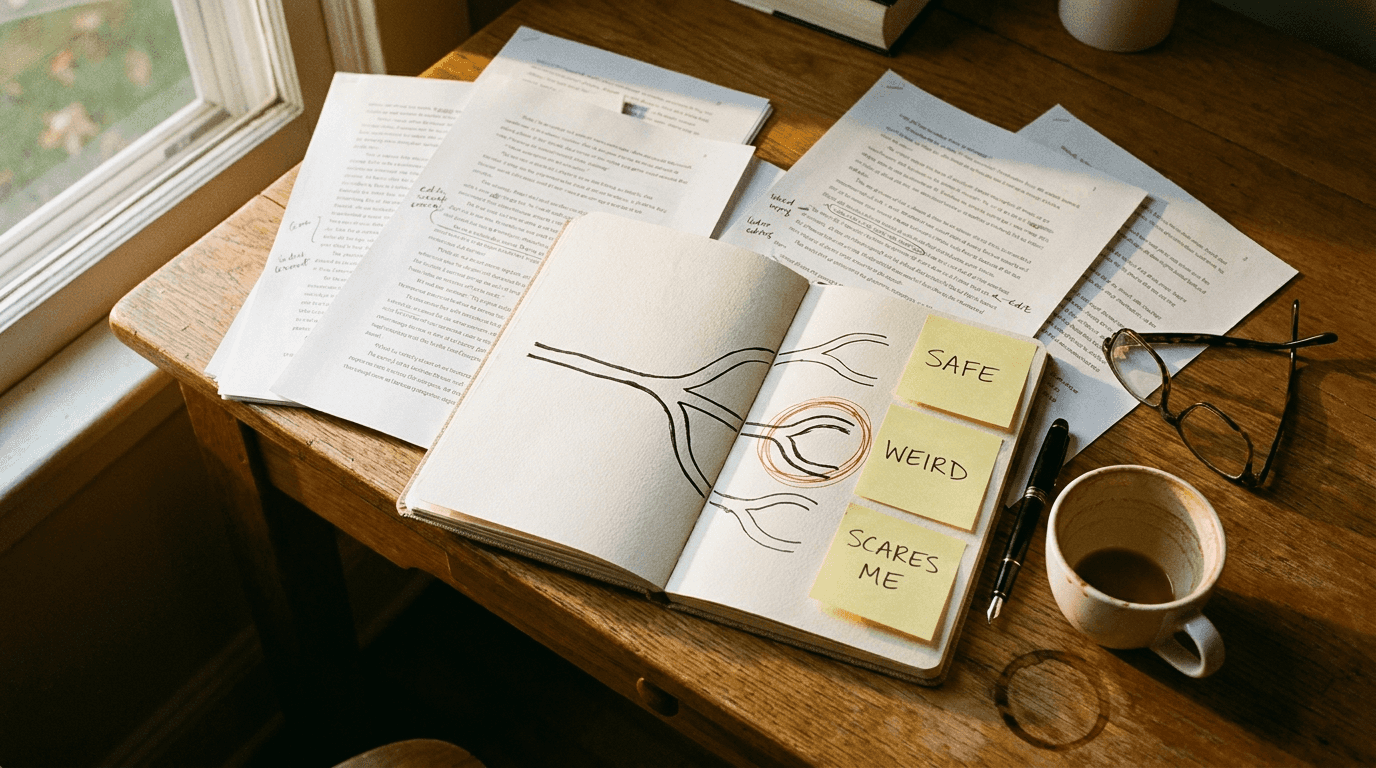
- •The branching method: stop at each chapter end, ask for three or four divergent directions ranked from safe to weird, and pick one. You stay surprised because you didn't invent the options; the plot stays coherent because you chose the turn.
- •The "goes wrong three chapters later" half of the problem isn't creativity at all — it's context drift, and it's fixed with a maintained story-state note, not better prompting.
The Question Reddit Keeps Asking
The thread behind this article was posted in r/WritingWithAI. The author wants something very specific: to hand the AI a plot and let it take over the drafting, while the story still manages to surprise them along the way. Instead they were getting predictable continuations, and worse, continuations that quietly contradicted the outline they had carefully fed in.
r/WritingWithAI
How do you get your stories to take unexpected creative turns?
“I’m not sure if it’s an issue of prompting (I say in custom instructions to take unexpected twists and turns without derailing the plot) or the tools I’m using… I have done long outlines chapter by chapter but then it forgets or gives me something wrong and I have to go back 3 chapters to fix.”
View on Reddit →I answered that thread directly (I'm the founder of Automateed, so this exact problem is my day job), and this article is the long version of the answer — plus the approaches the rest of the thread converged on, and the research that explains why the naive approach can't work.
Why AI Defaults to the Most Expected Story
Models sample the middle of the distribution
A language model predicts the most likely next piece of text given everything before it. That is the entire trick. It's why the prose is fluent, and it's also why the plot is safe: the most probable continuation of a story premise is, by definition, the most expected one. When you write "take unexpected twists" into your instructions, the model doesn't gain access to a stranger imagination — it samples from the same distribution and hands you the most statistically typical version of "a twist."
One commenter in the thread put it plainly: the LLM will always produce what it thinks is the most likely answer based on its training. Another was blunter still — if it's your story, the plot shouldn't be unexpected to you; the model isn't going to out-invent you, so be more inventive with the plot before prompting.
The research that puts a number on it
The same week this question was asked, the subreddit was busy digesting a massive new study of AI-written fiction — StoryScope, from the University of Maryland and Google DeepMind, which compared 61,608 stories written from 10,272 premises by human authors and five frontier models. The detail that matters here: when a classifier looked at six versions of the same premise, the human story was the statistical outlier 57.8% of the time, where chance would be 16.7%.
Read that again: the measurable difference between human and AI storytelling wasn't craft. It was variance. Humans wander off the expected path; models converge onto it. Which means "make it more unexpected" is asking the model for the one thing sampling-toward-the-probable structurally cannot give you. If you want the full breakdown of that study — the structural tells, the per-model fingerprints, why editing doesn't remove them — we cover it in our deep dive on the StoryScope findings.
What Reddit Actually Recommends
Filter the thread down and three working strategies emerge — all of them variations on one idea: stop asking the model to be creative, and start engineering the conditions where surprise can happen.
Negative constraints beat positive requests
One of the most upvoted practical tips: instead of asking for surprise, ban the expected. Constraints like "do not use genre conventions" force the model away from the center of the distribution — you're not asking it to imagine harder, you're making the probable continuation unavailable. Writers who use this approach stack negative constraints in their instructions: no stated themes, no self-aware characters, no tidy moral resolutions, no standard beats for this genre.
Talk scenes, not twists
A commenter with real workflow scars described a subtler method: don't ask for "a twist" at all. Discuss the individual scene with the model — its intent, the character's direction and trajectory, the possible ways a reader could read it — and in that discussion you'll find things worth twisting. Their sharpest observation: a twist for the sake of a twist reads weak even when the twist itself is decent, because the story around it doesn't have the scaffolding. What does the heavy lifting is how something happens, not the shock of it. Sometimes the strongest version is the thing everyone saw coming, executed so the reader still says "that's messed up." That matches everything we know about writing plot twists that actually land — setup does the work, not surprise.
Keep the plot decisions human
The third camp is the most direct: AI is, by its statistical nature, not the place surprise comes from — so generate the surprise yourself and let the model execute. One writer described opening a separate chat, feeding it a summary of the plot so far, and asking for potential twists and revelations as a brainstorming exercise — then returning to the main draft with the chosen one. Another drafts first and only uses AI to polish and spitball when stuck. If you need raw material for that brainstorming session, a bank of plot twist ideas plus your own premise beats asking the drafting model to invent one mid-chapter.
The Branching Method: How I Answered on Reddit
My answer in the thread pulled these strands into one repeatable loop. Here's the comment, then the expanded version.
r/WritingWithAI
“The ‘goes wrong three chapters later’ part is usually a context problem, not a prompting problem. The model isn’t rereading your whole outline every time, so it slowly loses the thread. What helps most: keep a short story-state note (where each character is, open plot threads, what the next chapter must accomplish), update it after every chapter, and paste it fresh at the start of each new one… For the twists: instead of asking for ‘unexpected turns’ up front, stop at the end of each chapter and ask for three or four directions the next one could go, ranked from safe to weird, then pick one. You still get surprised because you didn’t invent the options, but the plot stays coherent because you chose the turn.”
View on Reddit →Step 1: Draft to the end of a chapter, then stop
The branching point is the chapter boundary. Mid-scene branching produces incoherent options; end-of-chapter branching gives the model a complete state to reason from and gives you a natural decision point.
Step 2: Ask for three or four divergent directions, ranked safe to weird
The ranking instruction matters more than it looks. Without it, the model gives you four versions of the same safe idea wearing different hats. Forcing a spectrum — "option one should be the expected continuation, option four should be something that recontextualizes an earlier scene" — makes the model spend its probability budget across the distribution instead of at the center. This is the same mechanism as the negative-constraints trick, pointed at ideation instead of drafting.
Step 3: Pick the one that scares you a little
You are the variance. The study numbers above say the human contribution is precisely the willingness to be the outlier — so when you choose between branches, resist the comfortable one. You still get the reader's experience of surprise (you didn't generate the options), but the turn passes through a human filter for whether it's earned, which is the thing pure generation can't check.
Step 4: Fold the choice back into the outline and the state note
The chosen branch becomes canon: update the outline beats ahead of it and the story-state note behind it. A turn the model doesn't remember two chapters later isn't a twist, it's a plot hole — our guide on how to avoid plot holes covers the audit habit that catches these before readers do.
Fix the Other Half: The Forgetting Problem
Notice that the original question was really two questions. "How do I get unexpected turns" is the creativity half. "It forgets and I have to go back 3 chapters to fix" is the continuity half, and no amount of twist engineering fixes it, because it isn't a creativity failure — it's context drift. Models don't reread your outline every generation; they see what's in the current prompt, and the rest fades.
The fix is mechanical: a story-state note — where each character is, what they know, which plot threads are open, what the next chapter must accomplish — updated after every chapter and pasted fresh at the start of the next one. Tedious, and it kills the drift. We wrote the full workflow up in our guide to keeping an AI-generated book consistent, which came out of another r/WritingWithAI thread asking exactly this.
How Automateed Handles This
Full disclosure: I run Automateed, so weigh this section accordingly.
We built the branching loop into the product because it was the only pattern from these threads that survived real use. Automateed generates books chapter by chapter against a structured outline plus a maintained story state — the model never free-runs across the whole manuscript — and the direction of the story stays a human decision at every step. The honest version of the pitch is the same as the Reddit answer: the method works with any tool, including a notes app and copy-paste. Our tool just removes the bookkeeping where humans reliably slack off.
Mistakes That Flopped for Reddit Writers
- "Take unexpected twists" in custom instructions. The original poster's approach, and the thread's consensus failure. The model reworks the safe middle; the instruction adds no variance.
- Twist-for-twist's-sake requests. You get a twist. It reads weak, because nothing upstream was built to earn it.
- One giant prompt for the whole book. The model drifts off the outline, and every deviation compounds — that's the "fix three chapters back" loop.
- Letting the model pick its own branch. If the generator both proposes and chooses the direction, you've reinstated convergence one level up. The choice is the human job.
- Treating surprise as a drafting problem. Surprise is an outline-level property. If the structure is expected, no sentence-level brilliance makes the story feel unexpected — a solid book outline is where the turn gets built.
FAQ
Why does my AI story feel so predictable no matter how I prompt it?
Because models generate the most probable continuation of your premise. Predictability isn't a prompting bug — it's the objective the model optimizes. You get unexpected stories by making unexpected choices yourself, or by constraining the model away from the probable path.
What's the fastest prompt-level fix for boring AI plots?
Negative constraints. Ban the expected: "do not use genre conventions," "no stated morals," "the obvious suspect is innocent." Removing the probable options forces the model off the center of the distribution.
How do I get plot twists from AI without derailing my story?
Branch at chapter ends: ask for three or four possible directions ranked from safe to weird, pick one, and fold it back into your outline and story-state note. You keep the surprise (you didn't write the options) and the coherence (you chose the turn).
Why does the AI forget my outline after a few chapters?
Context drift. The model only sees the current prompt; earlier instructions fade out of the window. Maintain a short story-state summary and paste it fresh into every chapter generation — it's the difference between a book and twenty disconnected chapters.
Can AI ever genuinely surprise its author?
Within a single generation, rarely — it converges on the expected. But a ranked set of divergent options can absolutely contain a direction you hadn't considered. The surprise comes from the menu, not from the model's own taste.