Table of Contents
What Is Lavalier AI?
Honestly, I was pretty skeptical when I first heard about Lavalier AI. The idea of an AI-driven platform that helps startups run more structured, evidence-based interviews sounded promising, but I’ve seen plenty of tools overhype their capabilities without delivering on the core experience. So I decided to give it a whirl to see if it’s worth the fuss.
At its core, Lavalier AI claims to automate and improve the hiring process by providing interview plans, real-time guidance, and synthesizing feedback across multiple interviewers. Instead of relying on gut feelings or disorganized notes, it aims to give hiring teams clear, evidence-based summaries that make decision-making easier. The problem it’s trying to solve is pretty clear: startups often struggle with inconsistent interviews, misaligned evaluation criteria, and the chaos of manual note-taking. These issues can lead to bad hires or missed opportunities, especially when teams are under pressure to move fast.
The platform is built by the team behind Textio, a known name in AI-driven writing tools, which lends some credibility. They launched Lavalier in March 2026, positioning it as an interview intelligence platform tailored for fast-growing companies. My initial impression was that it looks as advertised—focused on structure, consistency, and evidence collection—but I was also aware that, as a new product, it might still have rough edges.
That said, it’s important to set expectations early: Lavalier isn’t a full-blown ATS or hiring platform. It’s specifically about running better interviews and making sense of candidate feedback. If you’re looking for a recruiting CRM or a pipeline manager, you’ll need to look elsewhere. Lavalier’s niche is quite targeted, which is both a strength and a limitation.
Key Features of Lavalier AI
Automated Interview Plan Generation
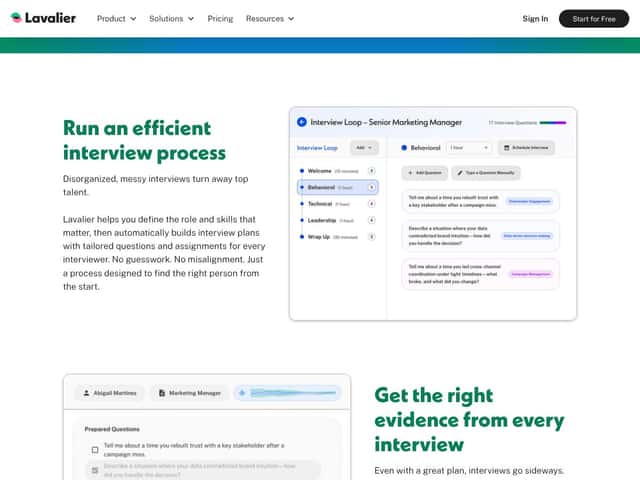
The platform claims to help you craft interview plans automatically based on the role and skills you specify. This includes tailored questions and assignments for each interviewer. In practice, I found it straightforward: you input the role, define key skills, and Lavalier suggests a structured interview guide. It’s like having a template but customized to your needs. However, I noticed that the quality of questions varied—some felt generic, others aligned well with the role. It’s not perfect, but it’s a solid starting point.
Role Intake Guidance
This feature helps you clarify what you’re looking for by guiding you through defining competencies and evaluation criteria. It’s a step that’s often skipped in startups, leading to inconsistent interviews. I appreciated that Lavalier prompts you to think about what truly matters for the role. That said, I wish the guidance was a bit more detailed—sometimes it felt like a checkbox exercise rather than deep strategic input.
Real-Time Interview Guidance
While conducting interviews, Lavalier provides prompts and signals. For example, it suggests follow-up questions or reminds interviewers to cover certain topics if they’re missing. I tested this during a mock interview, and it was somewhat helpful—though not intrusive. The issue is that it relies on speech recognition and natural language processing, which isn’t flawless. Sometimes it missed cues or gave prompts that felt out of place, especially with accents or background noise.
AI-Powered Transcription and Summaries
This is where it gets interesting. Lavalier transcribes the interview and then synthesizes key evidence—highlighting candidate strengths, weaknesses, and notable responses. I was surprised to find that the transcription was reasonably accurate for clear speech, but struggled with overlapping conversation or fast talking. The summaries are useful, but I’d caution that they’re only as good as the transcription quality. It’s not a substitute for attentive note-taking, but a helpful supplement.
Candidate Comparison & Decision Support
After multiple interviews, Lavalier generates summaries that compare candidates side-by-side. This part felt quite handy—especially when trying to remember who said what or how each candidate met the criteria. Still, I wonder how well it handles nuanced responses; I noticed some summaries were a bit generic and didn’t capture the full depth of responses.
Integration & Data Handling
Here’s where I found the biggest gap. As of now, Lavalier doesn’t seem to integrate directly with popular ATS or calendar systems. You have to export summaries or use their own interface, which adds friction. For startups already juggling multiple tools, that’s a heads-up. It might improve over time, but right now, it’s a bit standalone.
How Lavalier AI Works
Getting started was surprisingly smooth. The signup process took a minute—just some basic info and role details. Once inside, the interface is clean but minimal. I didn’t encounter any confusing menus, but I did spend a few minutes figuring out where to input the role details and how to start a new interview.
My first impression was that it felt like a tool built for teams that want to standardize their process without a lot of manual setup. You can quickly generate an interview plan and share it with your interviewers, though sharing options are limited (no direct link, just exporting or inviting team members via email).
In terms of actual use, I’d say you could be up and running with a test interview in about 10–15 minutes. The real question is how much value you get from the AI guidance and summaries. I found that the initial setup was straightforward, but the AI’s suggestions and transcription quality required some patience. There’s a slight learning curve in understanding how best to phrase questions for optimal transcription and summary results.
One thing I wish they’d been clearer about upfront: the platform seems to assume you have some familiarity with structured interviews. If you’re new to this approach, you might need to do a bit of homework first. Also, the AI features are promising but not yet mature enough to fully replace experienced interviewers or manual note-taking.
Overall, I’d say Lavalier is a helpful tool for startups trying to bring more consistency and evidence-based decision-making into their hiring, but don’t expect it to magically fix everything. It’s a supportive assistant, not a complete hiring overhaul.
Lavalier AI Pricing: Is It Worth It?
| Plan | Price | What You Get | My Take |
|---|---|---|---|
| Free Tier | Free | Basic interview automation, limited interviews per month, core question generation, transcription, and summaries. | Great for startups just getting started or testing the waters. However, the free tier probably caps usage and features, so scaling might require an upgrade. |
| Scalable Plans | Contact for pricing | Unlimited or higher volume interviews, advanced features like deeper integrations, team management, and custom question sets. | Fairly typical for SaaS tools targeting teams; expect tiered pricing based on usage and features. Be prepared to negotiate or inquire directly for specifics. |
Honest assessment: Since Lavalier's pricing isn't publicly listed beyond the free tier, it's hard to judge whether it's fair. Compared to platforms like Greenhouse or Lever, which have well-defined tiered plans, Lavalier’s model seems scaled for startups and small teams, which is promising. But beware: hidden costs might emerge if you need advanced integrations or high interview volumes. This might be a dealbreaker for some if the pricing scales steeply as your team grows, or if the features you need are locked behind higher tiers. For solo founders or small teams, starting with the free tier makes sense—just keep an eye on your usage and upgrade when necessary.
The Good and The Bad
What I Liked
- Structured interview plans: Lavalier automatically generates tailored questions based on role requirements, which saves a ton of prep time and helps standardize the process. I was honestly expecting more manual setup here, so this automation is a plus.
- Real-time interviewer guidance: During interviews, Lavalier offers prompts and signals to keep the conversation on track. Even inexperienced interviewers can run effective interviews, which is a big win for scaling teams.
- Evidence synthesis: The platform consolidates notes and transcriptions into clear summaries, making it easier to compare candidates without digging through disorganized files. This feature alone could cut hours off your decision-making process.
- Focus on objective data: By emphasizing evidence-based evaluation, Lavalier helps teams move away from gut decisions—something I think many hiring managers would appreciate.
- Free to start: The initial free tier lowers the barrier for testing, which is rare for AI-driven recruitment tools. You can experiment without committing upfront.
What Could Be Better
- Limited transparency on features: The website is vague about what exactly you get at each tier, and there's no detailed feature list or user reviews. This makes it tough to evaluate if it’s worth investing in higher plans.
- Lack of integrations: If your team uses ATS like Greenhouse or Lever, Lavalier's lack of apparent integrations might be a pain point. Seamless workflow integration is crucial for scaling recruitment efforts.
- New product, unproven track record: Launched only in March 2026, so long-term reliability and customer support are untested. Early adopters should proceed with caution.
- Pricing uncertainty for scaling: Without clear costs, it's hard to say whether the platform remains affordable as your hiring volume increases. Expect to negotiate or ask for quotes.
- Potential over-reliance on AI: While helpful, AI-generated questions and summaries may occasionally miss nuance or context, especially for complex roles. Human oversight remains essential.
Who Is Lavalier AI Actually For?
If you're a startup founder, recruiter, or HR team at a high-growth company, Lavalier is tailored for you—especially if you’re struggling with inconsistent interviews, misaligned interviewers, or simply want to speed up your hiring process. The ideal user is someone who values structured, evidence-based hiring but doesn’t have the time or resources to manually design and manage every interview.
For example, if you’re a small recruiting team trying to scale quickly, Lavalier can help standardize your interview process, reduce bias, and ensure everyone is evaluating candidates based on the same criteria. It’s perfect if you’ve experienced frustration with unorganized interview notes or missed flags during candidate conversations.
Moreover, teams that are just starting to implement structured interviews but lack the expertise or time to build templates will find Lavalier’s automated plans useful. It can serve as a coach for less experienced interviewers, helping them ask better questions and stay focused.
However, it’s less suited for companies that rely heavily on custom, highly technical assessments or have complex, multi-step hiring workflows with tight integrations. Also, if you’re a solo hiring manager or need highly specialized interview techniques, Lavalier’s generalized AI guidance might not meet all your needs.
Who Should Look Elsewhere
If your team already has a robust ATS with built-in interview management, or if you rely on manual, unstructured interviews that work fine for your volume, Lavalier might not offer enough value. It’s also not ideal if you need deep integrations with your existing HR tech stack—since those aren’t clearly available yet.
Similarly, if you’re looking for a platform with extensive analytics, cultural fit assessments, or employer branding tools, Lavalier probably isn’t the right fit. Its focus is narrow: structured interview automation and evidence synthesis. If you need a comprehensive talent acquisition platform, alternatives like Greenhouse, Lever, or specialized assessment tools could be better.
Finally, for teams that prefer a fully customizable, hands-on approach to interview design or have very specific technical requirements, Lavalier’s AI-driven plans might feel limiting or too generic. Be prepared for a learning curve if you’re not comfortable with AI-generated content.
How Lavalier AI Stacks Up Against Alternatives
Interview GPS
- What it does differently: Interview GPS offers a comprehensive interview scheduling and tracking platform with some automation for question flow, but it lacks the AI-driven synthesis and real-time guidance Lavalier provides. It’s more about managing interview logistics than improving evaluation quality.
- Price comparison: Typically costs around $50–$100 per month depending on features, which is more of a traditional SaaS fee compared to Lavalier’s free-to-start model.
- Choose this if... you mainly want scheduling, candidate tracking, and basic interview flow management without needing AI insights.
- Stick with Lavalier AI if... you want evidence-based, structured interviews with real-time guidance and AI-powered summaries to improve hiring quality.
Interview Builder
- What it does differently: Focuses on creating customizable interview templates and question banks, but doesn’t incorporate AI-driven synthesis or guidance. It’s more about manual question assembly.
- Price comparison: Usually around $10–$30/month, making it a budget-friendly option if you want control over questions without automation.
- Choose this if... you prefer to craft your own interview questions and want a simple tool without AI features.
- Stick with Lavalier AI if... you need structured, evidence-based interviews and real-time support, which Interview Builder doesn’t offer.
Textio
- What it does differently: Textio is primarily a writing platform that helps craft better job descriptions with AI. It’s not an interview tool but can complement Lavalier by improving candidate outreach.
- Price comparison: Usually subscription-based, with custom pricing for enterprise plans; can be several hundred dollars per month.
- Choose this if... you want to optimize your job postings and attract better candidates.
- Stick with Lavalier AI if... you want to directly improve your interview process and candidate evaluation, which Textio doesn’t cover.
Greenhouse & Lever
- What they do differently: These are comprehensive ATS platforms with robust recruiting workflows, including interview scheduling and candidate pipeline management. They offer some evaluation tools but aren’t specialized in structured interview guidance.
- Price comparison: Typically enterprise pricing, often thousands per year, suitable for larger teams with complex needs.
- Choose these if... you need an all-in-one recruiting platform with extensive integrations and pipeline management.
- Stick with Lavalier AI if... your focus is on improving interview consistency and candidate evaluation quality without the bulk of full ATS features.
Bottom Line: Should You Try Lavalier AI?
Honestly, I’d give Lavalier AI a solid 7/10. It’s still pretty new, so long-term reliability remains to be seen, but the concept is promising—especially if you’re a startup or high-growth team that struggles with interview consistency. The real-time guidance and evidence-based approach can genuinely help you make better hiring decisions without the usual guesswork.
If you’re someone who often feels the interview process is inconsistent or relies heavily on gut feeling, Lavalier AI could be a game-changer. It’s especially worth trying if you’re onboarding multiple roles and want a scalable, structured approach.
On the flip side, if you’re looking for a fully integrated ATS with extensive pipeline management or detailed analytics beyond interviews, tools like Greenhouse or Lever might be better suited. Also, if you’re skeptical about AI’s accuracy or prefer manual control, Lavalier’s automated summaries may not satisfy you yet.
Is the free tier worth trying? Absolutely. It lets you test the core features without commitment. Upgrading might be worth it if you see value in the summaries and guidance at scale. Personally, I’d recommend giving it a shot if your hiring volume is growing and you want to raise standards without adding complexity.
If your team is small and your interviews are already consistent, Lavalier AI might be overkill. But if you’re serious about evidence-based hiring and want a tool that can scale with you, this could be a solid addition.
In conclusion, give Lavalier AI a try if you’re eager to improve your interview quality. If your needs are more about pipeline management or advanced analytics, consider other options first.
Common Questions About Lavalier AI
- Is Lavalier AI worth the money? It’s early days, but if you value structured, evidence-based interviews, it’s worth testing out. The free tier helps you evaluate without risk.
- Is there a free version? Yes, Lavalier offers a free-to-start plan that includes core features like interview plan generation and summaries. Limits may apply on the number of interviews or access to advanced features.
- How does it compare to competitors? Lavalier is more focused on AI-driven interview guidance and evidence synthesis, whereas competitors like Greenhouse focus on broader recruiting workflows. Lavalier’s strength is in structured, consistent interviews.
- Can I get a refund? Refund policies depend on the plan and vendor terms. Since Lavalier is new, check their contact for specific support options.
- What kind of roles can it support? Lavalier is designed for a wide range of roles but is especially useful for positions where structured evaluation improves hiring quality.
- Does it integrate with ATS? Integration details are limited, but it’s designed to fit into existing workflows. Confirm with Lavalier if you need specific ATS integrations.
- Is the AI accurate for questions and summaries? It’s generally reliable but may occasionally need human oversight, especially for complex or nuanced interviews.