Table of Contents
How to Use Our AI Target Audience Problem Generator?
- Register on automateed.com
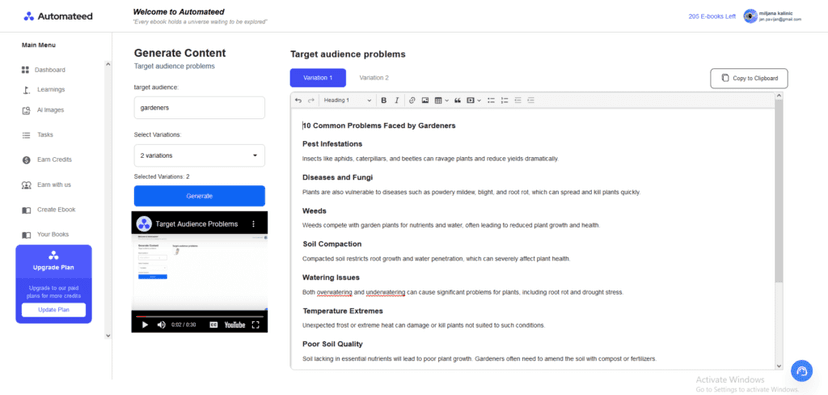
- Go to dashboard and look for “AI Target Audience Problem Generator”
- Type in your target audience
- Pick 3 variations to maximize the output and AI will craft your target audience pain points in seconds.
What Does AI Target Audience Problem Generator Do?
If you’ve ever struggled to understand your target audience’s pain points, you’re not alone. That’s where the AI Target Audience Problem Generator comes in. This AI-powered tool helps you quickly identify the problems and challenges your ideal customers face, making it easier to tailor your marketing efforts and create content that truly resonates.
How It Works
Using this tool is super simple. You only need to enter your target audience, and the AI takes care of the rest. Here’s a step-by-step breakdown:
- Enter Your Target Audience: Just specify who your audience is. This could be based on demographics like age, company size, or even specific customer behaviors.
- Generate Pain Points: With a click of a button, the AI instantly creates a list of 10 pain points that your audience is likely experiencing. This is done using advanced algorithms that analyze various data points to provide you with valuable insights.
- Multiple Variations: You can get up to 3 variations in one go, giving you a total of 30 pain points to work with. This ensures you have a comprehensive understanding of your audience’s challenges.
- Example: If your target audience is small business owners, the tool might generate pain points like managing cash flow, finding new clients, and keeping up with marketing trends.
Why It’s Powerful
This AI-powered content generator isn’t just about saving time. It’s about diving deeper into your audience’s needs and creating a more personalized experience. Here are a few reasons why it’s a game-changer:
- Simplifies Market Research: Traditional methods of market research can be time-consuming. This tool automates the process, giving you instant results.
- Enhances Personalization: By understanding the specific pain points of your audience, you can create more targeted and effective marketing strategies. This leads to higher conversion rates and a stronger connection with your audience.
- Supports Strategic Planning: Knowing what your audience struggles with helps you make better business decisions, from product development to customer service improvements.
- Tip: Use these pain points to create detailed user personas. This will guide your marketing campaign and ensure your messaging is spot-on.
Real-Life Application
Imagine you’re launching a new product or service. Knowing your audience’s pain points can help you highlight how your offering solves their problems, making your marketing efforts more effective. For example, if you’re promoting an SEO tool, understanding that your audience struggles with keyword research can help you emphasize how your tool simplifies this task.
By using the AI Target Audience Problem Generator, you’re taking a significant step towards understanding your target audience on a deeper level. This tool helps you create more engaging, relevant content that truly addresses your audience’s needs.
Why Use AI Target Audience Problem Generator
Understanding your target audience is crucial for any marketing strategy. The AI Target Audience Problem Generator is a powerful tool that helps you dive deep into your audience’s motivations and pain points. Here’s why you should consider using it.
Understanding Motivations and Pain Points
Knowing what drives your audience and what challenges they face is key to creating content that resonates. With the help of AI, this tool can provide a detailed understanding of your target audience’s needs.
- Identify Core Issues: The AI-generated insights reveal the primary problems your audience is dealing with, allowing you to address these issues directly in your content.
- Create Relevant Content: By understanding customer pain points, you can tailor your copywriting to speak directly to their concerns, making your content more engaging and effective.
Aligning Business Goals with User Personas
Creating well-defined buyer personas helps align your business goals with your marketing efforts. The AI Target Audience Problem Generator makes it easy to create detailed user personas.
- Customization: Customize the insights provided by the AI to fit your specific target audience. This ensures your marketing strategies are aligned with real customer needs.
- Strategic Decisions: Use the generated data to make informed business strategies that cater to your audience’s preferences and pain points.
Enhancing Personalization and Engagement
Personalization is key to engaging your audience. The AI-driven insights help you cater to individual needs, ensuring higher engagement and conversion rates.
- Tailored Messaging: Use the insights to customize your messaging, making it more personal and relevant to your audience.
- User-Friendly Interface: The tool’s user-friendly interface makes it easy to generate and apply these insights without needing extensive marketing expertise.
Streamlining Your Marketing Efforts
Automation tools like the AI Target Audience Problem Generator simplify repetitive tasks, saving you time and effort.
- Efficiency: Quickly generate detailed customer profiles without the need for extensive market research.
- Focus on Creativity: With automation taking care of the data analysis, you can focus on creating compelling content that resonates with your audience.
Making Data-Driven Decisions
Utilizing AI-generated data helps you make strategic decisions that are backed by real customer insights.
- KPI Tracking: Monitor key performance indicators to ensure your marketing efforts are on track.
- Informed Campaigns: Use the insights to create marketing campaigns that are tailored to your audience’s needs and behaviors.
Improving Copywriting and Content Quality
High-quality content is essential for attracting and retaining your audience. The insights provided by the AI tool can enhance your copywriting efforts.
- Content Templates: Use the generated insights to create content templates that are tailored to your audience’s needs.
- SEO Optimization: Incorporate the identified pain points into your SEO strategy to improve your search engine rankings.
With the AI Target Audience Problem Generator, you gain a deeper understanding of your audience, allowing you to create content that truly resonates. This tool is not only powerful but also easy to use, making it an invaluable asset for any marketer looking to improve their marketing strategies and business outcomes.
Who Can Use AI Target Audience Problem Generator
The AI Target Audience Problem Generator is a versatile tool designed for a wide range of users. Whether you’re a marketer, business owner, or content creator, this tool can help you understand your target audience and create more effective strategies.
Marketers
Marketers can benefit greatly from using this AI-powered tool. By generating detailed insights into customer pain points, you can tailor your marketing strategy to resonate with your target audience. This persona generator helps in creating well-defined ideal customer profiles that are crucial for successful marketing campaigns.
- Use Case: Develop targeted marketing campaigns that address specific customer needs, enhancing engagement and conversion rates.
Business Owners
Business owners looking to understand their customers better can use this tool to gain valuable insights. It helps you create an ideal customer profile, making it easier to align your products or services with customer needs.
- Example: If you own an online store, use the tool to understand what issues your customers face, such as shipping delays or product quality concerns, and address them in your business strategy.
Content Creators
Content creators can use the AI Target Audience Problem Generator to find inspiration for their content. By understanding the pain points of your audience, you can create content that resonates with them and provides real value.
- Tip: Use the generated pain points as prompts for blog posts, videos, or social media content.
Product Managers
Product managers can use this tool to gather user feedback and understand customer needs better. This helps in developing products that cater to the specific requirements of your target audience.
- Use Case: Identify common issues customers face with your product and prioritize them in your development roadmap.
SEO Specialists
SEO specialists can leverage this tool to create content that ranks well in search engines. By understanding the pain points and queries of your audience, you can optimize your content for better search engine visibility.
- Tip: Use the pain points to develop SEO-friendly content that addresses common search queries related to your niche.
Advertising Professionals
Advertising professionals can use the insights generated by this tool to create more effective ad campaigns. Understanding what resonates with your target audience helps in crafting messages that drive action.
- Example: Use the pain points to create compelling ad copy for platforms like LinkedIn ads, ensuring higher engagement rates.
Customer Support Teams
Customer support teams can use the AI Target Audience Problem Generator to better understand common issues customers face. This helps in providing more personalized and effective support.
- Use Case: Develop a knowledge base or FAQ section that addresses the most common pain points identified by the tool.
The AI Target Audience Problem Generator is a multi-faceted tool that caters to various roles within a business. By providing detailed insights into customer pain points, it helps you make informed decisions, create targeted strategies, and ultimately, improve your business outcomes.
The Benefits and Challenges of Using AI in Marketing
Using AI in marketing has become increasingly popular due to its ability to streamline processes and provide deeper insights. However, like any technology, it comes with its own set of benefits and challenges. Let’s explore both sides.
Benefits of Using AI in Marketing
- Enhanced Personalization
AI allows you to understand your target audience better, helping you create highly personalized marketing campaigns. By analyzing customer data, AI can tailor messages and offers that resonate with your audience, leading to higher engagement and conversion rates.
- Example: Use AI to create personalized email campaigns that cater to individual customer preferences and behaviors.
- Efficiency and Automation
One of the biggest advantages of AI is its ability to automate repetitive tasks. This saves time and allows marketers to focus on strategic planning and creative work.
- Use Case: Implement an AI-powered marketing strategy generator to automate the creation of campaign strategies, freeing up time for more critical tasks.
- Data-Driven Insights
AI provides valuable insights by analyzing large sets of data quickly and accurately. This helps in understanding customer behavior, predicting trends, and making informed decisions.
- Tip: Use AI to analyze KPIs and other performance metrics to optimize your marketing strategies.
- Improved Customer Experience
By understanding their target audience, businesses can use AI to enhance the customer experience. AI can predict customer needs and provide personalized solutions, improving overall satisfaction.
- Example: Use an AI website chatbot to provide instant support and answers to customer queries, enhancing the user experience.
- Creating Detailed Personas
AI helps in creating well-defined customer personas by analyzing various data points. This allows marketers to tailor their strategies to specific audience segments.
- Tip: Use AI-generated insights to develop detailed personas that guide your marketing efforts.
Challenges of Using AI in Marketing
- Data Privacy Concerns
Collecting and analyzing customer data comes with privacy concerns. Businesses must ensure they comply with data protection regulations and maintain customer trust.
- Challenge: Implementing AI tools without compromising data privacy can be difficult and requires careful planning.
- High Initial Investment
AI technology can be expensive to implement initially. Businesses need to weigh the cost against the potential benefits to determine if it’s a worthwhile investment.
- Example: Smaller businesses might find the cost of AI tools prohibitive, limiting their ability to compete with larger companies.
- Complexity and Integration
Integrating AI with existing systems can be complex and time-consuming. It requires technical expertise and ongoing maintenance to ensure everything runs smoothly.
- Tip: Start with small AI projects and gradually scale up as you become more comfortable with the technology.
- Dependence on Quality Data
AI relies on high-quality data to provide accurate insights. Poor data quality can lead to incorrect conclusions and ineffective marketing strategies.
- Challenge: Ensuring your data is clean, accurate, and up-to-date is crucial for the success of AI-driven marketing efforts.
- Lack of Human Touch
While AI can automate many tasks, it lacks the human touch that can be crucial in certain aspects of marketing, such as building relationships and understanding nuanced customer emotions.
- Tip: Balance AI automation with human interaction to maintain a personal connection with your customers.
Audience research guide
Quick answer
A target audience problem generator turns a broad topic into a specific reader, situation and unresolved problem that can support a useful book. Treat the result as a research hypothesis, not a proven market. Choose one candidate, interview or observe real readers, compare competing books and then use the evidence to shape the promise, outline and examples.
Start with a situation, not a demographic label.
“Women aged 25–45” is not a book problem. “First-time managers who need to give difficult feedback without damaging trust” is much closer. The second description identifies a moment, a desired outcome and a source of tension. Those details give an author something concrete to solve and give the eventual reader a reason to recognize the book as relevant.
Use the generator to create several problem statements, then rewrite the strongest one in the reader’s language. Search reviews of related books, forum discussions, customer calls and questions people ask before buying. Save exact phrases that describe the frustration, failed alternatives and desired result. The book idea generator can expand a validated problem into possible formats, but it should not replace this evidence step.
- Who is experiencing the problem right now?
- What event makes the problem urgent?
- What have they already tried, and why did it fail?
- What observable result would make the book worthwhile?
Separate a market problem from a content angle.
A problem is the reader’s costly or frustrating situation. An angle is the author’s chosen way to explain or solve it. Several books can address the same problem with different angles: a 30-day plan, a reference handbook, a case-study collection or a workbook. Validate the problem first; then choose the angle that matches your expertise and the way the audience prefers to learn.
This distinction prevents a common mistake: falling in love with a clever format before confirming that readers care about the outcome. A quiz book, journal or short guide can be attractive, but the format does not create demand by itself. Compare the options in the format-by-format writing library after you can state the audience problem in one sentence.
Turn the selected problem into a book brief.
A usable brief contains the primary reader, the starting situation, the promised change, the limits of the book and the proof the author can provide. Add what the book will not cover so the outline does not drift into generic advice. For a practical nonfiction book, each chapter should remove one obstacle or move the reader through one stage of the result.
Before drafting, test the brief as a title-and-subtitle pair and a short sales description. If the promise becomes vague as soon as it is explained, the audience is probably still too broad. Use the book title generator for variations only after the positioning is clear, and use the book blurb generator to stress-test whether the value can be communicated without invented urgency.
Validate the language before building the product.
Take the strongest problem statement back to real audience evidence. Compare it with search queries, review complaints, sales-call notes, community questions and support conversations. Look for the words people use without prompting. If the generated statement relies on language that appears only in marketing copy, rewrite it before using it in a title or sales page.
Ask five potential readers to describe the last time the problem occurred, what they tried and what made the situation difficult. Do not begin by pitching the book. The differences between their answers reveal whether one audience segment is actually several groups with different needs. Save objections and constraints because those details should shape examples, chapter order and the promise you can responsibly make.
Connect the problem to a measurable reader outcome.
A strong problem statement leads to an outcome the reader can recognize: completing a first feedback conversation, preparing a weekly meal plan, choosing a publishing format or calculating a paperback price. Avoid promises such as “transform your life” when the book cannot define or demonstrate the change. Specific outcomes make the eventual outline easier to test for relevance.
When the positioning is stable, create the first outline with the AI ebook generator and check that every chapter removes a distinct obstacle. If several sections repeat the same advice, narrow the promise or add evidence and application. Audience research is complete only when it changes what the author writes, not when it produces an attractive persona label.
Decide whether the audience is reachable.
A precise audience can still be commercially weak if there is no practical route to reach it. List where the reader already searches, subscribes, gathers or buys. Distinguish channels you can access from channels that merely contain the audience. “New parents” may be large, but a specialist newsletter, professional association or search query can provide a more realistic acquisition path than a broad social category.
Estimate the evidence available in each channel: query patterns, publication audiences, podcast topics, community rules and competing offers. Do not scrape private spaces or turn vulnerable disclosures into marketing copy. Use public, consented or first-party research and record where each insight came from. A book premise becomes stronger when the author can explain both why the problem matters and how qualified readers will discover the solution.
Review the positioning after the first draft.
Generation often reveals that the original audience statement was too broad or that the most useful material serves a narrower situation. Re-read the introduction, examples and exercises after the first draft. Note which reader they assume, which prior knowledge they require and which outcome they actually support. Update the positioning before finalizing the title, cover and description.
Keep the revised audience brief beside the manuscript during editing. Remove examples aimed at a different skill level, define terms the reader will not know and avoid adding chapters only to make the book appear longer. When the book is ready, use the author website builder to present it with language consistent with the validated reader problem instead of reverting to generic claims on the sales page.