Table of Contents
You can spend less than $100 on AI tools to illustrate a children’s book yourself. Hiring a professional illustrator for a full picture book can cost $2,000–$10,000, depending on the artist and how much artwork you need.
AI can save you a lot of money, but you’ll be the one fixing odd-looking hands, keeping your characters consistent and making room for the text. An illustrator brings those skills to the project, though you’ll still need to check whether their fee includes the cover and page layout. Let’s break down the costs so you can decide what’s worth paying for and what you’d like to do yourself.
AI or a commissioned illustrator: what are you paying for?
| Route | Our example budget | What it covers | Work still on your side |
|---|---|---|---|
| DIY AI illustrations | $80 | Two $30 subscription months, plus a $20 reserve | Character design, prompting, selection, corrections, layout and print preparation |
| Commissioned illustration package | $7,040 | 22 interior art assets, a $900 cover/layout/usage allowance, and 10% contingency | Briefing, approvals and any work excluded from the agreed package |
The savings come from taking on more of the work yourself. AI can make exploring a scene inexpensive, but somebody still has to notice that the rabbit has changed color, the bedroom window has moved, or a beautiful picture leaves nowhere for the text. If you enjoy that process, a modest software budget gives you room to experiment. If you want someone else to solve those storytelling problems, include their fee.
Can you illustrate a children’s book with AI for under $100?
Yes, your image-generation software spend can fit below $100 when you do the creative and production work yourself. For this example, we use a $30 monthly image plan for two months. Midjourney’s Standard plan currently lists that price and unlimited image generation in Relax mode. The following budget is our calculation using that published subscription price, not a completed-book invoice.
| Item | Calculation | Budget |
|---|---|---|
| Image software | 2 months × $30 | $60 |
| Reserve for an optional extra tool or top-up | Chosen allowance | $20 |
| Editing and layout software | Use tools you already own or suitable free software | $0 additional |
| Cash planning total before tax | $60 + $20 | $80 |
Work from the same 32-page map used for the commission example: six spreads, eight single-page scenes and eight spots, with four pages reserved for other material. That means 22 interior assets plus a separate cover image. As an initial working plan, three candidates for each of those 23 images gives you 69 candidates to review. Add six character-design experiments and you have a first batch of 75. Some scenes will need more attempts; track the images you can actually use rather than counting every generation as a finished illustration.
Make one character sheet before building the whole book. Record the character’s proportions, clothing, colors and distinctive features, then test a close-up, an action pose and a scene with another character. Choose a visual direction that survives those changes. A successful portrait is a useful start, but a picture book needs the reader to recognize that character across a sequence.
Keep a contact sheet in page order as you work. Compare the chosen images for scale, props, expressions, light and continuity. Put the actual text over a rough layout early, so you can see whether the art supports the page turn and leaves enough room to read. Save your selected originals and edits separately; replacing one image later should not mean rebuilding the entire interior.
The $80 plan assumes you can finish within two subscription months, use the included generation mode, and handle corrections without paid outside help. A third $30 month would take the plan to $110 with the same reserve. Taxes, paid fonts, printing and a hired designer would add to the total. Your time matters too: if you spend 20 hours and value them at $20 an hour, that is another $400 of your time, making the combined example $480. Those hours and that hourly value are assumptions you can replace.
Check the tool’s terms before choosing it for a commercial book. Midjourney’s terms include a Pro-or-Mega requirement for companies over $1 million in annual revenue and describe default public visibility and remixing. This $30-plan example therefore does not fit every business or privacy requirement. Permission under a tool’s terms also does not, by itself, establish copyright protection for an AI-generated image; see the U.S. Copyright Office’s explanation of human authorship and AI.
If only a few pages defeat your editing skills, a mixed approach may work: make the AI draft yourself, then request a separate quote for those corrections or for layout. Send the actual files and name the tasks. That gives you a price for the help you need instead of assuming either a fully commissioned book or a completely solo project is your only option.
Published illustrator prices for comparison
A full children’s picture-book illustration project can cost US$2,000–$10,000, according to Reedsy’s marketplace data. Its guide also reports US$60–$200 for a single-page illustration and US$100–$400 for a two-page spread. These are ranges from illustrator quotes, so your price depends on the artist and the work included. Reedsy updated its guide on March 5, 2026.
Experienced specialists may charge more. Talitha Shipman lists illustration from $10,000 for a 32-page picture book, plus $2,000 for picture-book design and formatting. Those are her published prices; other artists set their own rates.
| Work | Published price | Source |
|---|---|---|
| Full picture-book project | US$2,000–$10,000 | Reedsy marketplace quotes |
| Single-page illustration | US$60–$200 | Reedsy marketplace quotes |
| Two-page spread | US$100–$400 | Reedsy marketplace quotes |
| 32-page picture-book illustration | From $10,000 | Talitha Shipman’s own rates |
| Picture-book design and formatting | $2,000 | Talitha Shipman’s own rates |
Use these published prices as a comparison, then count the artwork your book needs. Ask whether the cover, rights, revisions and production files are included. Editing, printing, distribution and advertising belong outside the illustration total unless you’re buying them in the same package.
Give illustrators a clear brief
Send a stable manuscript, provisional page map and delivery list with your quote request. Mark spreads, single-page scenes, small spots and text-only areas. If you want the illustrator’s help with page planning, include it as a paid stage; the layout isn’t settled yet.
Describe your intended reader, book format, trim size, printer or distributor, editions and deadline. List recurring characters and settings, and explain the finish you have in mind: loose watercolor, expressive linework, restrained backgrounds or richly rendered scenes. References can help you show the qualities you admire without asking someone to copy another artist’s work.
Give every illustrator the same core information so you can compare their proposals fairly:
- The manuscript version, page map and any storytelling decisions still to be made.
- An artwork list with counts, asset IDs and notes on scene complexity.
- Separate requirements for the cover, endpapers, lettering, layout and print preparation.
- The approval stages, included revision rounds and feedback deadlines you want.
- The editions, languages, territories, duration, exclusivity and promotional uses you need.
- Specifications for finished files, including whether you want editable source files.
Share your budget and distinguish essentials from extras. A promotional character portrait, for example, can be an optional item rather than part of the interior-art fee. Ask what the price excludes, too.
Know what each illustration price covers
A spread fills two facing pages. A spot occupies a smaller area, often with little background. Neither label tells you the character count, research or rendering detail involved.
Compare a quiet exchange between two characters with a crowded station full of signs, luggage and overlapping figures. Both fill a spread, but the workload differs. Ask whether complex scenes cost extra.
| Quoted unit | Define before comparing | Comparison trap |
|---|---|---|
| Spot illustration | Size, characters, background, color and placement | Treating a detailed vignette like a simple isolated object |
| Single page | Trim, bleed, text space, scene detail and whether layout is included | Comparing artwork alone with a fully composed page |
| Spread | Facing-page composition, gutter, bleed and text-safe areas | Counting the same spread as one image in one quote and two illustrations in another |
| Cover | Front image or full wrap; back, spine, typography, barcode space and editions | Assuming cover artwork includes a print-ready cover PDF |
| Project fee | Complete inventory, development work, approvals, rights and delivery files | Overlooking missing character design, layout or print corrections |
| Hourly work | Estimated hours, spending cap, reporting and approval of overruns | Comparing an uncapped estimate with a fixed-price commitment |
A 32-page interior can mix spreads, single-page scenes, text-only pages and spots. Count the artwork separately even when the illustrator offers one project fee.
Make an artwork list from your page map
Give each piece an asset ID and a row describing its story purpose, characters, setting, props, time of day and continuity. Add bleed, text space, references, current stage and any approvals needed before work proceeds.
| Asset | Narrative job | Complexity drivers | Production role | Approval dependency |
|---|---|---|---|---|
| C01: Cover wrap | Introduce the central conflict | Main cast, setting and title area | Front, spine, back and bleed | Trim, binding, paper and final page count |
| S01: Opening spread | Establish the place and relationship | Recurring location and two characters | Interior bleed and text-safe areas | Character sheet and page map |
| P01: Recurring spot | Signal a transition | Consistent object design | Transparent or page-color background | Approved object reference |
Use these rows as a template, adapting them to your book. Add title-page art, endpapers, decorative initials, maps, activity pages, chapter spots, an author portrait, marketing crops or series assets only when you intend to commission them. For recurring artwork, explain whether the artist can reuse it unchanged or needs to draw a new pose.
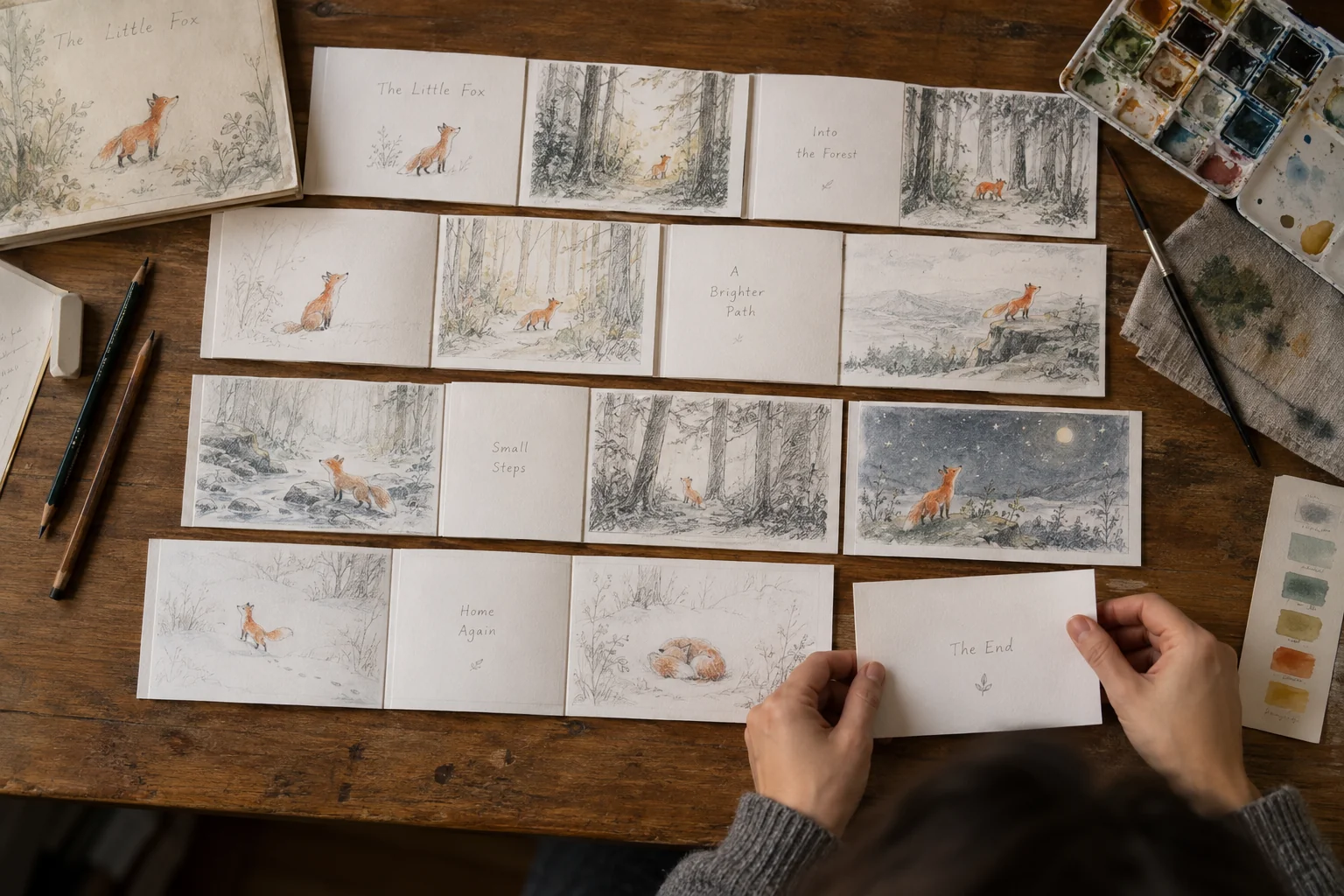
Here’s a hypothetical 32-page plan: reserve four pages for other material, use twelve pages for six full spreads, eight pages for eight single-page scenes, and eight pages for text-led layouts with one spot each. You’re commissioning six spreads, eight single-page illustrations and eight spots. That’s 22 interior art assets, rather than 32 full-page paintings. The cover is separate from the 32-page interior.
Check the plan in a dummy—a rough sequence of the book’s pages. You’ll be able to see which pages face each other and what each page turn reveals. Plan important faces and actions away from the gutter. If any of the four reserved pages need decorative artwork, add those pieces to the list so they can be priced too.
Add up the costs without counting anything twice
Your budget covers the contracted fee plus money reserved for changes. A bundle may include rights, character development or print preparation that another artist prices separately. Count each cost once.
Total illustration budget = creative work + separately priced usage rights + production work + approved changes + expenses + contingency
Use “included,” “additional” and “unresolved” columns to compare the fees. Put bundled services under included and extra charges under additional. Missing information about rights or layout needs an answer from the illustrator, rather than a zero in the budget.
Check whether taxes, shipping of originals, payment-processing charges or other expenses apply, and agree who pays them. Record any royalty arrangement separately from the cash illustration budget. That way, you can consider the money due upfront alongside any ongoing commitment you’re being asked to make.
A worked illustration budget
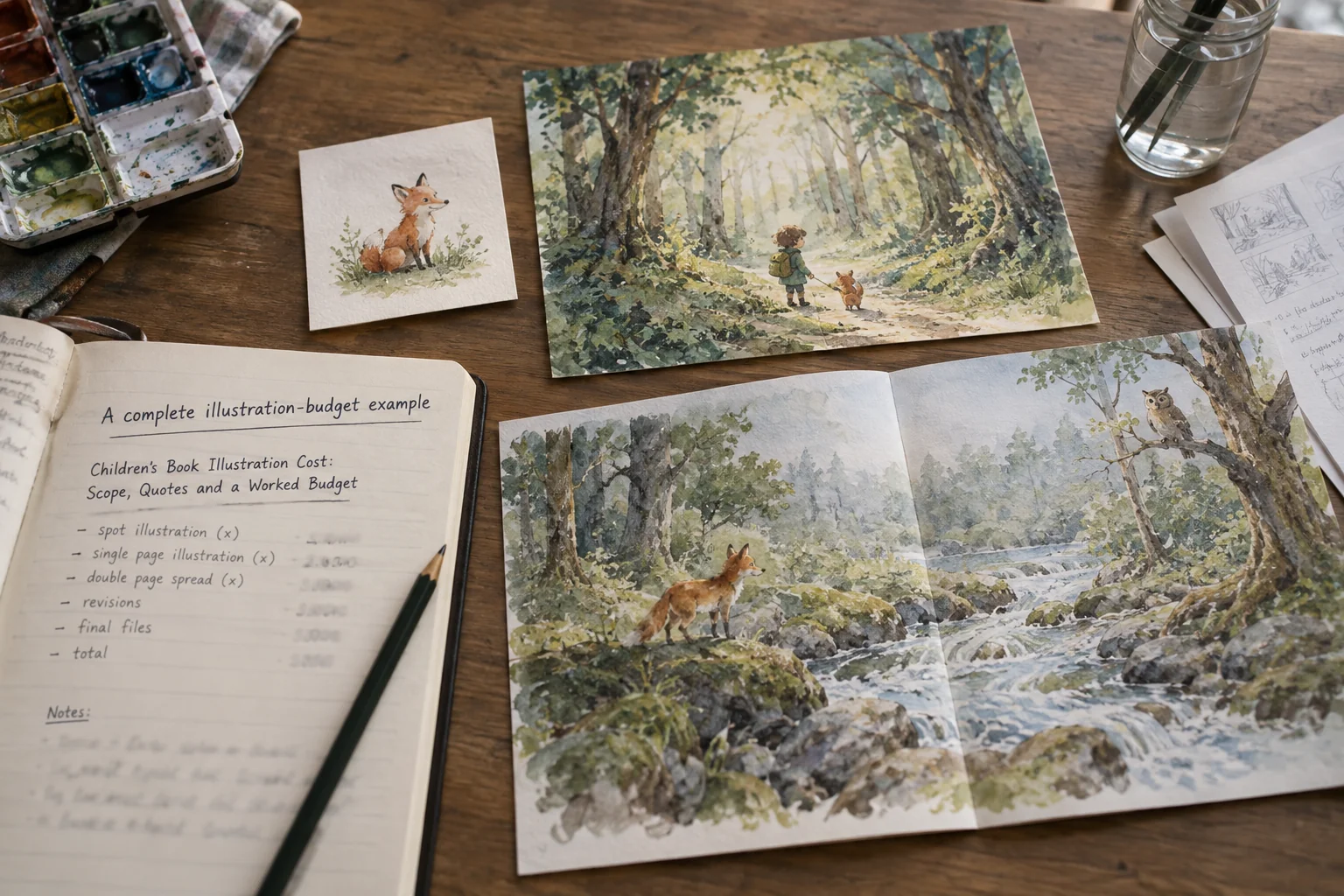
The mixed-art plan above totals $7,040 at the hypothetical rates below. All amounts are US dollars. These are calculation examples, not actual quotes, market averages or promises that an artist will accept these fees.
| Component | Quantity | Assumed unit price | Calculated amount |
|---|---|---|---|
| Spot illustrations | 8 | $100 | $800 |
| Single-page illustrations | 8 | $250 | $2,000 |
| Two-page spreads | 6 | $450 | $2,700 |
| Cover, layout and any separately priced permitted uses | One combined allowance | $900 | $900 |
| Subtotal | $6,400 | ||
| Chosen contingency | 10% of subtotal | $640 | |
| Planning budget | $7,040 |
Replace the assumed rates with your quote. Split the $900 allowance into specific deliverables and remove anything already included in the art fee. Ask for the cost of any planned edition the quote excludes.
You can also build a starting estimate from Shipman’s published prices: $10,000 for illustration plus $2,000 for picture-book design and formatting. Together, those listed fees give a $12,000 starting-fee scenario. A chosen 10% reserve brings it to $13,200. This calculation uses published service prices, rather than a completed client budget or a binding combined quote. Confirm the cover, rights, revisions and any other charges directly before relying on the total. (talithashipman.com)
The contingency stays in your reserve; it doesn’t purchase extra revisions. The 10% figure is a choice in these examples, not an industry recommendation. Base your own reserve on the decisions still open.
Agree how you can use the artwork
Describe the publishing permission you need instead of relying on “commercial rights.” In the United States, original visual art generally receives copyright protection when fixed, and the creator is generally its first owner. Paying someone to create the illustrations doesn’t, by itself, give you ownership of the copyright. The U.S. Copyright Office explains ownership and the rights attached to visual art.
| Rights model | Budget question | Contract details to resolve |
|---|---|---|
| Limited license | Which publishing and promotional uses are included in this fee? | Formats, languages, territory, term, exclusivity and reserved uses |
| Copyright assignment | What price is proposed for the transfer, beyond creating the artwork? | Precisely what transfers, its effective date, credit and retained portfolio permissions |
| Work made for hire | Has a qualified lawyer confirmed that the intended arrangement qualifies? | Eligibility, required writing, authorship, ownership and any fallback assignment |
Start with a practical list of uses: an English-language paperback and ebook, for example, sold worldwide, with artwork excerpts used on the book’s website and in advertising. Ask separately about translations, later editions, merchandise, animation and reuse in a sequel. Describing your plans helps you request the rights you need without seeking an expansive transfer simply because the plans are unclear.
Specially commissioned work-made-for-hire arrangements require more than a label on an invoice. The Copyright Office explains which categories can qualify and the requirement for an express written agreement signed by the parties. Employee-created work follows a separate route. Circular 30 lists the requirements and consequences of work-made-for-hire status. Have a qualified lawyer review an agreement you may sign.
The Graphic Artists Guild’s sample commissioned-illustration purchase order treats rights, changes, cancellation, credit, payment and ownership separately, reserving rights that aren’t expressly granted. Review the Graphic Artists Guild sample commissioned-illustration agreement. It can help you identify questions to discuss, though it was written for magazine illustration and isn’t a ready-to-sign children’s-book contract.
Compare quotes side by side
Compare proposals in one sheet using the same asset IDs, approvals and delivery requirements. Preserve each artist’s pricing structure so you can see what the total buys and where the offers differ.
| Comparison row | Record from the proposal | Wording that needs clarification |
|---|---|---|
| Art inventory | Asset IDs, counts, types, complexity and development work | “All interior illustrations” |
| Milestones | Character, thumbnail, sketch, color, final-art and production approvals | “Revisions included” |
| Change control | Included rounds, scope-change triggers and additional-work approval | “Reasonable changes” |
| Rights | Uses, territory, languages, duration, exclusivity and effective date | “Commercial rights” without definitions |
| Files | Dimensions, color mode, resolution, formats, layers, fonts and archive arrangements | “High resolution” |
| Schedule | Milestone dates, feedback windows, dependencies and delay treatment | A final deadline without intermediate approvals |
| Payment | Deposit, milestone amounts, due dates and additional expenses | A total with no payment schedule |
| Exit | Cancellation payment, partial work, rights and file handling | No cancellation terms |
Agree what a feedback round means in practice—for example, one consolidated response to a submitted milestone. Choose one person to approve the work and pass on that response, so the illustrator doesn’t have to untangle contradictory instructions from several readers.
Send each illustrator the relevant unanswered questions and keep replies with the proposal. Compare payment dates as well as totals: an affordable project can still require a deposit you can’t pay when it’s due.
Plan how you’ll handle changes
Agree before work begins how the illustrator will estimate changes and how you’ll approve them. A short request can affect several pictures or undo work already approved, so consider the pieces and stages involved rather than the length of the request.
| Change | Check before approval | Potential downstream work | Decision rule |
|---|---|---|---|
| Manuscript edit | Text space, pacing and page-turn effects | Repagination, recomposition and lettering | Approve the affected page map before new finals |
| Character redesign | Every approved scene containing that character | Continuity corrections across illustrations | Settle character sheets before detailed scenes |
| New scene or location | Setting, perspective, props and references | Research, thumbnails, sketching and rendering | Return the asset to sketch approval |
| Different trim or printer | Template, bleed, gutter, color and cover geometry | Art extensions, resizing, text movement and exports | Check existing files before promising reuse |
| Additional edition or merchandise | Granted rights and suitability of existing files | Permissions, adaptation, crops and production files | Document and price the new use before release |
For each proposed change, note who requested it and whether it corrects work that missed the approved brief or changes the brief itself. Record who estimates the work, who approves the cost and any revised delivery date. These details give both of you a clearer agreement than an undefined promise of unlimited revisions.
Imagine deciding to remove a fox’s red scarf after six scenes have reached final art. The illustrator might need to repaint fur, shadows and overlapping paws, then check continuity across all six scenes. Make the same decision at the character-sheet stage and only the early design needs changing. In this hypothetical example, deciding sooner saves work; calling the late repaint a minor adjustment doesn’t make it smaller.
Set the print specifications before final art
Choose how the book will be manufactured and get the relevant template before approving final compositions. For KDP paperback interiors with edge-to-edge artwork, the bleed extension is 0.125 inches, or 3.2 millimeters, beyond the trim on the affected outside edges—specifically at the top, bottom and outside edges. KDP requires interior files to contain individual pages, even when an illustration was composed across a two-page spread.
KDP’s paperback-cover instructions specify CMYK images placed at full size, flattened, and supplied at a minimum of 300 DPI. The cover guidance also calls for one PDF containing the back, spine and front. Preparing that complete production file is a separate requirement from creating an attractive front-cover painting, so make sure someone is responsible for it.
Attach your chosen template and record its download date, trim, binding, paper, page count, spine dimensions, barcode area, bleed and safe areas. Agree who will place the title and back-cover copy, prepare the wrap, export the interior and deal with file rejections. If you’re using another manufacturer, follow its specifications rather than automatically carrying over KDP’s settings.
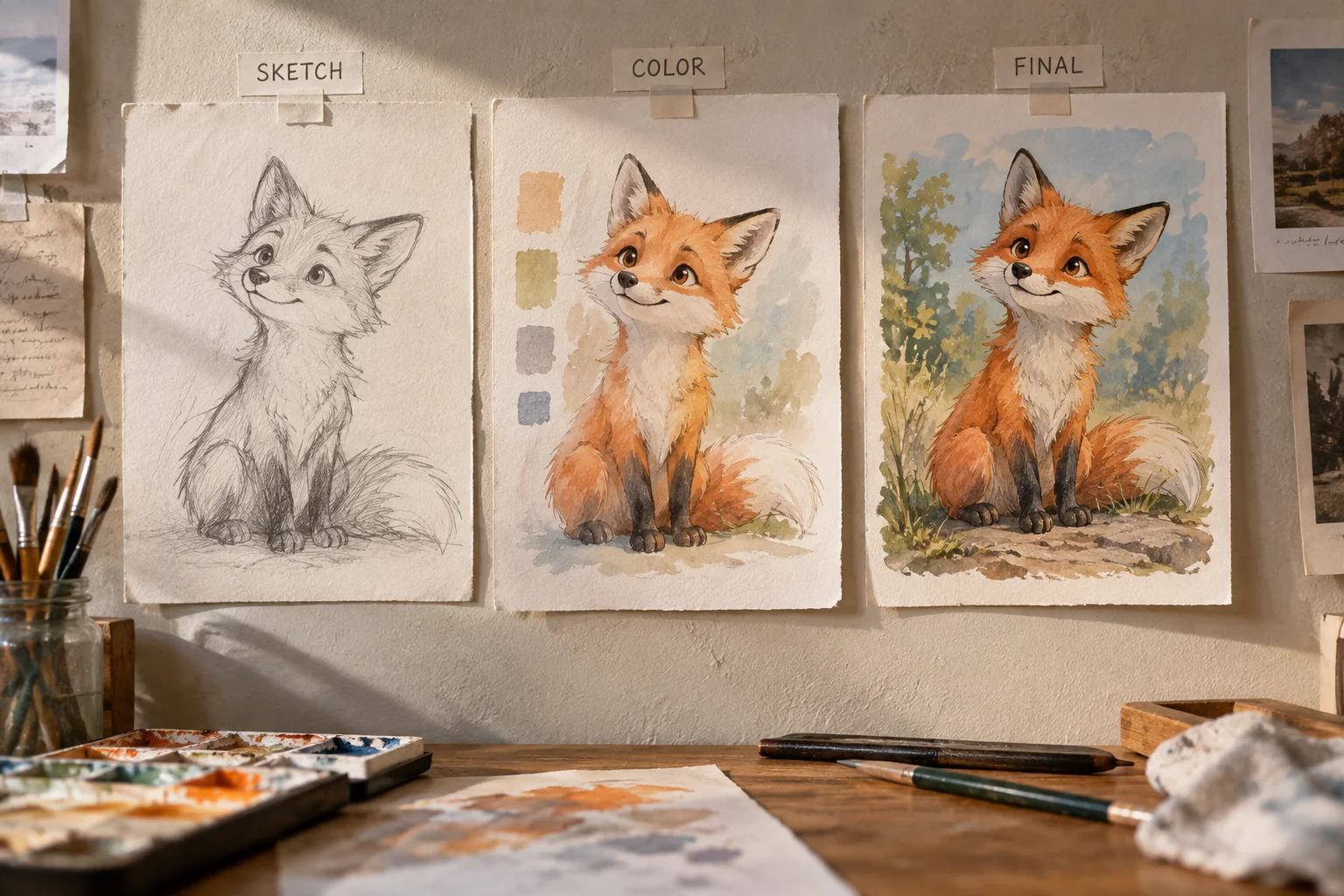
Build a proof-review checkpoint into the schedule. Agree who checks cropping, gutter placement, legibility and continuity, and how corrections will be handled. If you need editable files for future editions, request them explicitly. List the software, layers, linked assets and font arrangements you need, separately from the final print PDFs.
Choose the offer that can deliver your book
Read exclusions alongside the services promised. A modest offer can be excellent value when it covers your book; an apparently generous package can leave essential work unpaid.
Before accepting, look for answers to these questions in the portfolio and written proposal:
- Does the artwork list include every image you need, including the cover and incidental artwork?
- Does the portfolio show consistent characters across sequential scenes, as well as attractive standalone pictures?
- Will you approve character design and page composition before detailed rendering begins?
- Do the rights cover the editions and promotion you actually plan?
- Is someone clearly responsible for files that suit your named printer and digital edition?
- Are changes, delays, cancellation, payment, credit and portfolio use covered in writing?
If the complete commission costs more than you can spend, ask about revising the artwork list rather than requesting an unexplained discount. You might keep the emotionally important spreads, simplify secondary settings or replace a transitional scene with a spot. Check the revised dummy to make sure the story still works, then ask for a price for that specific version.
Keep the accepted proposal, emails, artwork list, approvals and change orders together. Track the original fee, approved additions, payments and remaining reserve so you know what you still owe.
Use the illustration-scope calculator
Enter the quantity and quoted rate for each artwork type, then add separately priced deliverables and your chosen contingency. To reproduce the hypothetical $7,040 example, use eight spots at $100, eight single pages at $250, six spreads at $450, $900 in other deliverables and a 10% reserve.
Select the proposal’s currency and use it for every entry. Count a two-page composition once as a spread; don’t also enter it as two single pages. For a bundled project fee, enter the amount once under other deliverables and leave any overlapping item fields at zero.
Check which amount the calculator uses as the contingency base, and make sure its subtotal matches the written proposal. It adds up the costs you enter. You’ll still need the proposal and your conversations with the illustrator to judge the rate, confirm usage rights, assess artistic suitability and check that everything your book needs is covered.
Illustration scope budget
The initial counts and rates are invented planning inputs, not observed quotes or market averages. Replace them with your proposal and check rights, cover, lettering, layout, revisions, and production files.