Table of Contents
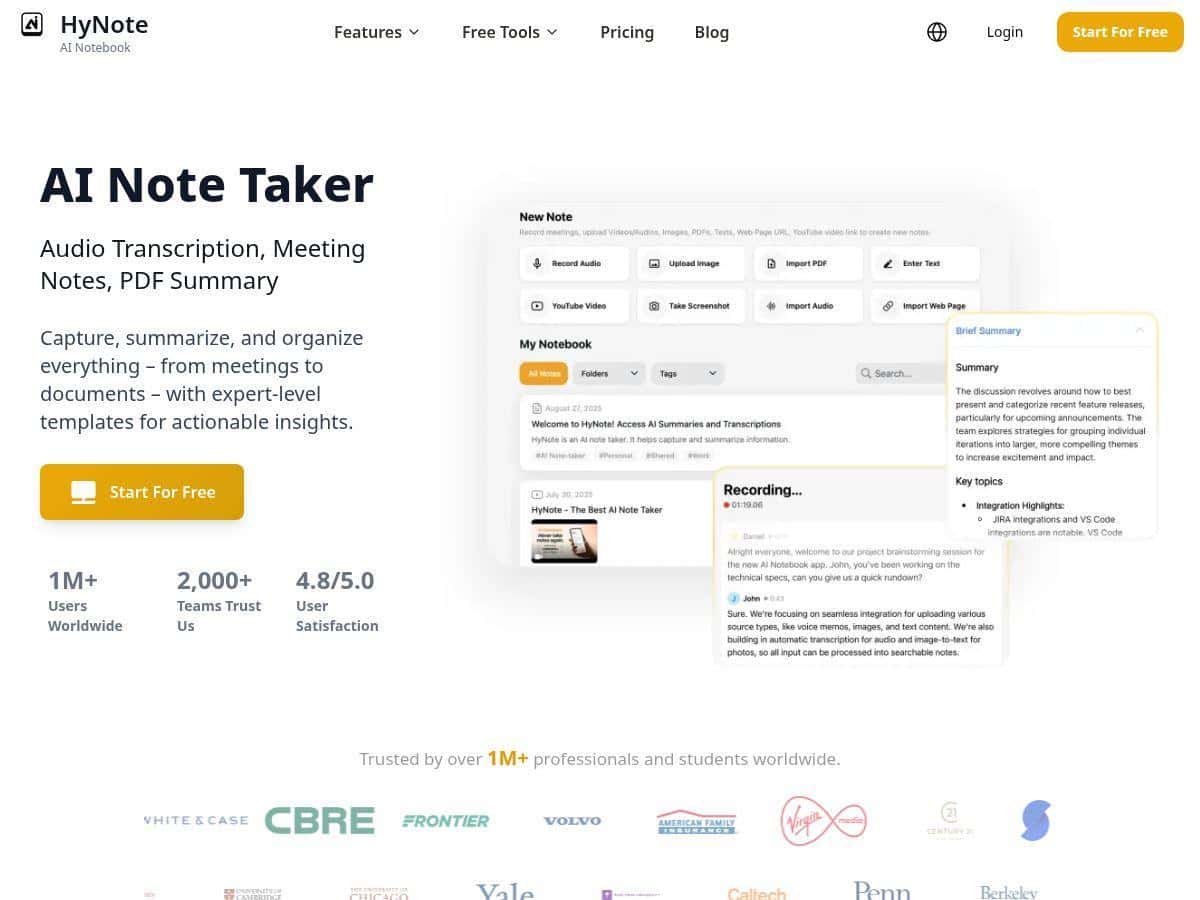
If you’ve ever sat through a meeting, hit “stop recording,” and then realized you still don’t know what decisions were made… yeah, you’re not alone. I tested HyNote for a few weeks to see if it actually makes note-taking less painful—or if it’s just another AI app that sounds good on paper.
HyNote Review: What I Actually Did (And What Happened)
I used HyNote on a mix of devices—mostly on desktop for setup and review, then on mobile for quick edits. My workflow was pretty simple: record or upload something, let HyNote generate a summary, then check whether the “important bits” were actually there (not just pretty formatting).
To stress-test it, I tried three common note scenarios:
- 1) A 30-minute meeting recording (quiet office, one speaker most of the time). I compared the transcript against what I remembered and skimmed for missed names and unclear sentences.
- 2) A lecture-style audio clip where the speaker went a bit fast. This is where transcription usually struggles, so I wanted to see how HyNote handled it.
- 3) Article/PDF summarization where the goal wasn’t to “paraphrase,” but to pull out key claims and any actionable takeaways.
Here’s the big picture: HyNote is strongest when you want a clean “review layer” on top of messy raw input. Instead of re-listening to audio or hunting through a long document, it gives you something you can scan in seconds.
Now, about that “up to 99% accuracy” claim—HyNote markets high transcription accuracy, but I didn’t see a clearly published methodology in the app UI itself (like a link to a benchmark dataset). So I treated it as a marketing number and focused on my own tests. In my 30-minute meeting sample, the transcript was accurate enough that I could follow along without constantly guessing what was said. But I did notice a few issues: the occasional misheard proper noun and some times where a sentence got split awkwardly. It wasn’t “broken,” just not flawless.
One thing I really appreciated: the summaries weren’t just a wall of text. They were structured enough that I could quickly find decisions, topics, and next steps—especially when I’m trying to write follow-up notes.
And yes, cross-device syncing is a real feature you’ll feel if you use it day-to-day. I started notes on desktop, then opened them on mobile to add a couple of bullets. The sync worked, but like most apps, it wasn’t instant in every case. Sometimes I’d wait a minute or two for the latest version to show up, and I didn’t love how it handled edits if I changed the same note on two devices within a short window.
Key Features: Transcription, Summaries, Sync, and Learning Tools
- AI transcription for audio
When it works well, it’s fast and readable. I found it particularly useful for meetings where you need to capture names, action points, and phrasing without replaying everything. For heavy accents or background noise, you should expect the occasional “close but not exact” word. - Meeting summaries + action items
This is the feature that actually saves time for me. After a recording, HyNote generated a summary that grouped topics and pulled out next steps. In one test, the “action items” section listed tasks in a way I could copy-paste into an email. Not every item was perfect, but it gave me a solid starting draft. - Summarization for PDFs, articles, and videos
I tried a couple of documents and looked for two things: (1) did it capture the main claim, and (2) did it miss the sections I cared about. It’s better at pulling out the “headline ideas” than it is at preserving nuanced details. If your PDF is dense with numbers or jargon, you’ll still want to skim the original. - Flashcards and quizzes from your notes
If you’re studying, this part is surprisingly handy. I generated flashcards from a set of summarized notes and the questions were usable right away. The downside? You might need to tweak a few cards so they match how you actually understand the material. - Integrations (Google/Notion-style workflows)
HyNote supports integrations that matter if you live inside those tools. I used it to move notes into a structure that’s familiar, and it reduced the “copy/paste fatigue.” Still, integration features can be finicky depending on what plan you’re on and what export options are available. - Cross-device sync
This is where HyNote feels like a companion instead of a one-off transcription tool. I could add a few bullets on mobile, then review the updated note later on desktop. What I noticed: offline behavior depends on how the app caches content—if you edit while offline, expect syncing to happen once you reconnect. - Export and sharing
HyNote lets you export notes (including formats like PDF/Word). In practice, I used exports for sharing with teammates who don’t want to open an app. The formatting was generally clean, but long notes sometimes got a little messy when exported—headings stayed, but spacing varied. - Encrypted storage
HyNote advertises encryption and privacy. I can’t verify their internal key management from the UI alone, but the practical takeaway is this: treat it like a notes app with encryption-at-rest/in-transit protections (as most reputable services do). If you need enterprise-grade guarantees, you’ll want to read their security docs or contact support for specifics. - Multiple input types
Text, images, and audio are all supported. I used text for quick prompts and audio for the heavy lifting. Images were fine for extracting context, but I wouldn’t treat it like a document-scanning replacement unless the image quality is good.
Pros and Cons: What I Liked and What Slowed Me Down
Pros
- Transcription is usable for real work—I could follow along and extract key points without replaying audio constantly.
- Summaries are actually scannable. The output is structured enough that I can write follow-ups quickly.
- Action items help reduce “what did we decide?” moments. Even when phrasing isn’t perfect, it gives you a starting list.
- Cross-device workflow fits how I take notes (desktop for review, mobile for quick edits).
- Learning tools (flashcards/quizzes) are a nice bonus if you study from your own notes.
Cons
- Don’t expect 100% accuracy on every word. In my tests, proper nouns and fast speech occasionally slipped.
- Most of the “magic” depends on an internet connection. If you lose connectivity, you’ll feel it.
- Sync/edit conflicts can happen if you change the same note on multiple devices close together.
- Premium features are real. I hit paywall-style limits when trying to do more advanced workflows (like deeper exports/integrations and higher usage).
- Exports aren’t always perfectly formatted for very long notes.
Pricing Plans: What’s Free vs Paid (And What I Could Verify)
I wasn’t able to reliably confirm exact pricing tiers inside the content I was working with here, and prices on AI tools change fast. So I don’t want to guess and mislead you.
What I can tell you from using the product: HyNote uses a freemium model. In my case, basic transcription/summarization features were available to test, while more advanced capabilities (higher limits, expanded integrations, and heavier usage) were gated behind a paid plan.
If you want the exact numbers—like transcription minutes, storage limits, and which export formats are included—I recommend checking the official pricing page directly on HyNote’s site (since that’s where the current limits are listed accurately).
Mini Case Studies From My Tests
- Case study: meeting recap for a follow-up email
I recorded a ~30-minute meeting and asked HyNote to summarize. The summary included the main discussion topics and a short list of action items. I copied the action items into a draft email and only had to tweak names/timing. - Case study: lecture notes for studying
I ran a faster lecture clip through transcription and then generated flashcards from the summary. A few flashcards needed edits (mostly wording), but the overall structure helped me review without replaying the lecture. - Case study: PDF summary for quick understanding
I used HyNote to summarize a longer PDF. It captured the core idea and key sections, but it didn’t preserve every detail. I still skimmed the original for the fine print—HyNote is great for getting oriented, not for replacing the source.
Who HyNote is best for (and who should be cautious)
- Best for: people who take notes from audio/video often (meetings, lectures), and anyone who wants summaries + action items without manual cleanup.
- Be cautious if: you need ultra-precise transcription for legal/medical contexts, or you can’t rely on internet access for the workflows you care about.
If you want a tool that turns messy recordings and long documents into something you can actually review, HyNote is worth trying. Just go in expecting “very helpful drafts,” not perfection on every single word.