Table of Contents
Every few weeks someone on a self-publishing forum asks the same quietly loaded question: is IngramSpark's Share & Sell actually worth using, or is it just another feature that sounds better than it works? This week a self-publisher on r/selfpublish asked it plainly, wanted answers from other authors rather than from IngramSpark's marketing, and got almost nothing back. So here is the honest version: how Share & Sell works, the margin math nobody spells out, and the three catches that decide whether it belongs in your plan.
⚡ TL;DR – Key Takeaways
- •Share & Sell gives you a shareable purchase link (URL, QR code, or embed) for a book you already have on IngramSpark. A reader clicks, Ingram prints on demand and ships, and you get paid — no inventory, no upfront cost.
- •The margin is better than most authors expect: you earn the list price minus the print cost minus a flat fulfillment fee (about $3.50 in the US, £3.00 in the UK), and the buyer pays shipping and tax on top.
- •Three catches decide everything: the buyer pays shipping on a single print-on-demand copy, Ingram keeps the customer's contact info (so it's not list-building), and each link is one book per order with no cart.
- •It shines on warm traffic — a "buy direct" link in your newsletter or bio, or events where you'd rather not haul stock. It's weak as a storefront for cold strangers who could just buy on Amazon.
- •If capturing emails matters, pair it with a small personal stock for signed sales and treat Share & Sell as the no-inventory fallback for everyone else.
The Question a Self-Publisher Actually Asked
The thread that prompted this article was short and honest. A third-time novelist wanted real user experience with Share & Sell before committing to it — not the pitch from the company selling it.
r/selfpublish
Your experience with IngramSpark’s Share & Sell purchase links?
“Buying or selling, I am looking for information not from the company. I am self-publishing my third novel and wonder if this is a good way to go.”
View on Reddit →It's a fair thing to be cautious about. Direct sales sound great in a headline — keep more of the money, own the relationship — but the details are where the idea either earns its place or quietly wastes your time. Below is the answer I gave in the thread, expanded.
What IngramSpark Share & Sell Actually Is
The mechanics, minus the marketing
Share & Sell is a direct-sales feature layered on top of IngramSpark's existing print-on-demand distribution. For any title you already have set up with IngramSpark, you generate a shareable purchase link. You can hand it out as a plain URL, a QR code, or an embed you drop on your website. A reader clicks it, lands on a dedicated product page for your book, and buys. IngramSpark prints the copy on demand, ships it, collects any sales tax, and handles customer service. You get paid the difference. There's no inventory to buy, no boxes in your closet, and no upfront investment — it's pay-as-you-go.
That last part is the genuine appeal. If your book is already on IngramSpark for bookstore and library distribution, turning on Share & Sell is close to free effort. You're not standing up a new store or learning a new platform; you're bolting a "buy direct" button onto infrastructure you already use.
The Margin Math (Better Than People Expect)
Here's the part the forum question was really circling, and the part IngramSpark's own page doesn't lay out in plain numbers. On each Share & Sell order you earn:
- Your list price
- minus the print cost of that specific book (page count and color drive this)
- minus a flat fulfillment fee — around $3.50 in the US and £3.00 in the UK
The buyer pays shipping and sales tax on top of that, so those don't come out of your cut. A worked example: if your paperback's print cost is roughly $9 and you list it at $14.99, you keep most of the spread after the fulfillment fee — which typically beats what you net on the same paperback through Amazon, where the retailer takes a much larger slice. You can price above the minimum to widen that margin further. For the wider picture on setting numbers that actually sell, our guide to book pricing strategies for indie authors is worth a read alongside this.
This is the honest case for the feature: per-copy, direct through Share & Sell, you often earn more than you would letting Amazon fulfill the same print book. Here's the answer I posted in the thread, verbatim.
Automateed founder · r/selfpublish
The margin is better than most people expect. You earn the list price minus the print cost minus a flat fulfillment fee (about $3.50 in the US), and the buyer covers shipping and tax on top of that. So if your print cost is around $9 and you list at $14.99, you keep most of the spread, which usually beats what you net from the same paperback on Amazon.
Two catches matter, especially by your third novel. First, the buyer pays shipping on a single print-on-demand copy, and that is often slow and not cheap, so it converts worse than Amazon for anyone who isn’t already sold on buying direct from you. Second, Ingram owns the buyer’s contact info, not you, so it’s not a list-building tool. Each link is also one book per order with no cart, so a reader grabbing two of your titles checks out twice and pays shipping twice.
Where it actually earns its keep is warm traffic: a “buy direct” link in your newsletter or bio, or events where you’d rather not haul a box of stock. As a storefront for cold strangers it’s weak.
View on Reddit →The Three Catches That Decide Whether It's Worth It
The margin is the easy part. These three constraints are what separate "great fit" from "waste of a link," and they're exactly the things the company's own materials tend to gloss over.
1. The buyer pays shipping on a single print-on-demand copy
Print-on-demand shines when it removes inventory risk. It struggles when a customer has to pay to ship one book by itself. There's no warehouse pooling orders, so the shipping quote on a lone paperback is often slower and pricier than the reader expects — and it's compared, in their head, against free two-day shipping on the same book from Amazon. For a stranger who isn't committed to buying from you specifically, that friction kills the sale. Share & Sell converts on intent, not impulse.
2. Ingram keeps the customer, not you
This is the one that stings for authors who care about the long game. When someone buys through your Share & Sell link, their contact information belongs to IngramSpark, not to you. You don't walk away with an email address you can market your next book to. So while it looks like a direct-sales channel, it doesn't do the single most valuable thing direct sales are supposed to do: build a list you own. If growing an audience you can reach again is the goal, this feature isn't the tool for it.
3. One link, one book, no cart
Each Share & Sell link resolves to a single title and a single order. There's no shopping cart, so a reader who wants two of your books goes through checkout twice — and pays shipping twice, and eats the per-order handling twice. You also can't bundle orders to bring the shipping or print surcharge down. For a series author whose fans want to grab the whole set, this is a real tax on exactly your best customers.
When Share & Sell Is Worth It — and When It Isn't
Put the margin and the catches together and the verdict is situational, not universal.
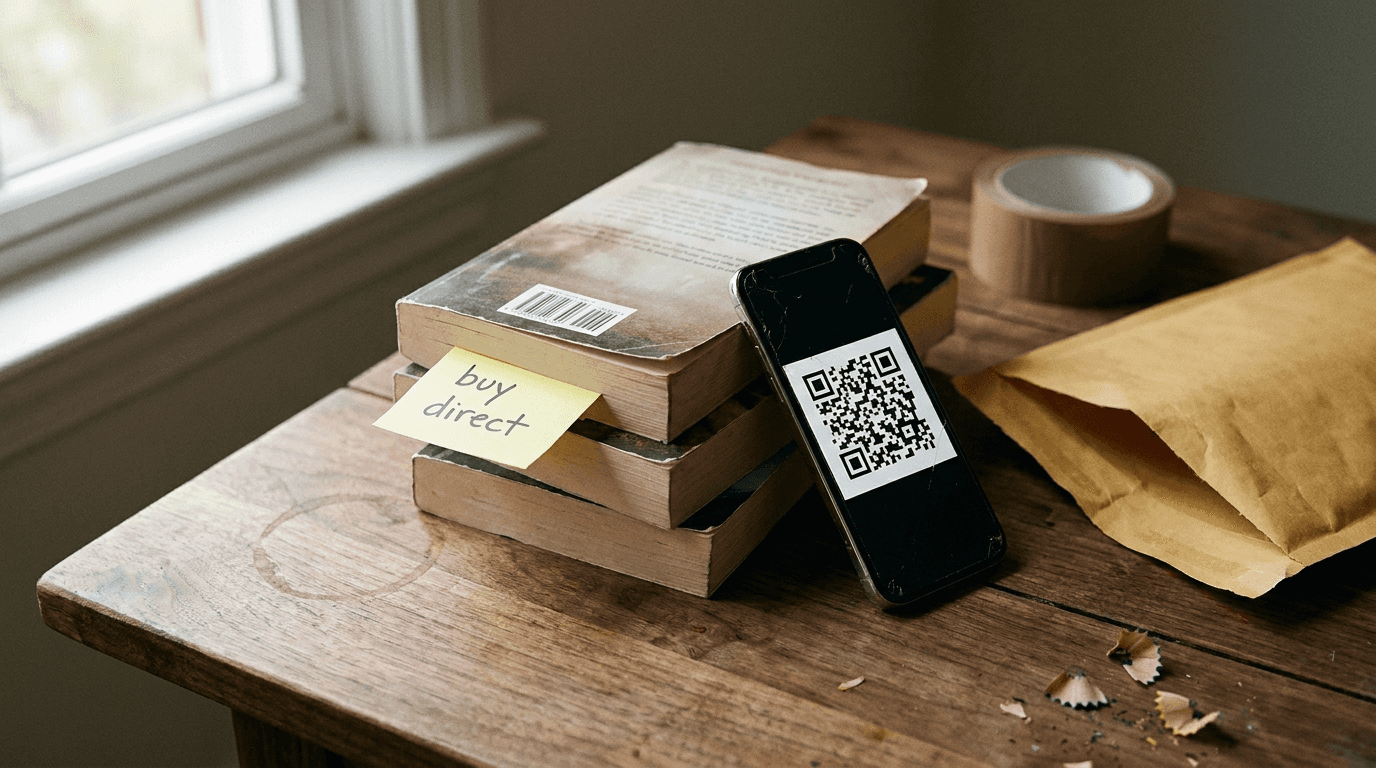
It's worth it when the traffic is already warm. A "buy signed/direct" link in your newsletter, a QR code on a bookmark at a signing, a button in your link-in-bio for readers who followed you because they like your work — these are people who are choosing to buy from the author, not shopping a marketplace. The shipping friction doesn't scare them off, and the better per-copy margin is real money. It's also a clean answer for events where you don't want to front the cash for a box of stock or risk hauling unsold copies home.
It's not worth leaning on when you need discovery. As a primary storefront for cold strangers, it's weak — those readers will bounce to Amazon for cheaper, faster shipping every time. And if list-building is your actual objective, the fact that Ingram owns the buyer means you're doing the work of a direct sale without the payoff. Wide retail reach is a different job entirely; for that, IngramSpark's core distribution and Amazon KDP do the heavy lifting, and our breakdown of how Amazon KDP works covers that side.
How It Compares to Your Other Direct-Sell Options
Share & Sell isn't the only way to put money in your own pocket instead of a retailer's. Weigh it against the alternatives before you decide it's your direct channel:
- Author copies + selling stock yourself. Buy your own copies at cost (through KDP or IngramSpark), then sell them in person or ship them yourself. This is the only route that lets you sign books, capture emails, and control the buyer experience — at the cost of fronting cash and doing the packing. Best for events and superfans.
- A real direct storefront (Payhip, Shopify, Bookshop.org affiliate). For ebooks especially, selling direct from your own store keeps the customer relationship and the email. Print gets more complicated because you still need fulfillment, but you own the checkout and the data. See our full rundown on how to sell ebooks online for the platform trade-offs.
- IngramSpark Share & Sell. The no-inventory, no-relationship middle ground. You give up the email and the cart in exchange for zero setup and zero risk. It's the fallback, not the foundation.
Most authors don't pick one. The realistic stack is: keep a small personal stock for signed direct sales, run your own store or list for the readers you want to own, and use Share & Sell as the frictionless "just send them a link" option for everyone else. The infrastructure behind all of this — print-on-demand — is the same reason none of it requires a garage full of boxes anymore, and it's why we added print-on-demand books into our own workflow.
Where the Writing Tool Fits (Founder Disclosure)
Quick disclosure so you can weight this accordingly: I'm the founder of Automateed, an AI ebook creator with a small publishing marketplace attached. Share & Sell is IngramSpark's feature, not ours, and this article isn't a pitch for a competing button.
The reason it's relevant at all is that the distribution decision only matters once you have a finished, well-formatted book to distribute — and that's the part most authors stall on. Whether you draft it yourself, use an ebook generator, or hire it out, the sequence is the same: make the book genuinely good, get it print-ready, then decide which of these channels fits how you actually reach readers. The channel maths above changes nothing about that order. A great Share & Sell link on a book nobody wants still sells nothing; a mediocre channel on a book readers love still moves copies.
FAQ
Is IngramSpark Share & Sell free to use?
There's no upfront cost or subscription for the feature itself — it's pay-as-you-go. You pay the print cost and a per-order fulfillment fee (around $3.50 US / £3.00 UK) out of each sale, and the buyer covers shipping and tax. You do still need your title set up on IngramSpark, which can carry its own title setup fee depending on current promotions.
How much do you actually make per book on Share & Sell?
Your earnings are the list price minus the print cost minus the flat fulfillment fee. On a $14.99 paperback with a ~$9 print cost, you keep most of the remaining spread after the fee — usually more per copy than the same book nets through Amazon, because the buyer's shipping and tax are separate.
Does Share & Sell give me my customer's email address?
No. The buyer's contact information belongs to IngramSpark, not to you. That's the biggest limitation for authors who want direct sales in order to build an email list — Share & Sell handles the transaction but doesn't hand you the relationship.
Can a reader buy several of my books in one Share & Sell order?
Not in a single cart. Each link is one title, one order. A reader buying three of your books checks out three times and pays shipping three times, and you can't bundle orders to lower the per-order costs. For series authors, that friction lands on your most loyal readers.
Is Share & Sell better than just selling on Amazon?
For per-copy margin on a committed buyer, yes. For discovery and convenience with cold shoppers, no — Amazon's cheaper, faster shipping wins those. Treat Share & Sell as a direct link for warm traffic, not a replacement for retail distribution.
The Honest Verdict
Is Share & Sell worth it? For a third-time novelist with even a small warm audience, yes — as one link in a wider plan, not as your storefront. Turn it on because it's nearly free to add and the per-copy margin is genuinely good for readers who already want to buy from you. Just don't expect it to build your list, close cold traffic, or make it easy for a fan to grab the whole series. Know exactly which job you're hiring it for, and it earns its place. Ask it to be your whole direct-sales strategy, and it will quietly underperform.