Table of Contents
I wanted a faster way to handle first-round screening without burning out my team. So I tested Merra to see if it actually replaces the “schedule 12 candidates, send 12 emails, repeat” cycle—or if it’s just another AI tool that sounds good on paper.
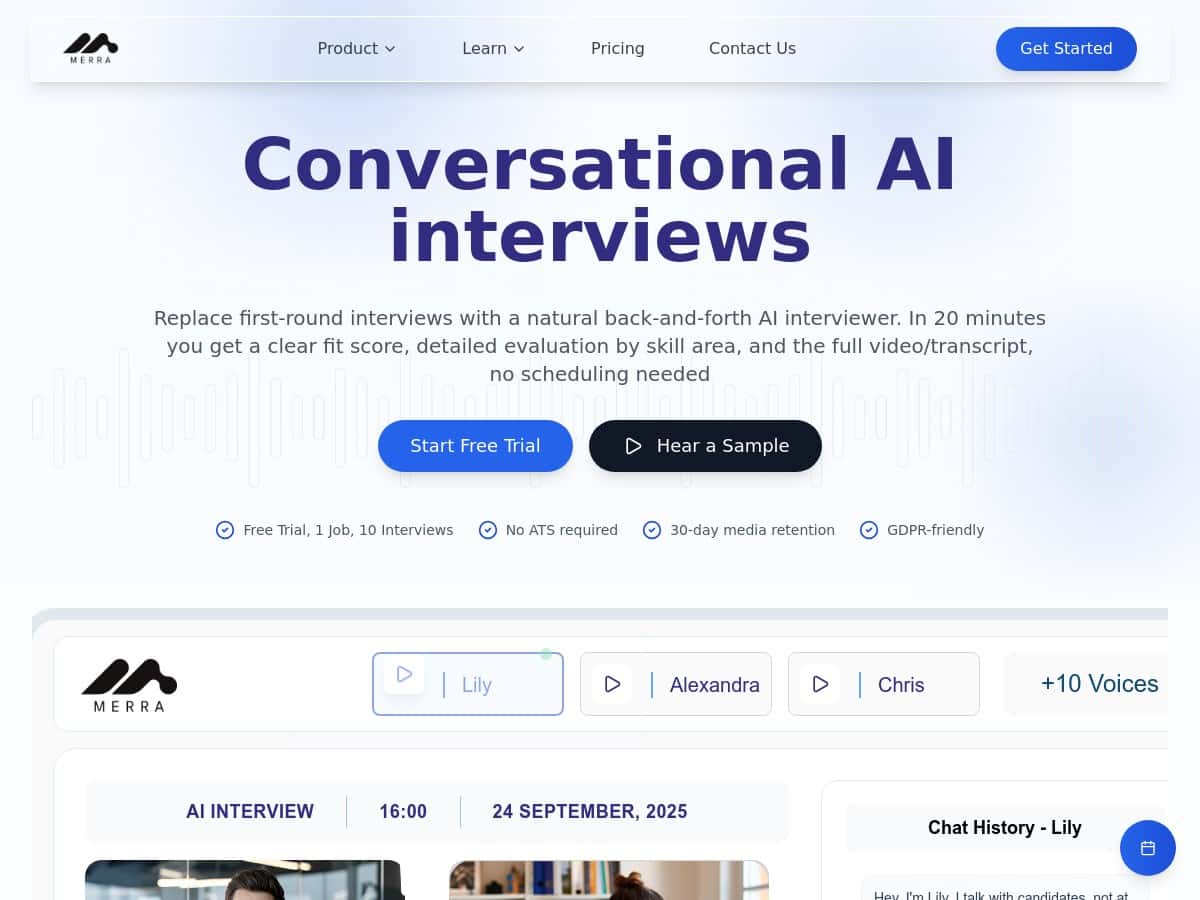
In my experience, the setup is straightforward and the interview flow feels closer to a real recruiter chat than a form-filling exercise. You’re not just collecting transcripts—you’re getting a structured evaluation (a 0–100 fit score plus skill notes) that makes it easier to compare candidates quickly. And yes, the time savings are real when you’re screening lots of people.
Merra Review: What I Actually Saw in the Interview Flow
I didn’t just click around for a few minutes—I ran a small screening setup and tested the end-to-end flow like a real hiring manager would: create a role, define what “good” looks like, send interviews out, and then review the results.
Here’s what stood out to me during my test:
- Setup felt quick: I was able to create a job, add focus areas, and generate the interview flow without needing a bunch of back-and-forth with support. The interface is pretty “guided,” which matters when you’re busy.
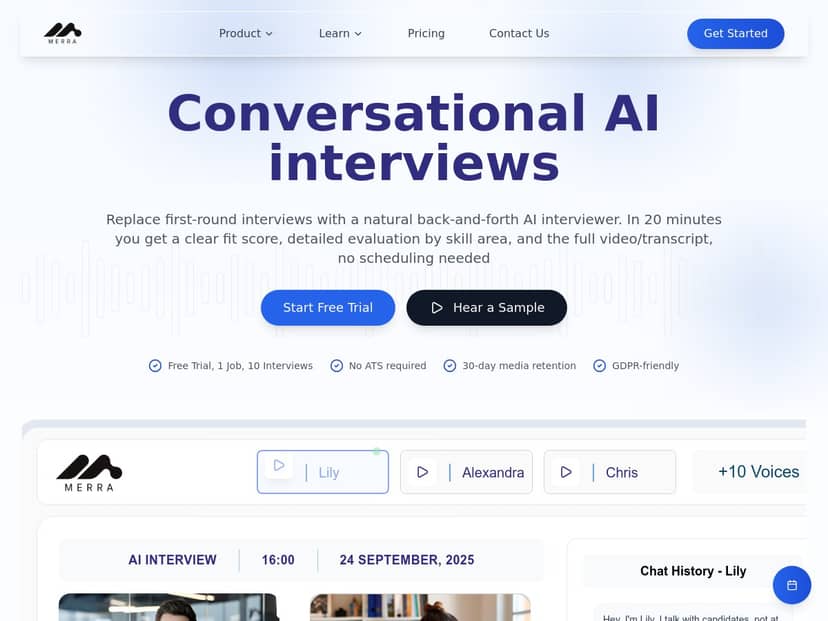
- The interview felt conversational: Candidates weren’t stuck answering robotic multiple-choice prompts. The AI asked follow-ups naturally enough that it didn’t feel like they were reading a script.
- Scoring was the real time-saver: Instead of rewatching everything or taking messy notes, I could scan a 0–100 fit score and then jump straight to the skill-specific feedback.
- Reviewing later is painless: The platform provides both video recordings and transcripts, so you can skim first, then re-check anything that’s unclear.
In practical terms, this is the part I cared about most: when you’re screening high volumes, scheduling is what kills speed. With Merra-style interviews, candidates complete the interview when it works for them. That removes a ton of “are you free tomorrow?” friction.
One thing I also noticed: the quality of the output isn’t magic. If your job description and question prompts are vague, the evaluation will be vague too. But when I tightened the role focus, the scoring and feedback became much more useful.
Key Features That Matter (and How They Show Up in Practice)
- Conversational AI interviews
- This isn’t just a question bank. The AI runs a back-and-forth conversation that keeps candidates engaged. In my test, it avoided the “interviewer jumps topics randomly” feeling and stayed mostly on track with the role context.
- Fit score & skill evaluation
- You don’t just get a single number. Merra provides a match-fit score (0–100) plus skill-specific feedback. The way I used it was simple: compare candidates by score first, then open the transcript/video only for the ones that look borderline or especially promising.
- Pro tip: if you’re hiring for multiple skill areas, make sure those focus areas are clearly defined. Otherwise the “skill breakdown” can end up sounding generic.
- Video recording & transcripts
- For me, this is non-negotiable. I want an audit trail. Merra gives you both, so you can skim transcripts quickly and only watch video when you need tone, clarity, or depth cues.
- Highly customizable interview setup
- When they say customizable, it’s not just branding. You can adjust the job details and the interview focus so the AI isn’t interviewing for a totally different role. In my setup, I used focus areas to steer what candidates should talk about (and what the AI should listen for).
- Also, the better your customization, the more consistent the scoring feels. Garbage in, garbage out—plain and simple.
- Flexible scheduling (async interviews)
- This is where the time savings really come from. Candidates don’t need to find a shared time slot. In my test, that meant fewer delays and less coordination work on my side.
- Data retention & security
- Merra states it stores data for 30 days and claims GDPR compliance with encryption. The practical takeaway for me was knowing there’s a defined retention window, plus the system is built for recruiters who care about compliance.
- What I’d still do: if you’re rolling this out internally, confirm how exports and deletions work for your org’s policies. Don’t assume every workflow handles deletion the same way.
- ATS integration
- Merra claims integration with 60+ Applicant Tracking Systems. In real hiring workflows, this matters because you don’t want candidate data living in three places. The setup typically involves connecting your ATS and mapping where interview outcomes should land.
- My advice: before you commit, check which ATS you use and how Merra structures the fields (status updates, candidate records, etc.). That’s where implementations either feel smooth or get annoying.
Pros and Cons From My Test
Pros
- Fast screening: The biggest win is that you’re not waiting on scheduling. You can review multiple candidates in one sitting.
- Easy to set up: I didn’t feel like I needed a technical specialist to get a role running.
- Clear evaluation output: The 0–100 fit score plus skill feedback made comparisons easier than trying to interpret unstructured notes.
- Good for early-stage filtering: If your goal is to shortlist for later rounds, Merra fits that job well.
- Reviewable evidence: Video + transcripts mean you can double-check anything that doesn’t make sense at first glance.
- Compliance-minded: The 30-day retention and GDPR claim gives some peace of mind for teams that need guardrails.
Cons
- Free trial limits are real: The free trial is tight—1 job and 10 interviews—so you can’t fully stress-test volume, scoring consistency, or team workflows.
- AI can miss “soft” signals: If your rubric depends heavily on interpersonal presence, communication nuance, or leadership vibe, the AI scoring can underweight that. You’ll want to use transcripts/video to manually sanity-check the top candidates.
- Scoring quality depends on your setup: If your prompts, focus areas, or question structure are weak, the evaluation won’t magically get better. It’s only as good as the inputs.
Pricing Plans (and Who Each One Makes Sense For)
Merra has three main plans. Here’s how I’d think about them if you’re deciding what to start with:
Starter: £59/month (billed quarterly at £177)
- 30 interviews
- Up to 5 active jobs
- Unlimited users
- Includes: videos, transcripts, and scoring
This is the plan I’d pick if you’re screening a small pipeline and want to test whether AI interviews actually improve your speed-to-shortlist.
Growth: £149/month (billed quarterly at £447)
- 100 interviews
- 10 active jobs
- Priority support
- Includes: all Starter features
If you’re hiring more than a couple roles at a time—or you expect volume to spike—Growth is where it starts to feel worthwhile.
Enterprise: custom pricing
- Unlimited interviews
- Dedicated onboarding support
- Best for: larger teams and more complex hiring workflows
My take: Enterprise is for teams that need deeper rollout help (ATS mapping, internal adoption, and consistent scoring rubrics across roles).
Quick decision rule: choose Merra if you screen lots of candidates per week and you want transcripts + scoring to speed up early-stage review. Skip it (or keep it limited) if your process requires heavy human-only judgment in the first round for roles where soft skills are the main differentiator.
Wrap up
Merra is the kind of tool I’d actually use for early screening: it’s structured, reviewable (video + transcripts), and the scoring makes comparisons quicker than digging through notes. The tradeoff is also clear—if you rely on subtle interpersonal cues, you can’t let AI do all the thinking. You’ll still want humans to review the top candidates.
If you’re trying to cut down scheduling overhead and get consistent early signals, Merra is worth a serious look. Just make sure you put real effort into your role setup—because that’s what ultimately determines how good the results feel.