Table of Contents
If you’re trying to get in front of the right private equity or VC decision-makers, you quickly learn that “searching the internet” is… not a strategy. The Private Equity List (PEL) is built for exactly that: investor discovery plus outreach-ready details, without you spending hours bouncing between spreadsheets and half-working directories.
In my testing, I focused on one thing: could I go from a vague idea (“find PE/VC firms that invest in fintech in MENA”) to a usable shortlist fast—and could I actually get the contact info I’d need for outreach? Spoiler: the AI search is genuinely helpful, but what you can see on the free tier vs. paid tier matters a lot.
Private Equity List Review (PEL): what I found after testing it
I used PEL with a pretty simple goal: build a shortlist I could actually email. So I tested the AI search and filters by running a few realistic prompts and then checking what came back—especially whether contact details were visible or locked behind a subscription.
AI search test #1 (accuracy + relevance)
Prompt: “Find PE and VC investors that focus on fintech in MENA. I want firms that invest in Series A or early growth.”
What I noticed: the results were relevant enough that I didn’t feel like I was sifting through random lists. The AI seemed to combine sector + region + stage intent, which is usually where generic databases fall apart.
AI search test #2 (industry specificity)
Prompt: “Which gaming investors are active in APAC? Prefer firms that have backed mobile-first studios.”
What I noticed: the output leaned toward the kinds of firms you’d expect for mobile/gaming, but I still had to sanity-check a couple entries against their public focus areas. That’s not a deal-breaker—just don’t assume every AI-generated match is automatically “perfect.”
AI search test #3 (practical outreach workflow)
Prompt: “Give me a list of investors who typically lead deals in ed-tech and have offices in the Middle East.”
What I noticed: this is where PEL felt more useful than “search engines.” Instead of me hunting for names and then hunting again for thesis clues, I got a structured list quickly. Again, the only consistent limitation: full contact details weren’t fully available unless you’re on a paid plan.
Database size (so you’re not working with a tiny pool)
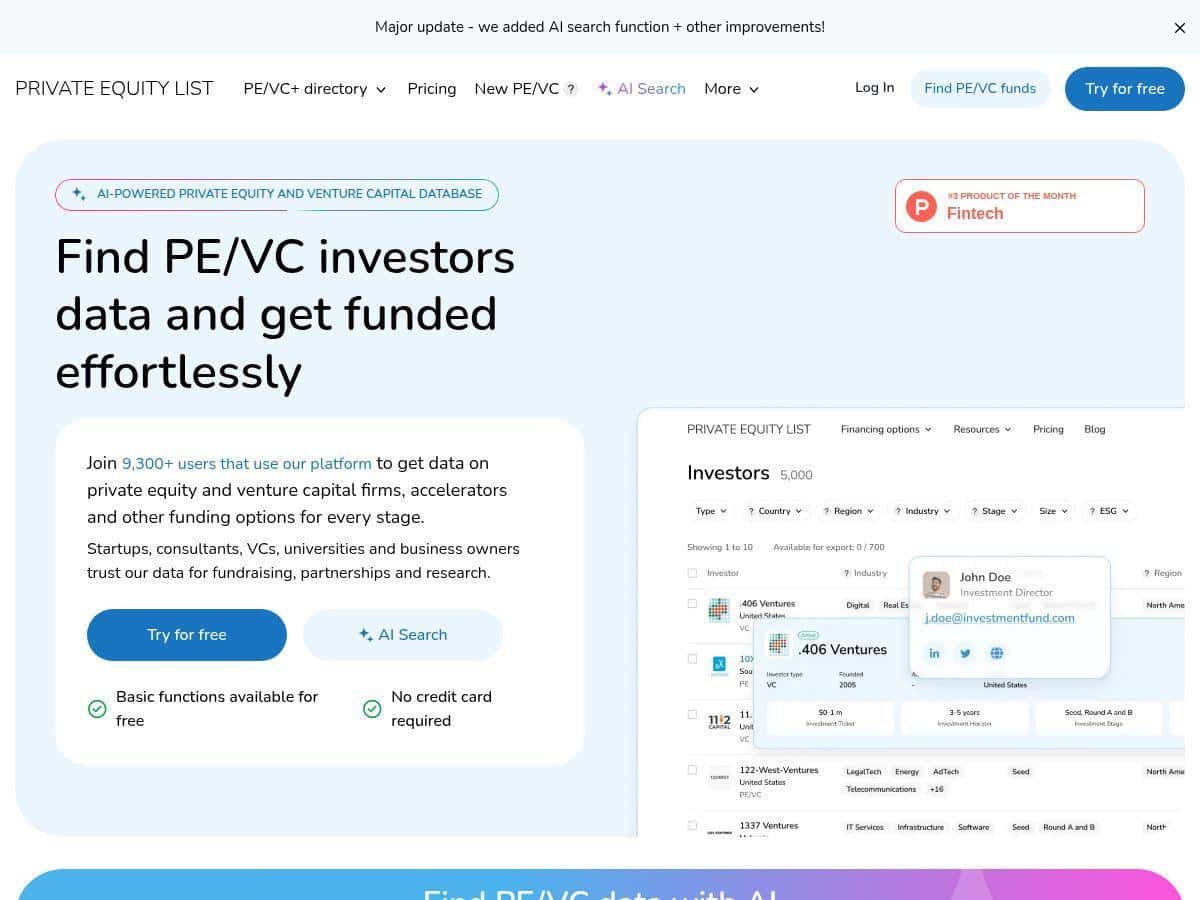
PEL’s database is positioned as a large one—over 6,700 PE and VC investors worldwide (their count appears as 6,757 in the interface I reviewed). That matters because a small database can look “clean” but still leave you with nothing to outreach.
And yes, the coverage isn’t just US/Europe either. I specifically looked for Middle East and APAC entries because that’s where fundraising lists often get thin. PEL does a better job here than the typical “global” directories that are mostly just recycled names.
Free vs paid: what’s actually paywalled?
On the free/basic access, you can explore and run searches, but when it comes to detailed investor contact information (the kind you’d use to actually reach someone—emails/complete contact fields), that’s where the subscription kicks in.
So if your plan is “try it for a day and export a full outreach list,” you’ll likely hit a wall. If your plan is “validate the targeting and learn how the search behaves,” the free tier is enough to tell you whether it’s worth paying for.
Key Features I’d actually use
- Large PE/VC coverage: PEL shows 6,757 PE and VC investors in its database (worldwide coverage).
- AI-powered search with natural language: you can describe what you want in plain English instead of building complex boolean queries.
- Industry-specific investor lists: fintech, ed-tech, gaming, and other verticals show up as focused categories, which saves time when you’re starting from a sector.
- Investor insights (not just names): you’re not only getting a list of firms—you’re also getting context like investment preferences (where available in the interface).
- Multi-region coverage: I found the Middle East (MENA) and APAC angle especially useful for founders who don’t want to compete for attention in saturated markets.
- Data refreshes: the platform positions itself as regularly updated, which matters because old lists are basically useless for outreach.
- Basic free access: you can try core functionality without immediately paying.
Pros and Cons (with the stuff that matters)
Pros
- The AI search is fast and practical. I didn’t have to translate my idea into a complicated query language. The prompts I used returned relevant investor-type results quickly.
- Good for targeted fundraising. When I searched with sector + region + stage intent, the output felt like it was built for outreach—not just discovery.
- Free tier is useful for “fit checking.” You can explore whether PEL actually has the kind of investors you need before you commit.
- Coverage includes emerging-market focus. If you’re doing MENA/APAC fundraising, this is one of the stronger angles compared to more generic tools.
Cons
- Contact details are the main paywall. You can explore and search on the free/basic tier, but full investor contact fields are subscription-gated.
- AI matches still need verification. In my tests, most results were on-target, but a few required manual checking to confirm the firm’s exact focus and stage fit.
- Free features are limited compared to paid. If you want exports, deeper filters, or outreach-ready fields, you’ll probably end up on a plan.
Pricing Plans (what you should expect to pay)
PEL does offer a free/basic option with limited access, so you can test the workflow first. For full access—especially investor contact details and advanced filters—the paid plans start at around $99/month.
That said, don’t take “starting at $99” as the whole story. Pricing tiers can change, and what you get at each level (exports, number of searches/leads, and how much contact detail is unlocked) is the real decision factor. The best move is to check the current plan page on their site before subscribing.
Quick decision rule I use:
If you need to send outreach emails to 20–50 investors right away, you’ll want paid access. If you’re still refining your target thesis and building the right search keywords, start with the free/basic tier.
Who PEL is best for (and who should look elsewhere)
PEL is a good fit if:
- You’re fundraising and need a shortlist fast (especially in MENA/APAC or niche verticals like fintech/ed-tech/gaming).
- You want to use AI search to go from idea → investor list without spending days on manual research.
- You plan to do outreach and eventually need contact fields (that’s where the paid tier matters).
PEL might not be the best choice if:
- You only need a couple names and you’re okay doing manual research from public sources.
- You require extremely granular institutional data (for example, very specific fund-level metrics) and expect it all in the free tier.
- You want deep CRM-style workflows—PEL is more “investor list + search” than a full pipeline tool.
Alternatives (how I’d compare them):
- Crunchbase: great for company/funding context, but investor-contact outreach lists aren’t always as clean or purpose-built for fundraising.
- PitchBook (and similar): powerful, but it’s usually overkill for smaller teams and often pricier; also, outreach workflow can still require extra steps.
- Dealroom: strong for startup ecosystem intelligence, but if your main need is investor contact discovery, you may still want a list-focused tool like PEL.
In other words: if you’re trying to build an outreach-ready list quickly, PEL’s “AI search + investor list” approach is the main reason to consider it. If you’re mostly doing background research on companies, other tools may be a better starting point.
Wrap up
Private Equity List is one of those tools that feels genuinely built for the fundraising grind. The AI search is the standout for me—it gets you from a messy idea to a targeted investor list quickly. The big catch is the same one you’ll see across most list platforms: full contact details are paid.
If you’re fundraising in emerging markets or you’re working with a narrower vertical, PEL is definitely worth checking out—just make sure you’re clear on what you’ll get on the free tier versus what unlocks once you subscribe.